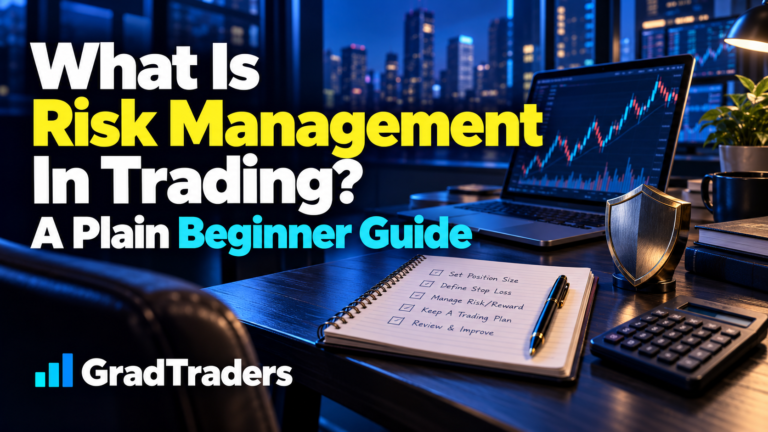
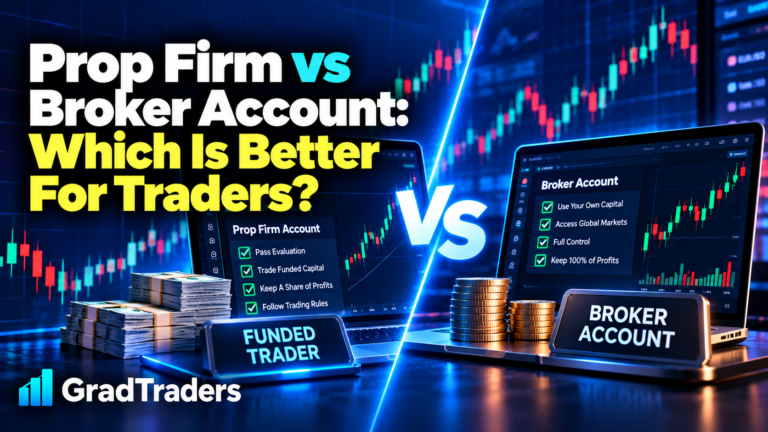
Trading For Beginners: A Complete GradTraders Guide
For beginners, my first priority is not finding a market or a winning setup. It is learning how leverage, margin, position sizing and losses work, then practising a decision process that includes knowing when not to trade. The order ticket is simple; taking sensible risk repeatedly is the skill worth building.
 ,
GradTraders
Live trading on YouTube
Learn The Risk Before The Setup
Beginners need a repeatable process for size, exits and patience before chasing entries.
Disclosure & Risk Notice: This article is for educational and informational purposes only and should not be considered financial advice, investment advice, tax advice or a personal recommendation. Trading leveraged products, futures, forex, indices, commodities, crypto-related products and prop firm challenges can involve significant risk. You may lose money, including challenge fees where applicable.
GradTraders may earn commission from some links without affecting the independent educational view. Readers comparing relevant providers or current partner routes can use the Exclusive Discounts & Updates page.
Quick Beginner View
Trading is easy to access and difficult to do well. The platform makes buying and selling look simple, but the real work is judgment, timing, risk, patience and knowing when not to trade.
Before a practice trade, write down why the setup qualifies, what would invalidate it and how much could be lost if the stop is reached. Afterwards, compare the plan with the actual decision. A profitable result from a poorly controlled trade should not be mistaken for a sound process.
Most beginners should spend more time learning what to avoid than searching for a perfect setup.
Start With Risk
Trading should begin with risk management, position sizing, stops, leverage and margin, not with excitement about the next setup.
Practise Before Live Money
A demo account can help beginners learn platforms and order types, but it should be treated as training rather than proof of future profit.
Use The Site In Order
Read this hub first, then move into the broker table, prop firm table, demo account guide and detailed risk guides when the basics are clear.
What is trading?
Trading means trying to profit from price movement. A trader may buy because they think a market will rise, or sell because they think a market will fall. The market might be an index, currency pair, commodity, share, crypto-related product or another financial instrument.
That simple definition hides the difficult part. A trader is not only making a prediction. They are also deciding how much to risk, where they are wrong, when to exit, whether the opportunity is worth taking, and whether they should be involved at all.
Beginners often focus on direction. Will the market go up or down? Better traders focus on the full decision. What is the risk? What is the reward? What happens if I am wrong? Is this trade necessary?
Trading is not the same as investing
This matters. Many beginners use the words loosely, but trading and investing are different activities.
Investing usually means buying assets with a longer time horizon. A long-term investor might buy funds, shares, ETFs or other assets and hold them for years. The aim is usually to benefit from growth, income, compounding or broad market participation over time.
Trading is usually shorter term. The trader is trying to benefit from a specific price move. That could last minutes, hours, days or weeks. Trading demands more timing, more decision-making and often more emotional pressure.
| Area | Investing | Trading |
|---|---|---|
| Time horizon | Usually years. | Often minutes, hours, days or weeks. |
| Main skill | Patience, diversification and long-term discipline. | Timing, risk control, restraint and execution. |
| Activity level | Often low activity. | Can be high activity, though it should not be for every trader. |
| Common beginner mistake | Panicking during normal market falls. | Overtrading, oversizing and chasing losses. |
Long-term investing has a stronger record of helping ordinary people build wealth than short-term speculation. Trading may have a place for some people, but it should not be confused with a basic financial plan.
GradTraders covers this idea more directly in Why Traders Should Invest.
Why beginners are vulnerable
Beginners are vulnerable because they are often attracted to the visible part of trading: the chart, the entry, the profit screenshot, the challenge account, the live trade, the excitement.
They are less attracted to the dull part: waiting, recording trades, reducing size, accepting losses, avoiding poor conditions, checking costs, reading product documents, and asking whether they should be trading at all.
The dull part is where survival lives.
Common beginner weaknesses
- They underestimate leverage.
- They trade too large.
- They believe confidence is the same as skill.
- They mistake a winning trade for proof of ability.
- They move stops because they do not want to be wrong.
- They add to losing positions without a plan.
- They follow other traders without understanding the trade.
- They think more activity means more opportunity.
None of this makes beginners foolish. It makes them human. The market is good at finding human weaknesses.
The first lesson: do less
Many beginners should begin by doing less, not more.
Less trading. Less leverage. Less switching between markets. Less reacting to every candle. Less watching other people. Less trying to make back losses quickly.
A beginner who learns to sit out poor conditions is already ahead of many beginners who feel they must always be involved.
Some of the best trading opportunities come during brief moments when markets are confused, stretched, emotional or dislocated. The trader does not need to be active all day to catch every small move. In many cases, the skill is waiting for the market to become worth the risk.
The basic terms every beginner should know
Trading has its own language. Beginners should not ignore it. These words describe risk.
| Term | Plain meaning | Why it matters |
|---|---|---|
| Spread | The difference between the buy price and sell price. | It is one of the costs of trading. |
| Leverage | Using a smaller amount of money to control a larger market position. | It can increase gains and losses. |
| Margin | The amount required to open or maintain a leveraged position. | Poor margin understanding can lead to forced exits or excessive risk. |
| Stop loss | An order intended to close a trade if price moves against you. | It helps define risk, though it does not guarantee perfect execution in all conditions. |
| Position size | How large the trade is. | This is often more important than the entry itself. |
| Drawdown | A fall in account value from a previous high. | Large drawdowns can damage both capital and confidence. |
| Slippage | When execution happens at a different price than expected. | It can affect real trading results, especially during fast markets. |
A beginner should not place live trades until these terms make practical sense.
The products beginners usually encounter
A beginner may come across several trading products. They are not identical.
Spread betting
Where it is offered, spread betting lets a trader stake an amount per point of market movement. It is especially associated with the UK and is not a standard retail account type in many countries, so international readers should check local availability before treating it as a live-account option.
CFDs
CFDs, or contracts for difference, let traders speculate on price movement without owning the underlying asset. They are leveraged products and can lead to rapid losses. Retail availability, leverage and protections vary by jurisdiction.
Forex trading
Forex trading involves currency pairs. It is widely marketed and available in many markets, but local regulation, broker access, leverage and product structure vary by country. Availability does not make it easy.
Index trading
Index trading involves markets such as the FTSE 100, S&P 500, Nasdaq, DAX or Japan 225. Indices can move sharply around news, macro events and market opens.
Futures
Futures are standardised contracts traded on exchanges. They can be serious instruments and are not beginner toys.
Prop firm challenges
Prop firm challenges are simulated evaluations with rules, fees, profit targets and drawdown limits. They are not a substitute for learning to trade.
International Beginners: Check The Country Before The Account
The core lessons in this guide are global, but product access is not. The same broker brand can serve different countries through different legal entities, with different products, leverage limits, protections and account types.
A UK reader may encounter spread betting, while a reader elsewhere may not. CFD, forex, futures and investing access can also change by jurisdiction. Before comparing platforms or brokers, identify the legal entity that would hold the account and the regulator responsible for it.
GradTraders rule: learn the risk first, then verify what is actually available where you live.
What a beginner should use first
A beginner should usually start with education and practice, not live risk.
- Read plain explanations of the products.
- Learn the basic language of risk.
- Use a demo account.
- Watch how markets move without needing to trade them.
- Keep notes.
- Learn one market in detail before trying many.
- Build or maintain a long-term investing plan.
There is nothing impressive about rushing into live trading before understanding the basics. The market does not reward urgency.
Demo accounts: useful, but not proof
Demo accounts are useful because they let beginners learn platforms, order types and basic trade management without risking real money.
They are also limited. Demo trading does not fully recreate emotion. A person can behave calmly with virtual money and very differently when real money is involved.
That does not make demo accounts pointless. It means they should be used properly.
How to use a demo account seriously
- Use realistic position sizes.
- Write down every trade.
- Do not reset the account every time it goes badly.
- Practise stop losses.
- Focus on process, not fantasy profits.
- Treat the demo as training, not entertainment.
Demo trading is not the final test. It is the first filter.
Choosing a broker is not the first step
Beginners often want to know which broker is best. It is a reasonable question, but it is not the first question.
The first question is whether the person understands what they are trying to do. The second is whether the product is suitable. The broker comes after that.
When a beginner is ready to compare brokers, the important factors include regulation, platform choice, demo access, product range, spreads, commission, margin requirements, funding methods, withdrawal process and support quality.
GradTraders has a dedicated broker comparison table for readers who are ready to compare providers properly. Complete beginners should read it slowly rather than treating it as a shopping list.
Trading platforms: useful tools, not solutions
Trading platforms help traders analyse markets and place orders. They do not make someone disciplined.
TradingView is widely used for charts and market analysis. MetaTrader 4 and MetaTrader 5 are common across forex and CFD brokers. cTrader is used by some active traders who prefer a cleaner execution-focused layout.
Beginners should not assume that a more advanced platform creates better decisions. A simple platform used carefully is better than a powerful platform used recklessly.
GradTraders has separate guides including the TradingView Review and TradingView vs MetaTrader 5.
The beginner’s first risk rule
Before entering any trade, a beginner should be able to answer one question:
How much can I lose if this trade is wrong?
Not how much can I make. Not where could price go. Not what does someone on YouTube think. How much can I lose?
If that number is unclear, the trade should not be placed.
This sounds simple, but many beginner mistakes come from not knowing the real answer. The position is too large. The stop is too wide. The leverage is misunderstood. The trader is hoping rather than managing risk.
Trading psychology begins before the trade
People often talk about trading psychology after losses. In reality, psychology starts before the trade is placed.
Why does the beginner want to trade today? Are they bored? Frustrated? Trying to recover yesterday’s loss? Trying to prove something? Trying to turn a small account into a large account quickly?
These motives matter. The market does not care about them, but the trader’s decisions will be shaped by them.
Bad reasons to trade
- Boredom.
- Revenge after a loss.
- Fear of missing out.
- Trying to make money urgently.
- Copying someone without understanding the trade.
- Believing a market “has to” move.
Better reasons to consider a trade
- The setup is clear.
- The risk is defined.
- The position size is controlled.
- The trader knows where they are wrong.
- The trade still makes sense if viewed calmly.
Why most beginners should think about long-term investing first
This is not popular trading content, but it is true enough to say plainly: many beginners would probably be better off learning long-term investing before active trading.
Long-term investing is not risk-free. Markets fall. Investments can lose value. Poor decisions still matter. But the general framework of patient saving, diversification and time is more suitable for most ordinary people than frequent leveraged trading.
Trading can become part of a wider financial life for some people. It should not be treated as the whole plan.
GradTraders covers the wider principle in Wealth Beyond Trading. UK readers may also find the ISA vs SIPP guide useful, while international readers should use their own local tax wrappers and retirement-account rules.
When trading may become more reasonable
Trading becomes more reasonable when the beginner stops needing it to work immediately.
That means they have learned the basics, accepted losses as part of the process, practised properly, understood position sizing, stopped chasing every move, and built enough patience to wait.
A trader does not need to be involved constantly. Some of the best opportunities appear when markets become unusually stretched, emotional or confused. Even then, the trader’s job is not to be heroic. It is to manage risk.
The goal is not to predict everything. The goal is to survive long enough to become selective.
A plain beginner checklist
Before risking real money, a beginner should be able to say yes to most of the following:
- I understand what product I am trading.
- I understand whether I am using leverage.
- I know what margin means.
- I can explain the maximum planned loss before entering.
- I know where the trade idea is invalid.
- I have used a demo account seriously.
- I have kept written records.
- I am not trading money I need.
- I am not trying to solve a financial emergency.
- I have considered long-term investing separately from trading.
Failing this checklist does not mean a person can never trade. It means they should slow down.
Common beginner mistakes
- Opening a live account too quickly.
- Using too much leverage.
- Trading markets they do not understand.
- Moving stops further away.
- Increasing trade size after losses.
- Taking trades because someone else is excited.
- Thinking a demo profit proves live skill.
- Confusing a lucky win with a trading edge.
- Buying a prop firm challenge before understanding drawdown.
- Ignoring boring long-term investing because trading looks more exciting.
These mistakes are common because they feel natural. A beginner’s job is to build rules that protect them from their own natural reactions.
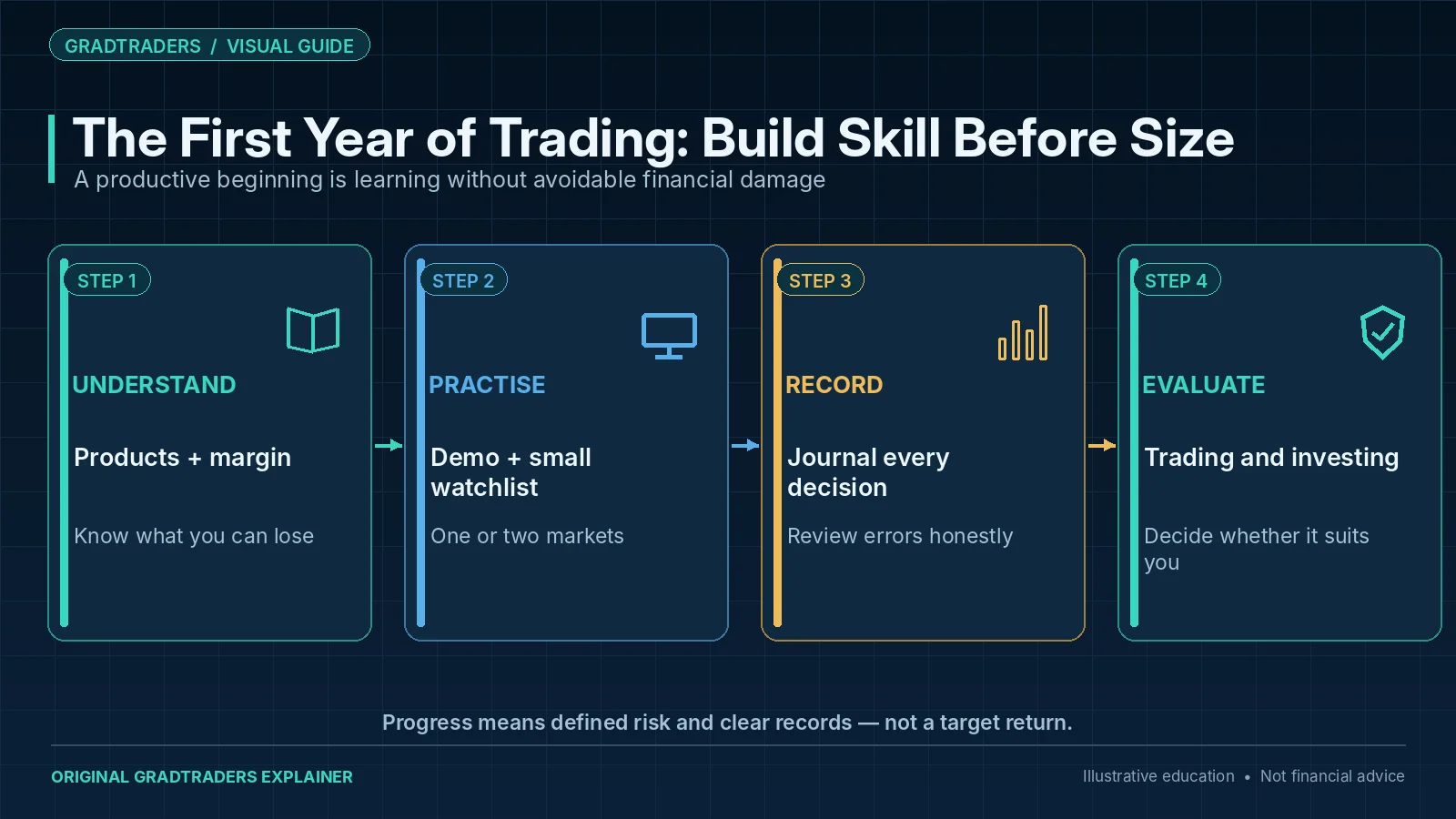
What a sensible first year might look like
A sensible first year in trading does not need to involve large profits. In many cases, the best outcome is simply learning without causing serious financial damage.
A realistic first-year aim might be:
- Understand the main trading products.
- Learn the language of risk.
- Use demo accounts properly.
- Keep a trading journal.
- Study one or two markets.
- Learn basic chart behaviour.
- Avoid large losses.
- Build long-term investing knowledge.
- Decide whether trading suits your temperament.
That may sound slow. Slow is not a weakness at the beginning. Slow is often the only sensible way to find out whether trading belongs in your life at all.
Where To Go Next On GradTraders
Once the basics are clear, use the most relevant route below rather than trying to learn brokers, prop firms, platforms and risk management all at once.
Broker Research
When readers understand the basics, they can compare providers using the GradTraders 24-broker comparison table, the trading broker guide and the broker costs guide.
Prop Firm Research
Readers tempted by funded-account challenges should use the GradTraders Prop Firm Comparison Table, then read Should Beginners Use A Prop Firm? and Best Prop Firms For Beginners.
Risk Foundation
Before live trading, readers should understand risk management, position sizing, stop losses, leverage, margin and trading psychology.
Practical next steps include What Is A Demo Trading Account?, Best Demo Trading Accounts, What Is A Trading Platform?, Best Trading Platforms For Beginners, What Are CFDs?, What Is Spread Betting? and Spread Betting vs CFD Trading.
Final GradTraders View
Trading for beginners should not begin with excitement. It should begin with caution.
The market is not short of opportunities. It is short of traders who can wait for the right ones, size them properly, accept being wrong, and step away when there is nothing worth doing.
Most beginners would be better off learning slowly, investing for the long term, practising on demo and treating trading as a difficult skill rather than a shortcut.
Forewarned is forearmed. The point of beginner education is not to make trading look easy. It is to make the risks visible before they become expensive.
Further Reading on GradTraders
- How To Start Trading In 2026
- Why Traders Should Invest
- ISA vs SIPP For Traders And Investors
- GradTraders Broker Comparison Table
- Best Prop Firms For Beginners
Useful comparison hubs: GradTraders 24-Broker Comparison Table · GradTraders Prop Firm Comparison Table · Best Demo Trading Accounts.
Source note: This guide combines GradTraders editorial judgement with the site’s broker, prop-firm and trading-education research. Current regulatory references were checked against official UK, US and European materials. Broker terms, platform access, product availability, leverage rules and local protections can change, so readers should verify the rules that apply to their country and account before trading.
Useful official sources: FCA retail CFD restrictions · CFTC forex risk guidance · Investor.gov day-trading risks · ESMA CFD protections.
Explore GradTraders Internationally
GradTraders has 20 dedicated international gateways with local livestream times, market context and country-specific routes into the wider research site.
Browse all 20 country gateways
Asia: Japan · South Korea · Taiwan · Hong Kong · India · Singapore · Thailand
Europe: Italy · Sweden · Switzerland · Germany · Norway
Americas: United States · Canada · Mexico
Middle East: United Arab Emirates · Saudi Arabia
Africa: South Africa
Oceania: Australia · New Zealand
Trading For Beginners FAQ
What is trading in simple terms?
Trading means trying to profit from price movement. A trader may buy because they think a market will rise or sell because they think a market will fall, but the full decision also includes risk, position size, exits and whether the trade is worth taking at all.
Is trading the same as investing?
No. Investing is usually longer term and often focuses on ownership, diversification and compounding. Trading is usually shorter term and depends more on timing, risk control, execution and emotional discipline.
What should beginners learn before live trading?
Beginners should understand risk management, position sizing, stop losses, leverage, margin, product structure, broker costs, platform basics and trading psychology before risking real money.
Should beginners use a demo account first?
In most cases, yes. Demo accounts are useful for learning platforms, orders, stops and position sizing without risking capital, although demo results do not prove someone can trade live.
Should beginners use prop firms?
Most beginners should be cautious with prop firm challenges. They involve fees, rules, drawdown limits and pressure. Normal education and demo practice should usually come before serious challenge attempts.