What Is Margin In Trading? A Plain Beginner Guide
Margin is the capital a broker requires to open or maintain a leveraged trade, not the trade’s total exposure or a cap on possible losses. My first check is what happens when the market moves the wrong way: how much free margin remains, when a margin close-out could occur, and whether the proposed position fits the trader’s risk limit. The applicable rules depend on the product and the account’s legal entity and country.
 , GradTraders
Live trading on YouTube
, GradTraders
Live trading on YouTube
Margin Is Not The Full Risk
Margin is the capital required to support a leveraged position, not the maximum amount that can be lost.
Disclosure & Risk Notice: This article is for educational and informational purposes only and should not be considered financial advice, investment advice, tax advice or a personal recommendation. Leveraged products can involve significant risk. You may lose money.
International context: Margin terminology is widely used, but exact requirements, leverage, close-out processes and client protections depend on product, provider, legal entity and local regulation.
GradTraders may earn commission from some links without affecting the independent educational view. Readers comparing relevant providers or current partner routes can use the Exclusive Discounts & Updates page.
Quick Beginner View
Margin is not the same as the full risk.
This is where many beginners get into trouble. They see the amount required to open a trade and mistake it for the amount at risk. In leveraged trading, margin is only the account requirement. The market exposure can be much larger.
I would not use a leveraged product with real money until I understood the position size, margin requirement, free margin, stop distance and maximum planned loss.
Margin Is A Requirement
Margin is the money required to open or hold a leveraged position. It is not the full size of the trade.
Exposure Is The Real Issue
The position can be much larger than the visible margin figure, which is why beginners must understand exposure before trading live.
Risk Comes First
Before using margin, understand position sizing, stop losses and risk management.
What Is Margin in Trading?
Margin is the amount of money a trader must have available to open or maintain a leveraged position. It is not normally the full value of the trade. It is the deposit or account requirement that allows the trader to control a larger position.
For example, you may need only a fraction of the full trade value to open a position. That can make trading look more accessible, but it also means the account may be exposed to a much larger market movement than the margin figure suggests.
In plain terms, margin is the amount the broker or trading environment requires before allowing the position to remain open. I treat it as an access requirement, not as a measure of whether the trade is sensible.
Margin and Leverage Are Connected
Leverage describes the relationship between the trader’s capital and the larger position being controlled. Margin is the amount required to open or maintain that position.
A lower margin requirement may allow more exposure from the same account. That can sound useful, but I think it becomes dangerous quickly when the available exposure is treated as a target.
| Term | Plain meaning | Beginner warning |
|---|---|---|
| Margin | The amount required to open or maintain a leveraged position. | It is not the same as the full value of the trade. |
| Leverage | The ability to control a larger position with a smaller amount of capital. | It magnifies gains and losses. |
| Exposure | The true size of the market position. | Exposure is often more important than the visible margin figure. |
GradTraders explains the related concept in more detail in What Is Leverage In Trading?.
Margin Rules Vary By Product, Entity And Country
The idea of margin is global, but the actual numbers and close-out rules are not. Margin requirements depend on the instrument, volatility, client classification, broker or venue, legal entity and local regulation.
UK and Australian retail CFD regimes, for example, both use leverage limits and margin-close-out protections, but they are separate rulebooks. Other countries can have different products or may not offer the same leveraged retail instruments at all.
Spread betting is a good example of why the product label matters: it is strongly associated with the UK and should not be assumed to be available to an international reader. Always check the local regulated entity before applying a margin example from another jurisdiction.
A Simple Margin Example
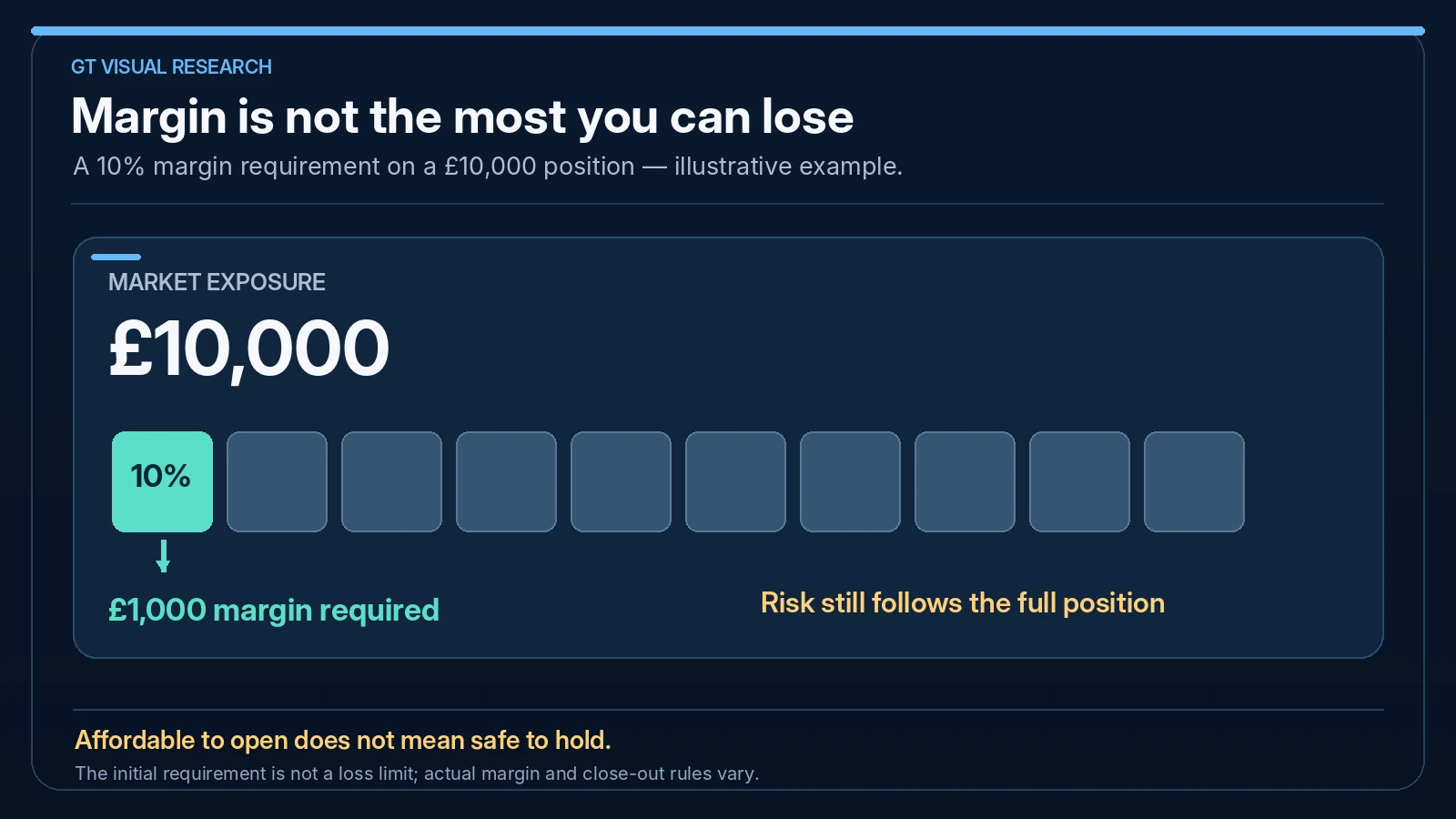
Imagine you want to open a £10,000 position and the margin requirement is 10%.
- The full position size is £10,000.
- The required margin is £1,000.
- The trader is still exposed to movement on the £10,000 position.
- If the market moves against the position, the account can lose money based on the larger exposure.
This is why margin is often misunderstood. You may think, “I only needed £1,000 to open the trade,” but the market movement still acts on the £10,000 exposure.
The margin is the entry requirement. It is not a safety guarantee.
Initial Margin, Maintenance Margin and Free Margin
Trading accounts may use several margin terms. Beginners do not need to become technical experts immediately, but they should understand what each figure is telling them.
Initial margin
Initial margin is the amount required to open a position. It is the margin needed at the start of the trade.
Maintenance margin
Maintenance margin is the amount that may be required to keep a position open. If the account value falls too far, the trader may need more funds or may be forced out of the position.
Used margin
Used margin is the amount of account funds currently tied up by open positions.
Free margin
Free margin is the amount still available after existing margin requirements are considered. It can change as open trades move in profit or loss.
Different brokers and platforms may present these terms slightly differently. The important point is that margin is dynamic: it can change as the account and market move.
Why Margin Matters
Margin matters because it affects how much room the account has to survive market movement.
A beginner may open a position because the required margin looks affordable. If the position is too large, however, a normal market move can quickly reduce equity, damage free margin and create emotional pressure.
This is especially important in volatile markets. Indices, forex pairs, commodities, shares and futures can move sharply around news, market opens, earnings, inflation data, central bank decisions and sudden changes in sentiment.
A position that looks manageable at entry can become uncomfortable very quickly when the trader has not allowed enough room for normal movement.
Margin Is Not the Same as Risk
This is one of the most important beginner lessons.
The margin required to open a trade is not automatically the amount the trader plans to lose. Risk should be defined by position size, stop distance, market volatility and account size.
A trade might require £500 of margin but still expose the trader to a larger loss if the position is badly sized or unmanaged. Equally, a trader may use a leveraged account but take a small position with a clearly defined risk.
I would stop asking only, “How much margin do I need?” and start with, “How much can I lose if I am wrong?”
Margin Calls and Forced Exits
A margin call is a warning or event that occurs when account equity is no longer sufficient relative to the margin required. The exact process depends on the broker, product and platform.
In some cases, the trader may be asked to add funds. In other cases, positions may be reduced or closed automatically. This is sometimes called stop-out, liquidation or margin close-out.
I would never rely on the broker’s margin process as a risk-management plan. By the time a margin call or forced exit is involved, the trade has usually already gone badly wrong.
Proper risk management should happen before the trade is placed, not after the account is under pressure.
How Margin Problems Usually Begin
Margin problems often begin quietly. The trader may not make one dramatic mistake; the position is simply too large for the account.
- The trader opens a position because the margin requirement looks affordable.
- The market moves normally, but the account reacts sharply.
- Free margin falls.
- The trader feels pressure and hesitates.
- The stop is moved or ignored.
- The loss becomes larger than planned.
- The trader tries to recover quickly.
Margin becomes dangerous when it makes large exposure feel affordable.
Margin in Spread Betting and CFDs
Margin is central to many leveraged products, but product availability differs internationally. CFDs are available in many jurisdictions under local rules; financial spread betting is especially associated with the UK and is not a universal retail account type.
Where these products are offered, margin lets the trader control exposure larger than the cash required to open the position. The exact margin percentage, close-out threshold and protections depend on the product and regulated entity.
Do not let the product label distract from the core questions: what is the real exposure, what rules apply to this account, and how much could the account lose?
Margin in Prop Firm Challenges
Prop firm challenges may use simulated buying power, notional account sizes, drawdown rules and platform margin settings. Even though the environment is usually simulated, margin and exposure still matter.
A trader who oversizes in a prop firm challenge can breach drawdown rules quickly. The account may fail even when the trader paid only a challenge fee rather than depositing the headline notional amount.
This is why I do not treat prop firm challenges as a shortcut. They can expose poor margin and sizing habits very quickly.
GradTraders covers this more cautiously in Best Prop Firms For Beginners.
Margin and Position Size
I always consider margin alongside position size.
Position size is how large the trade actually is. Margin is the account requirement attached to holding that trade. A low margin requirement can tempt a beginner into taking a position that is far too large.
This is why I focus on planned risk per trade rather than available margin. The important figure is the loss if the idea is wrong.
The broker may tell you what margin is required. It is still your responsibility to decide whether the position is sensible.
Margin and Stop Losses
A stop loss can help define risk, but it does not remove the need to understand margin.
A large position with a stop loss can still be dangerous if the stop distance creates too much account risk. A very tight stop can be hit by normal market noise. A stop may also be affected by gaps, fast markets or execution conditions.
Position size, stop distance, margin requirement and account size all need to fit together. If one element is wrong, the trade may be badly structured before the market moves.
Why Beginners Confuse Margin with Affordability
Margin can make a trade look affordable because the account needs to set aside only part of the exposure. That can be misleading.
A trader might see that a position only requires a small amount of margin and think the trade is reasonable. But affordability is not the same as suitability. The real question is whether the account can survive the planned risk and normal volatility.
A small required margin can become the most dangerous part of the trade when it encourages more exposure than the trader understands.
A Beginner Margin Checklist
Before opening a margin trade, I would want a beginner to answer these questions:
- What is the full size of the position?
- What margin is required to open it?
- How much free margin will remain?
- How much could I lose if the trade reaches my stop?
- What happens if price gaps beyond the stop?
- What is the market’s normal volatility?
- Am I using the margin because the trade is good, or because the account lets me?
- Am I trying to recover a previous loss?
- Do I understand the broker’s margin close-out rules?
- Have I practised this on demo?
A beginner who cannot answer them should not place the trade.
Margin and Emotional Pressure
Margin is often presented as a technical concept, but it also affects psychology.
When a position is too large, ordinary price movement can feel personal. The trader watches the account move quickly and begins making emotional decisions. They move the stop, close too early, add to a loser or try to win the money back immediately.
The problem may look psychological, but it often began with position size and margin. The trader created more pressure than they could handle.
Good Margin Use Is Often Boring
Beginners may think margin should be used to maximise opportunity. My view is that it should be used carefully, if at all.
Good margin use often means leaving plenty of room, taking smaller positions than the platform allows, avoiding unnecessary trades and accepting that available margin is not a reason to trade.
There is nothing impressive about using all available exposure. The more professional skill is often knowing how much not to use.
Margin Is Not Needed for Everyone
Many beginners do not need margin trading at all.
Someone who is still learning may be better off using a demo account. A person focused on long-term wealth building may be better served by learning about ISAs, pensions, funds and diversified investing. Someone who does not understand leverage should not be searching for more of it.
Margin trading belongs later, if it belongs at all. Access does not create readiness.
Where This Fits in the GradTraders Research Hub
Margin sits at the centre of the broker education cluster because it connects leverage, exposure, account risk and trading psychology. For international readers, it also connects directly to legal entity and local product rules.
Use the GradTraders International hub when you need the country-specific route before comparing leveraged brokers or account types.
Compare Broker Routes
Once the basics make sense, readers can use the GradTraders 24-broker comparison table and broker costs, spreads, execution and leverage comparison to compare real account conditions.
Compare Prop Firm Routes
Readers tempted by simulated challenge accounts should also use the GradTraders prop firm comparison table and read Should Beginners Use A Prop Firm? before paying a fee.
This guide links naturally with Leverage, CFDs, Spread Betting, Spread Betting vs CFD Trading, Position Sizing, Stop Losses, Risk Management, Trading Psychology and Demo Trading Accounts.
Final GradTraders View
Margin is the money required to open or maintain a leveraged position, but it is not the full story. You still need the true exposure, planned loss, stop distance, account size and the rules that apply to the specific product and legal entity.
Many failures begin because a small margin requirement makes a large position look manageable. That problem can be made worse when a trader copies leverage or margin assumptions from another country or account type.
Understand the exposure and the rulebook before the margin percentage. Margin can make trading accessible; it does not make the trade sensible.
Further Reading on GradTraders
Source note: This guide combines GradTraders editorial judgement with current regulator material on retail leverage and margin-close-out protections. Broker margin terminology, initial margin, close-out processes, product access and regulatory protections can change by product and jurisdiction.
Useful official sources: FCA PS19/18: retail CFD restrictions · FCA: Contract for differences · ASIC CFD product-intervention extension.
Explore GradTraders Internationally
GradTraders has 20 dedicated international gateways with local livestream times, market context and country-specific routes into the wider research site.
These country links are for site navigation only; broker availability, regulatory status and product eligibility must be checked separately.
Browse all 20 country gateways
Asia: Japan · South Korea · Taiwan · Hong Kong · India · Singapore · Thailand
Europe: Italy · Sweden · Switzerland · Germany · Norway
Americas: United States · Canada · Mexico
Middle East: United Arab Emirates · Saudi Arabia
Africa: South Africa
Oceania: Australia · New Zealand
Margin In Trading FAQ
What is margin in trading?
Margin is the amount of money a trader must have available to open or maintain a leveraged position. It is not the full value of the trade and should not be confused with the full risk.
Is margin the same as leverage?
No. Leverage describes the relationship between the trader’s capital and the larger position being controlled. Margin is the amount required to open or maintain that position.
Are margin rules the same in every country?
No. Margin requirements, leverage limits, close-out rules and client protections can vary by product, legal entity and jurisdiction. Check the rules that apply to the actual account you would use.
Why is margin dangerous for beginners?
Margin can make large exposure look affordable. A beginner may focus on the small margin requirement and miss the larger position size, planned loss and emotional pressure behind the trade.
What is a margin call?
A margin call is a warning or event that occurs when account equity is no longer sufficient relative to margin requirements. Depending on the broker and product, positions may be reduced or closed automatically.
Do prop firm challenges involve margin?
Prop firm challenges may use simulated buying power, platform margin settings and drawdown rules. Even when the environment is simulated, exposure, margin, position size and drawdown still matter.
What is free margin in trading?
Free margin is the amount of account equity not currently being used to support open positions. It can rise or fall as trades move in profit or loss.
What is used margin?
Used margin is the portion of account funds currently allocated to support open leveraged positions. It is not the same as the full market exposure.
Can a broker close a trade because of insufficient margin?
Yes. Depending on the provider, product and account rules, positions may be reduced or closed automatically when equity falls too far relative to the required margin.
Does a low margin requirement make a trade safer?
No. A low margin requirement may allow more exposure with less capital, but the position can still create a large loss when it is oversized or poorly managed.
Should beginners practise margin trading on demo first?
Yes. A demo account can help beginners understand margin, equity, free margin, exposure and close-out behaviour before accepting real financial risk.