What Is A Trading Broker? A Plain Beginner Guide
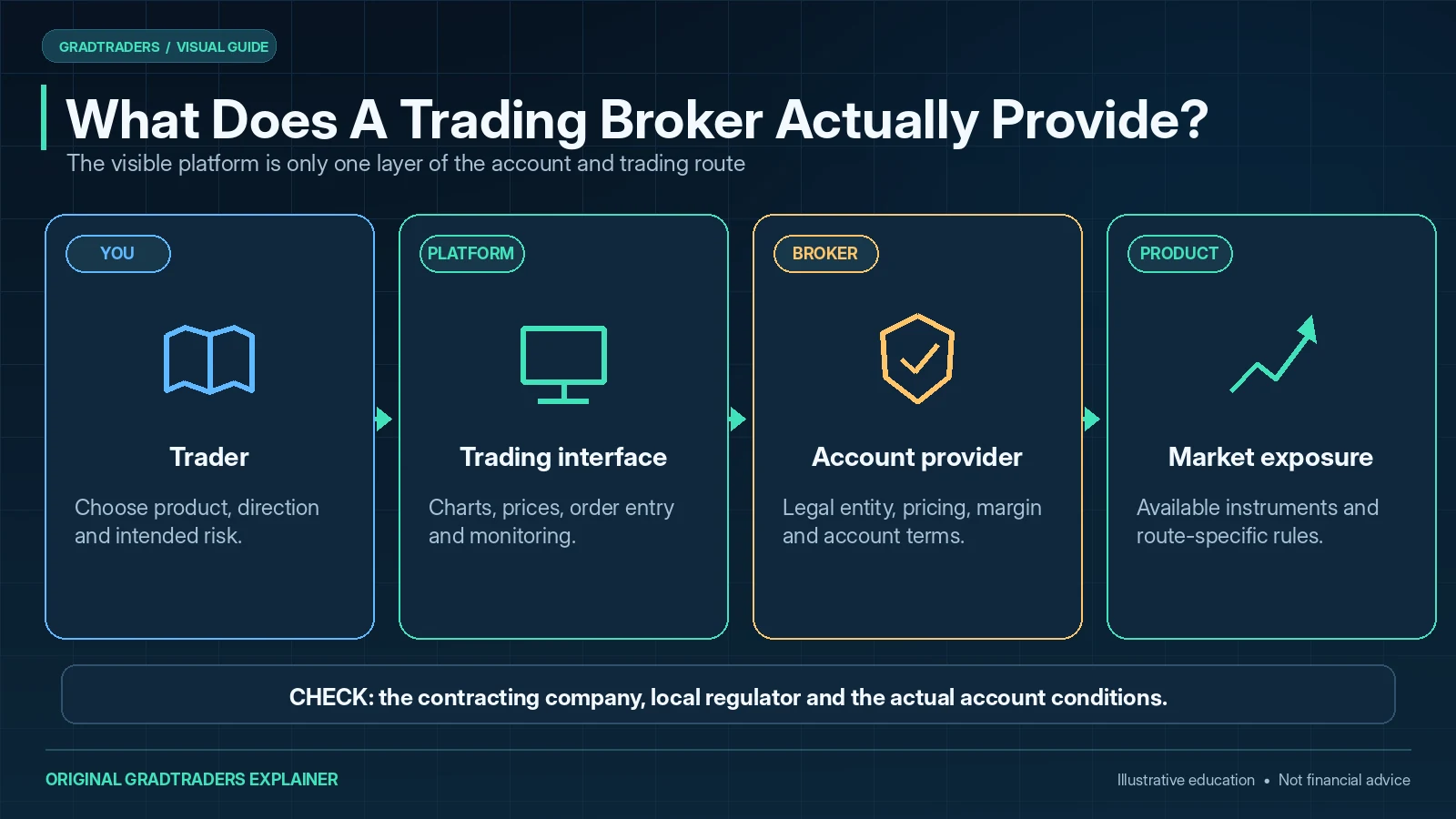
A trading broker provides the account, pricing, trading products and access route behind the platform. My first check is not the brand name or a headline spread: it is the legal company taking the account, the regulator overseeing that entity, and the costs and protections that actually apply in the trader’s country. Two accounts marketed under the same broker name may have materially different terms.
 ,
GradTraders
Live trading on YouTube
,
GradTraders
Live trading on YouTube
Market Access Is Only The Beginning
A broker provides the account and trading route; suitability depends on entity, products, costs and risk.
Disclosure & Risk Notice: This article is for educational and informational purposes only and should not be considered financial advice, investment advice, tax advice or a personal recommendation. Trading leveraged products, futures, forex, indices, commodities and crypto-related products can involve significant risk. You may lose money.
GradTraders may earn commission from some links without affecting the independent educational view. Readers comparing relevant providers or current partner routes can use the Exclusive Discounts & Updates page.
Quick Beginner View
A trading broker provides the account, market access, products, pricing and platform used to trade or invest. It does not make trading safe, suitable or profitable.
Beginners should understand the product, leverage, margin and possible loss before comparing broker scores, platforms or minimum deposits.
What A Broker Does
A broker provides the account, products, pricing, trading conditions, funding route and platform access. It shapes the whole trading experience.
What It Does Not Do
A broker does not make trading suitable, safe or profitable. The trader still needs product knowledge, risk control and discipline.
Where To Compare Next
Once the basics are clear, use the broker comparison table and the broker costs guide carefully.
What is a trading broker?
A trading broker is a company that gives traders access to financial markets or trading products. Through a broker, a trader may be able to trade forex, indices, commodities, shares, ETFs, CFDs, spread bets, futures or other instruments.
The broker provides the account, the platform, the pricing, the market access and the rules under which the trader operates. In simple terms, the broker is the bridge between the trader and the market or product being traded.
That does not make all brokers or broker entities the same. A broker group can operate several regulated companies for different regions, so account type, leverage, protections and product availability can vary with the trader’s country and the entity named in the agreement.
What does a broker actually do?
A broker usually does several jobs at once. Beginners often see only the platform, but there is more behind it.
- It opens and maintains the trading account.
- It provides access to a trading platform or app.
- It shows live or near-live prices.
- It allows the trader to place orders.
- It sets margin and leverage rules.
- It charges spreads, commissions or other costs.
- It handles deposits and withdrawals.
- It decides which markets and products are available.
- It operates under a specific regulatory entity or jurisdiction.
For a beginner, the important point is this: the broker is not just a website. It shapes the whole trading experience.
Different brokers suit different people
There is no single best broker for everyone. This is why beginner broker comparisons can be misleading when they reduce everything to one score.
| Broker type | Usually built for | Beginner caution |
|---|---|---|
| Share dealing broker | Buying and holding shares, funds or ETFs. | More suitable for investing than short-term trading, but capital is still at risk. |
| CFD broker | Speculating on price movement using leveraged products. | Leverage can magnify losses quickly. |
| Spread betting broker | UK traders betting an amount per point of market movement. | Tax treatment may be attractive, but the trading risk remains serious. |
| Forex broker | Trading currency pairs. | Forex is heavily marketed, but not easy. |
| Multi-asset broker | Traders and investors who want many markets in one place. | More choice can mean more confusion. |
| High-leverage global broker | Traders outside stricter retail leverage environments. | High leverage is not a beginner advantage. |
The question is not simply which broker is popular. The question is which broker, account type and product route match the trader’s knowledge, country, risk tolerance and purpose.
Broker Regulation And Legal Entities Matter
Regulation does not remove market risk, but it can affect how a broker holds client money, markets products, handles complaints and applies retail protections.
Global broker brands often operate through several legal companies. The entity named in the account agreement determines which regulator, leverage rules, complaint route and protections apply. The same brand can therefore provide different conditions in different countries.
UK readers should check the FCA Firm Checker or Financial Services Register. US readers should verify the relevant broker or dealer through official SEC, FINRA, CFTC or NFA resources, depending on the product. European and international readers should use their own regulator’s register and confirm that the named entity is permitted to serve their country.
Being regulated does not guarantee profits or prevent every failure. It is still one of the first checks a beginner should complete before depositing money.
Broker costs are not just spreads
Beginners often look at the spread and stop there. That is too narrow.
A broker may charge through spreads, commissions, overnight funding, currency conversion, withdrawal fees, inactivity fees or product-specific costs. Some costs are obvious. Others become clear only after the trader starts using the account.
Costs a beginner should check
- The spread between the buy and sell price.
- Any commission per trade.
- Overnight financing or swap charges.
- Currency conversion costs.
- Deposit and withdrawal charges.
- Inactivity fees.
- Minimum trade size.
- Whether pricing changes by account type.
A broker that looks cheap in one area may be more expensive in another. This matters more for active traders than for someone placing occasional long-term investments.
GradTraders has a deeper broker cost layer here: Broker Costs, Spreads, Execution And Leverage Compared.
Platforms are part of the broker decision
A broker normally gives access to one or more trading platforms. This may be the broker’s own web platform or app, or third-party platforms such as TradingView, MetaTrader 4, MetaTrader 5 or cTrader.
Beginners should not assume the most advanced platform is the best one. A clean, understandable platform may be better at the start than a professional platform full of features the trader does not yet understand.
The platform matters because it affects charting, order entry, stop losses, account visibility, watchlists, mobile use and general decision-making. A confusing platform can make bad decisions easier.
GradTraders has a deeper platform comparison layer here: Broker Platforms, Trading Tools, Demo Accounts And Mobile Apps Compared.
Demo accounts are useful, but limited
Many brokers offer demo accounts. A demo account allows a beginner to practise using the platform with virtual funds rather than real money.
This is useful. It lets the beginner learn how orders work, how charts behave, how stops are placed and how the account responds to price movement.
But a demo account is not proof that someone can trade live. Real money changes behaviour. Slippage, spreads, volatility, hesitation and fear can all feel different when capital is actually at risk.
A demo account should be treated as training. It should not be treated as evidence of future profit.
What beginners should not choose a broker for
Some broker features attract beginners for the wrong reasons.
Do not choose a broker mainly because of high leverage
High leverage can make losses faster and more severe. For beginners, high leverage is usually a danger, not a benefit.
Do not choose a broker because the minimum deposit is tiny
A low minimum deposit can make access easy, but access is not readiness. A person can still trade badly with a small account.
Do not choose a broker because the app looks exciting
A smooth app can make trading feel casual. Trading should not feel casual.
Do not choose a broker because someone else used it profitably
The broker does not make the trade good. The trader still needs process, risk control and judgment.
What beginners should look for instead
A beginner should look for clarity, control and suitability.
- Clear regulation and account entity.
- A demo account.
- Understandable costs.
- A platform the trader can actually use.
- Clear margin and leverage information.
- Products that match the trader’s knowledge level.
- Reasonable funding and withdrawal information.
- Support channels that are easy to find.
- Risk warnings that are visible, not hidden.
A good beginner broker decision is often boring. Boring is not a problem. Boring can be protective.
Broker Products And Account Types Vary By Country
International readers should not assume that a broker offers the same products in every country. The local legal entity may provide a different mix of investing accounts, CFDs, futures, forex or other products.
Spread betting is especially associated with the UK and is not a standard retail account type in many countries. CFD access also varies by jurisdiction. A product offered by one entity of a broker group may therefore be absent from another entity serving a different country.
The right check is the account agreement: identify the exact company holding the account, the regulator that oversees it and the products that company is permitted to offer to residents of your country.
A reader focused on long-term investing may need a very different broker route from an active leveraged trader. Country eligibility and product suitability should come before platform excitement or headline leverage.
Broker comparison should come after education
Broker comparisons are useful when the reader knows what they are comparing. Before that, they can become a shopping exercise.
A beginner might see a broker table and focus on the score, the leverage or the platform list. That is understandable, but incomplete. The more important question is whether the reader understands the product and risk.
GradTraders has a full 24-broker comparison table, but beginners should use it as research, not as a prompt to rush into trading.
The correct order is:
- Understand the basic products.
- Understand risk, leverage and margin.
- Practise on demo.
- Decide whether trading is suitable.
- Only then compare brokers seriously.
Questions to ask before opening a broker account
- What product am I planning to trade?
- Is this a spread betting, CFD, futures, forex, share dealing or investing account?
- Which legal entity will hold my account?
- What regulator applies?
- What leverage is available, and do I understand it?
- What are the spreads, commissions and overnight costs?
- Can I practise on demo first?
- How do deposits and withdrawals work?
- What platform will I use?
- What happens if I am wrong on the trade?
A beginner who cannot answer these questions should slow down.
Where This Fits In The GradTraders Broker Hub
This guide is the entry point for understanding brokers before readers start comparing account types, platforms, costs or affiliate offers. It should send beginners deeper into the broker cluster only after the product risk is clear.
Compare Broker Options
Readers who understand the basics can use the GradTraders 24-broker comparison table, then compare platform access, costs, spreads, execution, leverage and demo accounts carefully.
Compare Prop Firm Alternatives
Readers considering a funded challenge instead of a broker account should read Should Beginners Use A Prop Firm? and use the GradTraders prop firm comparison table.
This page also links naturally with What Is A Trading Platform?, What Are CFDs?, What Is Spread Betting?, Spread Betting vs CFD Trading, Leverage, Margin, Demo Trading Accounts, Risk Management and Position Sizing.
Final GradTraders View
A trading broker is a market access provider, not a shortcut. It can provide the account, platform, prices, products and execution route, but it cannot provide patience, discipline or judgment.
Beginners should not rush to choose a broker before understanding the products and risks. The first decision is not which broker to use. The first decision is whether trading is appropriate, what needs to be learned, and whether a demo account or long-term investing route is a better starting point.
Forewarned is forearmed. A broker can open the door to trading. It is still the trader’s responsibility to decide whether walking through that door is sensible.
Further Reading on GradTraders
- How To Start Trading In 2026
- Trading For Beginners: A Complete GradTraders Guide
- GradTraders Broker Comparison Table
- Broker Platforms, Trading Tools, Demo Accounts And Mobile Apps Compared
- Broker Costs, Spreads, Execution And Leverage Compared
Useful comparison hubs: GradTraders 24-Broker Comparison Table · Broker Platforms, Trading Tools, Demo Accounts And Mobile Apps Compared · GradTraders Prop Firm Comparison Table.
Source note: This guide combines GradTraders editorial judgement with regulator education on broker roles, legal entities, fees and registration checks. Broker permissions, products, leverage, platforms and protections can differ by country and entity, so readers should verify the exact company and local regulator before depositing.
Useful official sources: FCA firm authorisation checks · Investor.gov broker guide · CFTC forex broker and risk checks · ESMA CFD investor protections.
Explore GradTraders Internationally
GradTraders has 20 dedicated international gateways with local livestream times, market context and country-specific routes into the wider research site.
These country links are for site navigation only; broker availability, regulatory status and product eligibility must be checked separately.
Browse all 20 country gateways
Asia: Japan · South Korea · Taiwan · Hong Kong · India · Singapore · Thailand
Europe: Italy · Sweden · Switzerland · Germany · Norway
Americas: United States · Canada · Mexico
Middle East: United Arab Emirates · Saudi Arabia
Africa: South Africa
Oceania: Australia · New Zealand
Trading Broker FAQ
What is a trading broker?
A trading broker is a company that provides an account, platform, pricing and product access so a trader can buy, sell, speculate or invest in financial markets depending on the account type.
Is a broker the same as a trading platform?
No. The broker provides the account, products, costs, regulation, funding and trading conditions. The platform is the software used to analyse markets, place orders and manage positions.
What should beginners check before choosing a broker?
Beginners should check the account entity, regulator, product type, costs, platform, demo access, leverage, margin rules, funding process and whether the product is suitable for their level of knowledge.
Should beginners choose the broker with the highest leverage?
No. High leverage is usually a danger for beginners because it can magnify losses and make position sizing mistakes more expensive.
How should a beginner compare brokers?
A beginner should first understand products, risk, leverage, margin and demo practice, then use a broker comparison table as research rather than as a prompt to rush into live trading.