Should Beginners Use A Prop Firm? A Plain Beginner Guide
My recommendation for a complete beginner is to learn risk management and practise a repeatable approach before paying for a prop-firm challenge. A large simulated account balance does not give a new trader the skills to manage daily loss limits, drawdown or the pressure of chasing a profit target. The better first step is a demo account, realistic position sizing and a written record of decisions; the funded route can be assessed later, once the rules and likely costs make sense.
 ,
GradTraders
Live trading on YouTube
,
GradTraders
Live trading on YouTube
Learn First, Challenge Later
A prop firm adds rules, fees and drawdown pressure; it should not be where a beginner learns basic trading.
Disclosure & Risk Notice: This article is for educational and informational purposes only and should not be considered financial advice, investment advice, tax advice or a personal recommendation. Trading CFDs, spread betting, forex, crypto CFDs, futures, prop firm challenges and other leveraged products involves significant risk and may not be suitable for all traders. You may lose money, including challenge fees. Prop firm accounts are usually simulated trading environments, not traditional investment accounts. Some GradTraders articles may contain affiliate links or references to partner offers. If you sign up, purchase or open an account through certain links, GradTraders may earn a commission at no additional cost to you.
Looking for current GradTraders partner offers, broker discounts, prop firm promotions and trading platform deals? You can view the current offers and join the update list here: Access GradTraders Partner Offers.
Quick Beginner View
For most complete beginners, a prop firm should not be the first step. A prop firm challenge can teach discipline if the trader already understands risk, drawdown, position sizing, platform use and emotional control. But for a beginner who has not learned the basics, it can become an expensive way to practise bad habits.
The better order is simple: learn first, demo first, risk small or not at all, and only consider a challenge when the rules make sense rather than merely looking tempting.
Best First Step
Education, demo practice and risk management should come before buying a challenge or trying to pass a funded-account evaluation.
Best Prop Firm Research Hub
Use the GradTraders prop firm comparison table to compare rules, drawdown, payouts, platforms, country fit and beginner suitability.
Broker Account Alternative
Some beginners should compare prop firms against a normal broker account, especially if they need a slower route with fewer third-party rules.
What Is A Prop Firm?
A proprietary trading firm, often shortened to prop firm, is a company that gives traders access to a trading evaluation or simulated funded account structure. The trader usually pays a fee to take a challenge or evaluation. If they meet the rules, they may become eligible for a funded or simulated funded account and a share of future payouts.
The exact model depends on the firm. Some use one-step challenges, some use two-step challenges, some offer instant funding style products, and some specialise in futures rather than forex or CFDs.
The important beginner point is that a prop firm is not the same as a normal broker account. It is usually a rule-based evaluation environment. The trader is not simply opening an account and trading however they like.
Readers who want to compare the wider prop firm market can use the GradTraders Prop Firm Comparison Table. Readers who are unsure whether a broker account would be cleaner should also compare the GradTraders 24-broker comparison table.
Why Prop Firms Attract Beginners
Prop firms are attractive because they appear to solve the capital problem. A beginner may not have much money to trade, so a larger challenge account can look like a shortcut.
That is the temptation. Instead of slowly building experience, the beginner imagines passing a challenge, accessing a larger account and becoming profitable quickly.
The problem is that account size is not the same as skill. A larger simulated account does not make a trader patient, disciplined or selective. It can simply make the pressure feel bigger.
For many beginners, the issue is not lack of account size. The issue is lack of process.
How Prop Firm Challenges Usually Work
Prop firm rules vary, but many challenges include several common features. These rules matter more than the headline account size. A beginner who focuses only on the large number at the top of the account can miss the restrictions that decide whether the challenge is actually suitable.
Common Challenge Features
- A challenge fee.
- A simulated account size.
- A profit target.
- A maximum loss or drawdown rule.
- Sometimes a daily loss limit.
- Sometimes minimum trading days.
- Sometimes consistency rules.
Rules Beginners Often Miss
- News trading rules.
- Overnight and weekend restrictions.
- Permitted platforms.
- Permitted strategies.
- Payout rules.
- Refund policy, if any.
- What can cause an account breach.
For a deeper breakdown, use the GradTraders Prop Firm Challenge Explained guide before buying any evaluation.
The Headline Account Size Can Be Misleading
A beginner may see a £50,000, £100,000 or larger prop firm account and think in terms of the full account value. That can be misleading.
In practice, the usable risk is often much smaller because the account is governed by drawdown rules. A trader might have a large notional account, but only a limited amount of loss room before the challenge is breached.
This is why drawdown matters. A trader does not really have unlimited freedom over the headline account. They have a rule-defined operating space.
Beginners should learn to read the drawdown rules before they look at profit targets. The GradTraders Prop Firm Rules Explained guide is the natural next read.
Drawdown Is The Rule Beginners Must Understand
Drawdown is a fall in account value from a starting point or previous high, depending on how the firm calculates it. Prop firms may use fixed drawdown, trailing drawdown, end-of-day drawdown or other rule structures.
This is not a small detail. Drawdown rules can decide whether a trader survives a challenge even when their general market idea is reasonable.
| Rule Area | Plain Meaning | Beginner Risk |
|---|---|---|
| Profit target | The gain the trader must reach to pass a stage. | Can encourage rushing or oversized trades. |
| Daily loss limit | The maximum loss allowed in a day. | One emotional day can end the challenge. |
| Total drawdown | The maximum overall account decline allowed. | The real risk room may be much smaller than the account size suggests. |
| Trailing drawdown | A drawdown limit that may move as the account reaches new highs. | A trader can become trapped by profits that temporarily lift the threshold. |
| Consistency rule | A rule designed to stop one trade or one day dominating results. | Large wins may not help as much as expected if the account becomes unbalanced. |
A beginner who does not understand drawdown should not buy a challenge.
Why Prop Firms Can Be Hard For Beginners
Prop firms can be difficult because they combine several pressures at once.
The trader wants to pass. They have paid a fee. There is a profit target. There is a drawdown limit. There may be time pressure or psychological pressure even when there is no formal time limit. The trader may start focusing on the account outcome rather than the quality of each decision.
The Common Failure Pattern
- The trader starts cautiously.
- Progress feels too slow.
- They increase size.
- A normal market move creates a large account swing.
How It Becomes Emotional
- They feel pressure to recover.
- The challenge becomes about passing, not process.
- Losses trigger frustration.
- The trader breaks rules they thought they understood.
This is not a prop firm problem alone. It is a beginner psychology problem made sharper by rules and targets.
Challenge Fees Are Still Money At Risk
A beginner might think a prop firm challenge is safer than a live account because the fee is smaller than the headline account size. That can be true in one narrow sense, but it does not make the fee irrelevant.
Failed challenges can become a repeated cost. A trader may fail, buy another challenge, change strategy, fail again, then keep chasing the idea that the next attempt will be different.
The fee should be treated as risk capital. It should not be money needed for bills, debt, savings, rent, food, family commitments or short-term security.
A cheap challenge is not cheap if the trader keeps buying them without improving.
Prop Firms Are Not The Same As Learning To Trade
A prop firm challenge is an environment where trading rules are tested. It is not a complete trading education by itself.
Trading Basics Needed First
- Market structure.
- Position sizing.
- Stop losses.
- Leverage and margin.
- Drawdown.
Behaviour Basics Needed First
- Trading psychology.
- Platform use.
- Risk management.
- When not to trade.
- How to stop after losses.
Without those basics, a challenge can become a scoreboard rather than a training environment. Beginners who need platform practice should use a demo trading account before considering a paid challenge.
When A Prop Firm May Make More Sense
A prop firm may become more reasonable when the trader already has a tested process and understands the rules before paying a fee.
That does not mean success is likely or guaranteed. It simply means the trader is approaching the challenge with a better foundation.
A Prop Firm May Suit A Trader Who
- Has traded on demo seriously.
- Understands leverage and margin.
- Knows how to size positions.
- Can explain the drawdown rules clearly.
- Has a written trading plan.
- Does not need the payout quickly.
- Can stop trading after losses.
- Accepts that the fee may be lost.
A Prop Firm Probably Does Not Suit Someone Who
- Has never traded seriously before.
- Does not understand drawdown.
- Is attracted mainly by the large account size.
- Is trying to solve a financial problem quickly.
- Cannot stick to a stop loss.
- Regularly chases losses.
- Feels pressure to pass immediately.
- Would be damaged by losing the fee.
Instant Funding Is Not Automatically Beginner-Friendly
Some firms offer instant funding style products. These can sound easier because there may not be a traditional challenge stage before trading the account structure.
Beginners should be careful with this. Instant funding does not remove rules. It does not remove drawdown. It does not remove the need for discipline. In some cases, the rules, fees or payout structure may be less forgiving than a beginner expects.
The word “instant” should not be confused with “easy.” Read Instant Funding vs Prop Firm Challenge before treating any instant-style route as safer or simpler.
Futures Prop Firms Are Different From Forex And CFD-Style Prop Firms
Some prop firms focus on futures, while others focus on forex, CFDs, indices, commodities or crypto-related products through simulated environments.
Futures-style prop firms may have different rules, platforms, market hours, contract sizes, drawdown calculations and evaluation structures. A beginner should not assume that all prop firms work the same way.
This matters because a trader can choose the wrong type of firm for their market knowledge. A futures evaluation can be very different from a forex-style challenge, even if both are described as prop firm accounts.
Futures-focused readers should compare the dedicated Best Prop Firms For Futures Traders guide as well as the main prop firm table.
How Beginners Should Research A Prop Firm
A beginner who is researching prop firms should start with rules, not marketing.
Rule Checks
- Challenge fee.
- Profit target.
- Daily loss limit.
- Total drawdown.
- Whether drawdown is static or trailing.
- Minimum trading days.
- Consistency rules.
Practical Checks
- News trading rules.
- Weekend and overnight rules.
- Permitted platforms.
- Permitted strategies.
- Payout rules.
- Refund policy, if any.
- What can cause account breach.
GradTraders has a separate Best Prop Firms For Beginners guide for readers comparing firms, plus the Prop Firm Comparison Table for the full master-bank view. The safest beginner message is still to slow down.
How To Treat A Prop Firm Challenge Responsibly
A trader who decides to attempt a challenge should treat it like a risk-controlled test, not a lottery ticket.
Before Buying
- Read every rule before paying.
- Choose a size that would not cause financial stress if lost.
- Understand daily loss, max loss and payout rules.
- Check whether a broker account may be cleaner for your stage.
While Trading
- Trade smaller than the maximum account rules allow.
- Do not chase the profit target.
- Stop trading after a bad day.
- Keep written records.
- Use the challenge to test discipline, not excitement.
- Do not immediately rebuy after failure without reviewing why.
Passing slowly with discipline is better than failing quickly because the account looked large. The How To Pass A Prop Firm Challenge Without Blowing Up guide goes deeper on this.
What Should Beginners Do Before Buying A Challenge?
Before buying a prop firm challenge, a beginner should ideally complete a slower preparation stage.
Education And Practice
- Learn what trading is.
- Understand leverage and margin.
- Understand drawdown.
- Use a demo account seriously.
- Write a basic trading plan.
Risk And Behaviour
- Keep a trading journal.
- Practise risk per trade.
- Learn to stop after losses.
- Understand one or two markets properly.
- Accept that doing nothing is often the correct decision.
The challenge should come after preparation, not replace it.
A Simple Beginner Test
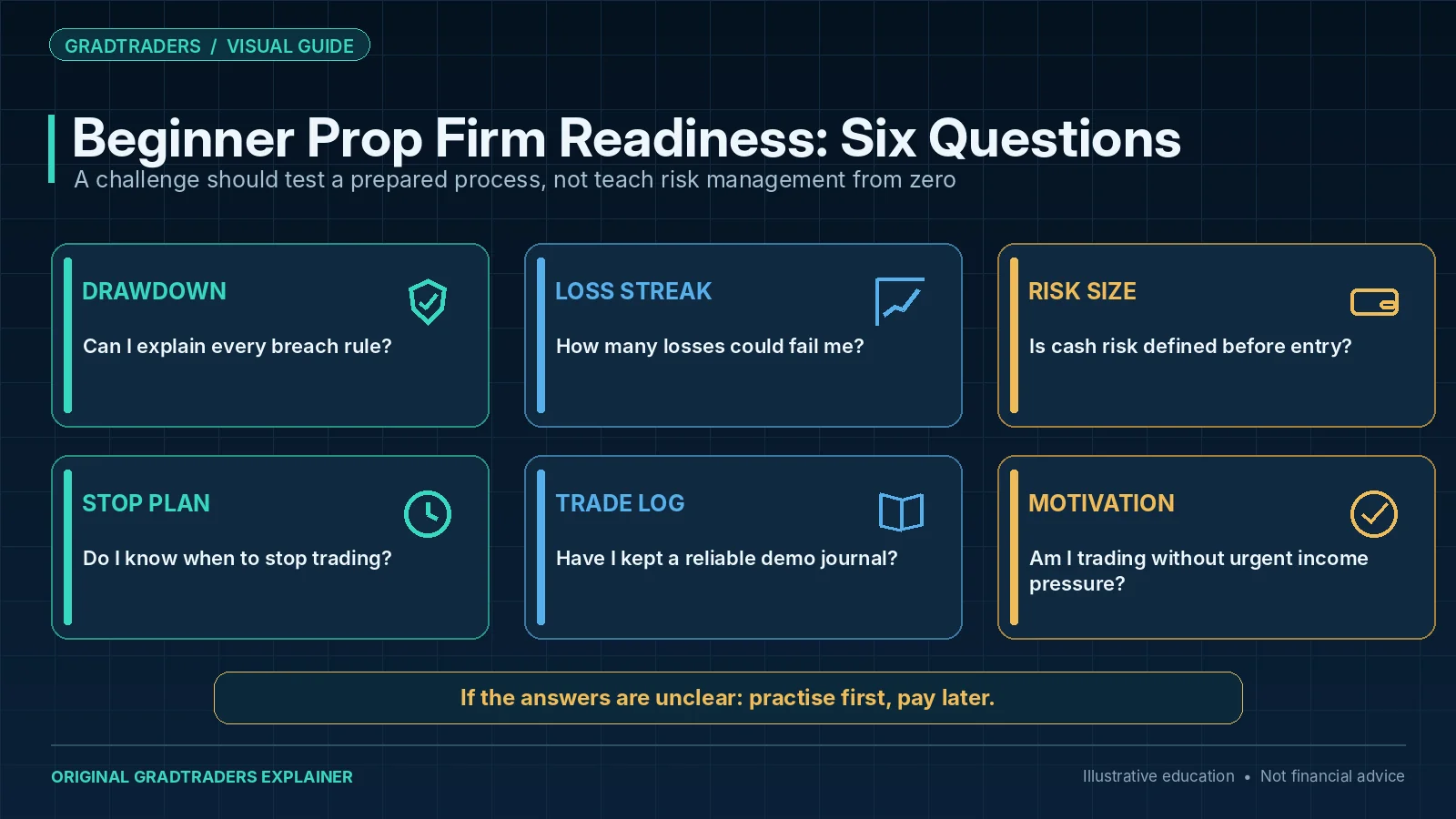
Before buying a challenge, ask:
- Can I explain the firm’s drawdown rule without checking again?
- Can I explain how many losing trades would breach the account?
- Do I know the maximum I would risk per trade?
- Do I have a written plan for when to stop trading?
- Would I still buy this challenge if there were no payout screenshots online?
- Am I doing this to learn, or because I need money quickly?
If the answers are unclear, the better decision is usually to wait.
Final GradTraders View
Most complete beginners should not start with a prop firm challenge. They should start with education, demo practice, risk management, position sizing and long-term financial planning.
Prop firms can have a place for traders who already understand rules and risk. They can also become a trap for beginners who are attracted by account size, payout potential and the idea of a shortcut.
Forewarned is forearmed. A prop firm challenge is not a substitute for learning to trade. It is a test of whether the trader can follow a process under rules. A beginner should not pay for that test until they understand what is being tested.
Further Reading On GradTraders
- Best Prop Firm Comparison Table 2026
- Broker Comparison Table 2026: 24 Trading Brokers Compared
- Best Prop Firms For Beginners 2026
- Best Prop Firms 2026
- Prop Firm Challenge Explained 2026
- Prop Firm Rules Explained 2026
- Prop Firm Payouts Explained 2026
- How To Start Trading In 2026
- Trading For Beginners: A Complete GradTraders Guide
- What Is Risk Management In Trading?
Source note: This guide is based on GradTraders editorial judgement, the site’s prop firm research and general trading education principles. Prop firm rules, fees, account structures, platforms, payout terms and availability can change, so readers should always check current firm rules directly before buying a challenge or risking money.
Current fact-check note: provider, platform and route details used in this September upgrade were checked against current source material; readers should still confirm live terms before acting.
Explore GradTraders Internationally
GradTraders has 20 dedicated international gateways with local livestream times, market context and country-specific routes into the wider research site.
Browse all 20 country gateways
Asia: Japan · South Korea · Taiwan · Hong Kong · India · Singapore · Thailand
Europe: Italy · Sweden · Switzerland · Germany · Norway
Americas: United States · Canada · Mexico
Middle East: United Arab Emirates · Saudi Arabia
Africa: South Africa
Oceania: Australia · New Zealand
Should Beginners Use A Prop Firm FAQ
Should complete beginners use a prop firm?
Most complete beginners should not start with a prop firm challenge. They should usually learn trading basics, use demo accounts, understand drawdown and practise risk management before paying for any evaluation.
Are prop firms safer than broker accounts?
Not automatically. A prop firm challenge may limit direct live-capital loss to the fee, but repeated failed challenges can become expensive. Broker accounts give direct control but put the trader’s own capital at risk. The right route depends on discipline, experience, rules and risk tolerance.
What is the biggest prop firm risk for beginners?
The biggest risk is usually misunderstanding drawdown, daily loss limits, payout rules and account restrictions. Beginners may focus on headline account size while ignoring the rulebook that controls the account.
Should beginners compare prop firms against broker accounts?
Yes. Some beginners may be better served by demo practice or a small broker account before paying for a prop firm challenge. Comparing both routes helps avoid choosing a challenge only because the account size looks attractive.
Where should I compare prop firms?
Use the GradTraders prop firm comparison table to compare firms by rules, drawdown, payouts, platforms, offers and trader type. Then read the deeper rules, payouts, beginner and broker-account comparison guides before buying a challenge.