What Is Spread Betting? A Plain Beginner Guide
Spread betting uses a stake per point to take leveraged exposure to market movements without owning the underlying asset. My starting point is suitability and eligibility, not a headline tax claim: check whether the product is actually offered to residents of your country, which regulated company provides the account, and what each point of movement could cost. The apparent simplicity of a stake-per-point ticket does not remove leverage, margin or execution risk.
 , GradTraders
Live trading on YouTube
, GradTraders
Live trading on YouTube
Stake Per Point, Leveraged Risk
Spread betting is a leveraged way to speculate on price moves, commonly associated with the UK and not available everywhere.
Disclosure & Risk Notice: This article is for educational and informational purposes only and should not be considered financial advice, investment advice, tax advice or a personal recommendation. Spread betting and other leveraged products can involve significant risk. You may lose money.
International availability: Spread betting is not a globally standard retail account type. Availability, leverage, protections and tax treatment depend on country, product and the legal entity serving the account.
GradTraders may earn commission from some links without affecting the independent educational view. Readers comparing relevant providers or current partner routes can use the Exclusive Discounts & Updates page.
Quick Beginner View
For an international reader, spread betting is a jurisdiction question before it is a trading choice.
It is strongly associated with the UK and is not a standard retail account type in many markets. A broker brand may offer spread betting through one legal entity and different products through another.
Where spread betting is available, it is still leveraged speculation. Stake size, margin, volatility, costs and stop discipline matter more than the simple-looking pounds-per-point ticket.
First Check
Is financial spread betting actually offered to residents of your country by the regulated entity serving you?
Then Check
Which regulator and legal entity apply, and what protections, leverage rules and complaints route come with that account?
Only Then
Compare stake per point, margin, costs, tax treatment and whether the product fits your risk tolerance.
International Readers: Spread Betting Is Not A Universal Account Type
GradTraders is an international site, so this guide does not treat the UK spread-betting model as a global default. The FCA includes financial spread betting within its CFD framework in the UK, while European product-intervention rules have also covered financial spread bets where they are offered. That does not mean every country offers the same account type.
Outside the UK, readers should check the local regulator, the broker’s exact legal entity and the products that entity is permitted to offer. A familiar broker name is not enough: account types, leverage, protections and tax treatment can change across jurisdictions.
Country first, product second. If spread betting is not an available local route, treat the rest of this article as product education rather than a reason to seek an offshore workaround.
What is spread betting?
Spread betting is a way of speculating on whether a market will rise or fall. Instead of buying the underlying asset, the trader bets a certain amount of money per point of movement.
For example, a trader might stake £1 per point on an index. If the market moves 50 points in the trader’s favour, the trade may make about £50 before costs. If the market moves 50 points against the trader, the trade may lose about £50 before costs.
This sounds straightforward, but the simplicity can be misleading. The stake per point, the market volatility, the stop distance and the use of margin all affect the real risk.
Spread betting does not mean you own the asset
A spread bet is not the same as buying a share, an ETF or a fund. The trader is not becoming an owner of the underlying asset.
The spread bet is a contract with the provider based on price movement. The trader is speculating on direction, not investing in the asset itself.
This distinction matters. A long-term investor may own units in a fund or shares in a company. A spread bettor is usually taking a leveraged short-term position based on market movement.
How spread betting works in plain terms
A spread bet usually has a few basic ingredients.
| Part | Plain meaning | Beginner warning |
|---|---|---|
| Market | The instrument being traded, such as an index, currency pair, commodity or share. | Different markets move at different speeds. |
| Direction | Whether the trader thinks the market will rise or fall. | Being right on direction is not enough if the position is too large. |
| Stake per point | The amount won or lost for each point the market moves. | A small stake can still become meaningful if the market moves sharply. |
| Spread | The difference between the buy price and sell price. | The spread is one of the trading costs. |
| Margin | The amount needed to open or maintain the position. | Low margin can make oversized trades look affordable. |
| Stop loss | An order intended to limit the loss if the market moves against the trader. | A stop helps define risk, but it does not make a bad position size sensible. |
A beginner should understand each of these before placing a live spread bet.
A simple spread betting example
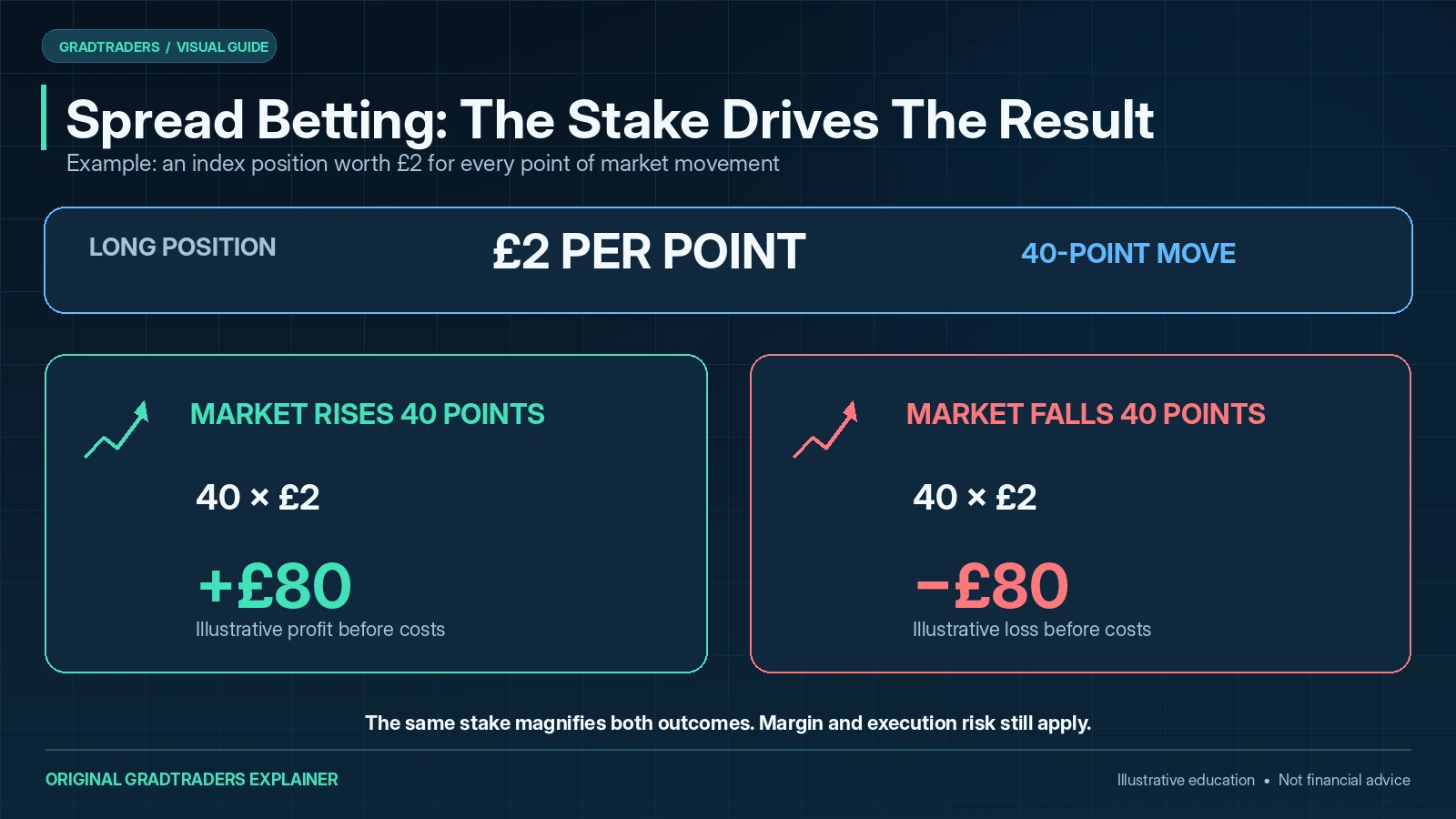
Imagine a trader goes long on an index at £2 per point. This means the trader is trying to profit if the index rises.
- If the index rises 40 points, the trade may make about £80 before costs.
- If the index falls 40 points, the trade may lose about £80 before costs.
- If the index moves 100 points against the trader, the loss may be about £200 before costs.
The key lesson is that the stake controls the speed of the result. Increasing the stake does not make the trade better. It only makes each point of movement more valuable or more damaging.
Why Spread Betting Is So UK-Focused
Spread betting is especially associated with the UK. One reason is local tax treatment: HMRC guidance says a taxpayer placing a spread bet is not normally carrying on a trade, so profits are not normally taxable and losses do not normally receive relief, subject to exceptions and individual circumstances.
That is a UK-specific context, not an international rule. Readers elsewhere should not assume the same tax treatment applies, or that the product is available through their local broker entity.
Even in the UK, tax treatment should come after suitability and risk. A favourable tax position does not protect an account from leverage, poor sizing or bad decisions.
Spread betting is usually leveraged
Spread betting is commonly a leveraged product. That means the trader may only need to put down a smaller amount of margin to control a larger market exposure.
Leverage is one of the main reasons spread betting can become dangerous. It can make a normal market move feel large in account terms. Beginners may focus on the small margin requirement and miss the larger exposure behind it.
GradTraders explains this in more detail in What Is Leverage In Trading? and What Is Margin In Trading?.
Spread betting and CFDs are similar, but not identical
Spread betting and CFD trading are often discussed together because both can provide leveraged exposure to price movement without ownership of the underlying asset. Internationally, however, they are not equally available.
Where both are offered, spread betting is usually structured around a stake per point while CFD trading uses contracts, units, lots or quantities. UK tax treatment is another local difference, not a global one.
The risk, however, can be very similar. In both cases, a beginner can lose money quickly if they use too much exposure, misunderstand margin or trade emotionally.
| Area | Spread betting | CFD trading |
|---|---|---|
| Structure | Stake per point of market movement. | Contract based on price difference. |
| Ownership | No ownership of the underlying asset. | No ownership of the underlying asset. |
| International availability | Jurisdiction-specific and especially associated with the UK; do not assume a local broker entity offers it. | Available in many jurisdictions under local rules, but not universally and not with identical protections. |
| Leverage | Usually leveraged. | Usually leveraged. |
| UK tax discussion | Often discussed as normally tax-free for individuals, subject to circumstances. | Different tax treatment may apply. |
| Beginner risk | Oversized stakes and leverage. | Oversized positions and leverage. |
GradTraders covers CFDs separately in What Are CFDs?.
The UK Tax Point Should Stay In Its Lane
UK readers often hear that spread betting is ‘tax-free’ and stop listening after that. HMRC’s published guidance is more nuanced and personal circumstances can matter.
International readers should use their own tax authority and local professional guidance rather than importing a UK assumption into another jurisdiction. This article is not tax advice.
More importantly, tax only matters after product access, regulation and risk. A product that is not offered locally is not made suitable by a tax rule from another country.
Why spread betting can hurt beginners
Spread betting can hurt beginners because it is easy to understand at the surface level and difficult to manage properly in real conditions.
- The stake per point can make risk look smaller than it is.
- Leverage can magnify losses.
- Fast-moving markets can produce sudden account changes.
- Mobile apps can make trading feel casual.
- Tax advantages can distract from trading risk.
- Beginners may increase the stake after losses.
- Stops can be moved or ignored under pressure.
The beginner problem is rarely one dramatic mistake. It is usually a chain of ordinary decisions made too quickly.
Spread betting costs beginners should understand
Spread betting is not cost-free. The costs may include the spread, overnight financing, guaranteed stop premiums, currency conversion effects or other provider-specific charges.
The spread is especially important for active traders. It is the difference between the buy and sell price. A wider spread means the market has to move further in the trader’s favour before the trade is in profit.
Overnight financing can also matter if a spread bet is held beyond the day. Beginners should check the provider’s current terms before placing trades.
Stop losses matter, but they are not magic
A stop loss is an order intended to close a trade if the market moves against the trader. It can help define the planned loss.
But a stop loss does not make an oversized spread bet sensible. If the stake per point is too large, even a normal stop distance can represent too much account risk.
Beginners should also understand that execution can be affected by fast markets, gaps and product terms. Guaranteed stops may be available with some providers, but they can come with specific conditions or extra costs.
Spread betting is not investing
This is worth repeating plainly.
Spread betting is speculation on price movement. It does not build long-term ownership and is not the same as buying diversified investments through the long-term accounts or wrappers available in your own country.
Many beginners would be better served by understanding long-term investing before active spread betting. GradTraders covers that wider principle in Why Traders Should Invest.
When Spread Betting May Be Relevant
Spread betting is only relevant as a live-account choice where it is permitted and actually offered to residents by the legal entity serving them.
Where it is available, it may suit someone who already understands markets, leverage, margin, position sizing, order types, local tax treatment and their own behaviour under pressure.
If it is not a normal local product, do not treat offshore access as a shortcut. Preserving local regulatory protections is more important than recreating a UK account type.
A beginner spread betting checklist
Before placing a live spread bet, a beginner should be able to answer these questions calmly:
- Is spread betting actually available to residents of my country through the regulated entity serving me?
- Which legal entity would hold my account, and which regulator oversees it?
- Am I relying on a UK tax or product assumption that does not apply where I live?
- What market am I spread betting on?
- What is my stake per point?
- How much could I lose if the market moves 25, 50 or 100 points against me?
- Where is my stop loss?
- What is the spread?
- Is there overnight financing?
- Am I using leverage?
- What is the margin requirement?
- Am I trading money I can afford to lose?
- Would I still take this trade if the tax treatment were not attractive?
A person who cannot answer these should slow down and use a demo account first.
Common spread betting mistakes
- Choosing a stake per point that is too large.
- Focusing on tax treatment before risk.
- Holding trades overnight without understanding financing costs.
- Trading fast markets with no clear plan.
- Moving the stop loss further away.
- Adding to a losing position without a plan.
- Assuming a well-known UK provider makes the trade safe.
- Using mobile trading too casually.
- Confusing a short-term bet with long-term investing.
These mistakes are common because spread betting feels accessible. Accessibility is not the same as readiness.
Where This Fits In The GradTraders Research Hub
Spread betting sits inside the broker education cluster, but international readers should enter through country eligibility first. The same broker brand can provide different products and protections through different legal entities.
Use the GradTraders International hub to enter through your country route before treating a UK spread-betting account as relevant to you.
Compare Broker Routes
Readers ready to compare providers can use the GradTraders 24-broker comparison table to compare broker routes, platform access, costs, leverage, spreads and account types.
Compare Challenge Alternatives
Readers weighing spread betting against prop firm-style accounts can use the GradTraders prop firm comparison table and read Should Beginners Use A Prop Firm?.
This guide also links naturally with Spread Betting vs CFD Trading, What Are CFDs?, Leverage, Margin, Risk Management, Position Sizing, Stop Losses and Demo Trading Accounts.
Final GradTraders View
Spread betting is a real part of the UK trading landscape, but it is not a universal global account type. International readers need to establish local availability, regulation and legal entity before comparing the product at all.
Where it is available, the practical work is the same: understand stake per point, leverage, margin, costs, stop distance and position size before risking money. UK tax treatment is a local consideration, not the starting point for everyone.
Country first, product second, risk always. Spread betting may look simple; the risk and jurisdiction behind it are not.
Further Reading on GradTraders
Source note: This guide combines GradTraders editorial judgement with current primary-source material on UK financial spread betting and jurisdiction-dependent leveraged-product rules. Product access, legal entity, leverage, protections and tax treatment can change, so check the regulator and provider terms that apply to your country before opening an account.
Useful official sources: FCA: Contract for differences, including spread betting · HMRC BIM22015 · HMRC CG56105 · ESMA retail CFD intervention context.
Explore GradTraders Internationally
GradTraders has 20 dedicated international gateways with local livestream times, market context and country-specific routes into the wider research site.
These country links are for site navigation only; broker availability, regulatory status and product eligibility must be checked separately.
Browse all 20 country gateways
Asia: Japan · South Korea · Taiwan · Hong Kong · India · Singapore · Thailand
Europe: Italy · Sweden · Switzerland · Germany · Norway
Americas: United States · Canada · Mexico
Middle East: United Arab Emirates · Saudi Arabia
Africa: South Africa
Oceania: Australia · New Zealand
Spread Betting FAQ
What is spread betting?
Spread betting is a way of speculating on whether a market will rise or fall by staking an amount per point of price movement. The trader does not own the underlying asset.
Is spread betting available in every country?
No. Financial spread betting is jurisdiction-specific and especially associated with the UK. Availability depends on country, provider and the regulated legal entity serving the account.
Can the same broker offer spread betting in one country but not another?
Yes. Global broker brands can operate through different legal entities, so product permissions, leverage, protections and account types can differ by country.
Is spread betting tax-free in the UK?
HMRC guidance says a taxpayer placing a spread bet is not normally carrying on a trade, so profits are not normally taxable and losses do not normally receive relief. Exceptions and personal circumstances can matter, so this is not tax advice.
Does UK spread-betting tax treatment apply internationally?
No. UK tax treatment is a local consideration. International readers should use their own tax authority and local professional guidance rather than applying UK assumptions to another jurisdiction.
Is spread betting safer than CFD trading?
No. Where available, spread betting and CFDs can both be high-risk leveraged products. Exposure, margin, position size, stop discipline and trader behaviour matter more than the product label.
Should beginners use spread betting?
Many complete beginners should start with education and demo practice. A live spread-betting account should only be considered where the product is locally available and the trader understands leverage, margin, costs, position sizing and tax limitations.