What Is Leverage In Trading? A Plain Beginner Guide
Leverage increases the market exposure a trader controls relative to the margin committed. I would start with the full position size and the money that could be lost if price moves against the trade, rather than with the small deposit required to open it. Leverage magnifies outcomes, and the available limits and retail protections still depend on the product, account classification, country and legal entity.
 ,
GradTraders
Live trading on YouTube
,
GradTraders
Live trading on YouTube
Leverage Magnifies Exposure
Leverage lets less capital control more market exposure, so losses can grow faster than beginners expect.
Risk notice: This article is for education only. It is not financial advice, investment advice, tax advice or a personal recommendation. Trading, spread betting, CFDs, forex, indices, commodities, futures, crypto-related products and prop firm challenges can involve significant risk. You may lose money.
GradTraders may earn commission from some broker, platform or prop firm links on the wider site. Readers who later decide to compare providers or look for available partner offers can check the Exclusive Discounts & Updates page. This guide is written to explain leverage, not to encourage beginners to use it.
Quick Beginner View
For beginners, leverage is not free money.
It increases market exposure. That exposure can work for you or against you. Beginners often notice the attractive part first: a small account can control a larger position. The danger is that losses can also arrive much faster than expected.
I would not trade a leveraged product with real money until I understood the position size, margin requirement, stop distance and maximum planned loss.
Plain Meaning
Leverage lets a trader control a larger market position than the money placed down as margin.
Main Danger
A normal market move can become a large account move when the position is too big for the account.
Best First Step
Learn margin, position sizing and risk management before using live leverage.
What is leverage in trading?
Leverage means using a smaller amount of money to control a larger trading position. You do not put down the full value of the position. Instead, the provider requires a smaller amount called margin.
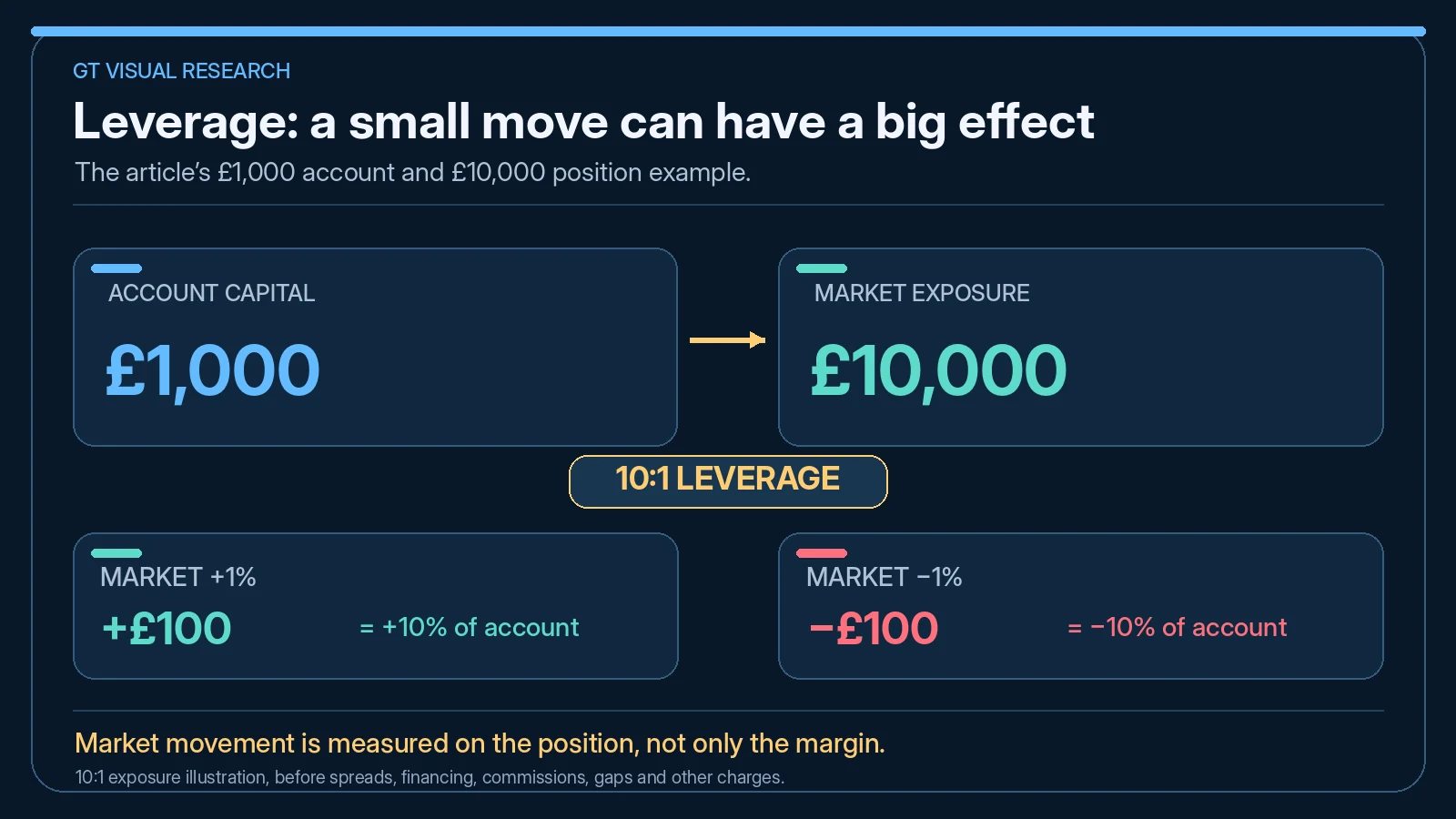
For example, with 10:1 leverage, £1,000 could theoretically control a £10,000 position. A 1% move is then measured against the £10,000 exposure, not only the £1,000 account balance.
This is why leverage can feel powerful. It is also why I treat it as a risk amplifier: a small market move can become a large account move.
Leverage and margin are connected
I treat leverage and margin as two sides of the same idea.
Leverage describes the size of the position compared with the trader’s capital. Margin is the amount the trader must provide or maintain to keep that leveraged position open.
| Term | Plain meaning | Beginner warning |
|---|---|---|
| Leverage | The relationship between account money and the larger position being controlled. | It magnifies both gains and losses. |
| Margin | The amount required to open or maintain a leveraged position. | Low margin can tempt traders into positions that are too large. |
| Exposure | The true size of the market position. | Exposure matters more than the deposit shown on the account screen. |
A beginner should understand margin before using leverage. Leverage is not merely an account-setting number; it changes how quickly a trade can affect equity.
A simple leverage example
Imagine you have £1,000 and open a £10,000 position. That is 10:1 leverage.
- If the market rises 1%, the £10,000 position gains about £100 before costs.
- That £100 is 10% of the £1,000 account.
- If the market falls 1%, the £10,000 position loses about £100 before costs.
- That loss is also 10% of the account.
The market moved only 1%, but the account moved roughly 10% before costs. That relationship is what every beginner needs to understand.
Leverage does not require a dramatic market move to create a dramatic account result. A normal move can become a serious loss when the position is too large.
Why leverage attracts beginners
Leverage attracts beginners because it appears to solve the small-account problem. Limited capital can control a position that would otherwise be unaffordable.
I think this can encourage the wrong question. Instead of asking what a larger position might make, the trader should first ask what it could lose.
This is where many accounts are damaged. The trader is not necessarily wrong about the market direction. The position is simply too large for the account to survive normal movement.
In trading, being too large can make being slightly wrong look catastrophic.
Leverage Rules And Protections Vary By Country
Retail leverage rules are jurisdiction-specific. In the UK, FCA rules restrict retail CFD leverage and include protections such as margin close-out and negative balance protection. Other countries can apply different leverage limits, product rules and client protections.
The same global broker brand may serve clients through different legal entities, so the leverage shown to one trader may not be the leverage available to another. Check the regulator and entity named in the account agreement rather than assuming a global brand has one worldwide rule set.
Beginners should not move to an offshore or differently regulated entity simply to obtain more leverage. Higher available leverage increases the amount of exposure that can be taken; it does not improve the trade.
Leverage in spread betting and CFDs
Leverage is common in CFD trading and, where the product is available, spread betting. Spread betting is especially associated with the UK and is not a standard retail account type in many countries, while CFD availability and protections also depend on local rules.
The product label changes, but the exposure problem does not. A leveraged CFD, spread bet or other margin product can make relatively small market moves create much larger account changes when position size is too high.
Tax treatment, product labels and platform layout should not distract from the central question I would ask before every trade: how much can this position lose if it moves against me?
Leverage in prop firm challenges
Prop firm challenges can also involve leverage, even when the environment is simulated. The trader may be given access to a notional account size with rules around drawdown, daily loss limits, profit targets and consistency.
Leverage can be especially dangerous in a challenge because the trader is under pressure to reach a target without breaching daily or total drawdown rules. That pressure can encourage oversized trades.
I would not dismiss the risk because only a challenge fee is paid. The fee is still money at risk, repeated failures can become expensive, and poor habits learned in a simulated challenge can carry into live trading.
GradTraders covers beginner suitability separately in Best Prop Firms For Beginners.
The real problem is usually position size
Leverage is often discussed as if it is the whole problem. In practice, I usually focus first on position size.
A broker may offer leverage, but the trader chooses how large to trade. A careful trader can use a leveraged account while taking small positions. A reckless trader can destroy an account even with relatively modest leverage if they oversize repeatedly.
The better question is not only “what leverage does the broker offer?” It is “what is my actual exposure, and what happens if the market moves against me?”
How leverage damages accounts
Leverage rarely damages an account in one clean, educational event. In my experience of trading behaviour, it more often works through a chain of ordinary mistakes.
- The trader opens a position that is too large.
- The market moves normally, but the account reacts sharply.
- The trader feels pressure and moves the stop.
- The loss becomes larger than planned.
- The trader tries to win it back.
- The next position becomes larger.
- Discipline disappears.
This is why I do not treat leverage as a purely mathematical issue. It also increases emotional pressure.
Leverage makes ordinary volatility feel personal
Markets move. That is normal. Indices move around opens, closes, earnings, inflation data, central bank decisions, geopolitical events and general risk sentiment. Forex pairs move. Commodities move. Shares gap. Futures can move quickly.
A small position may survive normal movement. An oversized leveraged position may not. The trader can then believe the market behaved unusually when the real problem was that the position was too large for ordinary volatility.
Good traders respect this. Beginners often learn it only after the account has been hit.
More leverage does not mean more opportunity
This is one of the most important beginner lessons.
More leverage means the ability to take more exposure. It does not mean the market is offering a better trade. It does not improve the entry. It does not improve the stop. It does not improve the trader’s judgment.
A bad trade with more leverage is still a bad trade. It is just a larger bad trade.
I would stop thinking of leverage as a reward and start thinking of it as permission to take more risk—permission that does not need to be used.
A beginner should not use all available leverage
The maximum leverage available on an account is not a recommendation. It is only a limit.
This distinction matters. A car may be capable of travelling at a dangerous speed, but that does not make it sensible to drive that way. A trading account may allow a larger position, but that does not mean the position fits the trader’s plan.
I would normally expect a beginner to use far less exposure than the account permits, or remain on demo until the relationship between position size, stop distance and account risk is clear.
The question before every leveraged trade
Before any leveraged trade, I would want one question answered clearly:
How much money can I lose if this trade is wrong?
Not how much margin is required. Not how much the trade could make. Not how confident the setup looks. The planned loss must be clear before the trade is placed.
If you cannot answer that question calmly before entering, I do not think the trade should be placed.
A simple risk checklist
Before using leverage, I would want a beginner to answer yes to most of the following:
- I know the true size of the position.
- I know the margin required.
- I know where the trade is wrong.
- I know the planned loss before entering.
- I understand that a stop loss may not always fill exactly at the chosen price.
- I understand the market’s normal volatility.
- I am not using leverage to solve a small-account problem.
- I am not trading money I need.
- I am not trying to win back a loss.
- I have practised the platform on demo.
Failing this checklist does not mean someone can never trade. It means the sensible next step is to slow down and learn the missing part.
Leverage and stop losses
A stop loss can help define risk, but I would never use it to justify an oversized position.
Beginners sometimes think a stop loss solves the leverage problem. It does not. A stop that is too wide can create a large planned loss. A stop that is too tight can be hit by normal market noise. A stop on a large position can still represent too much account risk.
Position size, stop distance and account size must work together. If they do not, the trade is poorly structured before the market even moves.
Leverage and overtrading
Leverage can also encourage overtrading. When the account offers large exposure, the trader may feel that every market movement is an opportunity.
This is dangerous. Most market movement is not worth trading. A beginner who combines leverage with constant activity is exposed to repeated costs, emotional fatigue and avoidable mistakes.
Good trading is selective. Sometimes the correct use of a leveraged account is to place no trade at all.
What leverage is suitable for beginners?
There is no universal answer, because suitability depends on the trader, product, account size, volatility, stop distance and experience level.
For many complete beginners, my answer would be no live leverage at first. Use a demo account, learn how price movement affects position size, practise placing stops and watch how quickly equity changes when exposure increases.
A beginner asking how much leverage to use may be better served by first asking why leverage is needed at all.
Leverage is not the same as skill
A profitable leveraged trade can make a beginner feel skilled. Sometimes the trader was simply oversized at the right moment.
This distinction matters. Luck plus leverage can create confidence very quickly. That confidence can then lead to larger positions, looser rules and worse losses.
For me, skill is not shown by how large a trader can go. It is shown by whether the trader can wait, manage risk, accept being wrong and avoid unsuitable trades.
Where This Fits in the GradTraders Research Hub
Leverage sits at the centre of the beginner risk cluster, but account rules are not globally identical. International readers should understand leverage, then confirm the local regulator, broker entity and product rules that apply in their country before comparing account limits.
Compare Broker Leverage Carefully
Readers researching providers can use the GradTraders 24-broker comparison table, but leverage should never be treated as a shopping feature before risk is understood.
Compare Prop Firm Rules Carefully
Readers considering challenge accounts should use the GradTraders prop firm comparison table alongside Should Beginners Use A Prop Firm?, because drawdown rules make oversized leverage especially dangerous.
This guide also links naturally with Margin, CFDs, Spread Betting, Spread Betting vs CFD Trading, Risk Management, Position Sizing, Stop Losses, Trading Psychology and Demo Trading Accounts.
Final GradTraders View
Leverage is one of the most important beginner concepts because it sits behind many trading failures. It makes market access easier, but it also makes mistakes faster and more expensive.
The central point is straightforward: do not treat leverage as an advantage until you understand how exposure can damage an account. Learn slowly, practise on demo and use small exposure if real money is ever introduced.
Forewarned is forearmed. Leverage opens the door to larger trades; it does not make the trader ready for them.
Further reading on GradTraders
- How To Start Trading
- Trading For Beginners: A Complete GradTraders Guide
- What Is A Trading Broker?
- Broker Costs, Spreads, Execution And Leverage Compared
- Why Traders Should Invest
Useful comparison hubs: GradTraders 24-Broker Comparison Table · GradTraders Prop Firm Comparison Table · Broker Costs, Spreads, Execution And Leverage Compared.
Source note: This guide combines GradTraders editorial judgement with official FCA material used as a UK regulatory example. Leverage limits, product access, margin rules and protections can differ by jurisdiction and broker entity, so international readers should check their local regulator and current account documents before risking money.
Useful official sources: FCA PS19/18: Retail CFD restrictions · FCA warning on losing retail protections.
Explore GradTraders Internationally
GradTraders has 20 dedicated international gateways with local livestream times, market context and country-specific routes into the wider research site.
These country links are for site navigation only; broker availability, regulatory status and product eligibility must be checked separately.
Browse all 20 country gateways
Asia: Japan · South Korea · Taiwan · Hong Kong · India · Singapore · Thailand
Europe: Italy · Sweden · Switzerland · Germany · Norway
Americas: United States · Canada · Mexico
Middle East: United Arab Emirates · Saudi Arabia
Africa: South Africa
Oceania: Australia · New Zealand
Leverage In Trading FAQ
What is leverage in trading?
Leverage means controlling a larger market position with a smaller amount of money. It increases exposure, which means both gains and losses can be magnified.
Is leverage the same as margin?
No. Leverage describes the relationship between account money and the larger position being controlled. Margin is the amount required to open or maintain that leveraged position.
Why is leverage risky for beginners?
Leverage can make normal market movement create large account movement. Beginners may focus on possible profit while underestimating exposure, position size, stop distance and emotional pressure.
Should beginners use leverage?
Many complete beginners should avoid live leverage at first and practise on demo instead. They should understand margin, position size, stop losses and risk management before using leveraged products.
How does leverage affect prop firm challenges?
Leverage can make prop firm challenges harder because strict drawdown, daily loss and profit target rules punish oversized positions quickly, even when the account is simulated.
How does leverage increase losses?
Leverage increases the size of the market position compared with the capital committed. A relatively small move against the position can therefore represent a much larger percentage loss on the trading account.
What does 10:1 leverage mean?
Ten-to-one leverage means every £1 of account capital can control up to £10 of market exposure. A £1,000 account could theoretically control a £10,000 position, although using the full amount would create substantial risk.
Can you trade without using all the leverage offered?
Yes. The maximum leverage available is only an account limit. Traders can choose much smaller positions and use only a fraction of the available exposure.
Does a stop loss make leveraged trading safe?
No. A stop loss can define an intended exit, but it does not make an oversized position sensible, and the final fill may differ during fast or gapping markets.
Is leverage suitable for long-term investing?
Many long-term investors do not need leverage. Borrowed or leveraged exposure adds financing costs and increases loss risk, so unleveraged investing is a more suitable foundation for many people.