What Are CFDs? A Plain Beginner Guide
CFDs let traders take leveraged positions on price movements without usually owning the underlying asset. My first question for a beginner is whether they understand the full market exposure, margin requirement and possible loss before opening the position. The next check is jurisdiction: CFD access, leverage and protections can differ by country and the broker’s legal entity, so an attractive platform or advertised account should never substitute for that verification.
 , GradTraders
Live trading on YouTube
, GradTraders
Live trading on YouTube
A Contract, Not Ownership
CFDs track price movement without normal asset ownership and can magnify losses through leverage.
Disclosure & Risk Notice: This article is for educational and informational purposes only and should not be considered financial advice, investment advice, tax advice or a personal recommendation. CFDs and other leveraged products can involve significant risk. You may lose money.
International availability: CFD rules, leverage limits, margin close-out, negative-balance protection and product access can vary by jurisdiction and legal entity. Check the regulator and provider terms that apply to your country.
GradTraders may earn commission from some links without affecting the independent educational view. Readers comparing relevant providers or current partner routes can use the Exclusive Discounts & Updates page.
Quick Beginner View
A CFD is a leveraged contract on price movement, not normal ownership of the underlying asset.
For international readers, the second lesson is just as important: CFD availability, leverage, margin-close-out rules and client protections vary by jurisdiction and regulated entity.
Do not assume that the account described on a UK broker page is the account you can open elsewhere. Check your local route before comparing platforms or leverage.
Plain Meaning
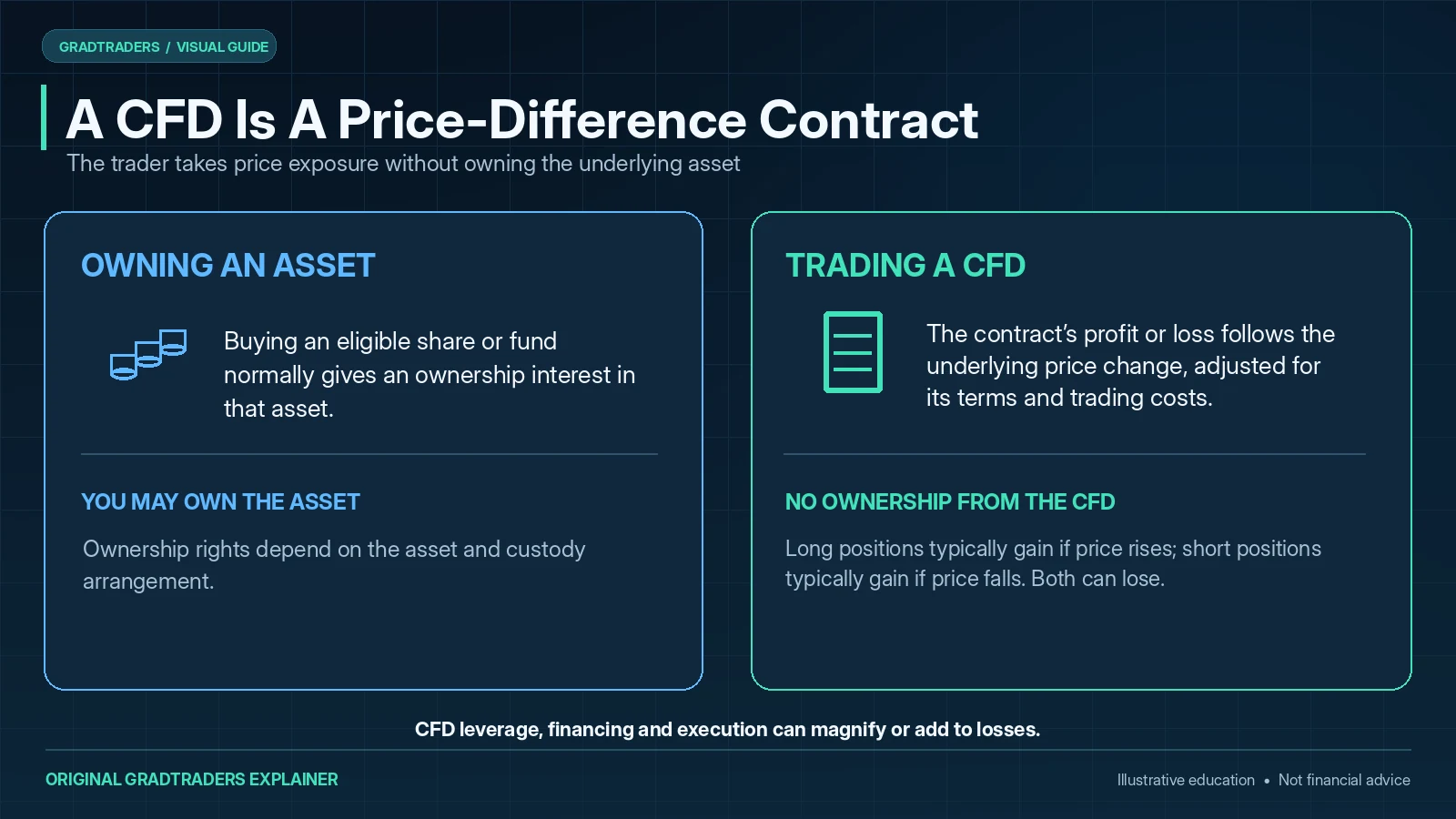
A CFD is a contract based on the difference between opening and closing price. You normally do not own the underlying asset.
Country Check
CFDs are available in many markets, but not universally and not under identical retail rules or protections.
Main Risk
Leverage can make a small market move create a much larger account move than a beginner expects.
CFD Rules And Availability Vary By Country
GradTraders is written for an international audience, so a CFD should never be treated as one identical global product. The legal entity, leverage, margin rules, negative-balance protection, eligible markets and complaints route can all vary with jurisdiction.
United Kingdom
FCA retail CFD rules include leverage limits, margin close-out, negative-balance protection, restrictions on incentives and standardised risk warnings.
European Market Context
ESMA introduced retail CFD intervention measures including leverage limits, margin close-out and negative-balance protection; local national implementation and broker entity still matter.
Australia
ASIC’s retail CFD product-intervention order applies leverage limits, margin close-out and negative-balance protection and currently runs to 23 May 2027.
United States
CFD availability follows a very different regime. A current SEC-filed disclosure describes CFDs as jurisdiction-dependent and generally not permitted to be offered to US retail investors.
International rule: verify country, regulator and account entity before treating any CFD comparison as actionable.
What does CFD stand for?
CFD stands for contract for difference.
A CFD is an agreement between the trader and the provider to exchange the difference in price between the opening and closing of a position. If the price moves in the trader’s favour, the trader may make a profit. If the price moves against the trader, the trader may make a loss.
The trader does not usually own the underlying asset. A CFD on the FTSE 100 is not ownership of the FTSE 100. A CFD on gold is not ownership of physical gold. A CFD on a share is not the same as owning the share in a long-term investment account.
CFDs are trading products. They should not be confused with simple investing.
A simple CFD example
Imagine a trader opens a CFD position on a stock index because they think the index will rise. If the index rises and the trader closes the position at a better price, the trader may make a profit before costs. If the index falls, the trader may make a loss.
The same can work in reverse. A trader can also sell a CFD because they think a market will fall. If the market falls, the short CFD may profit. If the market rises, the short CFD may lose.
This ability to speculate in both directions is one reason CFDs are popular with active traders. It is also one reason beginners can get into trouble. Being able to trade both ways does not mean the trader knows which way is sensible.
CFDs are usually leveraged
One of the most important things to understand about CFDs is leverage. A CFD trader often puts down only a smaller amount of money, known as margin, to control a larger position.
This means a small market move can have a larger effect on the account than a beginner expects. If the position is too large, a normal market move can create a serious loss.
Leverage is not automatically bad, but it is often misunderstood. It does not make the trade better. It increases exposure. If the trader is wrong, leverage can make the mistake more expensive.
GradTraders explains this separately in What Is Leverage In Trading? and What Is Margin In Trading?.
What markets can be traded with CFDs?
CFD providers may offer access to many different markets. The exact range depends on the broker, country, regulatory entity and account type.
| Market | What the CFD tracks | Beginner caution |
|---|---|---|
| Indices | A stock market index such as the FTSE 100, S&P 500, Nasdaq, DAX or Japan 225. | Indices can move quickly around market opens, news and macro events. |
| Forex | Currency pairs such as GBP/USD, EUR/USD or USD/JPY. | Forex is heavily marketed but still difficult and leveraged. |
| Commodities | Markets such as gold, oil, silver or natural gas. | Commodity markets can be volatile and affected by supply, demand, news and geopolitical events. |
| Shares | The price movement of individual company shares. | A share CFD is not the same as owning the share as an investor. |
| Crypto-related products | Price movement linked to cryptoassets, where available and permitted. | Rules and availability vary. Crypto-related derivatives can be especially risky and restricted for retail clients in some places. |
A wide market list should not be treated as a reason to trade more. More choice often creates more confusion.
CFD trading is not the same as share dealing
This is one of the most important beginner distinctions.
Share dealing usually means buying a share, fund or ETF for ownership. A long-term investor may hold that asset for years. They may receive dividends, voting rights in some cases, and direct exposure to the asset they own.
CFD trading is different. The trader is entering a contract based on price movement. They are normally trying to benefit from a shorter-term move, often using leverage, and they may pay costs such as spreads, commissions or overnight financing.
| Area | Share dealing | CFD trading |
|---|---|---|
| Ownership | The investor usually owns the underlying asset. | The trader does not usually own the underlying asset. |
| Typical purpose | Long-term investing or ownership. | Shorter-term speculation on price movement. |
| Leverage | Often unleveraged for ordinary investors. | Usually leveraged. |
| Costs | Platform fees, dealing fees, fund charges or FX costs may apply. | Spreads, commissions, overnight financing and other trading costs may apply. |
| Beginner suitability | Often more suitable for long-term wealth building. | Higher-risk and not suitable for many beginners. |
A beginner who wants to build wealth over time may be better served by learning long-term investing before considering CFDs.
CFDs can be used to go long or short
CFD traders can usually go long or short.
Going long means the trader is trying to profit from a rising price. Going short means the trader is trying to profit from a falling price.
This flexibility can be useful for experienced traders, especially in volatile markets. It can also be dangerous for beginners because it creates the feeling that there is always something to do. If the market goes up, buy. If the market goes down, sell. If nothing is happening, search for another market.
That is not discipline. That is activity. Activity is not skill.
How CFD costs work
CFD trading costs vary by broker, product and account type. Beginners should not assume the only cost is the visible spread.
Common CFD costs may include:
- Spread between the buy and sell price.
- Commission on some markets or account types.
- Overnight financing or swap charges for positions held beyond the trading day.
- Currency conversion costs.
- Guaranteed stop premiums, where offered and used.
- Inactivity or account-related charges, depending on the provider.
Costs matter because they affect the result before the trader has even considered whether the idea was good. A trader can be right on direction and still produce poor outcomes if costs, timing and position size are not understood.
GradTraders covers this in more detail in Broker Costs, Spreads, Execution And Leverage Compared.
Overnight financing matters
CFD positions held overnight may incur financing costs. This is because the trader is controlling market exposure without paying the full value of the position upfront.
This matters for beginners who think they are taking a simple trade and then decide to hold it for days or weeks. The longer a leveraged CFD position is held, the more important overnight costs may become.
CFD trading is often better understood as an active trading product rather than a long-term investment route. That does not mean every CFD position must be very short term, but it does mean holding costs should be understood before the trade is placed.
CFD Protections Depend On The Jurisdiction
Retail protections are not identical worldwide. In the UK, FCA rules include leverage limits, 50% margin close-out, negative-balance protection, restrictions on incentives and standardised risk warnings.
Australia has a separate ASIC CFD product-intervention order with its own leverage limits, margin-close-out standardisation and negative-balance protection. European regulators also apply product-intervention measures to retail CFDs.
The same broker brand may therefore give different leverage, product access, legal protections and complaints routes depending on the entity serving the account. The regulator and legal entity matter more than the logo.
Why CFDs are risky for beginners
CFDs are risky for beginners because they combine several difficult things at once.
- Leverage.
- Fast price movement.
- Short-term decision-making.
- Costs that may not be obvious at first.
- The ability to trade many markets quickly.
- The temptation to go long or short constantly.
- Emotional pressure when real money is involved.
Any one of these can be difficult. Combined, they can become too much for a beginner.
The common beginner CFD mistake
The common mistake is not simply being wrong about direction. It is being too large.
A beginner might correctly think a market is likely to rise over time, but enter too early, use too much leverage, set a poor stop or hold through normal volatility with a position the account cannot survive.
The market does not need to do anything extraordinary for an oversized CFD position to become painful. Normal movement can be enough.
This is why the first CFD question should not be “where is the market going?” It should be “what happens if I am wrong?”
CFDs can make trading feel too easy
Modern CFD platforms can make trading feel simple. The trader sees a chart, a buy button, a sell button, a position size box and a live profit-and-loss figure.
That simplicity can be dangerous. The platform may make access easy, but it does not make the decision sensible. A trade that takes seconds to open can take weeks or months to recover from emotionally if it goes badly.
The easier it is to trade, the more important it becomes to slow down before trading.
CFDs are not usually the best first step
Many beginners would be better off learning the basics before touching CFDs. That means learning about investing, risk, diversification, demo accounts, leverage, margin, stop losses and position sizing first.
A beginner does not need a live CFD account to start learning. They can learn charts, market behaviour and platform mechanics on demo. They can also learn long-term investing separately, which may be more suitable for most ordinary people.
There is no prize for rushing into CFDs. The market will still be there later.
When CFDs may make more sense
CFDs may make more sense for traders who already understand the product, the risks, the costs and their own behaviour.
That usually means the trader can:
- Explain the difference between CFDs and investing.
- Understand leverage and margin.
- Calculate planned loss before entering.
- Use a stop loss without treating it as a guarantee.
- Keep position size controlled.
- Accept losses without revenge trading.
- Read the broker’s product, cost and risk information.
- Walk away when conditions are poor.
Even then, CFDs remain high-risk products. Understanding them does not remove the possibility of loss.
CFDs and prop firm challenges
Some prop firm trading environments may give traders simulated exposure to CFD-style markets, forex, indices, commodities or other leveraged instruments. The exact structure depends on the firm and platform.
The same risk concepts still apply. The trader needs to understand exposure, position size, drawdown, rules, stop losses and emotional pressure. A challenge account can make the numbers feel less real because the environment is simulated, but the fee is real and the habits are real.
A beginner should not use a prop firm challenge to avoid learning how CFDs and leverage work. The challenge format may actually make poor habits worse if the trader is rushing to hit a target.
CFDs and spread betting are related, but not identical
CFDs and spread betting are related leveraged products, but they are not equally available around the world. Spread betting is especially associated with the UK, while CFD access is broader but still jurisdiction-dependent.
Where both are offered, a CFD is contract-based while a spread bet is normally expressed as a stake per point. UK tax treatment can also differ, but that local tax point should not be exported to readers in other countries.
The risk message remains similar: both can involve leverage, fast losses and emotional pressure. Neither should be treated casually.
Questions to ask before trading CFDs
- Is a retail CFD account available to residents of my country?
- Which legal entity would hold the account and which regulator oversees it?
- Do the leverage, margin close-out and negative-balance rules I am reading actually apply to my entity?
- Do I understand what a CFD is?
- Do I understand that I do not usually own the underlying asset?
- Do I know whether leverage is being used?
- Do I know the true size of the position?
- Do I know the margin requirement?
- Do I know the planned loss before entering?
- Do I understand spreads, commission and overnight costs?
- Do I know whether I am using a UK-regulated account or another entity?
- Have I practised on demo?
- Am I trading money I can afford to lose?
A beginner who cannot answer these questions should not trade CFDs live.
A plain beginner checklist
Before using CFDs, a beginner should be able to say yes to most of the following:
- I know the product is a contract, not normal ownership.
- I understand the difference between trading and investing.
- I understand leverage.
- I understand margin.
- I have used a demo account seriously.
- I know the costs involved.
- I know the maximum planned loss on each trade.
- I am not trying to fix a financial problem quickly.
- I am not trading out of boredom or frustration.
- I have considered whether long-term investing is more suitable.
Failing the checklist does not mean someone can never learn. It means they should slow down.
Where This Fits In The GradTraders Research Hub
CFDs sit inside the broker education cluster, but the correct research path begins with country and legal entity. Before comparing providers, beginners should understand the product, leverage, margin, stop losses, position sizing and the difference between trading and investing.
Use the GradTraders International hub to enter through your country route and check locally relevant broker/entity options.
Compare Broker Routes
Readers ready to research providers can use the GradTraders 24-broker comparison table to compare platforms, costs, demo access, regulation and trading conditions.
Compare Prop Firm Routes
Traders considering simulated funded accounts should also read the GradTraders prop firm comparison table and Should Beginners Use A Prop Firm?, because challenge rules can add another layer of risk pressure.
This article also links naturally with Spread Betting vs CFD Trading, What Is Spread Betting?, Leverage, Margin, Risk Management, Position Sizing, Stop Losses and Demo Trading Accounts.
Final GradTraders View
CFDs are powerful leveraged trading products, but they are not one identical global account type. Product access, leverage, margin rules and protections depend on where you live and which regulated entity serves you.
Most beginners still do not need CFDs at the start. Education, demo practice, basic investing knowledge, country/entity checks and controlled risk should come before live leveraged exposure.
Country first, entity second, risk before leverage. A CFD can give access to a market; it does not make the trade sensible or the trader ready.
Further Reading on GradTraders
Source note: This guide combines GradTraders editorial judgement with current primary-source material on retail CFD rules in the UK, Europe and Australia, plus US jurisdiction context. CFD access, legal entity, leverage, margin-close-out and client protections can change, so verify the regulator and provider terms that apply to your country.
Useful official sources: FCA: Contract for differences · FCA PS19/18 · ESMA retail CFD intervention · ASIC CFD product-intervention extension · SEC-filed jurisdiction disclosure.
Explore GradTraders Internationally
GradTraders has 20 dedicated international gateways with local livestream times, market context and country-specific routes into the wider research site.
These country links are for site navigation only; broker availability, regulatory status and product eligibility must be checked separately.
Browse all 20 country gateways
Asia: Japan · South Korea · Taiwan · Hong Kong · India · Singapore · Thailand
Europe: Italy · Sweden · Switzerland · Germany · Norway
Americas: United States · Canada · Mexico
Middle East: United Arab Emirates · Saudi Arabia
Africa: South Africa
Oceania: Australia · New Zealand
CFD Trading FAQ
What does CFD stand for?
CFD stands for contract for difference. It is a contract based on the difference between the opening and closing price of a position.
Do CFD traders own the underlying asset?
Usually, no. A CFD trader is normally speculating on price movement through a contract rather than owning the underlying share, index, commodity or currency.
Are CFDs available in every country?
No. CFD availability is jurisdiction-dependent. Retail access, eligible products, leverage and protections can differ by country and by the legal entity serving the account.
Can the same broker offer different CFD terms in different countries?
Yes. Global broker brands can use different regulated legal entities, so leverage, product access, margin rules, protections and complaints routes may differ.
Why are CFDs risky for beginners?
CFDs are risky because they are commonly leveraged, can move quickly, may involve spreads, commissions and overnight costs, and can create emotional pressure when real money is involved.
Are CFDs the same as spread betting?
No. CFDs and spread betting are related leveraged trading products, but their structure, availability and tax treatment can differ. Spread betting is especially associated with the UK and is not a universal retail account type.
Should beginners trade CFDs live?
Many beginners should not start with live CFDs. They should learn the basics, use demo accounts, understand leverage, margin, stop losses, position sizing and costs, and verify the local regulatory and account-entity rules first.