Why Traders Should Invest: The Most Overlooked Form Of Risk Management
One of the biggest misconceptions in trading is that becoming a profitable trader automatically leads to long-term wealth. In reality, trading and wealth building are related, but they are not the same skill.
Trading can generate capital. Investing is how some traders protect, separate and compound that capital over longer periods of time. That difference matters because a trader who only focuses on the next trade may never build a financial structure beyond the trading account.
Disclosure & Risk Notice: This article is for educational and informational purposes only and should not be considered financial advice, investment advice, tax advice or a personal recommendation. Trading CFDs, spread betting, forex, crypto CFDs and other leveraged products involves significant risk and may not be suitable for all traders. You may lose some or all of your capital. Some GradTraders articles may contain affiliate links or references to partner offers. If you sign up, purchase or open an account through certain links, GradTraders may earn a commission at no additional cost to you.
Looking for GradTraders partner offers, broker discounts, prop firm promotions and trading platform deals? You can view the current offers and join the update list here: Access GradTraders Partner Offers.
Quick Verdict: Trading Produces Capital, Investing Gives It Somewhere To Go
Trading and investing should not be viewed as competing activities. They solve different problems. Trading is usually about generating returns from shorter-term opportunities. Investing is about preserving, diversifying and compounding wealth over longer periods.
Traders spend countless hours refining entries, exits and risk rules, but many give surprisingly little thought to what happens to the profits they withdraw. That may be one of the most important financial decisions a trader ever makes.
The trader asks, “How do I make money from the market?” The wealth builder asks, “What happens to that money once I have made it?”
Trading And Investing Are Not The Same Thing
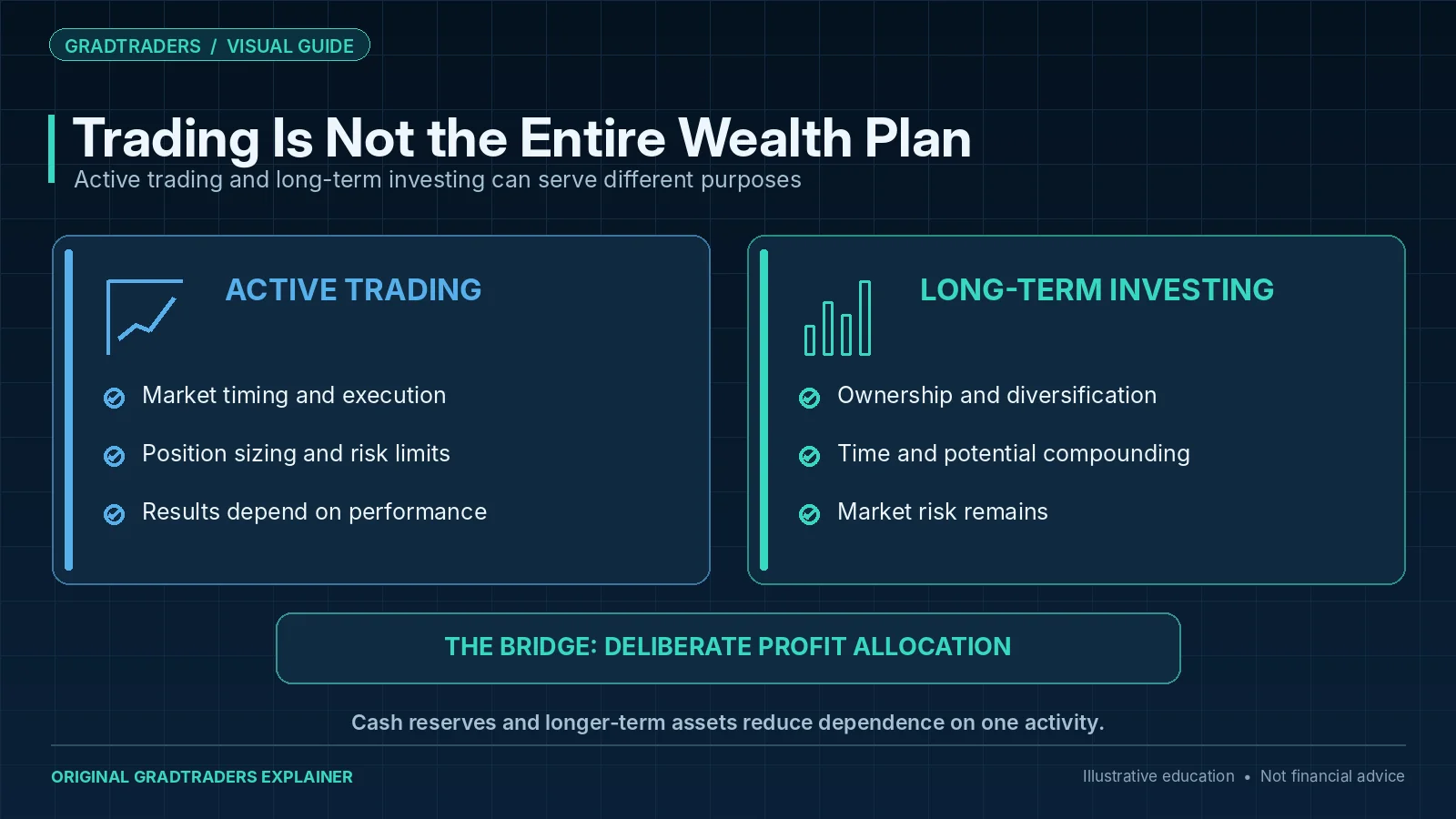
The words “trading” and “investing” are often used interchangeably, but they serve very different purposes. Trading is usually focused on shorter-term market movement. Investing is focused on building wealth over longer periods of time.
A trader may hold a position for minutes, hours, days or weeks. An investor may hold assets for years or decades. Neither approach is automatically better. They simply solve different problems.
Active Capital Generation
Trading relies on timing, execution, discipline, position sizing, market conditions and the trader’s ability to manage risk repeatedly.
Long-Term Wealth Building
Investing is more concerned with asset ownership, diversification, tax structure, time, compounding and long-term financial resilience.
The mistake occurs when traders assume that because they can trade successfully, they no longer need to invest. In reality, successful trading may make investing even more important because it creates capital that needs a long-term home.
The RiskMost Traders Never Consider
Traders spend enormous amounts of time managing risk inside individual trades. They think about position sizing, drawdowns, stop losses, maximum loss and risk-to-reward ratios. Yet many never ask a simple question: what happens if I stop trading?
A trader may stop because of a prolonged drawdown, changing market conditions, health issues, family commitments, stress, burnout or simply because the edge that once worked no longer works. If all future wealth depends on continued trading success, the trader has created a significant form of concentration risk.
Market Risk
Strategies can stop working, spreads can change, volatility regimes can shift and execution conditions can deteriorate.
Personal Risk
Health, family, work pressure and emotional fatigue can all affect a trader’s ability to perform.
Future-Income Risk
If every future financial outcome depends on trading, the trader has concentrated too much pressure in one activity.
Many traders would never risk 100% of their account on a single trade. Yet some effectively risk 100% of their future wealth on the assumption that they will remain profitable forever.
Investing Creates A Second Engine
One of the strongest arguments for investing is that it creates a second source of wealth creation. Rather than relying only on trading profits, traders can allow part of their capital to compound away from the pressure of active decision-making.
This creates a healthier relationship between trading and long-term wealth. Trading profits can fund investments. Investments can grow independently of future trading performance. Over time, that can reduce dependence on active trading.
| Capital Route | Main Purpose | GradTraders View |
|---|---|---|
| Trading Account | Active market opportunities, short-term speculation and strategy execution. | Useful, but it should not become the only place capital lives. |
| Emergency Savings | Liquidity, stability and protection during bad trading periods or life events. | A cash buffer can reduce pressure and improve trading discipline. |
| Long-Term Investments | Ownership of assets intended to grow over years rather than individual trades. | This is where trading profits can become part of a wider wealth-building plan. |
| ISA / Tax Wrapper | Country-specific tax-efficient investing where available. | UK readers often compare ISAs and SIPPs; international readers should check local equivalents. |
| Pension / Retirement Account | Long-term retirement planning and future financial security. | This may feel boring to active traders, but boring can be powerful over decades. |
Why Diversification Matters Beyond Markets
When traders hear the word diversification, they often think about different markets, asset classes or strategies. But diversification also applies to financial goals.
Trading capital, emergency savings, long-term investments and retirement planning each serve different purposes. A trader who keeps everything in the trading account may be diversified across markets but still financially concentrated in one activity.
Generate Capital
Trading may create returns, but it carries active risk and depends heavily on performance.
Protect Decisions
Cash reserves can reduce pressure during drawdowns and stop the trader forcing trades.
Compound Quietly
Long-term investments can build wealth away from day-to-day market noise.
Build Structure
The best setup may change as income, risk tolerance, tax position and goals evolve.
The Compounding Advantage
One reason investing remains so powerful is that it allows time to become an ally. A successful trader may generate excellent returns in a particular year, but an investor focuses on what happens over the next twenty or thirty years.
Compounding rewards patience. The earlier capital is invested, the longer it has to grow. That does not mean traders should stop trading. It means not every pound, dollar or euro needs to remain inside a trading account forever.
A trading account can grow quickly and fall quickly. Long-term investing is slower, but the purpose is different: resilience, ownership and compounding over time.
A Practical Approach For Traders
A common habit among financially disciplined traders is the regular withdrawal and allocation of profits. Rather than continually increasing trading size, they may choose to build cash reserves, invest through tax wrappers, contribute to retirement accounts or purchase long-term assets.
Everything Goes Back Into Trading
- Profits are used only to increase position size.
- The trader becomes more dependent on future performance.
- Drawdowns feel more threatening.
- There is no clear separation between trading and long-term wealth.
Profits Are Allocated Deliberately
- Some money stays as trading capital.
- Some builds emergency reserves.
- Some moves into long-term investments.
- Some supports retirement or tax-efficient accounts where appropriate.
UK readers may want to compare the role of ISAs and SIPPs in the separate GradTraders guide to ISA vs SIPP for traders. International readers should check their own local tax wrappers, retirement accounts and investment rules.
Why Most Traders Eventually Become Investors
Many successful traders eventually become investors because, at some point, preserving wealth becomes just as important as creating it. The objective changes from “How do I make more money?” to “How do I keep, protect and grow what I have already made?”
That is fundamentally an investing mindset. It does not remove ambition from trading. It simply recognises that trading is not the whole financial plan.
Early Trader Focus
- Find a strategy.
- Improve entries and exits.
- Reduce mistakes.
- Increase consistency.
Wealth Builder Focus
- Protect profits.
- Separate trading capital from long-term wealth.
- Use time and compounding.
- Reduce dependence on one activity.
Final Verdict: Investing May Be The Overlooked Risk Management Tool
Trading and investing should not be viewed as competing activities. They are complementary. Trading can generate capital. Investing can compound it. Cash reserves can reduce pressure. Diversification can protect the broader financial structure.
The traders who build lasting wealth are often not the ones who take the most risk. They are the ones who recognise that risk management extends beyond individual trades and into their overall financial lives.
In that sense, investing may be one of the most overlooked forms of risk management available to traders.
Further Reading On GradTraders
Explore GradTraders Internationally
Explore GradTraders research and market context through our 20 country gateways.
Browse all 20 country gateways
Asia: Japan · South Korea · Taiwan · Hong Kong · India · Singapore · Thailand
Europe: Italy · Sweden · Switzerland · Germany · Norway
Americas: United States · Canada · Mexico
Middle East: United Arab Emirates · Saudi Arabia
Africa: South Africa
Oceania: Australia · New Zealand
Why Traders Should Invest FAQ
Why should traders invest?
Traders should consider investing because trading can generate capital, while investing may help preserve, diversify and compound that capital over longer periods. This is general education, not personal investment advice.
Are trading and investing the same thing?
No. Trading usually focuses on shorter-term market movement and active decision-making, while investing usually focuses on long-term asset ownership, compounding and financial resilience.
Should all trading profits be reinvested into the trading account?
Not necessarily. Some traders choose to separate capital by keeping some money for trading, some for cash reserves and some for long-term investments. The right structure depends on personal circumstances.
Can investing reduce trading pressure?
It can. A trader with cash reserves and long-term investments may feel less pressure to force trades because their entire financial future is not dependent on the next trading result.
What should UK traders consider when investing outside trading?
UK traders often compare ISAs, SIPPs, taxable investment accounts and cash savings. Tax rules and suitability depend on personal circumstances, so this article should not be treated as tax or investment advice.
Source note: This article is based on GradTraders editorial judgement and general financial education principles around risk management, diversification, long-term investing, capital preservation and trader psychology. It does not recommend any specific investment product or personal financial strategy.
Risk reminder: trading and investing both involve risk. Leveraged trading can result in significant losses. Investments can fall as well as rise. Tax rules, account types, product availability and investor protections vary by country and can change over time.