What Do Successful Traders Do With Their Profits?
My view is that trading profits only become useful wealth when some of the money is deliberately protected from the next trading decision. A rising account balance is not the same as lasting financial progress: withdrawals, a cash reserve and longer-term investments can help reduce dependence on future trading results.
I would begin with a written plan for what happens after a profitable period: what stays in the trading account, what is withdrawn, what may be needed for tax and what can be allocated toward goals outside trading. Those choices depend on personal circumstances and jurisdiction, but leaving every gain exposed to the next position is not a wealth-building strategy.
Disclosure & Risk Notice: This article is for educational and informational purposes only and should not be considered financial advice, investment advice, tax advice or a personal recommendation. Trading CFDs, spread betting, forex, crypto CFDs and other leveraged products involves significant risk and may not be suitable for all traders. You may lose some or all of your capital. Some GradTraders articles may contain affiliate links or references to partner offers. If you sign up, purchase or open an account through certain links, GradTraders may earn a commission at no additional cost to you.
Looking for GradTraders partner offers, broker discounts, prop firm promotions and trading platform deals? You can view the current offers and join the update list here: Access GradTraders Partner Offers.
Quick Verdict: Successful Traders Turn Profits Into Real Wealth
Successful traders do not simply keep increasing account size forever. Many eventually focus just as much on withdrawals, tax, diversification and long-term protection.
Diversifying profits into savings, pensions, ISAs, businesses, property or long-term investments is what can separate a serious wealth-building trader from someone who is only chasing the next high. Developing a withdrawal and wealth-building plan can be just as important as developing the trading strategy itself.
Making money from trading is one skill. Keeping it, protecting it and turning it into long-term security is another.
The Misconception: Bigger Trading Account Equals More Success
One of the biggest misconceptions in trading is that successful traders simply keep increasing the size of their trading accounts forever. In reality, many experienced traders eventually become more focused on protecting profits than chasing bigger returns.
That might sound surprising, but profit protection is one of the key things that separates a trader from a gambler. The line between trading and gambling can become blurry when a trader has no plan for withdrawing, protecting or allocating profits.
Markets are full of people who have made substantial profits and then given them back because they never developed a structure for protecting what they had already earned.
The Shift: From Generation To Protection
Over time, many traders start to value profit protection more than profit generation. As experience grows, the opportunities outside of trading become clearer: pensions, long-term investing, business assets, cash reserves, property and other forms of financial security.
I have ridden some incredible waves over the years. I have scaled accounts aggressively and experienced gains that many traders never see. But with boom often comes bust, especially if you naturally enjoy taking risks.
When I was not giving money back to the market because I fancied a “play” with profits, I was often spending those profits on lifestyle. The problem is simple: every pound spent today is a pound that can no longer compound tomorrow.
Profit Becomes Fuel For More Risk
The trader keeps increasing size, spending more, taking bigger swings and treating profits as disposable because they feel easy to replace.
Profit Becomes Long-Term Security
The trader separates trading capital from life capital, protects part of the gains and builds assets outside the trading account.
The First Thing To Protect: Tax
Before deciding where to invest profits, traders should understand what they actually own after tax. Different forms of trading and investing can come with very different tax treatment, and the rules vary significantly depending on where you live.
What is right for one trader may not be right for another. In the UK, HMRC guidance says the taxpayer placing a spread bet is not normally carrying on a trade and is not normally taxable on those profits, although exceptions can exist. CFD trading, business income, prop firm payouts, affiliate income and investment income may be treated differently.
Prop firm payouts are an area where traders should be especially careful. Depending on the arrangement and the trader’s circumstances, withdrawals may potentially be treated as income or trading receipts rather than investment gains. That can create a serious tax issue if a trader becomes successful but has not planned for the bill.
I am not qualified to provide tax or financial advice. Always seek professional tax advice before making decisions, especially if your trading, prop firm, affiliate or business income becomes meaningful.
Why Some Traders Never Become Wealthy
Making money and keeping money are completely different skills. Many traders become obsessed with account growth. Every withdrawal feels like a step backwards because it reduces the size of the trading account.
The problem is that profits left inside a trading account remain exposed to trading risk. A trader can spend years building an account and then give back a significant portion during a difficult period.
Regular withdrawals are not a sign of weakness. They are evidence that trading profits are becoming real-world wealth rather than numbers on a screen.
| Trader Behaviour | What It Looks Like | Potential Result |
|---|---|---|
| No Withdrawal Plan | Every profit stays in the account to increase size. | The trader remains overexposed to market drawdowns. |
| No Tax Planning | The trader spends profits before understanding tax obligations. | A tax bill can become a serious financial shock. |
| No Cash Buffer | Life costs depend on the next trading result. | Pressure rises and the trader may force poor trades. |
| No Long-Term Structure | Profits are either spent or recycled into more risk. | The trader may make money without building lasting wealth. |
The Prop Firm Problem
Many prop firm traders focus entirely on passing challenges and securing larger funded accounts. Very few spend time thinking about what happens if they actually become successful.
If payouts create taxable income, there may come a point where the tax bill becomes one of the trader’s largest expenses. That is why traders should think about wealth preservation long before they need to.
Generating trading profits is only the first step. Building a plan for those profits may become just as important.
Why I Prefer Keeping Capital Free
A lot of traders assume larger accounts automatically make them safer. I do not necessarily agree. One reason I have been willing to use higher leverage in certain contexts is because I prefer keeping more capital under my own control rather than depositing large sums with a broker.
That does not mean taking excessive risk. It means I would rather have capital available for pensions, investments, business opportunities and life outside trading than have every available pound tied up in one trading account.
For me, flexibility has value. Capital outside the trading account can serve more than one purpose. It can protect decision-making, reduce dependence on the broker, fund long-term assets and create breathing room during difficult market periods.
Where I Personally Put Money
Over time, I have found it essential to squirrel money away into my private pension. Why? Because I cannot spend it easily. More money often creates more temptation. Bigger profits can lead to bigger purchases, lifestyle inflation and unnecessary spending.
A pension creates a barrier between me and the money. It forces me to think long term and allows the capital to benefit from decades of potential compound growth. That is why I prefer moving a portion of profits into investments designed for the future rather than the next trade.
This is only my perspective, not personal advice. Another trader may have a different tax position, family situation, age, income pattern or risk tolerance. The principle is not “copy my pension approach.” The principle is “have a deliberate plan for profits.”
Other Places Traders Commonly Put Profits
There is no universally correct answer. The right decision depends on age, tax position, risk tolerance, family circumstances, country of residence, debt, savings, income stability and long-term objectives.
Cash Reserves
Emergency savings can reduce pressure and stop a trader from needing the next trade to pay for life.
Pension Accounts
Pensions can create long-term discipline and retirement structure, especially when tax relief applies.
Stock Market Investments
Long-term investments can allow trading profits to compound outside active trading decisions.
Property
Some traders diversify into property, although costs, debt, maintenance, taxes and illiquidity matter.
Businesses
Business assets can create income outside trading, but they also carry operational risk and require attention.
Alternative Investments
Alternative assets may appeal to some traders, but complexity, liquidity and valuation risk should not be ignored.
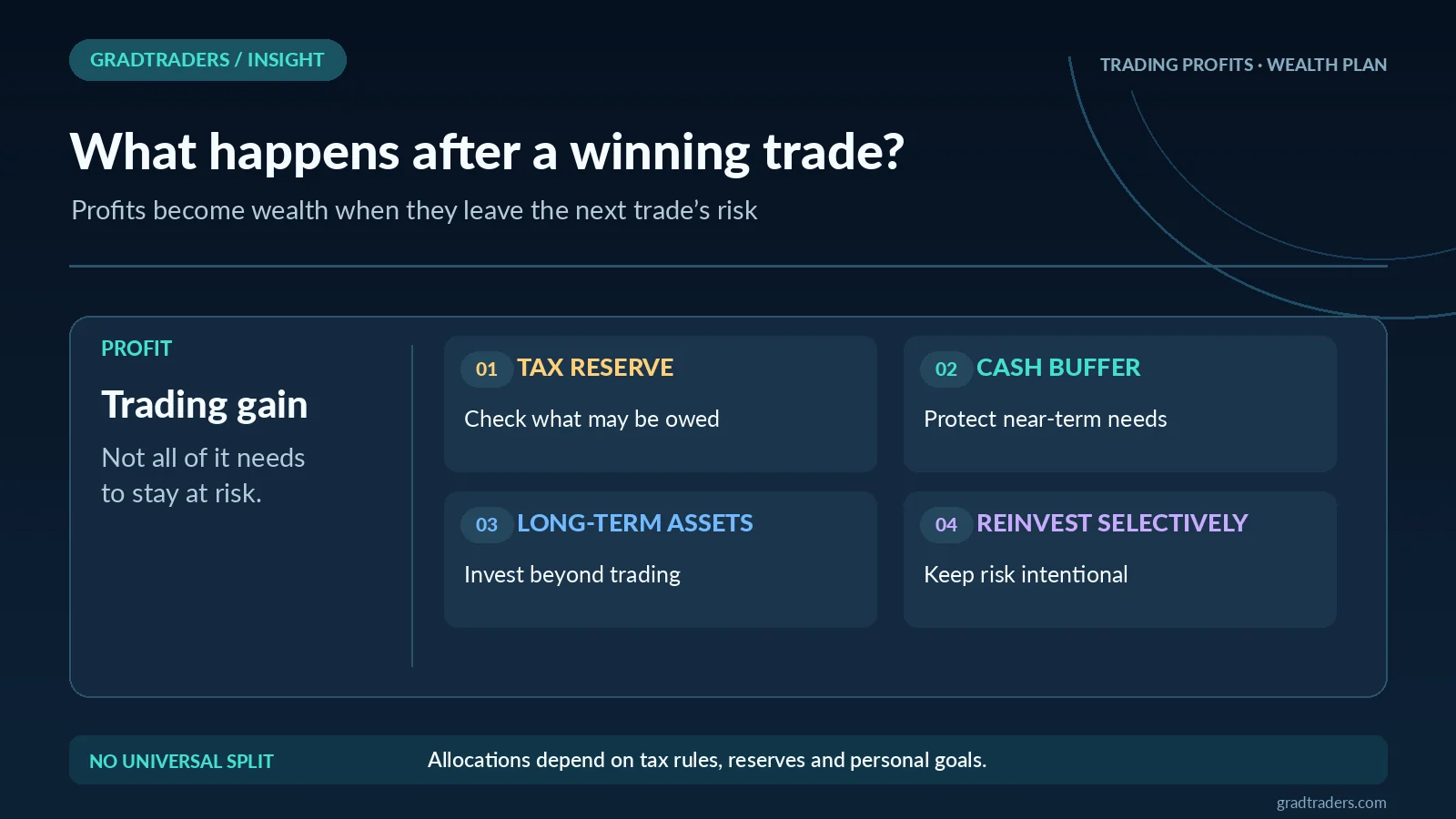
A Simple Profit Allocation Framework
A practical way to think about profits is to give each pound a job. Not every pound needs to increase trade size. Some capital may be better used reducing financial pressure or building long-term assets.
Set Aside Tax
Understand whether any tax may be due before treating trading or prop profits as spendable money.
Build Cash
Cash reserves can reduce stress and help avoid forced trading during difficult periods.
Invest Long Term
Long-term investments can help convert active trading profits into broader wealth.
Enjoy Some
Profits can improve life too, but lifestyle spending should not consume the whole plan.
Final Thoughts: Making Money Is Only Half The Challenge
Making money is only half the challenge. Keeping it is often harder. Most traders spend years learning how to generate profits but far less time thinking about how to protect them.
My own approach has gradually shifted towards protecting capital, understanding tax implications and moving a portion of profits into long-term investments such as my pension. Trading remains an important part of my life, but I no longer view a larger trading account as the ultimate goal.
For me, the real goal is turning trading profits into long-term financial security. That means building wealth beyond trading, diversifying away from one account, and having a plan for what happens after the profitable trade.
Further Reading On GradTraders
Broker And Prop Context
Source note: This article is based on GradTraders editorial judgement, personal trading experience and general financial education principles around profit protection, diversification, pensions, tax awareness and long-term wealth building. It does not recommend any specific tax strategy, pension product, broker, prop firm or investment.
Useful official sources: HMRC BIM22015 on spread betting and trade · GOV.UK Self Assessment · GOV.UK Individual Savings Accounts · GOV.UK Pension Tax Relief.
Risk reminder: trading and investing both involve risk. Leveraged trading can result in significant losses. Investments can fall as well as rise. Tax treatment depends on product, jurisdiction and personal circumstances, and rules can change.
Explore GradTraders Internationally
Browse GradTraders’ country gateways for regional trading information and related research. These links are for site navigation only; taxation, investment accounts, pension rules and product availability depend on the reader’s country and circumstances.
Browse all 20 country gateways
Asia: Japan · South Korea · Taiwan · Hong Kong · India · Singapore · Thailand
Europe: Italy · Sweden · Switzerland · Germany · Norway
Americas: United States · Canada · Mexico
Middle East: United Arab Emirates · Saudi Arabia
Africa: South Africa
Oceania: Australia · New Zealand
What Successful Traders Do With Profits FAQ
What do successful traders do with their profits?
Many successful traders withdraw some profits, set aside money for tax where relevant, build cash reserves, invest long term, contribute to pensions or retirement accounts, and keep trading capital separate from life capital.
Should traders keep all profits in their trading account?
Not necessarily. Profits left inside a trading account remain exposed to trading risk. Some traders choose to withdraw part of their profits so the money becomes real-world wealth rather than just account equity.
Why is tax planning important for traders?
Different trading routes can have different tax treatment depending on country, product, account type and personal circumstances. Traders should seek professional tax advice when profits become meaningful.
Do prop firm payouts create tax issues?
They can. The tax treatment of prop firm payouts may depend on the arrangement and the trader’s circumstances. Successful prop traders should not assume payouts are tax-free and should get professional advice.
Why do traders invest profits outside trading?
Traders may invest profits outside trading to diversify, reduce pressure, build long-term wealth and protect themselves from relying entirely on future trading performance.