Wealth Beyond Trading: Why Traders Need More Than A Trading Account
Trading can be a powerful skill, but it should not become the entire financial plan. The bigger question is not only how a trader can make money from markets, but what they are actually building with the capital they generate.
Wealth beyond trading means treating trading as one tool inside a wider financial structure: cash reserves, long-term investments, retirement accounts, tax wrappers, business assets and other forms of capital that can reduce dependence on the next trade.
Disclosure & Risk Notice: This article is for educational and informational purposes only and should not be considered financial advice, investment advice, tax advice or a personal recommendation. Trading CFDs, spread betting, forex, crypto CFDs and other leveraged products involves significant risk and may not be suitable for all traders. You may lose some or all of your capital. Some GradTraders articles may contain affiliate links or references to partner offers. If you sign up, purchase or open an account through certain links, GradTraders may earn a commission at no additional cost to you.
Looking for GradTraders partner offers, broker discounts, prop firm promotions and trading platform deals? You can view the current offers and join the update list here: Access GradTraders Partner Offers.
Quick Verdict: Trading Can Build Capital, But It Should Not Carry The Whole Future
A trading account is one form of capital. It is not the whole financial structure. The strongest traders often understand position sizing, stop losses and drawdown control, but the next level is applying that same risk-management mindset outside the trading account.
Trading can generate capital. Long-term investing can help compound it. Cash reserves can protect decision-making. Tax wrappers and retirement accounts can improve structure. Together, those pieces create something more resilient than relying entirely on future trading performance.
The question is not just “How can I grow my trading account?” The better question is “What am I building with the money trading produces?”
When Trading Becomes The Entire Plan
Most traders spend years chasing consistency. The focus is understandable because learning to trade profitably is difficult. However, something interesting often happens once profitability becomes the main goal: trading starts to dominate every financial decision.
Questions such as “How can I grow my account faster?”, “How can I increase position size?” and “How can I generate larger returns?” begin to crowd out a quieter but more important question: what am I actually building?
That question is not discussed enough in trading communities. Yet it may be one of the most important questions a trader can ask. It is also the reason many traders should think seriously about investing as part of a broader long-term plan.
Trading Is A Skill, Not A Financial Plan
A profitable trader has a valuable skill. That skill can create opportunities and may produce income. But a skill and a financial plan are not the same thing.
Trading Can Generate Capital
A trader may be able to read markets, manage risk and identify opportunities. That is valuable, but the income depends on performance, market conditions, discipline and personal circumstances.
A Plan Builds Structure Around Capital
A wider financial plan asks where capital should sit, how much risk belongs in trading, what should be invested long term, and how the trader can reduce reliance on one income source.
Imagine a successful builder. The builder would not normally keep all of their wealth tied exclusively to future building projects. Likewise, a trader does not need their entire financial future tied to future trading performance.
The Risk Management Contradiction
Traders spend countless hours discussing stop losses, position sizing, risk-to-reward ratios and maximum drawdowns. Yet some traders unknowingly create a much larger risk: they build their entire financial future around one activity.
Many traders would never risk their entire account on one trade. But some effectively risk their entire long-term wealth on the assumption that they will always be able to trade successfully. That is a contradiction worth taking seriously.
Trading Risk
Market conditions change, volatility changes, spreads change and strategies can stop working.
Personal Risk
Health, family responsibilities, time pressure and emotional bandwidth can affect trading performance.
Concentration Risk
If every financial outcome depends on trading, the pressure to perform can become enormous.
For the trading side of this topic, read the GradTraders guides to risk management, position sizing and stop losses.
Wealth Exists Outside A Trading Account
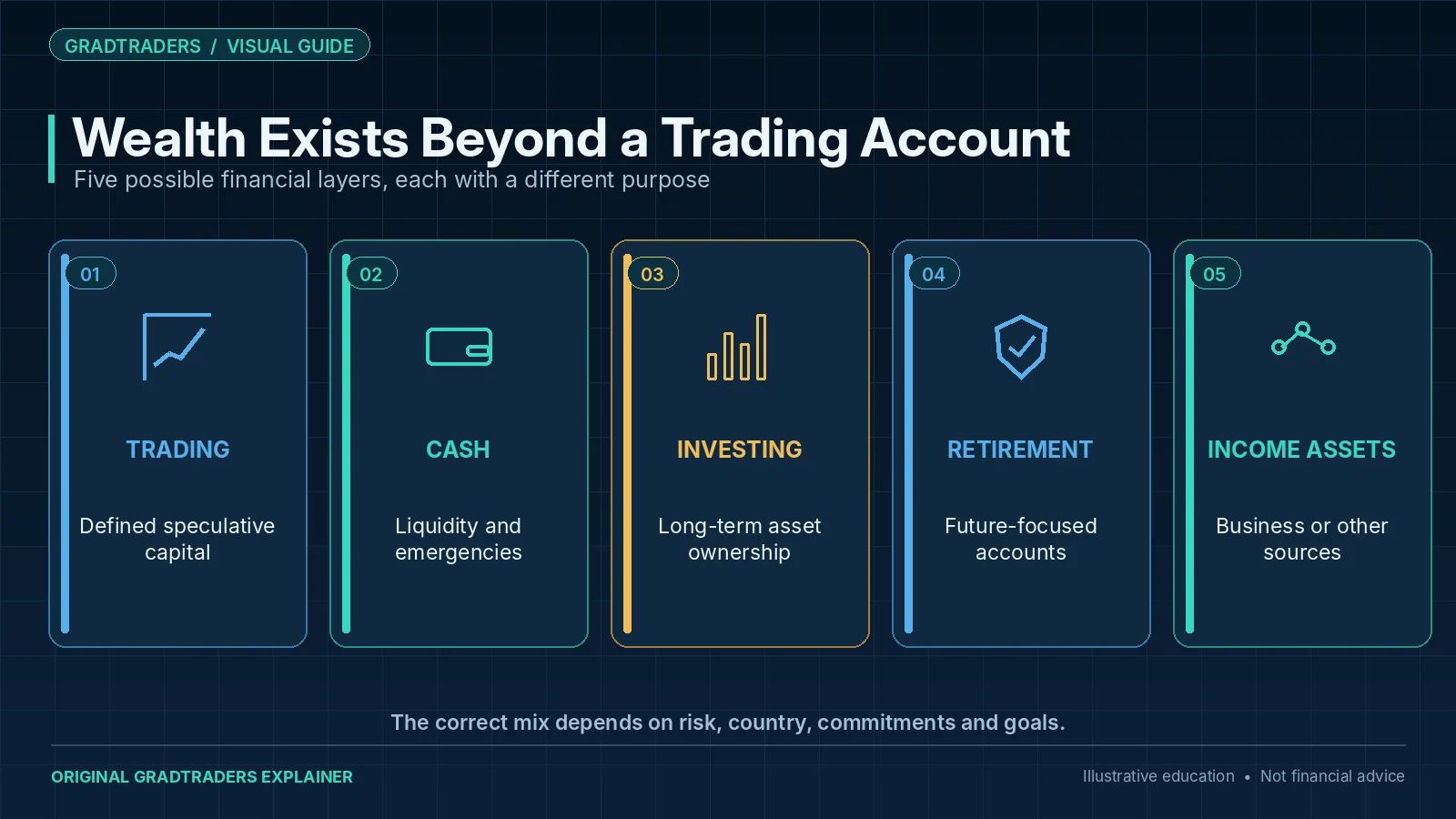
A trading account is one form of capital, but it is not the only form. The broader foundation can include investments, cash, pensions or retirement accounts, property, businesses and other assets. The exact route depends on the person, country, tax rules, risk tolerance and financial goals.
| Wealth Layer | Purpose | GradTraders View |
|---|---|---|
| Trading Capital | Capital allocated to active trading, speculation or short-term market opportunities. | Useful, but should be sized so one bad period does not threaten the whole future. |
| Cash Reserve | Liquidity for bills, emergencies, opportunities and reducing pressure during drawdowns. | Often overlooked, but it can improve decision-making because it reduces desperation. |
| Long-Term Investments | Assets intended to compound over years rather than generate immediate trading income. | This is where some traders begin turning active income into longer-term wealth. |
| Tax Wrappers / Retirement Accounts | Country-specific accounts that may offer tax advantages or retirement structure. | UK traders often compare ISAs and SIPPs, while international readers need to check their own local equivalents. |
| Business Or Income Assets | Projects, businesses or assets that may create income outside pure trading performance. | This can reduce dependence on the trading account and create a more resilient financial base. |
This table is educational, not personal financial advice. The right structure depends on your country, tax position, risk tolerance and wider circumstances.
Why Diversification Applies To Life, Not Just Markets
Most traders understand diversification within markets. They understand why concentration creates risk. The same principle applies outside trading.
Everything Depends On Trading
If all financial progress depends on monthly trading results, the trader may feel constant pressure to force opportunities.
Trading Becomes One Engine
Trading may still matter, but it becomes one part of a wider system instead of the only route to progress.
Pressure Starts To Reduce
A trader with savings, investments and other assets may approach markets with less urgency and more patience.
Ironically, this can sometimes improve trading itself. When a trader does not need every session to produce income, it becomes easier to wait, avoid poor setups and manage drawdowns rationally.
The Transition From Trader To Wealth Builder
Many financially successful traders eventually start thinking less like pure traders and more like wealth builders. The questions change.
Trader-Only Questions
- How can I grow the account faster?
- How can I increase position size?
- How can I make more this month?
- How can I take more trades?
Wealth-Builder Questions
- How do I protect what I have already made?
- How much capital should remain outside trading?
- What should compound quietly over years?
- How do I reduce dependence on one activity?
That shift is significant. It moves the focus from short-term performance towards long-term resilience.
A Practical Wealth-Beyond-Trading Framework
This is not a personal recommendation, but traders can use a simple framework when thinking about where capital sits.
Keep Cash Reserves
Cash can reduce pressure and stop a trader from treating every market move as a financial emergency.
Define Trading Capital
Trading capital should be separate from essential savings and long-term wealth-building money.
Invest Long Term
Some capital may be better suited to long-term investment rather than constant active risk-taking.
Check The Structure
A trader’s structure should evolve as income, family responsibilities, tax position and goals change.
UK readers may also find the ISA vs SIPP for traders guide useful. International readers should check the equivalent tax wrappers, retirement accounts and investment rules in their own country.
What Wealth Beyond Trading Really Means
Wealth beyond trading does not mean abandoning trading, becoming less ambitious or giving up on active markets. It means recognising trading for what it is: a tool.
A powerful tool, perhaps, but still a tool. The objective is not simply to build the biggest trading account possible. The objective is to build a life that is financially secure, resilient and capable of supporting your long-term goals.
Trading may contribute to long-term wealth. It should not be solely responsible for it.
Final Verdict: The Best Traders Extend Risk Management Beyond The Charts
The best traders are often exceptional risk managers. The next step is extending that mindset beyond the trading account.
Trading can generate capital. Investing can compound it. Diversification can protect it. Cash reserves can reduce pressure. Long-term accounts and tax wrappers can add structure. Together, those elements create something more valuable than a profitable trading account on its own.
They create lasting wealth. And ultimately, that is what most traders are pursuing in the first place.
Further Reading On GradTraders
Source note: This article is based on GradTraders editorial judgement and general financial education principles around risk management, capital preservation, diversification and long-term wealth building. It is not based on personal financial advice and does not recommend any specific investment product.
Risk reminder: trading and investing both involve risk. Leveraged trading can result in significant losses. Long-term investments can fall as well as rise. Tax rules, account types, product availability and investor protections vary by country and can change over time.
Explore GradTraders Internationally
Explore GradTraders’ country gateways for regional trading research and market context. Investment accounts, pensions, tax treatment, broker access and legal protections depend on the country and personal circumstances; these links do not establish local eligibility.
Browse all 20 country gateways
Asia: Japan · South Korea · Taiwan · Hong Kong · India · Singapore · Thailand
Europe: Italy · Sweden · Switzerland · Germany · Norway
Americas: United States · Canada · Mexico
Middle East: United Arab Emirates · Saudi Arabia
Africa: South Africa
Oceania: Australia · New Zealand
Wealth Beyond Trading FAQ
Does wealth beyond trading mean I should stop trading?
No. Wealth beyond trading does not mean abandoning trading. It means recognising that trading should be one part of a wider financial structure rather than the only plan.
Why should traders think about investing?
Traders should think about investing because trading can generate capital, but long-term investing may help that capital compound outside the pressure of constant active decision-making. This is an educational point, not personal investment advice.
Is a trading account the same as wealth?
A trading account can be part of wealth, but it is not the whole picture. Wealth can also include cash reserves, long-term investments, retirement accounts, property, businesses and other assets.
Why can relying only on trading be risky?
Relying only on trading can be risky because market conditions, personal circumstances, strategy performance and emotional pressure can all change. A wider financial structure may reduce dependence on one activity.
What should UK traders consider when building wealth outside trading?
UK traders often compare ISAs, SIPPs, cash reserves, taxable investment accounts and other assets. The right route depends on personal circumstances and tax rules, so this article should not be treated as tax or investment advice.