Spread Betting vs CFD Trading: A Plain Beginner Guide
Spread betting and CFD trading both provide leveraged exposure to market prices, but I would not compare them by headline tax treatment or trading interface first. Start by checking which product is legally available to the trader, which regulated entity supplies it and the actual margin, costs and protections attached to that account. Only then does it make sense to compare a stake-per-point ticket with a CFD position and consider whether either product fits the trader’s risk limits.
 ,
GradTraders
Live trading on YouTube
,
GradTraders
Live trading on YouTube
Similar Risk, Different Routes
Spread betting and CFDs can both give leveraged market exposure, but the account route and local rules differ.
Risk notice: This article is for education only. It is not financial advice, investment advice, tax advice or a personal recommendation. Spread betting, CFDs, forex, indices, commodities, futures, crypto-related products and prop firm challenges can involve significant risk. You may lose money.
GradTraders may earn commission from some broker, platform or prop firm links on the wider site. Readers who later decide to compare providers or look for available partner offers can check the Exclusive Discounts & Updates page. This guide is written for education first, not to push beginners into trading before they are ready.
International availability: Spread betting is not a globally standard retail account type. A broker may offer spread betting under one regulated entity and only CFDs, futures, securities or other products under another. Always check the rules and product permissions that apply to your country of residence and the exact legal entity you would contract with.
Quick Beginner View
For an international reader, the first difference is availability. Spread betting is not a universal account type, and the same broker brand can provide different products through different regulated entities.
If both products are available where you live, then compare structure, leverage, margin, costs and tax treatment. If spread betting is not offered to residents of your country, the comparison becomes educational rather than a choice between two live account types.
Both products can be dangerous for beginners when they are available because leverage can magnify losses. Country eligibility does not change the need for position sizing, stop discipline and risk control.
Main Difference
Spread betting is usually expressed as a stake per point. CFDs are usually expressed as contracts, units, lots or quantities.
Main Similarity
Both are commonly leveraged products that let traders speculate on price movement without owning the underlying asset.
Main Beginner Warning
The product label matters less than exposure, position size, margin, stop loss discipline and whether the trader understands the risk.
International Readers: Spread Betting Is Not A Universal Account Type
GradTraders serves readers across multiple countries, so the UK version of this comparison should not be treated as a global template. Spread betting is especially associated with the UK market. In many other jurisdictions it is not a normal retail account type, may not be offered by the local broker entity, or may sit under different legal and regulatory treatment.
United Kingdom
The FCA treats retail spread betting within its CFD framework. UK tax treatment is also a specific local consideration, not a rule that travels with the product when a reader lives elsewhere.
European Economic Area
ESMA’s retail CFD intervention has included financial spread bets where they are offered, but actual availability still depends on the country, local implementation and the regulated firm serving the client.
United States
The UK spread-betting model does not map cleanly to the US retail market. CFDs are generally not permitted to be offered to US retail investors, so US readers should research locally regulated products rather than assume either side of this comparison is available.
Australia And Other Markets
Australia permits retail CFDs under ASIC product-intervention rules, but that does not mean a UK-style spread-betting account is available. In every market, check the local regulator, the broker’s legal entity and the exact product list before comparing accounts.
GradTraders country-first rule: first establish what residents of your country can legally access through the relevant regulated entity; only then compare tax, platform, leverage, margin, costs and trading structure.
What is spread betting?
Where it is offered, spread betting is a way of speculating on market price movement by staking an amount per point. The trader does not own the underlying asset. They are taking a leveraged position on whether the market will rise or fall.
For example, a trader might stake £1 per point on a stock index. If the market moves 50 points in the trader’s favour, the trade may show a £50 gain before costs. If it moves 50 points against them, the trade may show a £50 loss before costs.
Spread betting is particularly associated with the UK. International readers should not assume that a spread-betting account is available through the local version of a broker simply because the same brand offers it in Britain.
What is CFD trading?
CFD stands for contract for difference. A CFD allows a trader to speculate on the price movement of a market without owning the underlying asset.
If the trader buys a CFD and the market rises, the trade may gain value. If the market falls, the trade may lose value. If the trader sells short through a CFD and the market falls, the trade may gain. If the market rises, the trade may lose.
CFDs are widely used across forex, indices, commodities, shares and other markets. They are commonly traded on margin, which means the trader only puts down part of the total exposure. That is where leverage enters the picture.
The simple difference
The practical difference is that spread betting is usually expressed as a stake per point, while CFD trading is usually expressed as a contract, unit, lot or quantity.
| Area | Spread betting | CFD trading |
|---|---|---|
| Basic structure | A bet on price movement, usually stated as an amount per point. | A contract based on the difference between opening and closing price. |
| Ownership | You do not own the underlying asset. | You do not own the underlying asset. |
| International availability | Jurisdiction-specific and especially associated with the UK; it may be unavailable even when the same broker brand operates locally. | Available in many jurisdictions under local rules, but not universally; US retail access is a major example of a different regime. |
| Tax / jurisdiction | UK tax treatment can be relevant for UK individuals, but it is not a global tax rule. | Tax and regulatory treatment vary by country, product and client circumstances. |
| Leverage | Commonly leveraged. | Commonly leveraged. |
| Beginner danger | The stake per point can make risk look smaller than it is. | The contract size or lot size can make exposure hard to understand. |
The products are different, but the beginner problem is often the same: the trader does not fully understand the exposure before entering.
Both products can use leverage
This is the part beginners must not skip.
Spread betting and CFDs are commonly leveraged. That means a trader can control a larger market position than the cash required to open it. Leverage can increase gains, but it can also increase losses.
The account may show a margin requirement that looks manageable. The real question is the total exposure. A small market move can create a large account move if the position is too big.
GradTraders covers this separately in What Is Leverage In Trading? and What Is Margin In Trading?.
UK Tax Treatment Is A Local Example, Not A Global Rule
For UK residents, tax is one reason spread betting is often compared with CFDs. HMRC guidance says a taxpayer placing a spread bet is not normally carrying on a trade and is not normally taxable on profits or entitled to relief for losses, subject to exceptions and personal circumstances.
That treatment is UK-specific. An international reader should not assume the same tax outcome applies in their own country, or that a spread-betting account is available there at all.
This article is not tax advice. Outside the UK, use your local tax authority and regulator as the starting point. Inside the UK, tax still comes after product suitability, leverage, risk and account structure.
Spread betting may feel simpler
Spread betting can feel simple because the trade is expressed as pounds per point. A trader might say, “I am trading £1 per point,” which sounds straightforward.
The danger is that a simple stake can hide large exposure. A market can move many points. Some indices, commodities and forex markets can move quickly around news, opens, closes or unexpected events.
A beginner should not ask only, “What is my stake?” They should ask, “How many points can this market reasonably move, and what would that do to my account?”
CFDs may feel more precise
CFDs can feel more precise because the trade may be expressed in contracts, lots, units or shares. This can suit traders who want a structure that looks closer to market exposure or contract size.
The danger is that the beginner may not understand what the contract size actually means. A small-looking lot size or quantity can still create more exposure than expected.
The platform may show margin required, profit and loss, and notional exposure in different places. A beginner should understand all of them before trading live.
Both can be used to go long or short
Spread betting and CFDs can both allow traders to speculate on rising or falling markets.
Going long means the trader is positioned for the market to rise. Going short means the trader is positioned for the market to fall.
This flexibility can be useful, but it also increases temptation. A beginner may feel there is always something to do because they can trade in either direction. That is not the same as having a good reason to trade.
Both can create overtrading
Because both products make it easy to enter and exit markets quickly, both can encourage overtrading.
A beginner may start by taking one planned trade and end the day with several emotional decisions. A loss leads to another trade. A win creates confidence. A near miss creates frustration. The platform remains open, and the account slowly becomes a reaction machine.
The problem is not only the product. The problem is the behaviour the product can encourage.
Which is cheaper?
There is no universal answer. Costs depend on the broker, market, account type and trade size.
Both spread betting and CFD accounts can involve spreads, overnight financing, currency conversion and other charges. CFD accounts may also include commission depending on the market and account type.
Beginners should not choose a product only because it appears cheaper at first glance. A small difference in spread matters less than poor position sizing, overtrading or misunderstanding leverage.
GradTraders covers broker costs in more detail here: Broker Costs, Spreads, Execution And Leverage Compared.
Which is better for beginners?
For many complete beginners, neither should be the first live step — and for many international readers, spread betting will not be an available live-account choice in the first place.
The safer sequence is country eligibility first, then education and demo practice. Understand the locally available product, leverage, margin, stop losses, position sizing and costs before choosing any leveraged account.
In the UK, spread betting may be a familiar account structure. Elsewhere, CFDs or other regulated instruments may be more common, and in some markets retail CFD access is restricted or unavailable. Do not force a UK comparison onto a different regulatory system.
A beginner who does not understand both the local rules and the leverage is not ready to trade the product.
When Spread Betting May Be Relevant
Spread betting is only relevant as a live-account choice where it is permitted and actually offered to residents by the regulated entity serving them.
For a UK trader who understands the product, accepts the risk and prefers a pounds-per-point structure, it may be one route to research alongside CFDs and other products.
For an international reader without local spread-betting access, this section is educational context rather than a recommendation to find an offshore workaround. Do not give up local consumer protections simply to access a product that is not normally offered in your market.
When CFD Trading May Be The Available Leveraged Route
CFDs are available to retail clients in a wider range of jurisdictions than UK-style spread betting, but availability and protections still vary by country.
For example, ASIC permits retail CFDs in Australia subject to product-intervention rules, while US retail access follows a very different regime and CFDs are generally not permitted to be offered to retail investors.
Availability is not suitability. A locally permitted CFD is still a complex leveraged product, and the relevant regulator, broker entity, leverage limits and client protections should be checked before account comparison.
Beginner comparison checklist
Before choosing between spread betting and CFDs, a beginner should be able to answer these questions:
- Is spread betting actually available to residents of my country through a regulated local or permitted entity?
- Which legal entity would hold my account, and which regulator oversees that entity?
- Am I relying on a UK tax or product assumption that does not apply where I live?
- Do I understand whether I own the underlying asset?
- Do I understand the difference between stake per point and contract size?
- Do I know the total exposure of the trade?
- Do I understand the margin requirement?
- Do I know how much I can lose if the trade is wrong?
- Do I understand the costs, including overnight financing?
- Do I understand the tax treatment is not the same for every product or person?
- Have I practised on demo?
- Am I choosing the product for risk control, not excitement?
- Would long-term investing be a better first step?
A beginner who cannot answer these questions should slow down.
A simple example of the risk
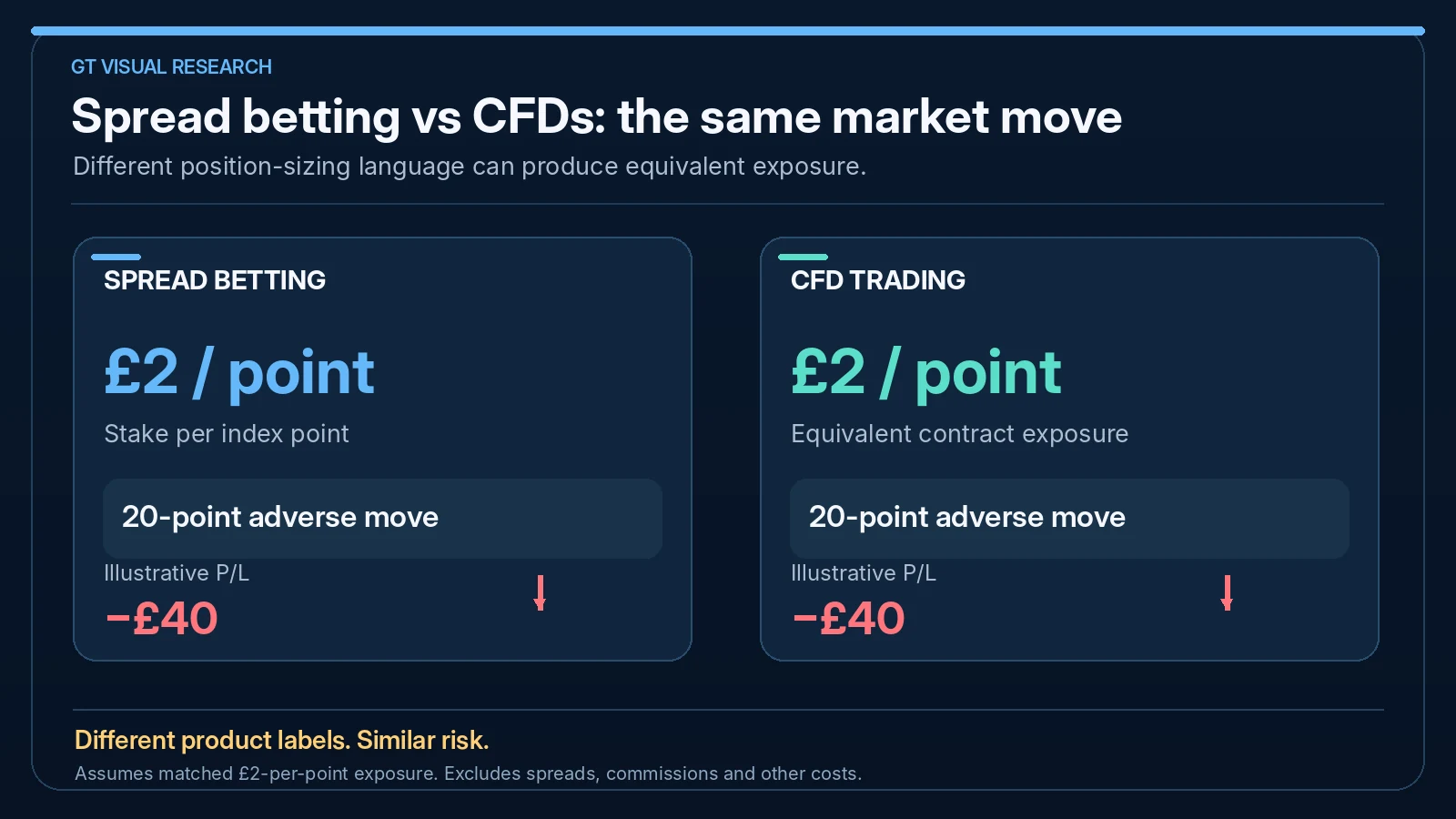
Imagine a trader uses either a spread bet or a CFD to take exposure to a stock index. The structure may look different, but the account still reacts to the size of the market move and the exposure taken.
If the trader risks too much per point, the spread bet can become dangerous. If the trader chooses too large a CFD position, the CFD can become dangerous. In both cases, the issue is not just the product label. It is exposure.
The beginner’s first job is not to pick the more exciting product. It is to understand how much the position can lose.
Common beginner mistakes
- Choosing spread betting only because of tax treatment.
- Choosing CFDs because they sound more professional.
- Ignoring leverage because the margin requirement looks small.
- Not understanding stake per point.
- Not understanding CFD contract size.
- Trading live before using demo properly.
- Comparing brokers before understanding the product.
- Overtrading because the platform makes it easy.
- Thinking a stop loss makes every position sensible.
- Forgetting that long-term investing may be more suitable than either product.
These mistakes are common because both products are easy to access. Easy access is not the same as readiness.
Where This Fits In The GradTraders Research Hub
Spread betting and CFD trading sit inside the broker education cluster, but international readers should start with country eligibility. The same broker brand can operate through different legal entities and offer different products, leverage and protections in different markets.
Use the GradTraders International hub to enter through your country route before treating a UK spread-betting account as relevant to you.
Compare Broker Accounts
Readers ready to research providers can use the GradTraders 24-broker comparison table to compare broker routes, platforms, costs and trading conditions.
Compare Prop Firm Alternatives
Readers thinking about a challenge account instead of a broker account should use the GradTraders prop firm comparison table and read Should Beginners Use A Prop Firm? first.
This guide also connects naturally with What Is Spread Betting?, What Are CFDs?, Leverage, Margin, Risk Management, Position Sizing, Stop Losses and Demo Trading Accounts.
Final GradTraders View
Spread betting and CFD trading are not two universally available global account types. Spread betting is especially associated with the UK, while CFDs are available under different rules in many — but not all — jurisdictions.
For an international reader, availability comes before preference. Check your country, the regulated broker entity and the products that entity is allowed to offer. If both are available, compare structure, leverage, margin, costs, tax and execution. If only one is available, do not use an offshore route simply to recreate the UK choice.
Country first, product second, risk always. The correct comparison is the one that fits your legal and regulatory environment, not the one that happens to be familiar in Britain.
Further reading on GradTraders
- What Is Spread Betting?
- What Are CFDs?
- What Is Leverage In Trading?
- What Is Margin In Trading?
- GradTraders Broker Comparison Table
Useful comparison hubs: GradTraders 24-Broker Comparison Table · GradTraders Prop Firm Comparison Table · Broker Costs, Spreads, Execution And Leverage Compared.
Source note: This guide combines GradTraders editorial judgement with current primary-source material on UK spread betting, EEA CFD treatment, Australian retail CFD rules and US retail CFD restrictions. Product availability can change and the same broker brand may use different legal entities in different countries, so readers should verify their local regulator and provider terms before opening an account.
Useful official sources: FCA: Contract for differences · HMRC BIM22015 · ESMA CFD product-intervention analysis · ASIC CFD product-intervention order · SEC-filed disclosure on jurisdiction-dependent CFD availability.
Explore GradTraders Internationally
GradTraders has 20 dedicated international gateways with local livestream times, market context and country-specific routes into the wider research site.
These country links are for site navigation only; broker availability, regulatory status and account eligibility must be checked separately.
Browse all 20 country gateways
Asia: Japan · South Korea · Taiwan · Hong Kong · India · Singapore · Thailand
Europe: Italy · Sweden · Switzerland · Germany · Norway
Americas: United States · Canada · Mexico
Middle East: United Arab Emirates · Saudi Arabia
Africa: South Africa
Oceania: Australia · New Zealand
Spread Betting vs CFD Trading FAQ
Does UK spread-betting tax treatment apply internationally?
No. UK tax treatment is a local consideration. International readers should use their own tax authority and local professional guidance rather than applying UK assumptions to another jurisdiction.
Can the same broker offer spread betting in one country but not another?
Yes. Broker brands can operate through different regulated legal entities. Product permissions, leverage, protections and account types can therefore differ by country even when the brand name is the same.
Is spread betting available in every country?
No. Spread betting is jurisdiction-specific and especially associated with the UK. In many countries it is not a standard retail account type or may not be offered by the regulated entity serving local residents.
What is the main difference between spread betting and CFD trading?
Spread betting is usually expressed as a stake per point, while CFD trading is usually expressed through contracts, units, lots or quantities. In both cases, the trader speculates on price movement without owning the underlying asset.
Is spread betting tax-free in the UK?
UK spread betting is often discussed because profits are not normally taxable for individuals under HMRC guidance, but tax depends on personal circumstances and this is not tax advice. A tax-efficient loss is still a loss.
Are CFDs riskier than spread betting?
Both spread betting and CFDs can be high-risk because they are commonly leveraged. The risk depends on exposure, position size, margin, market conditions, costs and trader behaviour.
Which is better for beginners?
For many complete beginners, neither should be the first live step. Education, demo practice, leverage, margin, stop loss, position sizing and risk management should come first.
Should I compare brokers before choosing between spread betting and CFDs?
Broker comparison is useful once the product basics are understood. Beginners can use the GradTraders broker comparison table to compare routes, but should not treat it as a shopping list before understanding the risk.