What Is Position Sizing? A Plain Beginner Guide
Position sizing means deciding how much exposure a trade should carry before opening it. I would start with the amount a trader can afford to lose on the idea, then account for the stop distance, product and contract size before calculating the position. A good entry with an oversized position is still a poor risk decision, especially where leverage and slippage can increase the loss.
 , GradTraders
Live trading on YouTube
, GradTraders
Live trading on YouTube
Size The Loss Before The Trade
Position size should follow account risk, stop distance and product value—not the maximum size a platform allows.
Disclosure & Risk Notice: This article is for educational and informational purposes only and should not be considered financial advice, investment advice, tax advice or a personal recommendation. Trading CFDs, spread betting, forex, futures, indices, commodities, crypto-related products and prop firm challenges involves significant risk. You may lose money, including challenge fees where applicable. Some GradTraders articles may contain affiliate links or references to partner offers. If you sign up, purchase or open an account through certain links, GradTraders may earn a commission at no additional cost to you.
GradTraders may earn commission from some links without affecting the independent educational view. Readers comparing relevant providers or current partner routes can use the Exclusive Discounts & Updates page.
Quick Beginner View
For beginners, position size is where many trades become dangerous. You can be right about market direction and still lose badly if the trade is too large. You can also be wrong and survive comfortably when the position is small enough and the loss is planned.
That is why I do not treat position sizing as an advanced detail. It is one of the first things a beginner should understand before using a live broker account, buying a prop firm challenge or increasing leverage.
Plain Meaning
Position sizing means deciding how large a trade should be before entering it, based on account size, stop distance, product risk and planned loss.
Main Beginner Mistake
Many beginners confuse margin required with total risk. A platform may allow a trade, but that does not mean the size is sensible.
Best First Step
Practise position sizing on a demo account before risking money or attempting a rule-based prop firm challenge.
What Is Position Sizing in Trading?
Position sizing means deciding how large a trade should be before entering it. It matches the trade size to the account size, stop-loss distance, market volatility and amount the trader is prepared to lose.
In plain terms, I use position sizing to answer one question before the trade begins:
If this trade is wrong, how much money could I lose?
Many beginners focus almost entirely on the entry. Better traders spend just as much time on size because the position determines whether a normal loss remains manageable or becomes damaging.
Why Position Sizing Matters More Than Beginners Expect
A trade can be sensible at one size and reckless at another. The market idea may be identical, but the effect on the account can be completely different.
For example, a trader with a small position may be able to handle ordinary market movement without panic. The same trader with a much larger position may feel pressure immediately, move the stop, close too early, add to the position or try to win back a loss.
This is why I do not see position sizing as purely mathematical. It is also psychological: a trade that is too large changes behaviour.
GradTraders covers the behavioural side separately in What Is Trading Psychology?.
Position Size Is Not the Same as Account Size
Beginners sometimes assume a larger account automatically means better trading. It does not.
Account size is how much money is in the account. Position size is the size of the trade being taken. Exposure is the true market value being controlled. Risk is how much can be lost if the trade reaches the planned exit.
| Term | Plain Meaning | Why It Matters |
|---|---|---|
| Account size | The amount of money in the trading account. | It sets the base from which risk should be measured. |
| Position size | How large the trade is. | It determines how much the account moves when the market moves. |
| Exposure | The real market value being controlled. | Exposure can be much larger than the cash placed down when leverage is used. |
| Risk per trade | The planned loss if the trade fails. | This is the number a beginner should know before entering. |
The dangerous mistake is to look only at the account balance or margin required while ignoring the true exposure and planned loss.
Position Sizing, Leverage and Margin
Position sizing becomes especially important when leverage is involved.
Leverage allows a trader to control a larger position with a smaller amount of money placed down as margin. That can make the trade look affordable on the platform, even when the real exposure is too large for the account.
This is a common beginner trap. A platform may show that a trade can be opened, but that does not mean I would consider the size sensible.
GradTraders covers these ideas separately in What Is Leverage In Trading? and What Is Margin In Trading?. Readers comparing broker leverage, costs and execution can also use the GradTraders 24-broker comparison table.
A Simple Position Sizing Example
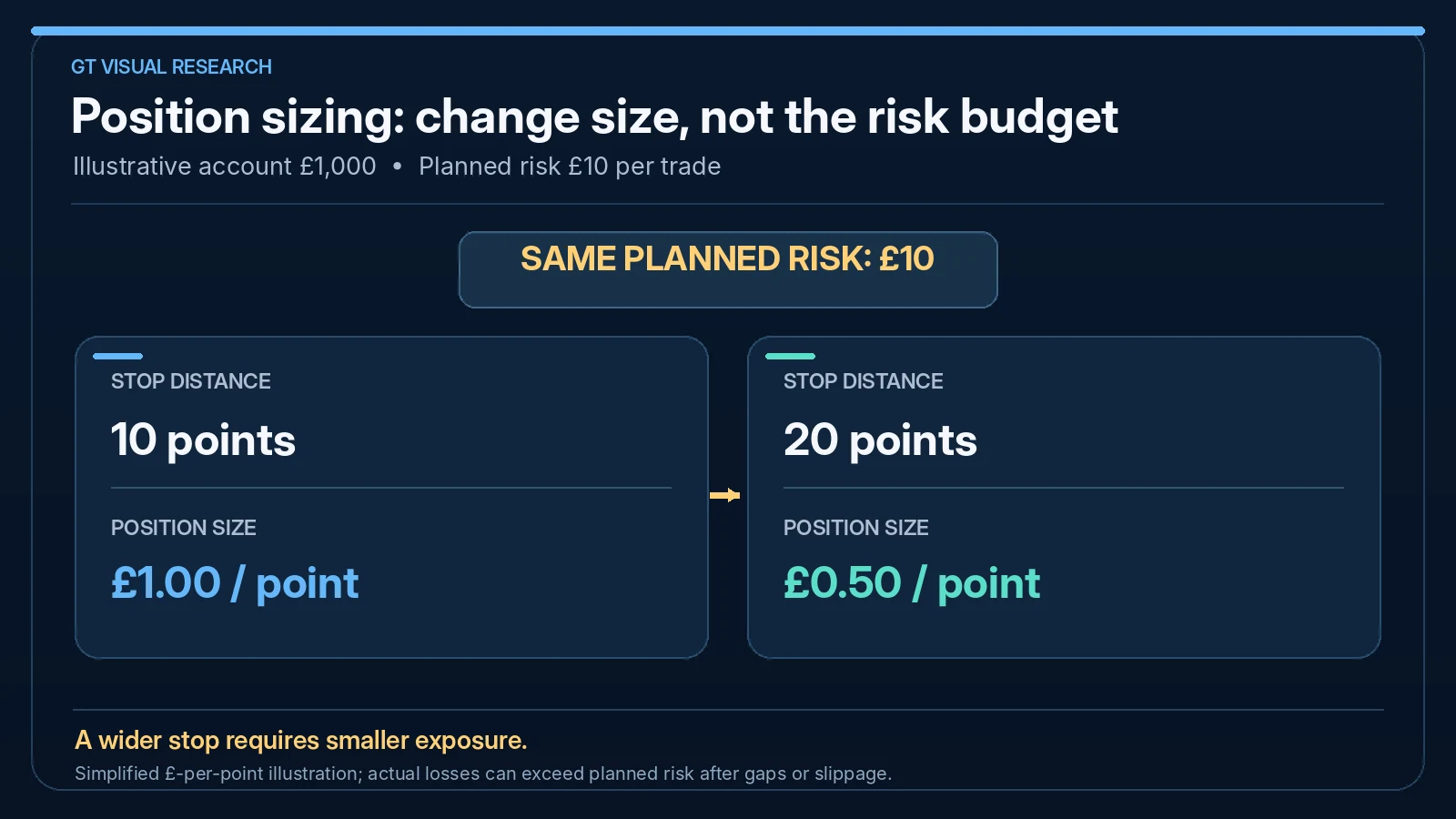
Imagine you have a £1,000 account and decide that the most you are prepared to lose on one trade is £10.
That £10 is the planned risk. It is not the margin required, the possible profit or the amount shown as available buying power. It is the loss accepted if the trade is wrong and the stop is reached.
If the stop loss is close, the position may be smaller or larger depending on the product and price movement. If the stop loss is wider, the position usually needs to be smaller to keep the planned loss at £10.
The principle is simple: the position size must fit the planned loss. The planned loss should never be discovered after the trade is already open.
The Stop Loss Affects Position Size
A stop loss is part of position sizing because the distance between entry and stop helps determine how much could be lost.
Beginners sometimes choose the trade size first and then place a stop wherever it looks convenient. I think that is backwards. A more careful approach is to decide where the trade idea is wrong, then choose a position size that keeps the loss acceptable.
A wider stop usually needs a smaller position. A tighter stop may allow a larger position, but it may also be more likely to be hit by normal market noise.
GradTraders explains stops separately in What Is A Stop Loss?.
Position Sizing and Market Volatility
Markets do not all move the same way. A quiet currency pair, a major stock index, a volatile commodity, an individual share and a crypto-related product can all behave very differently.
Position size should reflect that difference. A size that feels calm in one market may be dangerous in another. A stop that works in a slow market may be too tight in a fast market. A position that looks small in margin terms may still be large in exposure terms.
I would not assume one trade size works everywhere. The product, volatility, stop distance and execution conditions all matter.
Why Fixed Trade Size Can Be Dangerous
Some beginners trade the same size every time because it feels simple. That can be dangerous if the trades are not similar.
One trade may have a small stop distance. Another may have a much wider stop. One market may move slowly. Another may gap or swing quickly. If the trader uses the same size in both, the real risk can be very different.
Simple can be useful, but only when it remains sensible. A fixed size that ignores stop distance and volatility is not proper risk control.
Common Position Sizing Mistakes
Account And Platform Mistakes
- Choosing the trade size before knowing the stop loss.
- Using the largest size the platform allows.
- Confusing margin required with money at risk.
- Using the same size across very different markets.
Behaviour Mistakes
- Increasing size after a loss to try to recover quickly.
- Making the trade larger because the setup “feels obvious”.
- Forgetting that gaps and fast markets can affect execution.
- Ignoring overnight risk, news risk or market-open volatility.
These mistakes are tempting because a trader who wants a larger result is naturally drawn toward a larger position. That is exactly when I think caution matters most.
Position Sizing in Spread Betting
In spread betting, position size is often expressed as an amount per point. For example, a trader might stake £1 per point, £5 per point or some other amount depending on the market and broker.
This can sound simple, but it still needs careful risk thinking. If a trader stakes £5 per point and the market moves 20 points against them, the loss is £100 before any other effects. If the account is small, that may be far too much.
The key question remains the same: how much can be lost if the trade reaches the planned exit?
Position Sizing in CFD Trading
In CFD trading, position size depends on the product, contract size, price movement and account terms. The platform may show units, lots, contracts or another format depending on the broker.
I would not place a CFD trade until I understood how the provider calculates exposure and profit or loss. A number that looks small on the order ticket may represent more risk than expected.
The FCA describes CFDs as high-risk products and has rules around retail CFD restrictions, including leverage limits, margin close-out and negative balance protection. These protections matter, but they do not make poor position sizing safe.
Readers comparing broker terms should use the broker master comparison table after learning the basics.
Position Sizing in Prop Firm Challenges
Position sizing is central to prop firm challenges. A trader can fail not because every idea was wrong, but because one or two trades were too large for the drawdown rules.
Daily loss limits, total drawdown, trailing drawdown and consistency rules can all punish poor sizing. A beginner may see a large simulated account and assume there is plenty of room. In reality, the usable risk may be much smaller than the headline account size suggests.
I would size a prop firm account around the rules, not around the hope of passing quickly. Readers comparing drawdown rules, challenge models and beginner suitability should start with the GradTraders prop firm comparison table, Best Prop Firms for Beginners and Should Beginners Use a Prop Firm?.
Good Position Sizing Should Feel Boring
A sensible position size often feels underwhelming. I do not see that as a flaw; it is part of the protection.
If a single trade feels emotionally overwhelming, the position is probably too large. If the trader cannot calmly accept the planned loss, the position is probably too large. If the trader is already imagining how the win will change the account, the position may be too large.
Good sizing helps keep the trader thinking clearly. It does not make a trade risk-free, but it reduces the chance that one decision ruins the account.
The Danger of Increasing Size After a Loss
Increasing size after a loss is one of the most dangerous beginner habits.
The trader may feel that a larger next trade can recover the previous loss quickly. Sometimes it does. That can make the habit even more dangerous because the trader learns the wrong lesson. Eventually a larger recovery trade fails, and the damage is much worse.
Position size should come from the plan, not frustration. GradTraders covers the emotional side of this problem in What Is Trading Psychology?.
Position Sizing and Trading Psychology
The size of a trade affects how a trader feels. A small planned loss can be accepted calmly. A large possible loss can make the trader watch every tick, interfere with the trade and make decisions based on fear.
This is why position sizing sits between risk management and psychology. It is not only about protecting money. It is also about protecting judgment.
A trader who is constantly emotional may not have a psychology problem first. The position may simply be too large.
A Plain Beginner Position Sizing Checklist
Before entering a trade, I would want a beginner to answer these questions:
Trade And Account Questions
- What is my account size?
- What product am I trading?
- What is the true market exposure?
- Where is my stop loss?
- How much can I lose if the stop is reached?
Behaviour And Risk Questions
- Is that loss acceptable before the trade begins?
- Could slippage or a gap make the loss worse?
- Am I increasing size because I am frustrated?
- Would I still take the trade if the position were smaller?
- Can I accept the loss without trying to immediately win it back?
A beginner who cannot answer them should slow down and practise on demo. The Best Demo Trading Accounts guide explains how to practise before accepting live risk.
What Position Size Is Right for Beginners?
There is no single correct size for every beginner. The right size depends on the account, product, volatility, stop distance and trader experience.
For many beginners, my first answer would be no live position at all. Use a demo account, learn how the platform calculates position size, practise different stop distances and watch how changing size changes the account.
When real money is eventually introduced, the position should be small enough that a loss does not trigger panic, revenge trading or damage to wider finances.
Final GradTraders View
Position sizing is one of the least glamorous parts of trading and one of the most important. It decides whether a loss is manageable or harmful.
My view on what is position sizing is straightforward: it is the practical link between the trading idea and the account risk. A good setup can still be a bad trade when the size is wrong.
Forewarned is forearmed. The question is not only whether the market might move in your favour; it is whether the position is small enough for you to survive when it does not.
Further Reading on GradTraders
- What Is Risk Management In Trading?
- What Is A Stop Loss?
- What Is Leverage In Trading?
- What Is Margin In Trading?
- What Is Trading Psychology?
- Best Demo Trading Accounts In 2026
- Broker Costs, Spreads, Execution And Leverage Compared
- GradTraders 24-Broker Comparison Table
- GradTraders Prop Firm Comparison Table
Source note: I built this guide from my editorial judgement, general trading-education principles and official FCA information on UK retail CFD restrictions. Broker terms, margin rules, leverage, product access, execution, prop firm rules and regulatory protections can change, so always check current provider and regulator information before risking money. Rechecked 10 October 2026; provider, regulator and market conditions can change.
Useful official sources: FCA PS19/18: Retail CFD restrictions · FCA warning on losing retail protections.
Explore GradTraders Internationally
GradTraders has 20 dedicated international gateways with local livestream times, market context and country-specific routes into the wider research site.
These country links are for site navigation only; broker availability, regulatory status and product eligibility must be checked separately.
Browse all 20 country gateways
Asia: Japan · South Korea · Taiwan · Hong Kong · India · Singapore · Thailand
Europe: Italy · Sweden · Switzerland · Germany · Norway
Americas: United States · Canada · Mexico
Middle East: United Arab Emirates · Saudi Arabia
Africa: South Africa
Oceania: Australia · New Zealand
Position Sizing FAQ
What is position sizing in trading?
Position sizing means deciding how large a trade should be before entering it. It connects account size, stop distance, product risk and planned loss.
Why is position sizing important for beginners?
Position sizing matters because a trade can be sensible at one size and reckless at another. A beginner can be right about direction but still lose badly if the trade is too large.
Is position size the same as margin?
No. Margin is the amount required to open or maintain a leveraged position. Position size and exposure describe how large the trade really is, while planned risk describes how much may be lost if the trade fails.
How does a stop loss affect position size?
The distance between entry and stop helps determine the possible loss. A wider stop usually requires a smaller position if the trader wants to keep the planned loss controlled.
How does position sizing affect prop firm challenges?
Prop firm challenges usually have strict drawdown and daily loss rules. Poor position sizing can breach those rules quickly, even if the trader has some reasonable market ideas.
How do traders calculate position size?
Traders normally combine account size, planned monetary risk, entry price, stop-loss distance and the product’s value per point, pip, unit or contract. The exact calculation depends on the market and platform.
What is the difference between position size and risk per trade?
Position size is how large the trade is. Risk per trade is the amount expected to be lost if the trade reaches the planned exit. The two are connected through the stop distance and product value.
Can a position be too large even when the margin requirement is low?
Yes. A low margin requirement only shows how much capital is needed to open the leveraged position. The true exposure and possible loss can still be far too large for the account.
Should position size change when market volatility increases?
Often, yes. More volatile markets may require wider stops or smaller positions to keep the planned loss controlled. Using the same size in every market can create very different levels of risk.
Can good position sizing prevent every trading loss?
No. Position sizing cannot stop losses or guarantee good execution. Its purpose is to keep an individual loss proportionate so that one trade is less likely to cause serious account damage.