What Is a Stop Loss? A Plain Beginner Guide
A stop loss is an order intended to close a losing trade at a defined level, but I would decide the trade size and acceptable loss before entering—not assume that adding a stop makes an oversized position safe. A standard stop may execute at a worse price during a gap or fast move, so planned risk and actual loss can differ. The stop belongs inside a position-sizing plan, not in place of one.
 ,
GradTraders
Live trading on YouTube
,
GradTraders
Live trading on YouTube
Define The Exit Before Entry
A stop loss can define planned risk, but it cannot fix an oversized trade or guarantee the exact exit price.
Disclosure & Risk Notice: This article is for educational and informational purposes only and should not be considered financial advice, investment advice, tax advice or a personal recommendation. Trading CFDs, spread betting, forex, futures, indices, commodities, crypto-related products and prop firm challenges involves significant risk and may not be suitable for all traders. You may lose some or all of your capital.
GradTraders may earn commission from some links without affecting the independent educational view. Readers comparing relevant providers or current partner routes can use the Exclusive Discounts & Updates page.
Quick Beginner View
A stop loss is not a seatbelt for reckless trading. It is a tool for planning where a trade should end if the idea is wrong. Used properly, it can help a trader define risk before entering. Used badly, it can become a false comfort that allows the trader to take positions that are too large.
A beginner should understand the planned loss before the trade is opened, not after the trade is already moving against them.
Best Use
Use a stop loss to define where the trade idea is wrong before opening the position.
Main Mistake
Moving the stop further away after the trade loses usually turns a planned loss into hope.
Key Link
A stop loss only makes sense when combined with position sizing and wider risk management.
What Is a Stop Loss?
A stop loss is an instruction to close a trade if the market reaches a certain price. The aim is to limit the loss on a trade that has moved against the trader.
For example, a trader might buy a market at 100 and place a stop loss at 95. If the price falls to 95, the stop loss is intended to close the trade. The trader has decided in advance where the trade idea is no longer acceptable.
That is the real purpose of a stop loss. It is not there to prove the trader is right. It is there to define what happens when the trader is wrong.
Why Stop Losses Matter
Beginners often focus on the entry. They ask where to buy, where to sell, or whether the market will go up or down. The stop loss asks a more useful question: where is the trade wrong?
This matters because trading without a clear exit can turn a small loss into a large one. A trader who refuses to close a losing position can end up hoping rather than managing risk.
A stop loss does not make the trade good. It simply creates a planned boundary. That boundary helps the trader avoid making decisions in panic.
A Stop Loss Does Not Guarantee a Small Loss
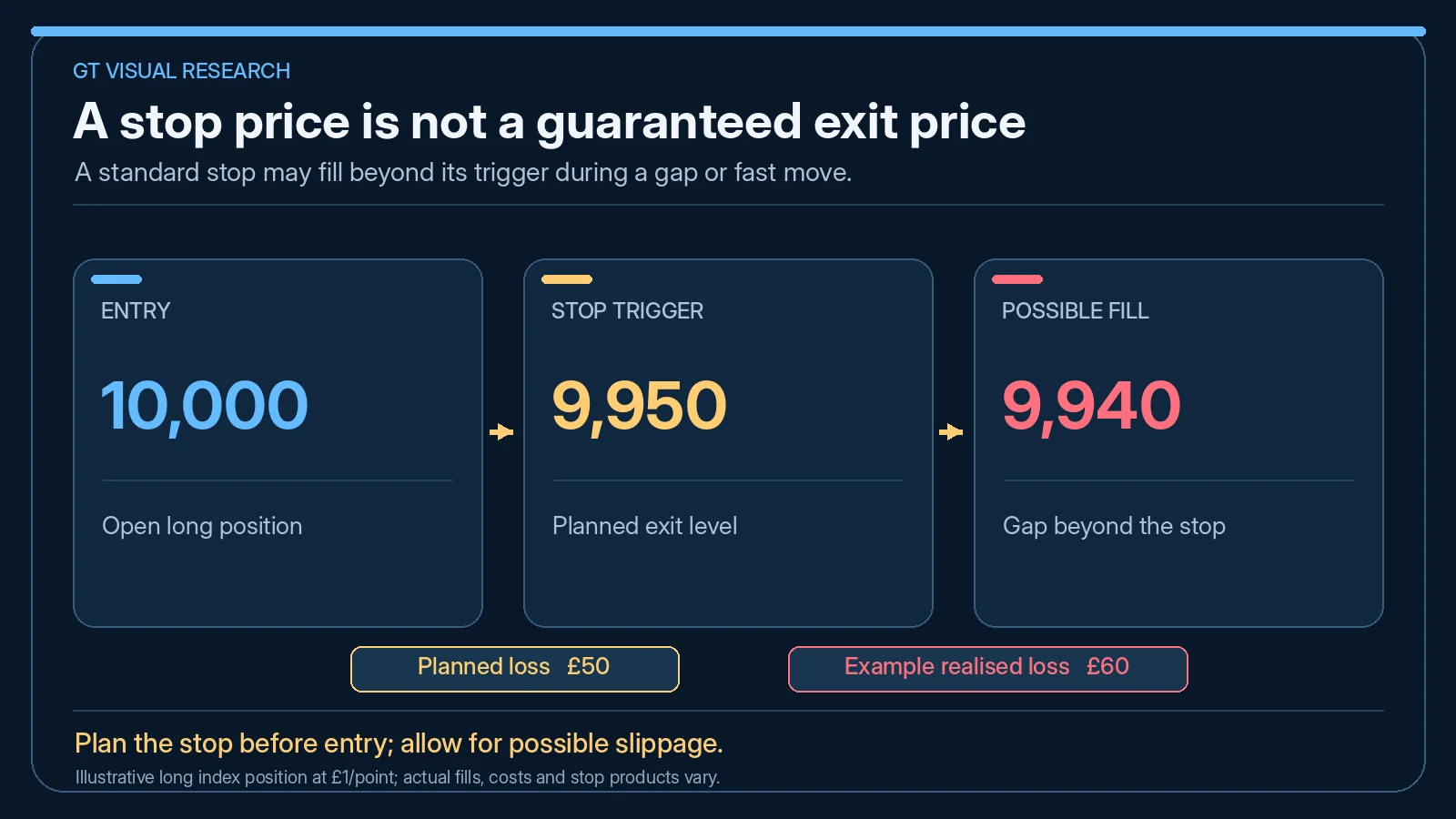
Beginners should be careful here. A normal stop loss is designed to close a trade when a level is reached, but the execution price can be affected by market conditions.
In fast markets, gaps, sharp volatility, thin liquidity or news events, the trade may close at a worse price than expected. This is often called slippage.
Some brokers offer guaranteed stop losses on certain products or accounts. These are different from normal stop losses and may involve extra costs or restrictions. A beginner should not assume all stops are guaranteed.
The practical lesson is simple: a stop loss helps manage risk, but it does not remove risk.
Stop Loss, Position Size and Account Risk
A stop loss only makes sense when combined with position size. The distance between the entry and the stop is not enough by itself. The trader also needs to know how large the position is.
A 10-point stop on a tiny position may be a small planned loss. A 10-point stop on a large leveraged position may be a serious account hit.
| Part Of The Trade | Plain Meaning | Why It Matters |
|---|---|---|
| Entry | The price where the trade is opened. | It starts the risk calculation, but it is not the whole decision. |
| Stop loss | The planned exit if the trade goes wrong. | It helps define where the idea is invalid. |
| Position size | How large the trade is. | It determines how much money is lost if the stop is reached. |
| Account risk | The amount of the account at risk on the trade. | This is what the trader must be able to accept before entering. |
This is why stop losses should not be treated as decoration on the chart. They are part of the risk structure.
A Simple Stop Loss Example
Imagine a trader buys an index at 10,000 and places a stop loss at 9,950. The stop is 50 points away.
If the trader is risking £1 per point, the planned loss is around £50 before costs and slippage. If the trader is risking £10 per point, the planned loss is around £500 before costs and slippage.
The chart distance is the same. The account impact is completely different.
Beginners often misunderstand this. They think the stop distance is the risk. The real risk is the stop distance multiplied by the position size.
Where Should a Stop Loss Go?
There is no universal answer. A stop loss should usually be placed where the trade idea is no longer valid, not simply where the trader feels comfortable losing money.
This is harder than it sounds. A stop that is too close may be hit by normal market noise. A stop that is too far away may create a loss that is too large for the account. A stop placed randomly is not risk management.
The trader must balance the market structure with the account risk. If the sensible stop is too far away for the account, the answer is not to move the stop closer without reason. The answer may be to reduce position size or avoid the trade.
Different Ways Traders Place Stops
Traders use different methods to decide where a stop loss should sit. Beginners should not treat any method as magic.
Structure-Based Stops
These are placed around market structure, such as below a recent low for a long trade or above a recent high for a short trade. The idea is that if price reaches that area, the setup may no longer be valid.
Volatility-Based Stops
These consider how much the market normally moves. A volatile market may need a wider stop than a quieter one. The wider stop may also require a smaller position.
Fixed-Distance Stops
Some traders use a fixed number of points, pips or ticks. This is simple, but it can ignore changing market conditions.
Time-Based Exits
Some trades are closed if they fail to work within a certain time. This is not the same as a price stop, but it can form part of a trading plan.
The Mistake of Moving the Stop
One of the most common beginner mistakes is moving the stop further away because the trade is losing.
This usually means the trader no longer wants to accept the loss they planned. The problem is that the trade was entered with one risk, and then changed into a larger risk after emotion appeared.
There are situations where experienced traders adjust stops as part of a pre-planned strategy. That is different from moving a stop because the loss feels uncomfortable.
A beginner should be very cautious with stop movement. If the rule changes only after the trade goes against them, it is probably not a rule. It is hope.
The Mistake of Using No Stop
Some traders avoid stop losses because they do not want to be “stopped out”. This can be dangerous, especially with leveraged products.
A trade without a defined exit can become an open-ended problem. The trader may keep waiting, averaging down, adding to the position or telling themselves the market will come back.
Sometimes markets do come back. Sometimes they do not. A risk plan cannot be based on the market being kind.
Beginners should understand this before trading CFDs, spread bets, futures, forex or prop firm challenges. Undefined risk and leverage are a poor combination.
Stop Losses in Spread Betting and CFD Trading
Stop losses are especially important in spread betting and CFD trading because these products are commonly leveraged. Small market movements can have a larger effect on the account when exposure is high.
A stop loss may help prevent a losing trade from growing beyond the planned level, but the trader still needs to consider spread, slippage, overnight funding, market gaps and position size.
The fact that a trading platform allows a stop loss does not mean the trade is suitable. The full risk calculation still matters. Readers comparing normal trading accounts can use the GradTraders 24-broker comparison table and the broker costs, spreads, execution and leverage comparison for wider research.
Stop Losses in Prop Firm Challenges
Stop losses can also matter in prop firm challenges. These challenges usually have rules around daily loss, maximum drawdown and sometimes consistency. A single oversized trade can damage the challenge quickly.
A beginner may think a stop loss protects the challenge account. It only helps if the stop distance and position size fit the drawdown rules.
In a prop firm setting, the question is not only “where is my stop?” It is also “what percentage of the allowed drawdown disappears if this stop is hit?”
Readers comparing firms should start with the GradTraders prop firm comparison table, then read Best Prop Firms For Beginners and Should Beginners Use A Prop Firm? before buying any challenge.
Guaranteed Stop Losses
A guaranteed stop loss is designed to guarantee the exit level even if the market gaps or moves quickly. Some brokers offer them on certain markets, usually with a cost or wider dealing terms.
This can be useful for some traders, but beginners should still understand the trade. A guaranteed stop does not turn a poor setup into a good one. It does not remove normal trading costs. It does not make overtrading sensible.
The key point is that a guaranteed stop loss and a standard stop loss are not the same thing. Beginners should check exactly what their broker offers before relying on any stop order.
A Stop Loss Should Be Planned Before the Entry
Many beginners enter first and then decide where the stop should go. That is backwards.
The stop should be part of the trade plan before the position is opened. That allows the trader to calculate the possible loss, choose the right size, and decide whether the trade is worth taking at all.
If the correct stop creates too much account risk, the answer is not to ignore the stop. The answer is to reduce size or skip the trade.
Stop Loss and Risk-Reward
A stop loss also helps a trader think about risk and reward. If the planned loss is £100 and the realistic target is £50, the trade may not make sense unless the win rate and strategy justify it.
Beginners often choose profit targets based on hope. The stop loss forces them to consider the other side of the trade.
A trade should not be judged only by whether it can make money. It should be judged by whether the risk is acceptable and whether the possible reward is worth that risk.
Stop Loss and Trading Psychology
A stop loss is partly technical and partly psychological.
Technically, it defines an exit level. Psychologically, it forces the trader to accept that the trade may be wrong. Many beginners struggle with this because being stopped out feels like failure.
It should not. A planned loss is part of trading. The real failure is usually not the losing trade. The real failure is refusing to control the loss.
A trader who can take small planned losses calmly is in a better position than a trader who needs every trade to work. GradTraders explains the behaviour side in What Is Trading Psychology?.
A Plain Stop Loss Checklist
Before placing a live trade, a beginner should be able to answer these questions:
Trade Plan Questions
- Where is my stop loss?
- Why is it there?
- How much money can I lose if it is hit?
- Does the position size make that loss acceptable?
- Could normal market noise hit this stop?
Risk and Behaviour Questions
- What happens if the market gaps through the stop?
- Am I using a standard stop or a guaranteed stop?
- Will I move the stop if the trade goes against me?
- Does the potential reward justify the planned risk?
- Am I comfortable being wrong on this trade?
A beginner who cannot answer these questions should slow down and use a demo trading account before risking real money.
Common Stop Loss Mistakes
Planning Mistakes
- Entering a trade before deciding where the stop should go.
- Using the same stop distance in every market condition.
- Placing the stop at a random level because it feels comfortable.
- Thinking a stop loss guarantees the exact exit price.
- Ignoring overnight gaps, news events and fast markets.
Behaviour Mistakes
- Moving the stop further away after the trade loses.
- Using a stop loss but taking a position that is still too large.
- Removing the stop because the trader does not want to accept the loss.
- Confusing a stopped-out trade with a bad trade.
- Confusing a trade without a stop with confidence.
These mistakes are common because they often appear during pressure. That is why the stop must be planned before the pressure begins.
When Being Stopped Out Is Acceptable
Being stopped out is not automatically bad. Sometimes it simply means the market invalidated the idea.
A trade can be well planned and still lose. A stop loss can be hit and the trader can still have made a sensible decision. The question is whether the trade was planned, sized correctly and followed properly.
Beginners should learn to separate outcome from process. A losing trade is not always a bad trade. A winning trade is not always a good trade.
Final GradTraders View
A stop loss is one of the basic tools a beginner should understand before risking money. It helps define where a trade should end if the idea is wrong, but it is not a guarantee of safety.
The stop loss only works as part of a wider risk plan. The trader still needs sensible position sizing, an understanding of leverage and margin, realistic expectations about slippage, and the discipline not to turn a planned loss into an emotional decision.
Forewarned is forearmed. A stop loss does not make a trader ready. It simply gives the trader a place to be wrong before the loss becomes too large.
Further Reading on GradTraders
Source note: I built this guide from my editorial judgement, general trading-education principles and official FCA information on UK retail CFD restrictions and protections. Broker terms, stop-order types, guaranteed-stop availability, leverage limits, execution, platform access, product availability, prop firm rules and regulatory protections can change, so always check current provider and regulator information before opening an account or risking money.
Useful official source: FCA: permanent restrictions on the sale of CFDs and CFD-like options to retail consumers.
Explore GradTraders Internationally
GradTraders has 20 dedicated international gateways with local livestream times, market context and country-specific routes into the wider research site.
These country links are for site navigation only; broker availability, regulatory status and product eligibility must be checked separately.
Browse all 20 country gateways
Asia: Japan · South Korea · Taiwan · Hong Kong · India · Singapore · Thailand
Europe: Italy · Sweden · Switzerland · Germany · Norway
Americas: United States · Canada · Mexico
Middle East: United Arab Emirates · Saudi Arabia
Africa: South Africa
Oceania: Australia · New Zealand
Stop Loss FAQ
What is a stop loss in trading?
A stop loss is an order designed to close a trade if the market reaches a certain price. It helps define where the trade idea is wrong and what the planned loss may be.
Does a stop loss guarantee my loss will be small?
No. A normal stop loss does not always guarantee the exact exit price. Fast markets, gaps, volatility and slippage can cause a trade to close at a worse level than expected.
Where should beginners place a stop loss?
A stop loss should usually be placed where the trade idea is no longer valid, while still keeping the account risk acceptable. If the sensible stop creates too much risk, the position may need to be smaller or the trade may need to be skipped.
Why is position size important with a stop loss?
The stop distance alone does not define the money at risk. The actual planned loss depends on the stop distance and the size of the position.
Should beginners trade without a stop loss?
Beginners should be very cautious about trading without a defined exit. Undefined risk and leverage can be a dangerous combination, especially in CFDs, spread betting, futures, forex and prop firm challenges.
What is the difference between a standard and guaranteed stop loss?
A standard stop is intended to close the trade when its level is reached, but the execution price can slip. A guaranteed stop is designed to honour the selected exit level, although availability, costs and restrictions vary by provider.
What is stop-loss slippage?
Stop-loss slippage happens when a trade closes at a different price from the selected stop level. It can occur during gaps, fast markets, thin liquidity or major news events.
Is it ever sensible to move a stop loss?
Experienced traders may adjust a stop as part of a rule defined before entry. Moving it further away simply because a trade is losing is different and normally increases the risk after emotion has appeared.
How do stop losses affect prop firm challenges?
A stop loss only protects a prop firm challenge when the stop distance and position size fit the daily-loss and drawdown rules. One oversized stopped trade can still breach the account limits.
Should beginners practise stop losses on a demo account?
Yes. A demo account can help beginners practise stop placement, position sizing and order controls before risking money, although live execution and emotion can still be different.