Prop Firm vs Broker Account: Which Is Better For Traders?
My preference for a beginner is to build a repeatable trading process in demo conditions before considering a suitably small broker account. A prop-firm challenge makes more sense only after the trader can manage position sizing, drawdown and external rules consistently. The advertised simulated capital is not the same as personally owned trading equity.
By Matthew Jackson Matthew JacksonFounder of GradTraders,
A direct comparison of simulated programme capital, broker deposits, fees, drawdown, payouts, withdrawals and trader readiness.
Disclosure & Risk Notice: This article is educational and informational content, not financial advice, investment advice, tax advice or a personal recommendation. Leveraged trading can result in rapid losses. Prop-firm evaluation fees can be lost when rules are breached, while broker-account losses reduce the trader’s own deposited equity. Many retail prop-firm accounts are simulated environments rather than personal cash brokerage accounts.
GradTraders has commercial relationships with selected prop firms, brokers and trading services. If a reader uses certain partner routes, GradTraders may earn commission at no additional cost. Commercial relationships do not alter the central conclusion: the correct route depends on trader readiness, legal entity, account structure and risk behaviour—not the size of a headline account.
Current partner routes and offer conditions are maintained through the GradTraders offer list.
Compare-first principle: A prop-firm challenge fee and a broker deposit do different jobs. Compare the exact legal and economic route before comparing account size, leverage or promotional price.
Quick Verdict: Broker Account First, Prop Firm When Proven
For most beginners and traders still building a long-term process, a suitable regulated broker account—or a demo account before that—is the cleaner route. It places personal risk decisions, real account equity and genuine withdrawals at the centre of development rather than a challenge target.
A prop firm can make sense later for a trader who already has a tested process, respects fixed loss limits and can afford to lose the evaluation fee. The attraction is access to larger simulated capacity and performance-based rewards without depositing the displayed account size.
Learn execution, position sizing and emotional control before adding challenge pressure.
Only when the programme rules already match the established trading process.
Direct account equity, personal risk rules and a clearer withdrawal relationship.
Overtrading, revenge trading and uncontrolled size will transfer to either structure.
Prop Firm vs Broker Account At A Glance
| Comparison Point | Prop Firm Programme | Broker Trading Account | GradTraders View |
|---|---|---|---|
| Money paid at the start | Evaluation, challenge, activation or account fee | Deposit placed into the trader’s own account | The fee buys programme access; the deposit becomes account equity subject to losses and broker terms. |
| Displayed account size | Usually simulated capital allocated under programme rules | Actual account equity plus permitted margin | The figures are not economically equivalent. |
| Capital at risk | The trader generally risks fees rather than the displayed simulated balance | The trader risks deposited funds and open-position equity | Prop firms reduce deposited-capital exposure but add fee and rule risk. |
| Profit access | Performance reward or payout under programme conditions | Withdrawal request from available account funds | A prop reward and broker withdrawal are different legal mechanisms. |
| Risk limits | Externally imposed daily, maximum, trailing, consistency or strategy rules | Broker margin rules plus the trader’s own risk framework | A broker gives more discretion, which helps disciplined traders and harms reckless ones. |
| Regulatory position | Often an educational or simulated-performance business rather than a retail broker | Depends on the exact broker entity, regulator, jurisdiction and product | Check the legal entity—not only the brand name. |
| Account control | Programme rules can limit holding, news trading, size, strategies and payouts | Greater direct control within product, leverage and margin restrictions | The broker account wins for control. |
| Best fit | Proven trader lacking sufficient personal capital | Trader prioritising control, account equity and long-term development | Broker first for most traders |
What Are You Actually Buying?
Access To A Rule-Based Simulation
The customer usually pays for an evaluation, service or simulated trading environment. Passing can create eligibility for a performance account and monetary rewards under the provider’s contract.
The displayed balance is not normally a personal cash deposit. FTMO states that its accounts are demo accounts with fictitious capital, while E8 describes its accounts as simulated environments powered by real market data.
An Account Holding Your Trading Equity
The trader deposits personal money with the broker entity and uses the available equity and permitted margin to trade the products offered through that account.
Closed profits and losses change the account balance. Withdrawal requests normally relate to available account funds, subject to verification, payment-source, margin and legal terms.
Broker Account Does Not Always Mean The Same Thing
“Broker account” is a broad label. The product and legal entity matter as much as the broker brand.
| Account Type | Typical Exposure | Ownership Position | Main Caution |
|---|---|---|---|
| Share-dealing account | Shares and exchange-traded investments | May provide beneficial ownership or custody of the purchased asset | Custody, dealing costs, market risk and tax treatment still matter. |
| CFD account | Leveraged contract based on price movement | No ownership of the underlying asset | Leverage, financing costs and counterparty/entity risk. |
| Spread-betting account | Leveraged bet on price movement | No ownership of the underlying asset | Availability and tax treatment are jurisdiction-specific. |
| Futures account | Exchange-traded futures contracts | Contractual futures position rather than ownership of the underlying asset | Margin, contract value, expiry and tick risk. |
| Retail forex account | Leveraged OTC currency exposure | Counterparty-based trading relationship | Registration, leverage, execution and withdrawal risk vary by country. |
Regulation And Client-Money Protection
A suitable regulated broker account may provide statutory conduct and client-money protections. Those protections depend on the exact entity, jurisdiction, product and client classification.
For UK retail CFD accounts, FCA rules include leverage limits, a margin close-out requirement and negative balance protection. Where applicable, FCA CASS rules require client money to be handled and segregated under the relevant framework.
In the United States, the CFTC advises traders to verify registration and disciplinary history before sending funds. Retail forex counterparties must fall within permitted registered categories.
Prop-firm programmes should not be assumed to provide the same protections. A simulated evaluation company may not take investment deposits or operate as a regulated broker.
Entity check: Confirm which company will hold the broker account, where it is regulated, which products it offers and whether the stated protections apply to your client classification.
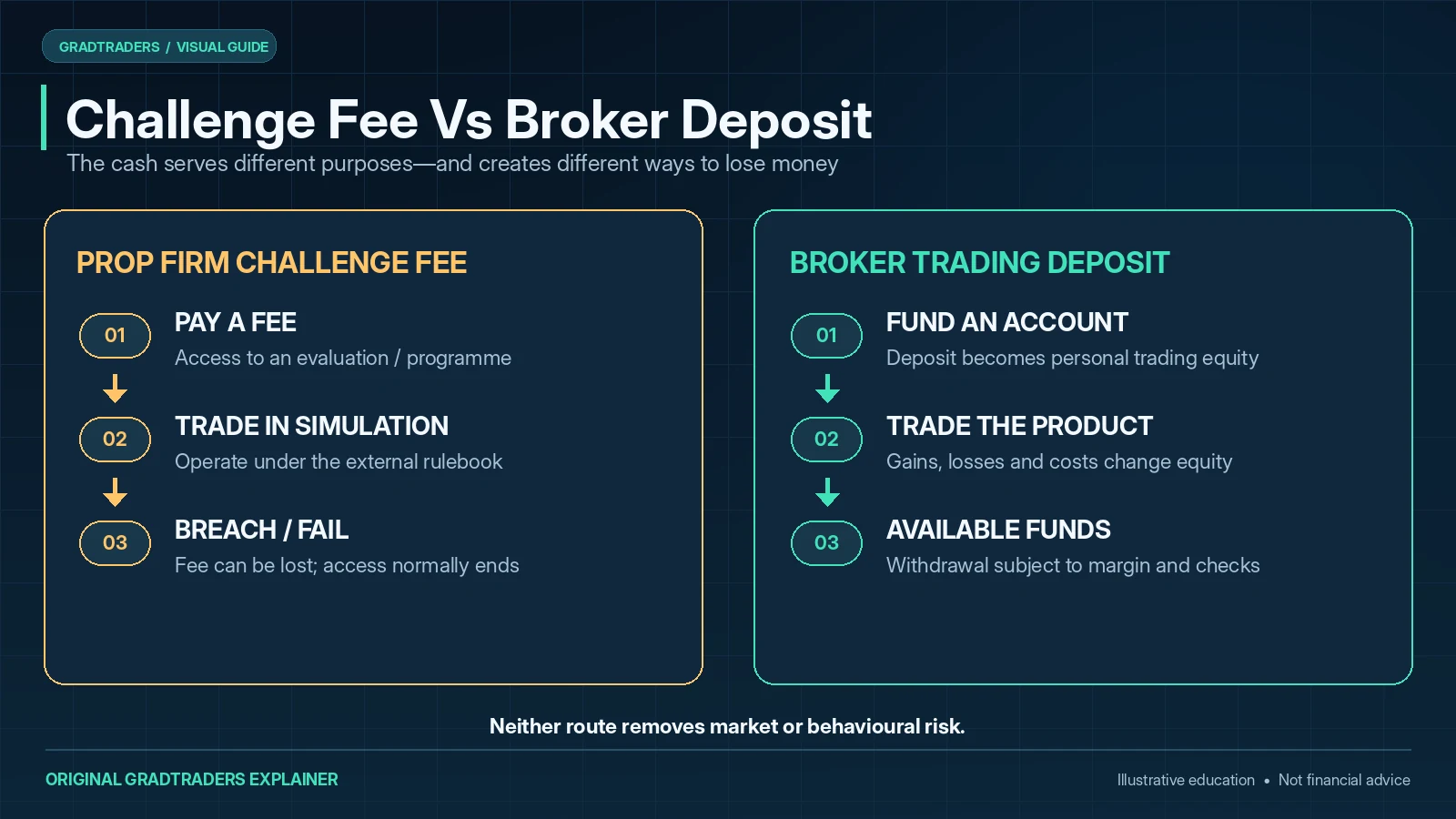
Challenge Fee vs Trading Deposit
A challenge fee and broker deposit perform different economic jobs.
Programme Access Can End At Breach
The prop-firm fee purchases access to the programme. Failure normally ends that account and leaves no trading equity to withdraw. Repeated challenge purchases can become a hidden trading-loss category.
Personal Equity Can Be Lost
A broker deposit becomes account equity. It may be withdrawn when available, but trading losses, costs and margin requirements can reduce or eliminate it.
Drawdown Rules vs Personal Risk Rules
Prop firms can impose daily loss, maximum loss, static drawdown, trailing drawdown, end-of-day drawdown, consistency and per-symbol risk limits. A profitable strategy can still fail if the sequence of trades breaches an external rule.
A broker account replaces most challenge rules with the broker’s margin system and the trader’s own risk policy. That gives more freedom, but freedom is not protection. An undisciplined trader can overleverage, average into losses or ignore a stop more easily.
Prop-Firm Payouts vs Broker Withdrawals
A prop-firm payout is normally a contractual performance reward. The trader must satisfy the programme’s payout date, minimum profit, consistency, buffer, strategy and compliance requirements.
A broker withdrawal is normally a request to return available account funds. It can still be delayed by incomplete verification, payment-source checks, insufficient free margin or suspected fraud.
| Question | Prop-Firm Payout | Broker Withdrawal |
|---|---|---|
| What is being requested? | A contractual share of eligible simulated performance | Available funds from the trading account |
| Who defines eligibility? | The programme rulebook | Account balance, margin, verification and broker terms |
| Can profitable trading still fail the request? | Yes—consistency, strategy or risk breaches may matter | Yes—when funds are unavailable or compliance checks fail |
| Is the displayed account balance withdrawable? | No—the simulated allocation is not the trader’s cash balance | Available account equity may be withdrawn subject to conditions |
Which Route Creates More Psychological Pressure?
Targets And Rule Cliffs
- Trying to reach a profit target quickly.
- Trading differently near a loss limit.
- Protecting payout eligibility rather than following the strategy.
- Buying another challenge immediately after failure.
- Treating the fee as already lost and taking excessive risk.
Personal-Money Emotion
- Feeling every loss as a direct financial setback.
- Overleveraging because the account is small.
- Closing good trades too early to protect cash.
- Adding money to rescue poor risk decisions.
- Refusing to realise a loss because it is personal capital.
Neither structure fixes trading psychology. The better route is the one whose pressure can be managed without changing the tested process.
When A Prop Firm May Make Sense
Evidence The Trader May Be Ready
- A documented strategy has worked across different market conditions.
- Position risk is calculated before every trade.
- The trader can stop after reaching a daily loss limit.
- Challenge fees can be lost without affecting household finances.
- The selected programme rules match the existing strategy.
- The trader does not need an immediate payout to pay bills.
Evidence The Trader Is Not Ready
- The strategy changes after every losing week.
- The account size is being used to justify larger risk.
- Previous failures have not been reviewed.
- A discount code is the main purchase reason.
- The drawdown calculation cannot be explained.
- The next payout is already included in personal spending plans.
Which Prop Firms Should You Research First?
The GradTraders master framework gives the four flagship firms different roles rather than declaring one universal winner.
| Firm | GradTraders Role | Rating | Why It May Fit |
|---|---|---|---|
| FTMO | Best Benchmark | 8.5/10 | Strong reference point with direct GradTraders challenge experience. |
| The5ers | Best Patient-Trader Route | 9/10 | Scaling-focused programmes and patient-trader positioning. |
| Funded Trading Plus | Best Flexible Partner Route | 8.7/10 | Instant, one-step and two-step route choice. |
| E8 Markets | Best Modern Challenger | 9/10 | Modern simulated-finance positioning, platform choice and configurable routes. |
The5ers
Best for: traders whose existing process suits patience and measured progression.
Current code: UR06YMJ gives 10% off eligible purchases, subject to live terms.
FTMO
Best for: proven traders who want the established benchmark before comparing newer routes.
Current route: active GradTraders partner link; no fixed GradTraders coupon code is listed.
Funded Trading Plus
Best for: experienced traders comparing Instant Funding, 1-Step and 2-Step structures.
Current code: GRADTRADERS10 gives 10% off eligible purchases; Instant Funding and resets are excluded.
When A Broker Account May Make More Sense
A broker account is the stronger route when the trader wants direct control, can accept slower growth and understands that the deposited capital is genuinely at risk.
Broker Route Strengths
- No evaluation target or challenge expiry.
- Available profits become account equity.
- More control over holding periods and withdrawal timing.
- Personal risk rules can match the strategy exactly.
- Can connect trading with saving and investing.
- Regulated entities may provide statutory client protections.
Broker Route Weaknesses
- Losses reduce the trader’s own money.
- Small accounts can encourage overleverage.
- Broker entities and protections vary by jurisdiction.
- CFDs and spread bets do not provide underlying ownership.
- Financing, spreads, commissions and slippage affect returns.
- Unregulated or unsuitable brokers create serious counterparty risk.
Which Brokers Should You Research First?
Start with the 24-broker comparison table, then open the review that matches the required platform, jurisdiction, costs and market access.
24-Broker Comparison
Compare regulation, platform access, active-trader suitability and specialist strengths before choosing an entity.
IC Markets
GradTraders Rating: 9.2/10. Strong for experienced active CFD traders comparing cTrader and TradingView access.
FP Markets
GradTraders Rating: 9.0/10 in the current broker master bank. Strong for active traders prioritising platform breadth.
Beginner Route: Demo, Broker Or Prop Firm?
A complete beginner should usually start with education and demo execution rather than paying for a challenge or depositing enough money to create emotional pressure.
| Development Stage | Better Starting Route | Evidence Needed Before Moving On |
|---|---|---|
| Learning order entry | Demo account | Can place, modify and close trades without operational mistakes. |
| Learning risk | Demo or very small broker account | Uses repeatable position sizing and accepts stop losses. |
| Building emotional control | Small broker account | Can follow the same process with real money. |
| Proven but capital-limited | Compare prop firms | Documented discipline and programme-rule compatibility. |
| Repeated failures | Pause and review | Behavioural cause identified and corrected. |
Experienced-Trader Route
An experienced trader can use both routes for different jobs. A broker account may hold the core personal trading capital, while a carefully selected prop programme provides additional rule-bound capacity.
This hybrid approach should not multiply the same uncontrolled risk across several accounts. Total exposure must be measured across the broker account and every prop account together.
Operational resilience also matters: platform stability, execution, payout or withdrawal processes, tax records, entity risk and the effect of rule changes.
UK Traders
UK traders may be able to compare FCA-regulated CFD accounts, spread betting, overseas broker entities, prop-firm programmes and longer-term investment accounts. These routes can have different protections and tax consequences.
UK retail CFD protections include leverage restrictions, margin close-out and negative balance protection when the account is genuinely provided under the applicable FCA-regulated retail entity. Moving to another entity can change those protections.
Spread betting can have different UK tax treatment from CFDs, but individual circumstances and tax rules can change. This article does not provide tax advice.
US Traders
US traders face a different product and regulatory landscape. Many international CFD and spread-betting accounts are unavailable, while regulated forex and futures routes require country-specific research.
The CFTC advises checking registration and disciplinary history before sending funds. Futures-focused prop firms may be more relevant for some US readers, but they require contract, tick, platform and drawdown knowledge.
Common Decision Mistakes
Weak Decision Process
- Comparing simulated account size with broker deposit size.
- Choosing a prop firm only because of a discount.
- Choosing a broker only because it offers high leverage.
- Ignoring the legal entity and jurisdiction.
- Assuming a payout and withdrawal are legally identical.
- Using either route to solve an unprofitable strategy.
Stronger Decision Process
- Identify the strategy’s real holding and drawdown needs.
- Check regulation, product type and entity.
- Calculate total cost across failures, spreads and financing.
- Confirm withdrawal or payout rules before paying.
- Start smaller than the maximum available size.
- Keep trading separate from household financial pressure.
Which Route Fits You?
| Trader Profile | Better Starting Route | Why |
|---|---|---|
| Complete beginner | Demo, then small broker account | Needs operational skill, risk control and real-money discipline. |
| Proven but undercapitalised | Prop firm may fit | Can access larger simulated capacity without depositing the displayed balance. |
| Patient capital builder | Broker account | Direct account equity and gradual compounding fit the objective. |
| Trader needing strict external limits | Prop firm or hard broker controls | External loss rules may prevent uncontrolled escalation. |
| Trader who resents restrictions | Broker account | Prop-firm rules are likely to create repeated conflict. |
| Trader overleveraging a small account | Neither aggressively | The behavioural problem will transfer to a larger account. |
| Swing trader | Route with verified holding rules | News, overnight, weekend and financing conditions are decisive. |
| US futures trader | US-regulated futures broker or futures prop research | US access differs from global CFD routes. |
Related GradTraders Reviews And Guides
| Guide | Why Read It? |
|---|---|
| Broker Comparison Table 2026 | Compare 24 brokers by platform, regulation, costs and suitability. |
| Prop Firm Comparison Table 2026 | Compare prop-firm roles, rules, payout cautions and current offers. |
| Best Prop Firms 2026 | See the full GradTraders ranked prop-firm view. |
| What Is A Broker? | Understand the broker’s role, entity and trading relationship. |
| What Are CFDs? | Understand leveraged derivative exposure and lack of underlying ownership. |
| Spread Betting vs CFD Trading | Compare two UK-focused leveraged trading structures. |
| Prop Firm Rules Explained | Understand challenge and payout compliance before buying. |
| Prop Firm Payouts Explained | Understand why performance rewards and broker withdrawals are different. |
Final Verdict: Prop Firm Or Broker Account?
A prop firm and a broker account solve different problems. The prop firm offers rule-bound access to larger simulated capital. The broker account provides direct control over deposited equity and a clearer connection between trading results and personal capital.
For most beginners, the broker-led route is better—but only after demo practice and with an appropriately small account. It creates a more realistic development process and avoids making a challenge target the trader’s first objective.
For a proven but undercapitalised trader, a reputable prop firm may be rational. The programme must fit the existing strategy, the fee must be affordable to lose, and the trader must understand that the displayed account size is not personal cash.
My verdict: practise a repeatable strategy in demo first, then choose a broker account or a prop-firm evaluation according to risk tolerance and the actual account terms. I would not pay for a challenge simply because its advertised simulated balance looks larger than my own capital.
Source note: This guide draws on the GradTraders broker and prop-firm comparisons, my direct FTMO Challenge experience, published UK and US regulatory information and prop-firm disclosures explaining simulated account structures. The 10 October editorial revision clarifies my risk-based recommendation, not a new complete regulatory or provider fact-check. Legal protections and product access vary by entity and jurisdiction.
Official regulatory sources: FCA retail CFD protections · FCA CASS 7 client-money rules · CFTC registration checks · CFTC retail forex framework.
Official simulated-account sources: FTMO simulated-account disclosure · E8 Markets simulated-environment disclosure.
Explore GradTraders Internationally
Browse GradTraders’ country pages for regional market context and related research. These navigation links do not confirm broker or prop-firm availability, account eligibility or regulatory status in any country.
Browse all 20 country gateways
Asia: Japan · South Korea · Taiwan · Hong Kong · India · Singapore · Thailand
Europe: Italy · Sweden · Switzerland · Germany · Norway
Americas: United States · Canada · Mexico
Middle East: United Arab Emirates · Saudi Arabia
Africa: South Africa
Oceania: Australia · New Zealand
Prop Firm vs Broker Account FAQ
Is a prop firm account the same as a broker account?
No. A prop-firm account is commonly a simulated programme account governed by evaluation, drawdown and payout rules. A broker account holds the trader's deposited account equity and provides access to specified financial products under the broker entity's terms.
Do you own the money in a prop firm account?
No. The displayed simulated allocation is not normally personal cash that the trader owns or can withdraw. The trader may become eligible for a monetary performance reward under the programme terms.
Does a broker account mean you own the underlying asset?
Not always. Share-dealing accounts may provide ownership or custody rights, while CFDs, spread bets, futures and retail forex positions are contractual exposures rather than ownership of the underlying asset.
Which route is better for beginners?
Most beginners should start with education and demo trading, followed by an appropriately small broker account when ready. A paid prop-firm challenge should not be used to learn basic risk management.
When does a prop firm make sense?
A prop firm may make sense when the trader already has a tested process, can follow strict external rules, lacks sufficient personal capital and can afford to lose the programme fee.
Are broker accounts safer than prop firms?
Not automatically. A suitable regulated broker entity may provide statutory protections, but the trader's own deposit is at risk. Prop firms limit direct capital exposure to fees but add programme, rule and payout risk.
What is the difference between a prop-firm payout and a broker withdrawal?
A prop-firm payout is normally a contractual performance reward that depends on the programme's eligibility rules. A broker withdrawal is a request for available account funds, subject to verification, margin and the broker's terms.
Should experienced traders use both?
Some experienced traders may combine a personal broker account with carefully selected prop accounts. Total exposure should be measured across all accounts so the same risk is not unknowingly multiplied.