Are Offshore Brokers Safe?
I would not call an offshore broker safe or unsafe solely because of where it is incorporated. My first checks are the exact contracting company, its verifiable licence, how client money is treated, what happens if the account goes below zero and how a trader can challenge a failed withdrawal or other dispute. A familiar platform and an attractive leverage allowance cannot answer those questions; compare the actual protections with those available through a properly authorised local account.
By
Matthew Jackson
 Matthew JacksonFounder of GradTraders
, GradTraders
Live trading on YouTube
Matthew JacksonFounder of GradTraders
, GradTraders
Live trading on YouTube
A global entity can differ in platform, product, margin and protection terms, so the exact legal company and regulatory framework should be checked before any account decision.
Compare the regulator, client-money rules, negative-balance terms, withdrawal process and dispute route before relying on the account.Disclosure & Risk Notice: This article is for educational and informational purposes only and should not be considered financial advice, investment advice, tax advice or a personal recommendation. Trading CFDs, spread betting, forex, crypto CFDs and other leveraged products involves significant risk and may not be suitable for all traders. You may lose some or all of your capital. Some GradTraders articles may contain affiliate links or references to partner offers. If you sign up, purchase or open an account through certain links, GradTraders may earn a commission at no additional cost to you.
Looking for GradTraders partner offers, broker discounts, prop firm promotions and trading platform deals? You can view the current offers and join the update list here: Access GradTraders Partner Offers.
Quick Verdict
Are offshore brokers safe? Some are legitimate, but they require substantially more due diligence than a properly authorised local retail account. The term “offshore” can describe a genuine licensed global company, a lightly supervised entity, an unregistered dealer or a clone website pretending to be part of a known broker.
The attraction is normally higher leverage, lower margin requirements, different products or a platform option unavailable locally. The cost can be weaker client-money protection, different negative-balance terms, no familiar complaints body, foreign legal jurisdiction and a much harder recovery process if withdrawals fail.
GradTraders does not treat high leverage or a famous platform as proof of quality. The safer approach is to verify the company and regulator independently, understand the protection differences, review the withdrawal terms and complaint route, and compare the account with the protections available in your own jurisdiction.
Licensed Global Entity
A genuine overseas company within an established group, regulated under a separate international licence.
Lightly Supervised Entity
A real company or registration may exist, but conduct, capital, complaints and client-money standards can be limited.
Unregistered Dealer
The operator solicits customers without the authorisation required in the customer’s jurisdiction or its own claimed market.
Clone Or Fake Broker
A fraudulent site copies a genuine broker’s name, licence number, logo or trading interface to collect deposits.
Are Offshore Brokers Safe? Start With The Legal Entity
In retail trading, offshore usually means the account contract sits outside the trader’s normal domestic regulatory system. A UK trader may be offered a global entity instead of the FCA company. An Australian, European, US or Japanese customer can face a similar cross-border question.
The term describes geography and legal structure more than quality. A company can be licensed offshore and operate professionally, while another can misuse an address or registration that provides almost no meaningful investor protection.
| Broker Route | What It Usually Means | Main Attraction | Main Risk |
|---|---|---|---|
| Local regulated retail entity | The trader contracts with a company authorised in their home jurisdiction. | Clearer local rules, verification and complaints route. | Lower leverage or narrower product access. |
| Licensed global entity | A separate overseas company holds the account under its local licence. | Margin flexibility, platforms and broader international products. | Different client protection and foreign recourse. |
| Lightly supervised entity | Registration or licensing exists, but supervision and redress may be limited. | Very high leverage and few product restrictions. | Weak capital, complaints, client-money or enforcement standards. |
| Unregistered or clone website | The operator lacks required permission or is falsely copying a genuine firm. | Bonuses, guaranteed-profit claims and aggressive marketing. | Deposit theft, manipulated balances and blocked withdrawals. |
Offshore Does Not Mean One Regulatory Standard
Regulators differ in what they require from brokers. A licence can involve meaningful capital, audits and conduct supervision, or it can provide little more than company registration and a basic local presence.
Strong Retail Framework
Clear leverage limits, margin close-out, negative-balance rules, client-money standards, risk warnings and an established complaint process.
Intermediate Framework
A recognised licence and supervisory body exist, but retail protections or compensation arrangements may be narrower.
Minimal Or No Supervision
The regulator may not actively supervise online dealing, customer assets, withdrawals or cross-border solicitation.
Do not compare licences by name alone. Read what the regulator actually supervises, whether it publishes a register and warnings, how complaints are handled and whether customer-money or compensation rules exist.
Why Traders Choose Offshore Brokers
Higher Leverage
A global entity may offer substantially lower margin requirements than a UK, EU, Australian or Japanese retail account.
Different Products
Some CFD, crypto-linked or international market options may be restricted or unavailable through the local entity.
Platform Availability
The preferred cTrader, MT5, TradingView or copy-trading arrangement may sit under a different group company.
Pricing And Margin
Raw-style pricing or lower margin can appeal to active traders, although headline spreads do not measure withdrawal or counterparty risk.
A Familiar Platform Does Not Prove The Broker Is Safe
The CFTC warns that unregistered offshore forex dealers can use popular trading software to create an appearance of legitimacy. In an over-the-counter setup, the customer is connecting to the dealer rather than a regulated exchange, and the dealer controls the prices and information shown through its system.
A professional-looking app, live chart, account balance or profitable demo therefore proves very little about the legal company holding the deposit.
Platform Check
Confirm the broker appears on the platform provider’s official broker directory where one exists.
Entity Check
Match the client agreement, licence, company name, address and payment recipient.
Withdrawal Check
Review the withdrawal process, payment route, verification requirements and complaint procedure. A displayed balance on its own does not establish that funds are recoverable.
The Main Protection Trade-Offs
A properly authorised local firm is easier to verify and is subject to the domestic regulator’s permissions and conduct framework. A global entity may not be authorised to provide the same service locally.
Rules on segregation, reconciliation, permitted banks and the treatment of customer funds during insolvency can differ substantially.
A local retail account may cap losses at the funds in the trading account. Offshore protection can be contractual, discretionary, excluded during abnormal markets or absent entirely.
A domestic Ombudsman or recognised dispute scheme can be replaced by an overseas regulator, private arbitration or foreign courts.
Some local frameworks provide eligible compensation if a firm fails. An offshore account may sit outside that scheme even when the group has a regulated local subsidiary.
A regulator may publish warnings but have limited ability to recover money across borders. The practical cost of foreign legal action can exceed the account balance.
The Same Brand Can Contain Several Risk Levels
Large broker groups often operate multiple companies. A local regulated entity, professional account and global entity can share the same website design and platform while providing different leverage and protection.
Local Retail Company
The domestic regulated agreement, retail product controls and local complaints route apply.
Professional Classification
The legal company may remain the same, but retail leverage and loss protections can change.
Global Company
A separate regulator, client agreement and dispute jurisdiction can sit behind the same brand and login.
UK Traders: FCA Checks
The FCA says most firms providing regulated financial services in the UK need authorisation and maintains both a Firm Checker and Warning List. International firms carrying on regulated UK activities generally need FCA authorisation.
UK retail CFD controls generally include leverage limits from 30:1 to 2:1, a 50% account-level margin close-out rule and negative-balance protection. Moving to a different legal entity can change those protections even when the group brand remains familiar. In a 25 September 2026 enforcement update, the FCA reported that 21 CFD firms had closed since 2025 and three more were cancelling permissions following scrutiny of firms using UK authorisation to make linked overseas businesses appear more trustworthy. This reinforces the need to check the company named in the actual client agreement, not merely a UK licence displayed by the wider broker group.
What The FCA Route Adds
- UK authorisation and permission checks.
- Retail product controls and negative-balance protection where applicable.
- A clearer UK complaints route, including the Financial Ombudsman Service where eligible.
- Potential FSCS protection where the relevant conditions are met.
What Changes Outside The FCA Route
- The legal entity and regulator can change.
- Retail leverage, client-money and negative-balance protections may differ.
- Complaint and compensation routes can move outside the UK.
- Platform, product or margin differences should be assessed separately from protection.
US Traders: Registration Is A Critical Filter
The CFTC states that foreign entities soliciting US customers are generally required to register unless a specific exemption applies. It also warns that customers using unregistered offshore dealers can have fewer protections and may need foreign legal assistance to resolve disputes.
US residents should verify registration and background through official CFTC and NFA tools rather than assuming an overseas licence permits the firm to solicit them.
Registration
Check whether the company and individuals appear in official US registration and background systems.
Solicitation
An overseas website accepting US customers is not proof that the firm is lawfully permitted to target them.
Recovery
Foreign litigation, unidentified payment recipients and cross-border enforcement can make recovery impractical.
Global Traders: Check Both Home-Country And Broker-Country Rules
A genuine overseas licence does not automatically permit a broker to market every product into every country. ASIC has warned Australian licence holders that overseas laws can restrict cross-border activity, while IOSCO maintains an international network of alerts concerning unauthorised firms and clones.
Home Country
Check whether residents are allowed to use the product and whether overseas solicitation requires local permission.
Broker Country
Confirm the legal company is genuinely licensed for the dealing activity and not merely incorporated or registered.
Cross-Border Alerts
Search the home regulator, broker regulator and IOSCO I-SCAN for warnings, clones and unauthorised activity.
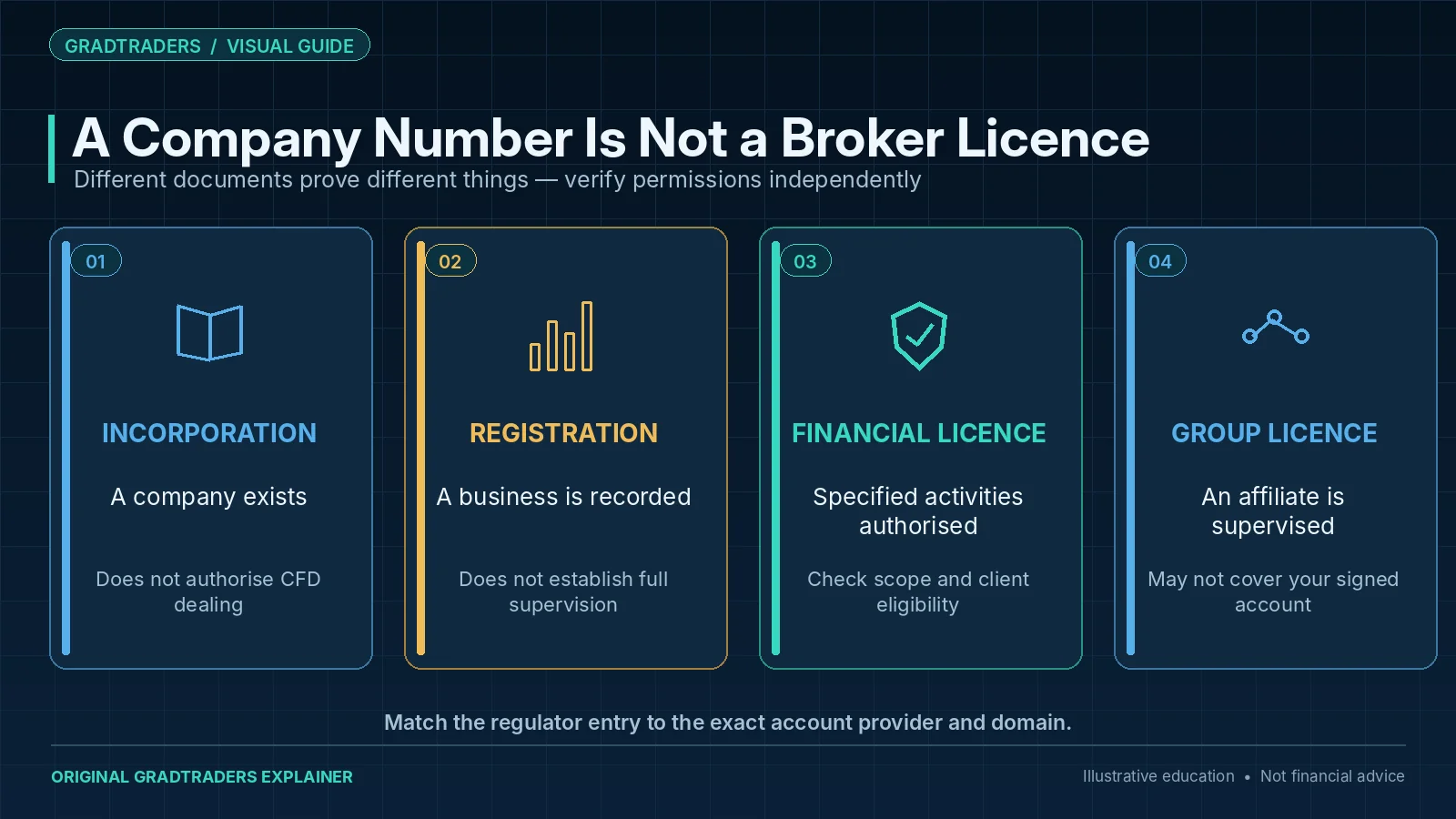
Licence, Registration And Incorporation Are Not The Same
| Document Or Claim | What It May Prove | What It Does Not Prove | Required Follow-Up |
|---|---|---|---|
| Company incorporation | A legal company was created in that jurisdiction. | Permission to hold client money or deal in leveraged products. | Find the financial-services licence and scope. |
| Business registration | The company has a local registration or office record. | Active prudential or conduct supervision. | Read the regulator’s powers and broker obligations. |
| Financial licence | The regulator has authorised defined activities. | Every product, website or foreign customer is covered. | Match the entity, domain, permissions and customer location. |
| Group regulation claim | Another company in the group is regulated. | The customer’s offshore account receives that entity’s protection. | Read the account agreement and payment recipient. |
Higher Leverage Is A Margin Feature, Not A Safety Feature
A broker offering 500:1 leverage can require only £20 of margin to support £10,000 of exposure. A 1% adverse move still represents £100 before trading costs—the same market loss as the identical £10,000 position opened through a lower-leverage account.
Higher maximum leverage becomes especially dangerous when the trader uses the extra capacity to enlarge the position. It can also interact with faster stop-out levels, wider spreads during volatility and weaker negative-balance terms.
30:1 Route
Approximate initial margin on £10,000 exposure: £333.33.
100:1 Route
Approximate initial margin on £10,000 exposure: £100.
500:1 Route
Approximate initial margin on £10,000 exposure: £20.
Client Money And Negative Balance Must Be Read Separately
Client-Money Treatment
Check whether funds are legally treated as client money, where they are held, how often accounts are reconciled and what happens during insolvency. “Segregated” marketing can be narrower than a full statutory protection framework.
Negative-Balance Treatment
Check whether protection is mandatory or voluntary, applies per account or across the relationship, and excludes professional clients, abnormal markets, prohibited strategies or account abuse.
Withdrawal Risk Deserves Its Own Investigation
A broker can provide usable spreads and execution while deposits are flowing in, then reveal its real risk profile when the customer requests money out. Withdrawal terms deserve the same scrutiny as pricing and execution before the account balance becomes important.
Method
Confirm withdrawals return through the original payment route and identify any permitted alternatives.
Timing
Read processing times and distinguish broker approval from bank, card or wallet settlement.
Conditions
Check minimum amounts, currency conversion, verification and any bonus-related restrictions.
Escalation
Know the complaint email, regulator, dispute body and governing law before money becomes stuck.
Withdrawal Red Flags
Pay More To Release Funds
The broker demands an advance tax, insurance, account-unlocking fee or additional deposit before processing the withdrawal.
Unexpected Bonus Conditions
A bonus or credit suddenly creates a large trading-volume requirement that was not understood at deposit.
Account Manager Pressure
The broker insists that more trading or a larger deposit is required to recover losses or qualify for withdrawal.
Clone Firms And Impersonation Risk
Clone firms copy genuine company names, logos, addresses and licence numbers. ASIC’s investor alerts and the FCA Warning List both include impersonation and clone concerns, while IOSCO’s international alert network aggregates warnings from member regulators.
Domain Match
Compare every character in the broker domain with the regulator’s official record and the genuine group website.
Contact Match
Use the telephone number and email address recorded by the regulator rather than details supplied by the caller.
Payment Match
The beneficiary name should make sense in relation to the contracted legal company and disclosed payment provider.
Offshore Broker Verification: Ten-Step Process
Record The Legal Company
Copy the exact company name, number and registered address from the application and agreement.
Open The Regulator Register
Navigate independently to the regulator and search the company and licence number.
Read The Licence Scope
Confirm it covers leveraged dealing, derivatives and client-money activities where required.
Match The Domain
Confirm the website and contact details are those recognised by the regulator or genuine group.
Search Warning Lists
Check home, broker and international alert databases for unauthorised activity or impersonation.
Read Protection Terms
Review client money, negative balance, stop-out, governing law and dispute clauses.
Check The Payment Recipient
Confirm the bank, card or payment processor relates to the contracted entity.
Review Funding Terms
Check accepted funding methods, beneficiary details, currencies, fees and whether the payment recipient matches the contracted legal entity.
Review Withdrawal Terms
Check processing times, identity requirements, payment routes, fees and the escalation path if a withdrawal is delayed or rejected.
Set A Counterparty Limit
Decide how much capital exposure you are prepared to accept after considering the regulator, protections, complaint route and recovery risk.
Positive Signs And Warning Signs
Positive Evidence
- The legal company and regulator are disclosed before signup.
- The licence is independently verifiable and covers the activity.
- Client, margin and withdrawal terms are accessible and specific.
- No guaranteed returns, trading bonuses or deposit pressure are used.
- Support answers entity and protection questions in writing.
- Withdrawal methods, timing and escalation procedures are clearly documented.
Serious Warning Signs
- The ownership, company or licence is unclear or constantly changes.
- The broker uses social-media relationships or unsolicited account managers.
- Profits are guaranteed or losses are blamed on a need to deposit more.
- Crypto or personal bank transfers are required without a clear legal recipient.
- Withdrawals require extra tax, insurance or release payments.
- The website appears on a regulator or IOSCO warning database.
Who Should Not Use An Offshore Broker?
Beginners
New traders rarely need more leverage and may not yet recognise weak account terms, execution issues or withdrawal manipulation.
Traders Seeking Bigger Positions
Moving offshore solely to increase exposure is a direct risk-management failure rather than an operational improvement.
Anyone Unable To Verify The Entity
If the company, regulator, domain, payment recipient or withdrawal route cannot be confirmed, the account should not be funded.
What A Licensed Global Entity Can Change
Margin Requirements
A global entity may require less margin for the same exposure, but lower margin does not reduce the market loss on an identical position.
Platform Or Product Availability
A market, platform or workflow can differ between legal entities even within the same broker group.
Protection And Recourse
The regulator, client-money rules, complaint route and recovery options may differ materially from the trader’s local account choices.
Three Offshore Broker Scenarios
Established Group, Separate Global Entity
The company and licence are real and the terms are clear. The key question is how its protection, complaint and recovery framework compares with the trader’s local options.
Unknown Broker With A Licence Claim
The site displays a certificate but the regulator register, domain and permission scope cannot be matched.
Social-Media Forex Opportunity
A contact promises returns, demonstrates profits and demands additional payments when withdrawal is requested.
Common Offshore Broker Myths
“Offshore Means Scam”
False. Some global entities are legitimate. The correct conclusion is that protection and recourse vary and must be verified.
“A Licence Means Safe”
False. A licence can be genuine but narrow, lightly supervised or irrelevant to the customer’s country and product.
“High Leverage Is For Professionals”
False. High leverage is widely marketed to inexperienced customers and does not prove institutional quality or trader skill.
“A Famous Platform Protects Funds”
False. Trading software provides functionality; it does not replace regulation, client-money rules or withdrawal evidence.
“Good Reviews Prove Reliability”
False. Reviews can be outdated, incentivised, manipulated or refer to another entity within the broker group.
“Small Deposits Remove Risk”
False. Small tests reduce exposure, but identity theft, payment fraud and pressure to add funds can still occur.
What To Do If You Already Have Concerns
Stop Additional Payments
Do not send tax, insurance or unlocking fees in response to a blocked withdrawal.
Preserve Evidence
Save agreements, statements, emails, chat logs, payment records, wallet addresses and screenshots.
Contact Payment Providers
Ask the bank, card issuer or payment service about fraud reporting, recalls or chargeback options.
Report The Firm
Contact the relevant regulator, national fraud service and qualified legal adviser where appropriate.
GradTraders Best Native Platform Choice: Plus500
United Kingdom
GradTraders does not promote broker services to UK customers unless the relevant UK entity is authorised and regulated by the Financial Conduct Authority (FCA). Plus500UK Ltd (FRN 509909) is authorised and regulated by the FCA, and Plus500 is a firm we’re proud to partner with for our UK audience.
UK risk reminder: CFDs are leveraged products and can result in rapid losses. The provider-specific retail loss warning is displayed within the Plus500 banner above.
United States
For United States readers, Plus500 provides a separate futures service through Plus500US Financial Services LLC d/b/a Plus500, a Futures Commission Merchant registered with the U.S. Commodity Futures Trading Commission and a member of the National Futures Association (NFA ID 0001398).
The US futures service is separate from the UK CFD service provided by Plus500UK Ltd.
US risk reminder: Futures and options involve substantial risk of loss and are not suitable for every investor. Losses may exceed the amount originally invested. Trading privileges are subject to review and approval.
Partner disclosure: Plus500 is a GradTraders affiliate partner. GradTraders may earn a commission if an eligible account is opened through these links, at no additional cost to you. This commercial relationship does not alter the editorial analysis or verdict on this page.
Related GradTraders Research
FCA Broker vs Offshore Broker
Compare the UK protection route with global leverage, platform and margin alternatives.
Leverage By Country
See why maximum leverage changes across UK, EU, Australian, US, Japanese and global entities.
Compare Regulation
Compare FCA, ASIC, CySEC and offshore frameworks without treating every licence as equivalent.
Negative Balance Protection
Understand when losses are limited to account funds and why protection can change by entity or status.
High Leverage Risk
Separate legitimate capital efficiency from the danger of using maximum available exposure.
Compare Broker Routes
Review regulation, platforms, account routes and major trade-offs across the full comparison table.
Final Verdict
So, are offshore brokers safe? Some can be legitimate, but “offshore” covers everything from established licensed global companies to weakly supervised entities, unauthorised dealers and outright clones.
For most retail traders, a properly authorised local account remains the better default because the regulatory framework, complaint process and client protections are easier to verify and use. Higher leverage or lower margin is not enough reason on its own to accept weaker recourse.
A verified global entity may offer different platform, product or margin terms, but those differences should be assessed separately from the protection and recourse attached to the account. Verify the exact company and licence, check whether the service is available in your country, understand the client-money and complaint framework, and compare those protections with your local alternatives.
Popularity, a familiar platform and a licence somewhere are not proof of safety. The legal entity and the ability to recover money when something goes wrong matter more.
Research basis: GradTraders reviewed official material from the Financial Conduct Authority, Commodity Futures Trading Commission, Australian Securities and Investments Commission and International Organization of Securities Commissions. An additional 11 October 2026 factual check reconfirmed the FCA’s retail CFD leverage, margin-close-out and negative-balance measures, the importance of legal-entity verification, and official FCA/CFTC/ASIC warnings about unauthorised or clone firms. No substantive factual correction was warranted. Broker licences, permissions, warning lists and protection terms can change.
Official checks: FCA Firm Checker · FCA Warning List · FCA international firms · FCA CFD protections · CFTC registration checks · CFTC forex fraud guidance · IOSCO I-SCAN · ASIC online trading scam warning.
Explore GradTraders Internationally
Browse GradTraders’ country pages for local market and regulatory context. These are site-navigation links, not confirmation that an offshore broker is authorised, available or suitable in any jurisdiction.
Browse all 20 country gateways
Asia: Japan · South Korea · Taiwan · Hong Kong · India · Singapore · Thailand
Europe: Italy · Sweden · Switzerland · Germany · Norway
Americas: United States · Canada · Mexico
Middle East: United Arab Emirates · Saudi Arabia
Africa: South Africa
Oceania: Australia · New Zealand
Offshore Broker Safety FAQ
Are offshore brokers safe?
Some offshore brokers are genuine licensed businesses, but offshore status alone does not establish safety. The exact legal entity, regulator, client-money terms, negative-balance policy, withdrawal process and dispute route must all be verified.
Are offshore brokers always scams?
No. Large broker groups can operate legitimate international entities. However, unregistered dealers, lightly supervised entities and clone websites are also common, so the broker brand and trading platform are not enough evidence.
What is the biggest risk with an offshore broker?
The biggest risk is weak or impractical recourse when something goes wrong. A trader may face different client-money rules, no familiar local complaints or compensation route, foreign legal proceedings and difficulty enforcing a withdrawal or complaint.
Why do traders choose offshore brokers?
Common reasons include higher leverage, lower margin requirements, different products, platform availability and global active-trader pricing. These differences should be assessed separately from the protection and recourse attached to the account.
Is an offshore licence the same as FCA, ASIC or EU regulation?
No. Regulators differ in capital standards, supervision, client-money rules, leverage limits, disclosure, complaints and enforcement. A genuine licence can still provide materially different protection from the trader’s local retail framework.
Does a popular trading platform prove a broker is legitimate?
No. Regulators have warned that unregistered offshore dealers can use familiar trading software to create an appearance of legitimacy. The legal company and licence must be checked independently.
Should beginners use offshore brokers?
Most beginners are better served by a properly authorised local retail account. Extra leverage and different protection arrangements add complexity before the trader has developed reliable position sizing, execution awareness and account-verification habits.
How should I assess an offshore broker?
Verify the legal entity, licence scope, domain, payment recipient, client-money terms, negative-balance policy, withdrawal process, complaint route, local availability and regulator warning lists before making an account decision.
Can a broker move me from a local entity to an offshore entity?
A broker group may offer a separate global account, but the trader should receive a new legal agreement and clear disclosure of the company, regulator and protection changes. Do not assume the local entity’s protections continue.
What should I do if an offshore broker blocks a withdrawal?
Stop sending additional money, preserve account statements and communications, contact the named regulator and payment provider, check investor-warning databases and obtain legal or specialist fraud advice where the amount is significant.