Saxo Review 2026: Is It A Good Broker For Serious Traders And Investors?
Saxo is a premium multi-asset platform rather than a narrow forex or CFD broker. Its 8.6/10 GradTraders Rating reflects broad global-market access, SaxoTrader, SaxoInvestor, TradingView, advanced order tools, research, a flexible UK ISA and a dedicated SIPP route—balanced against tiered pricing, product-specific costs, no cTrader or MetaTrader route and no current UK financial spread-betting account.
By Matthew Jackson Matthew JacksonFounder of GradTradersIndependent trading research backed by more than 20 years of personal market experience., GradTraders · Live trading on YouTube · Last updated: 13 October 2026 · Last checked: 12 October 2026
The GradTraders View
Saxo interests me as a serious all-round investment and trading account: global shares, bonds, listed derivatives and capable platforms brought into one environment. Its biggest test is whether that convenience justifies the complete bill, including dealing, currency conversion, custody and eventual transfer costs. For an investor who uses the breadth, Saxo deserves consideration; for a narrowly focused trader, specialist accounts may offer better value.
Disclosure & Risk Notice: This article is for educational and informational purposes only and should not be considered financial advice, investment advice, tax advice or a personal recommendation. Trading CFDs, spread betting, forex, futures, crypto CFDs and other leveraged products involves significant risk and may not be suitable for all traders. You may lose some or all of your capital. Backtests, simulations, replay results, demo results and strategy tests do not guarantee future performance. Historical testing can be misleading if spreads, slippage, commissions, execution, liquidity, psychology and changing market conditions are ignored. Some GradTraders articles may contain affiliate links or references to partner offers. If you sign up, purchase or open an account through certain links, GradTraders may earn a commission at no additional cost to you.
Looking for GradTraders partner offers, broker discounts, prop firm promotions and trading platform deals? You can view the current offers and join the update list here: Access GradTraders Partner Offers.
Quick Verdict: Saxo Earns 8.6/10
Saxo is strongest when investing and trading need to share one serious account. It brings international shares, ETFs, funds and bonds together with listed options, futures, research and more advanced trading tools. That is a different proposition from opening a narrowly focused forex or index-CFD account.
My main reservation is cost rather than market breadth. A polished platform is valuable, but dealing commissions, foreign-currency conversion, custody, market data and financing can accumulate in very different ways. I would compare Saxo closely with Interactive Brokers for a global portfolio, and with a suitable specialist only when the strategy is mainly short-term leveraged trading.
The question I’d settle before opening an account: will I genuinely use Saxo’s multi-asset infrastructure, or am I paying for capability that sits idle? The account, pricing and product comparisons below make that decision more concrete.
Saxo Against The Alternatives: Different Jobs, Different Brokers
Saxo’s closest competitors change with the task. A portfolio of listed securities and options needs a different comparison from a short-term index-CFD strategy or occasional ETF buying. The table below follows those actual choices.
| Broker alternative | Choose Saxo when | Choose or compare the alternative when |
|---|---|---|
| Interactive Brokers | Saxo offers a more guided, integrated investing and research experience for someone who also trades listed derivatives. | IBKR deserves the closer look when currency management, professional order routing, APIs or options/futures transaction costs drive the decision. |
| IG, CMC Markets, City Index | Saxo is the more natural starting point for a portfolio of owned shares, bonds and funds alongside exchange-listed derivatives. | The alternatives offer distinct index/forex trading platforms and, for eligible UK clients, spread betting. Check each product and legal entity rather than treating them as interchangeable. |
| FxPro and Pepperstone | Saxo suits a broader investing account where a trading platform is only one part of the job. | Choose around the actual automated strategy if cTrader, MT4/MT5, VPS workflows or an eligible CFD/spread-betting account are essential. |
| IC Markets and FP Markets | Direct listed securities, bonds and a portfolio-led account make Saxo a different tool from an OTC CFD setup. | For frequent short-term forex/index CFD trading, compare the permitted entity, spread, commission, swaps, leverage and execution setup first. |
| XTB and eToro | Saxo gives investors who will use bonds, listed options/futures and deeper tools room to grow. | A simpler investment app may be the more economical and manageable choice when the task is mainly occasional share/ETF purchases. |
For me, the main divide is between owning and trading listed investments, and running a focused CFD strategy. Saxo and Interactive Brokers would be the two I’d compare for the first job. For the second, I’d look much harder at the specialist platforms and their trading costs. And if I only bought the occasional ETF, I wouldn’t pay extra for tools I’d rarely open.
What Is Saxo?
Saxo is a global trading and investment group founded in Denmark in 1992. The UK business operates through Saxo Capital Markets UK Ltd, while the wider group is built around the licensed Danish Saxo Bank structure.
The account is designed to combine conventional investing and active trading. Users can access global securities, funds, bonds, listed derivatives, forex and CFDs through the same broader platform ecosystem.
What catches my attention is the range of things you can do with the same brokerage relationship. Saxo makes much more sense to me as a serious investment account with trading facilities attached than as another place to trade a handful of forex pairs.
Saxo Ownership And Leadership In 2026
J. Safra Sarasin Group completed its acquisition of approximately 71% of Saxo Bank on 2 March 2026 after the required regulatory approvals. Founder Kim Fournais retained approximately 28% and moved from chief executive to chairman of the Board of Directors.
Daniel Belfer became Saxo Bank CEO at completion. Saxo’s April 2026 results reported 1.523 million clients and EUR 133 billion of client assets at the end of 2025.
The new majority owner is worth noting, but it doesn’t change the question I’d ask before opening an account: which Saxo company would I actually be dealing with? UK customers still use Saxo Capital Markets UK Ltd, the FCA-authorised business. Someone elsewhere needs to look at their own account entity and protections, not rely on the reputation of the group as a whole.
Trading Platforms: SaxoTrader, SaxoInvestor, TradingView And APIs
The important thing with Saxo’s platforms is knowing which one would actually be on your screen each day. SaxoInvestor makes sense for managing investments; SaxoTrader is where the more demanding market and order tools come in. I’d work backwards from the instruments and orders I intend to use rather than choose a broker because its platform list looks impressive.
| Job | Saxo setup | Named alternative and trade-off |
|---|---|---|
| Build an international investment portfolio | SaxoInvestor for shares, ETFs, funds and bonds; switch to SaxoTrader for more complex trades. | Interactive Brokers has GlobalTrader, Client Portal, Desktop and TWS. Both have simpler and advanced interfaces; compare research depth and costs. |
| Trade listed options and futures actively | SaxoTrader offers options chains, multi-leg tickets, portfolio analytics and a multi-screen workspace. | IBKR Trader Workstation (TWS) provides advanced order controls, routing and derivatives workflows. This is a direct product-to-product comparison. |
| Trade through TradingView | Supported stocks, forex, CFDs and futures connect; unsupported instruments must be traded in Saxo. TradingView scripts do not automate Saxo orders by default. | FxPro offers TradingView through eligible cTrader accounts, mainly for CFD trading. The supported instruments and pricing are different. |
| Run a ready-made Expert Advisor or cBot | No native MT4, MT5 or cTrader platform. Moving existing code requires a different integration. | FxPro supports MT4/MT5 and cTrader. Existing algorithms usually fit a compatible execution platform more directly than a rewrite. |
| Build custom automated execution | Saxo OpenAPI enables bespoke integrations; check actual endpoints, permission and product support. | IBKR has TWS and Client Portal APIs, including Python-oriented development. Compare authentication, order coverage and ongoing costs. |
There’s plenty here I like, particularly for someone combining investments with listed derivatives. But if I already had a working Expert Advisor or cBot, I wouldn’t rush to rebuild it around a different API. I’d compare IBKR’s TWS for listed-market trading and FxPro for established MT4, MT5 or cTrader workflows. That’s a more useful comparison than counting platform features. Official platform details: SaxoTrader, Saxo/TradingView, IBKR and FxPro.
Account Tiers, Demo Access, Currencies And Service
Saxo’s UK Classic account has no ordinary-account minimum deposit. That makes it accessible, but it doesn’t mean every account gets the most attractive prices on the website. Platinum and VIP can be reached through qualifying funds or trading activity, and the difference is worth looking at closely—particularly if you buy overseas investments and convert currency regularly.
| UK tier | Qualification / support | Examples of published UK transaction pricing | Currency conversion and custody |
|---|---|---|---|
| Classic | No ordinary-account funding minimum; standard human/digital support. | UK stocks/ETFs 0.08%; bonds 0.20%; stock options $2 per contract. | UK FX settlement conversion up to 0.60%; stocks/ETFs/bonds custody 0.12% p.a. |
| Platinum | £200,000+ qualifying funding or qualifying trading activity; priority support and eligible currency sub-accounts. | UK stocks/ETFs 0.05%; bonds 0.10%; stock options $1 per contract. | UK FX settlement conversion up to 0.40%; stocks/ETFs/bonds custody 0.12% p.a. |
| VIP | £1,000,000+ qualifying funding or qualifying trading activity; enhanced service and privileges. | UK stocks/ETFs 0.03%; bonds 0.05%; stock options $0.75 per contract. | UK FX settlement conversion up to 0.20%; stocks/ETFs/bonds custody 0.08% p.a. |
One detail I’d pay attention to is custody. On the published UK figures, Platinum cuts some dealing and currency-conversion charges, but its 0.12% annual rate on eligible securities remains the same as Classic’s. VIP has a lower published custody rate. I’d compare the benefits I’d actually receive, not aim for a tier simply because it sounds better. These are UK terms, with minimum commissions, venue costs, tax and other charges still relevant; Saxo’s UK tiers and fees provide the detail.
I’d also spend time with Saxo’s demo before committing to the platform. It is a sensible way to get used to the layouts and order tickets, particularly for someone new to SaxoTrader. Live fills, withdrawals and support are separate matters, so I’d judge those against the terms and actual account arrangements.
Stocks, ETFs, Funds, Bonds, Options, Futures And Global Markets
Saxo’s UK material advertises more than 71,000 instruments. That’s a big number, but the attraction for me is the mixture rather than the total. Being able to hold shares and bonds, then use a listed option or futures contract when the strategy calls for it, is a more meaningful advantage than adding another hundred markets I’ll never trade.
| What the investor wants | Saxo route | Named alternative | Decision that matters |
|---|---|---|---|
| Own listed shares and ETFs | Saxo offers direct listed shares and eligible ETFs with custody and FX charges to consider. | Interactive Brokers also offers directly held shares and ETFs. FxPro’s share CFDs are a different leveraged product. | Check actual share ownership and voting/corporate actions, not merely whether a broker lists a company name. |
| Hold bonds and funds | Saxo offers eligible direct bonds and funds alongside the share portfolio. | IBKR also offers bonds and funds; FxPro is oriented around OTC CFD instruments rather than a comparable bond portfolio. | The useful cost comparison is bond pricing/spread, fund access, market coverage and custody; ‘market count’ misses the differences. |
| Trade exchange-listed futures or options | SaxoTrader supports eligible listed contracts and tools for expiry, risk, strategy and margin. | IBKR TWS offers listed options and futures with a detailed trading/margin infrastructure. FxPro’s ‘futures’ CFD instruments are not interchangeable with exchange-listed futures contracts. | Contract specification, exchange fees, exercise/assignment, clearing and margin must match the strategy. |
| Trade forex or index CFDs | Saxo combines eligible forex and CFD markets with its broader investment account. | FxPro and Pepperstone offer specialist CFD trading environments including eligible cTrader/MetaTrader routes. | If the strategy depends on Expert Advisors, cBots or a narrow raw-spread/index-CFD workflow, compare the specialist account first. |
I’d put Saxo head-to-head with Interactive Brokers for that kind of listed-market account. I wouldn’t confuse it with an OTC CFD broker just because both firms offer access to a familiar index or share name. Owning the security and trading a contract on its price can lead to very different costs, rights and risks.
Execution, Orders, Margin, Research And Active-Trader Fit
SaxoTrader combines a lot and at times the user experience can feel as though its been over complicated. Buying a share is one thing; trading an option means thinking about strike, expiry, liquidity and assignment, while a futures position brings contract size, margin and roll dates into the picture. If I were using Saxo for those markets, I’d want the order ticket and position tools to make those details easier to manage.
I’d check the contract specification and the cost of holding the position before deciding whether I liked the platform. Saxo’s research and analytics could be useful, but they don’t make exchange fees, margin requirements or short-option risk disappear. A good-looking ticket is no substitute for understanding what you’re buying or selling.
Automation is another area where I’d be selective. Saxo OpenAPI offers a route for custom development, but it isn’t a plug-in replacement for an existing MetaTrader Expert Advisor or cTrader cBot. And connecting TradingView charts doesn’t automatically mean a strategy can send live orders through Saxo. I’d check the precise workflow before committing to it.
Saxo reported an average market-order execution speed of 0.012 seconds for July 2026. For a real strategy, I would pay closer attention to fills during the relevant market session, spreads, order rules and slippage than to one broker-wide speed figure.
Commissions, Currency Conversion, Custody And Account Costs
This is where Saxo becomes interesting—and where I’d be most careful. A few pounds saved on a share commission can be wiped out by converting the purchase currency, converting it back later, or paying custody year after year. I’ve put Saxo’s published UK prices alongside Interactive Brokers on the same example amounts, because that’s the sort of comparison I’d want before opening an account.
| Investment decision | Saxo UK | Interactive Brokers UK | Why it matters |
|---|---|---|---|
| Buy £10,000 of UK-listed shares | Classic £8; Platinum £5; VIP £3 at headline 0.08% / 0.05% / 0.03%. | UK stock commission is 0.05% at the standard tier: £5 for £10,000 before third-party charges. Minimum: £1 tiered or £3 fixed SmartRouting. | Saxo VIP’s headline UK-share rate is lower; Classic is higher. Compare minimums, venue fees and eligibility. |
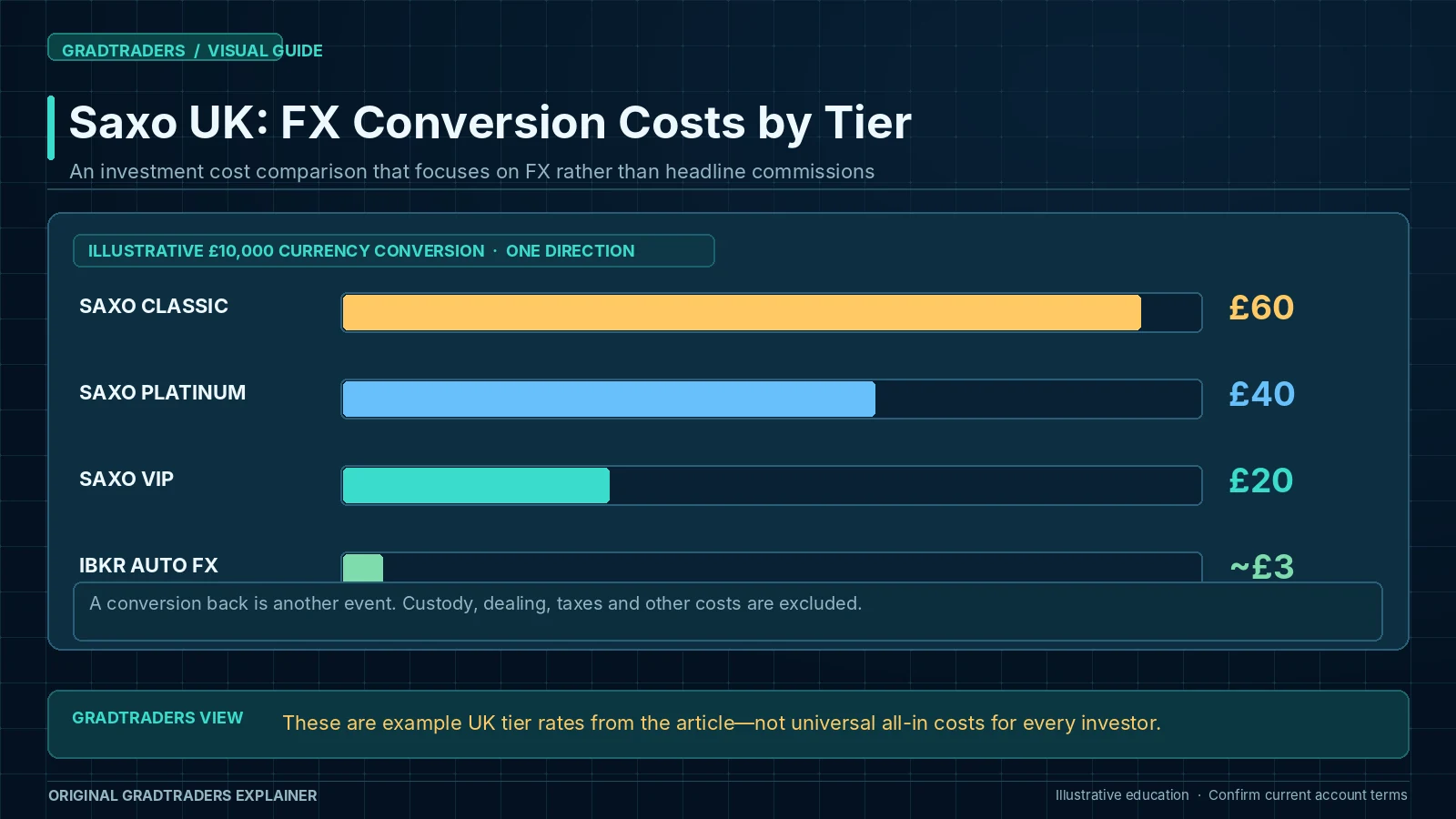
| Automatically convert £10,000 for a foreign share purchase | Classic £60, Platinum £40, VIP £20 at UK settlement-conversion rates of 0.60% / 0.40% / 0.20%. | IBKR typically applies a 0.03% exchange-rate adjustment for automatic conversion: about £3. A manual FX order has different pricing. | Saxo’s one-way FX cost exceeds this IBKR illustration by about £57 / £37 / £17. A conversion back is a second event. |
| Hold £50,000 of eligible shares, ETFs or bonds for a year | UK custody: £60 / £60 / £40 for Classic / Platinum / VIP at 0.12% / 0.12% / 0.08%. | No equivalent general UK stock custody percentage appears in IBKR’s share commission schedule, though its separate fee schedule lists market-specific pass-through custody charges. | Holdings and markets matter. Neither Saxo’s UK schedule nor a zero-custody assumption can be applied universally. |
| Trade US-listed stock options | Saxo UK account-tier examples: $2 / $1 / $0.75 per contract for Classic / Platinum / VIP. | IBKR’s US stock-option charges vary with contract premium and volume; published tiers, order minimums and applicable exchange fees matter. | Compare actual contract premium, quantity, exchange costs and margin, not only a headline per-contract rate. |
| Buy £10,000 of eligible foreign shares, hold a year, then sell and convert back | Illustrative £132 / £92 / £48 for Classic / Platinum / VIP, combining two £10,000 FX conversions plus one year of UK custody at constant portfolio value. | Two separate 0.03% automatic FX conversions would be about £6 together, before commissions and any market-specific custody charges. | The largest difference here is conversion and custody, not the initial share commission. This is not an all-in quote: assumes a return conversion is needed, unchanged asset and FX values, no currency-sub-account benefit, and excludes dealing, taxes and other fees. |
How the holding period changes the result: take the £10,000 foreign-share example above, keep its value and exchange rate unchanged, and extend the holding period to five years. Two conversions still cost an illustrative £120 / £80 / £40 at Saxo UK Classic / Platinum / VIP rates. Five years of eligible share custody add approximately £60 / £60 / £40, making a combined £180 / £140 / £80 before dealing commissions, taxes, market-specific charges and any other applicable fees. The comparable IBKR illustration still includes about £6 for two automatic FX conversions, before commissions or market-specific charges. The difference grows with time because custody recurs, whereas the example’s two conversions happen only on purchase and sale. These figures concern eligible shares at Saxo’s UK custody rate, not mutual funds; Saxo publishes a separate 0.05% UK fund custody schedule.
Sources and assumptions: Saxo UK account tiers, Saxo fee schedule, IBKR UK share commissions, IBKR currency fees, IBKR option fees and IBKR custody exceptions. Excludes applicable dealing minimums, market fees, taxes, currency movements and product-specific charges unless stated. The IBKR automatic FX rate is typical, not guaranteed; Saxo conversion and custody terms depend on country and tier.
What stands out to me: Saxo’s higher account tiers improve the picture, but the currency-conversion gap against IBKR can still be sizeable on an international portfolio. That wouldn’t rule Saxo out for me; it would mean asking whether I get enough value from the platform and service to justify the difference. Someone trading options or futures frequently would have to do a separate calculation around contracts, exchange fees, data and financing.
Forex, CFDs, TradingView And UK Spread-Betting Fit
It’s worth remembering that Saxo does offer forex and CFDs. I wouldn’t dismiss that side of the business, especially for an investor who also wants to trade a market view without opening another account. But the pricing, margin requirements and account permissions are different from buying the underlying investments, and those are the details I’d compare.
TradingView can be used for forex, supported CFDs, futures and stocks. Some indices and CFDs are unavailable through the integration, and automation is not enabled by default.
Saxo does not currently present a UK financial spread-betting account. Futures-spread tools and options combinations are different products and do not create the same UK tax treatment.
If spread betting were my main objective in the UK, I’d look at Pepperstone, IG, CMC Markets and the other eligible UK routes before Saxo. They are more directly set up for that type of account. Saxo comes back into the picture for me when the trading sits alongside a much broader investment portfolio.
If I were only looking for an index or forex trading account, I’d put the specialist brokers first. Saxo has more appeal when the investment side would get as much use as the trading side.
Funding, Portfolio Transfers, Withdrawals And Reliability
For someone moving a meaningful investment portfolio, the operational test is bigger than whether an account can be funded by bank transfer. I would ask three questions before moving assets to Saxo.
Can my existing holdings move without being sold? Saxo provides transfer arrangements for eligible share positions, but the actual security, fractional holdings, existing broker’s charges and any period out of the market need checking. Selling and repurchasing merely to change broker could generate taxes, dealing costs and another currency conversion.
Can I hold and withdraw the currencies I need? Saxo has multicurrency arrangements, with additional UK currency sub-accounts subject to eligibility and tier conditions. I would check which cash currency the account settles in, whether repeated conversions are necessary, the verified-bank-account withdrawal route, and what banks on either side may charge.
What would it cost to leave? Saxo’s UK schedule lists €50 per ISIN for outgoing stock transfers, capped at €160. Four eligible security lines therefore reach the cap on that schedule, before any receiving-provider charges. An account that looks inexpensive to open can be expensive to move later. Service priority, escalation routes and local support availability also vary by tier and location.
I’ve seen enough of brokerage accounts to value the practical side as much as the list of tradable markets. With a serious investment portfolio, transfers and currency arrangements can be expensive mistakes to discover too late. Our support and account-reliability comparison is useful reading alongside Saxo’s own transfer and withdrawal terms.
Flexible ISA, SIPP, Regulation And Client Protection
Saxo Capital Markets UK Ltd is authorised and regulated by the Financial Conduct Authority under FRN 551422. It is a distinct account route within the wider Danish banking group; the contracting entity and applicable protections matter more than the parent group’s reputation alone.
| UK route | What is available | Practical distinction |
|---|---|---|
| Standard investments | Eligible stocks, ETFs, funds, bonds and other listed products through Saxo’s UK investment accounts. | Direct securities ownership, custody rules, commissions and currency costs; market losses remain possible. |
| Flexible stocks-and-shares ISA | Saxo advertises more than 23,000 eligible instruments across more than 25 exchanges. | UK tax-wrapper rules and permitted assets apply; not a CFD or spread-betting account. |
| SIPP investing | A Saxo investment platform route supported by approved pension trustees and administrators. | Pension administration, trustee fees and eligible investments must be checked separately. |
| Margin and derivatives | Eligible forex, CFDs, listed futures and options under applicable product permissions. | Different rules on leverage, liquidation, liability and compensation; segregated assets do not protect against market losses. |
The official UK account range and GradTraders regulation comparison provide routes for checking protections. ISA, SIPP and FCA arrangements described here should not be assumed available to overseas clients.
International Saxo Accounts: Different Rules, Different Costs
One thing I’d be especially careful about with Saxo is assuming the same deal applies worldwide. An account in London, Zurich or Singapore can mean different custody charges, product access and investor protections. Saxo is an international group, but what matters to the customer is the local business they’re actually dealing with. The countries below illustrate those differences; they are not a list of guaranteed new-account eligibility.
| Market / route | Relevant service and oversight | What would change for the reader |
|---|---|---|
| United Kingdom | Saxo Capital Markets UK Ltd — FCA, FRN 551422. | UK ISA and trustee-administered SIPP routes; UK-specific Classic/Platinum/VIP fees and investor safeguards. |
| Denmark / eligible European countries | Saxo Bank A/S — Danish Financial Supervisory Authority; local branches/arrangements where applicable. | A Danish banking-group route is not the UK FCA account; custody, taxation and product access depend on the client’s own service. |
| Switzerland | Saxo Bank (Switzerland) Ltd — FINMA-regulated Swiss bank. | Separate Swiss banking and depositor rules; Saxo advertises no custody fees on its Swiss site, unlike the UK example. |
| Singapore | Saxo Capital Markets Pte Ltd — Monetary Authority of Singapore (MAS). | Singapore product and client-money rules apply. Local risk warnings say margin losses may exceed deposits. |
| Australia | Saxo Capital Markets (Australia) Ltd — ASIC, AFSL 280372. | Australian account permissions, local disclosures and SMSF options differ from UK ISA/SIPP and European structures. |
| Japan | Saxo Bank Securities Ltd — local Japanese regulated route. | Japanese services and eligible instruments require their own terms; being listed as a served country does not make UK products available. |
| United States | Not listed among countries Saxo currently services in its published help-centre country list. | US readers should not infer eligibility from international marketing or from Saxo’s non-US group licences. |
The country difference is an actual cost difference. Saxo’s published international schedule shows no custody fee on specified holdings for accounts in Denmark and Switzerland, whereas the UK lists 0.12% annually on eligible shares, ETFs and bonds for Classic/Platinum and 0.08% for VIP. Singapore’s terms can also change depending on the holding and whether securities lending is enabled. On £100,000 of eligible UK holdings, 0.12% is £120 a year before any other applicable charges. The comparison is not simply which country has the lower dealing commission: Saxo’s published international custody conditions make the account location material.
For account eligibility, use Saxo’s serviced-country guidance; it does not guarantee acceptance of a new application. The group licences, Singapore disclosures and Australian licences remain the official starting points for entity checks.
If I lived outside the UK, I wouldn’t start with a British review’s commission example and assume it applied to me. I’d look up the local Saxo business, its charges and the products it could offer first. That matters far more than seeing the same company name on the website.
Who Is Saxo Best For?
Serious Investors
- You want global stocks, ETFs, funds and bonds.
- You value research and portfolio tools.
- You need an ISA or SIPP route.
- You prefer a premium integrated platform.
Multi-Asset Traders
- You trade options or futures.
- You use forex or CFDs alongside investments.
- You value advanced orders and research.
- You understand product-specific costs.
Narrow Retail Workflows
- You require cTrader or MetaTrader.
- You mainly want UK spread betting.
- You need raw-spread CFD pricing.
- You want the simplest beginner app.
GradTraders Best Native Platform Choice: Plus500
United Kingdom
GradTraders does not promote broker services to UK customers unless the relevant UK entity is authorised and regulated by the Financial Conduct Authority (FCA). Plus500UK Ltd (FRN 509909) is authorised and regulated by the FCA, and Plus500 is a firm we’re proud to partner with for our UK audience.
UK risk reminder: CFDs are leveraged products and can result in rapid losses. The provider-specific retail loss warning is displayed within the Plus500 banner above.
United States
For United States readers, Plus500 provides a separate futures service through Plus500US Financial Services LLC d/b/a Plus500, a Futures Commission Merchant registered with the U.S. Commodity Futures Trading Commission and a member of the National Futures Association (NFA ID 0001398).
The US futures service is separate from the UK CFD service provided by Plus500UK Ltd.
US risk reminder: Futures and options involve substantial risk of loss and are not suitable for every investor. Losses may exceed the amount originally invested. Trading privileges are subject to review and approval.
Partner disclosure: Plus500 is a GradTraders affiliate partner. GradTraders may earn a commission if an eligible account is opened through these links, at no additional cost to you. This commercial relationship does not alter the editorial analysis or verdict on this page.
Saxo Pros And Cons
Saxo Pros
- Integrated research, portfolio oversight and advanced order management.
- FCA-regulated UK entity and established banking group.
- SaxoTrader and SaxoInvestor platform ecosystem.
- TradingView and API connectivity.
- Global stocks, ETFs, funds and bonds.
- Listed options, futures, forex and CFDs.
- Flexible UK ISA and dedicated SIPP route.
- No minimum initial funding for ordinary UK accounts.
Saxo Cons
- No native MT4, MT5 or cTrader route for established automated strategies.
- No current UK financial spread-betting account.
- Currency conversion, custody, financing and minimum commissions can add up.
- Some TradingView products and automation routes are unavailable.
- SIPP access requires an approved trustee.
- Smaller, simpler portfolios may not justify the overall account cost.
One Saxo Account Or Two Specialist Brokers?
There is a practical difference between having everything on one platform and having the right account for each job. Consider an investor holding international shares and bonds who also takes short-term index CFD trades. Saxo can bring both activities together, but the investment costs are driven by custody, dealing and currency conversion, while the CFD trades depend on spreads, financing and the execution platform. Those are two different calculations.
I’d price Saxo against two separate arrangements: Interactive Brokers for the long-term investments and an eligible specialist such as FxPro for the CFD strategy. The comparison would include a year’s actual transactions, conversions, holding charges, platform/data costs and the practical inconvenience of separate accounts. Saxo could justify a premium through better organisation; it would need to be a benefit I’d genuinely use, not simply the attraction of one login.
Further Reading And Broker Comparisons
For the closest broker-to-broker decision, read Saxo vs Interactive Brokers. The 24-broker comparison bank puts Saxo’s 8.6/10 alongside the wider market, while the broker costs research provides a broader pricing comparison.
For the details behind that choice, explore market and product coverage, platform coverage, and wealth beyond trading. These comparisons matter most when you know what you actually want the account to do.
My View On Saxo
The most interesting part of Saxo’s offering is what it allows a serious investor to manage without reducing everything to a CFD position. Direct holdings, listed bonds and funds can form the portfolio, while eligible exchange-listed options or futures bring different ways to manage exposure. Those instruments have their own permissions, contract obligations and costs; that distinction is precisely why Saxo deserves comparison with a proper international brokerage rather than an index-CFD provider.
SaxoInvestor and SaxoTrader make more sense viewed as two ways of working within a larger account, not as a competition over which screen has more features. An investment allocation and a multi-leg options order demand different tools. The value is in moving between them without treating the underlying investments and active positions as unrelated decisions.
I’d measure that advantage against Interactive Brokers on the transactions actually expected over several years. IBKR has compelling order and currency tools; Saxo’s attraction is the way its investing, research and trading workflow hangs together. The comparison should include the cost of the portfolio sitting there between trades, not simply the day a position is opened.
Final Verdict: Saxo Earns 8.6/10
Saxo earns its place on an international investing shortlist by combining direct securities, research and listed-derivatives capabilities with interfaces suited to both portfolio management and active orders. That combination matters most when an investor genuinely expects to use more than straightforward share dealing.
Its real test against Interactive Brokers is the total cost of ownership of an international portfolio. Currency conversions, transaction charges, custody and the account’s ongoing usefulness all play a part. The one- and five-year illustrations in this review show how the balance can change as the holding period lengthens.
International readers should judge the account available in their country, because Saxo’s local charges and protections are not identical. If the products and overall costs suit the portfolio, I regard Saxo as a strong contender. If the main requirement is a specialist forex or index-CFD setup, I would choose around that strategy instead. That’s where the distinction between a serious multi-asset broker and a specialist trading account really matters.
Explore GradTraders Internationally
Browse GradTraders’ country pages. These links are for site navigation only; they do not confirm broker availability, regulatory status or eligibility.
Browse all 20 country gateways
Asia: Japan · South Korea · Taiwan · Hong Kong · India · Singapore · Thailand
Europe: Italy · Sweden · Switzerland · Germany · Norway
Americas: United States · Canada · Mexico
Middle East: United Arab Emirates · Saudi Arabia
Africa: South Africa
Oceania: Australia · New Zealand
Saxo Review FAQ
Is Saxo a good broker?
Saxo earns 8.6/10 in the GradTraders broker bank. It is a strong premium choice for serious traders and investors who want global investments, listed derivatives, research and tax-wrapper access.
Is Saxo regulated in the UK?
Yes. Saxo Capital Markets UK Ltd is authorised and regulated by the Financial Conduct Authority under firm reference number 551422.
Does Saxo support TradingView?
Yes. Saxo supports TradingView connectivity for forex, supported CFDs, futures and stocks. Not every Saxo instrument or automated strategy is available through the integration.
Does Saxo support MT4, MT5 or cTrader?
Saxo is not a native MT4, MT5 or cTrader broker. Its main routes are SaxoTrader, SaxoInvestor, TradingView and connectivity APIs.
Does Saxo offer UK spread betting?
No current UK financial spread-betting account is clearly offered. Saxo should be treated primarily as an investment, listed-products, forex and CFD platform.
Does Saxo offer an ISA?
Yes. Saxo offers a flexible stocks-and-shares ISA with access to more than 23,000 eligible instruments across more than 25 exchanges.
Does Saxo offer a SIPP?
Yes. Saxo provides a SIPP investment route through approved pension trustees and administrators. Trustee fees and pension-specific rules should be checked separately.
Sources and fact-checking: The GradTraders 24-broker comparison bank, Saxo’s published account and pricing terms, company announcements and relevant regulatory records underpin this review. UK account tiers and custody rates were checked against Saxo’s published terms on 11 October 2026. Pricing, product permissions and protections can differ by country and account.
Official Saxo research: accounts and tiers · platforms · TradingView · products · ISA · SIPP.
Useful GradTraders research: 24-Broker Comparison Table · Market Coverage · Regulation & Protection.
2026 corporate and execution checks: J. Safra Sarasin majority acquisition · 2025 results published April 2026 · July 2026 execution statistics.
Risk reminder: conventional investments, listed derivatives, forex, CFDs, ISA products and SIPP products have different legal, tax and risk structures. Confirm the exact account and product before funding or transferring assets.