What Is Slippage In Trading?
Slippage in trading is the difference between a reference price and the price actually filled. I would assess it through a record of real executions, not assume that every worse fill proves a broker problem or that every fast fill is good. Check positive and negative slippage, the size of the differences and the market conditions at the time; for a short-term strategy, those outcomes can materially alter its costs.
 Matthew Jackson
Founder of GradTraders
Independent trading research backed by more than 20 years of personal market experience.
, GradTraders ·
Live trading on YouTube ·
Last updated: 10 October 2026
Matthew Jackson
Founder of GradTraders
Independent trading research backed by more than 20 years of personal market experience.
, GradTraders ·
Live trading on YouTube ·
Last updated: 10 October 2026Slippage can come from volatility, gaps, liquidity, order size, network delay or broker handling. Judge the complete execution outcome rather than assuming every price difference has the same cause.
Disclosure & Risk Notice: This article is for educational and informational purposes only and should not be considered financial advice, investment advice, tax advice or a personal recommendation. Trading CFDs, spread betting, forex, crypto CFDs and other leveraged products involves significant risk and may not be suitable for all traders. You may lose some or all of your capital. Some GradTraders articles may contain affiliate links or references to partner offers. If you sign up, purchase or open an account through certain links, GradTraders may earn a commission at no additional cost to you.
Looking for GradTraders partner offers, broker discounts, prop firm promotions and trading platform deals? You can view the current offers and join the update list here: Access GradTraders Partner Offers.
Quick Verdict
Slippage in trading is neither automatically bad nor automatically evidence of broker misconduct. It is the price difference created when the order cannot be completed at the reference price and must interact with the liquidity actually available.
Positive slippage gives the trader a better result. Negative slippage gives a worse result. The important questions are how often each occurs, how large the differences are, whether they match the market conditions and whether the broker’s execution policy treats favourable and unfavourable price movement consistently.
Short-term and highly active strategies are most sensitive because slippage can consume a large share of a small expected profit. Longer-term traders face it less frequently, but gap risk, stop execution and larger orders can still create substantial differences.
Reference Price
The documented quote, trigger, limit or benchmark used to assess the order.
Execution Price
The actual price or volume-weighted average price received for the filled quantity.
Slippage
The difference between those values, adjusted for buy or sell direction and order size.
Slippage In Trading Meaning
Slippage occurs when the price available at execution differs from the price the trader expected or used as a reference. The change can happen while the order is travelling, being validated, routed, queued or matched against available liquidity.
The reference price must be chosen carefully. For a market order, it may be the executable bid or ask visible when the order is sent. For a stop order, it may be the stop trigger. For a limit order, the limit is a price boundary rather than a promise that the order will fill.
Direction-adjusted concept: a buy is negatively slipped when it executes higher and positively slipped when it executes lower. A sell is negatively slipped when it executes lower and positively slipped when it executes higher.
Basic Slippage Formula
Buy Order
Buy slippage = execution price − reference price.
A positive numerical result is a worse fill for the buyer; a negative numerical result is price improvement.
Sell Order
Sell slippage = reference price − execution price.
A positive numerical result is a worse fill for the seller; a negative numerical result is price improvement.
This direction-adjusted convention makes positive numbers represent execution cost and negative numbers represent improvement. Trading platforms and research tools may use different sign conventions, so methodology should always be stated.
Worked Buy And Sell Examples
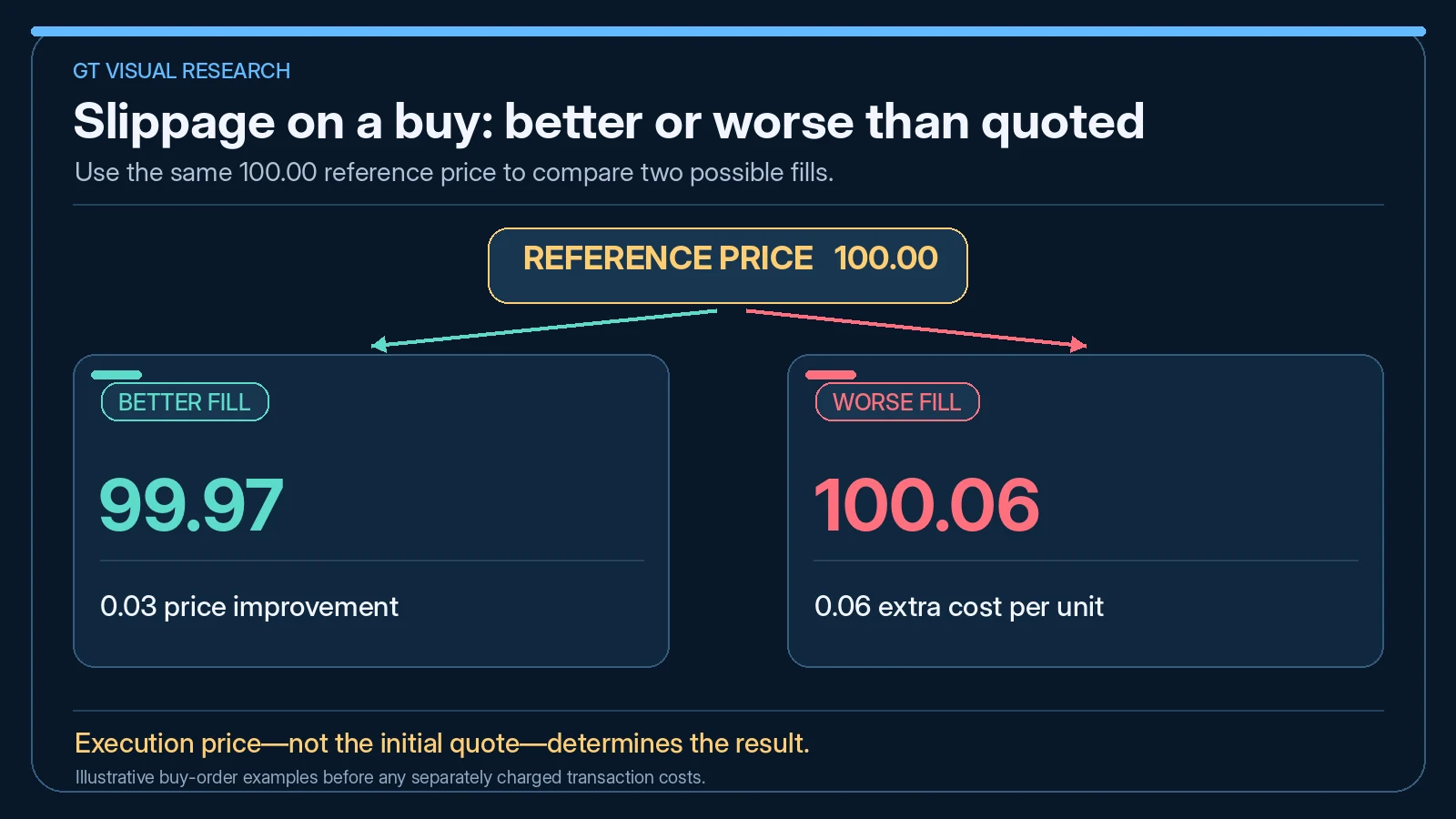
| Order | Reference | Fill | Result | Interpretation |
|---|---|---|---|---|
| Buy | 100.00 | 100.06 | 0.06 negative slippage | The trader paid 0.06 more per unit. |
| Buy | 100.00 | 99.97 | 0.03 positive slippage | The trader paid 0.03 less per unit. |
| Sell | 100.00 | 99.92 | 0.08 negative slippage | The trader received 0.08 less per unit. |
| Sell | 100.00 | 100.04 | 0.04 positive slippage | The trader received 0.04 more per unit. |
Slippage In Money, Points And Pips
A price difference only becomes meaningful when it is translated into position size and contract value. A small number of points can be negligible on one trade and material on another.
Price Difference
Execution price minus the properly defined reference, adjusted for direction.
Position Value
The quantity, stake, contract multiplier or pip value attached to the trade.
Monetary Impact
Slippage cost = direction-adjusted price difference × position value per price unit.
Example: 1.5 points of negative slippage on an index position worth £10 per point creates a £15 execution cost before spread, commission and financing.
Positive Slippage vs Negative Slippage
Positive Slippage
The market or available liquidity changes in the trader’s favour and the broker executes at the improved price.
- A buy fills below the reference ask.
- A sell fills above the reference bid.
- The final trading cost is reduced.
Negative Slippage
The market or available liquidity changes against the trader and execution occurs at a less favourable price.
- A buy fills above the reference ask.
- A sell fills below the reference bid.
- The final trading cost is increased.
The Reference Price Depends On The Order
| Order Situation | Possible Reference | Important Limitation |
|---|---|---|
| Market buy | Executable ask displayed when submitted | The quote can change and may show less size than requested. |
| Market sell | Executable bid displayed when submitted | The last traded price is not necessarily the executable bid. |
| Stop order | Stop trigger price | The trigger usually activates another order and is not a guaranteed fill. |
| Limit order | Limit price | The limit controls the worst permitted price but does not guarantee execution. |
| Partially filled order | Reference compared with volume-weighted average fill | Each portion can execute at a different price. |
| Broker investigation | Server-side timestamp and price record | A chart screenshot alone may not show the executable side or available quantity. |
Why Slippage Happens
Price Movement
The market changes between submission, activation and execution.
Limited Liquidity
Insufficient quantity is available at the reference price, requiring execution at additional levels.
Market Gap
No tradable prices exist between the previous market and the reopening level.
Order Size
The requested quantity exceeds the liquidity available at the best displayed price.
Network Delay
The order takes longer to reach the broker because of distance, routing, Wi-Fi or connection instability.
Broker Processing
Validation, risk controls, bridging, internalisation or external routing add time before completion.
Queue Position
Orders already resting at the same price can receive available quantity first.
Spread Change
The bid or ask moves even when the underlying midpoint appears relatively stable.
Order Types And Slippage
| Order Type | Primary Objective | Slippage Exposure | Main Trade-Off |
|---|---|---|---|
| Market order | Execute promptly at available prices | Can receive positive or negative slippage | Execution priority over price certainty |
| Limit order | Execute only at the limit or better | Should prevent a worse price than the limit | May not fill or may fill only partially |
| Stop order | Activate after a trigger is reached | Can execute materially beyond the trigger | Activation does not guarantee the exit price |
| Stop-limit order | Trigger an order with a price boundary | Prevents execution beyond the limit | The position may remain open during a rapid move |
| Guaranteed stop | Close at the guaranteed level under qualifying terms | Designed to remove gap slippage at that stop | Premiums, distance rules and product limits |
A Stop Price Is Usually A Trigger, Not A Guaranteed Fill
When a standard stop is reached, it commonly activates a market-style instruction. If the market has moved through the stop or reopened beyond it, execution can occur at the next price where liquidity is available.
Continuous Liquid Market
The stop can execute close to its trigger because prices and size remain available nearby.
Fast Intraday Move
Several price levels can disappear while the activated order is being completed.
Weekend Or Overnight Gap
The first executable price can be far beyond the stop because no intermediate market was available.
Spread, Slippage, Commission And Market Impact
| Cost | What It Represents | How It Appears |
|---|---|---|
| Spread | The difference between the executable bid and ask. | The position begins relative to the opposite side of the quote. |
| Commission | A separately charged fee based on volume, contracts or trade value. | Account charge or included transaction cost. |
| Slippage | The difference between the reference and actual fill. | A better or worse execution price. |
| Market impact | Price movement caused or amplified by executing the requested size. | Multiple fills and a worse average price for larger orders. |
| Financing | The cost or credit for holding the position over the broker’s financing period. | Separate overnight adjustment rather than entry slippage. |
All-in execution cost should normally be assessed using spread, commission, direction-adjusted slippage and any market-impact cost rather than one headline component.
Slippage vs A Market Gap
Slippage
The execution difference between the properly defined reference and the received fill.
Gap
A discontinuity where the market moves from one tradable area to another without available prices in between.
A gap is one cause of slippage, but slippage can also occur in a continuously trading market when quotes or available quantities change before completion.
Slippage And Broker Execution Speed
Lower latency reduces the time during which the market can move against an order, but speed cannot guarantee the reference price. A 20-millisecond route can still encounter poor liquidity, while a slower route can receive price improvement if the market changes favourably.
Fast And Good
The order is processed quickly and receives a competitive price with reliable fill handling.
Fast But Poor
The broker responds rapidly but fills at a weak price or rejects the order.
Slower But Improved
The final price is better than the reference despite a longer response time.
Best Execution Is Wider Than Slippage
FCA best-execution rules identify price, costs, speed, likelihood of execution and settlement, size, nature and other relevant considerations. Slippage belongs within that wider outcome rather than acting as a standalone verdict.
For retail clients, price plus execution-related costs normally has particular importance. A broker with marginally tighter displayed spreads can still produce a weaker total result if slippage, rejections or partial fills are materially worse.
Price
The actual execution compared with reliable market or underlying references.
Costs
Spread, commission, venue fees, mark-ups and other execution-related charges.
Speed And Likelihood
How quickly and reliably the order can be completed at an acceptable result.
Size And Nature
The quantity, instrument, urgency, order type and other characteristics.
One-Sided Slippage Is A Serious Warning Sign
A fair market can naturally produce both favourable and unfavourable price changes. Historical CFTC enforcement has addressed systems that passed unfavourable slippage to retail forex clients while withholding equivalent favourable movements.
A single comparison cannot prove asymmetry. The trader needs a meaningful sample, reliable timestamps, the correct bid or ask reference and separation by instrument, size, order type and market condition.
Normal Pattern
Both positive and negative slippage occur, with distributions changing logically during volatility and thin liquidity.
Concerning Pattern
Favourable changes are repeatedly withheld while unfavourable changes are consistently applied.
Market Conditions That Increase Slippage
Major Economic Releases
Prices reprice quickly while spreads widen and liquidity providers withdraw or reduce size.
Market Open
Overnight information is incorporated rapidly and opening liquidity can be uneven.
Weekend Reopening
Forex, indices and other products can reopen away from Friday’s closing area.
Rollover And Thin Sessions
Reduced liquidity can widen spreads and limit quantity at the best price.
Unexpected Headlines
Geopolitical, corporate or policy news can create immediate repricing without warning.
Market Suspension
Trading resumes after information has changed, potentially at a distant price.
Slippage Across Different Markets
| Market | Typical Slippage Drivers | Important Check |
|---|---|---|
| Forex and rolling spot | News, session changes, liquidity-provider depth and broker pricing | Bid/ask reference, entity, mark-up and positive-slippage treatment |
| Index CFDs and spread bets | Underlying futures, cash-market opens, out-of-hours pricing and macro events | Broker trading hours and underlying-price methodology |
| Share CFDs and shares | Opening auctions, earnings, limited depth, halts and order size | Exchange status, queue priority and partial fills |
| Exchange-traded futures | Order-book depth, queue position, volatility and contract rollover | Exchange timestamps, market data and routing |
| Crypto markets | Fragmented venues, continuous trading, rapid volatility and variable depth | Venue, product type, weekend liquidity and liquidation mechanics |
Order Size And Liquidity Depth
The best displayed price may be available for only a small quantity. If the order is larger, the remaining amount can execute across additional price levels, creating a volume-weighted average price.
| Available Sell Liquidity | Quantity | Buy Order Filled |
|---|---|---|
| 100.00 | 2 units | First 2 units |
| 100.04 | 3 units | Next 3 units |
| 100.10 | 5 units | Final 5 units |
| Volume-weighted average | 10 units | 100.062 average fill |
This example assumes the liquidity remains available. In a live market, other orders can trade first and prices can change while the order is executing.
Broker Model And Execution Route
Broker As Principal
The broker is the contractual counterparty and controls its quoted OTC price within the applicable rules and policy.
External Routing
The order is transmitted to a venue, counterparty or liquidity source where price and size may change.
Hybrid Internalisation
Some flow is matched or warehoused internally while net exposure can be hedged externally.
Marketing labels such as STP, ECN, DMA or “no dealing desk” do not eliminate slippage and are not substitutes for the execution policy, client agreement and observed live results.
Platform, Server And VPS Effects
The route from the trader to the broker can influence how long the reference price remains available. Stable connectivity and a nearby server may reduce one part of the delay, particularly for automated systems.
Platform
Order construction, plugins, bridges, integrations and server configuration can affect transmission and confirmation.
Network
Distance, internet routing, packet loss and jitter can delay the order or its returned confirmation.
VPS
A suitable VPS can improve uptime and network consistency but cannot improve broker pricing or create market liquidity.
GradTraders Best Native Platform Choice: Plus500
United Kingdom
GradTraders does not promote broker services to UK customers unless the relevant UK entity is authorised and regulated by the Financial Conduct Authority (FCA). Plus500UK Ltd (FRN 509909) is authorised and regulated by the FCA, and Plus500 is a firm we’re proud to partner with for our UK audience.
UK risk reminder: CFDs are leveraged products and can result in rapid losses. The provider-specific retail loss warning is displayed within the Plus500 banner above.
United States
For United States readers, Plus500 provides a separate futures service through Plus500US Financial Services LLC d/b/a Plus500, a Futures Commission Merchant registered with the U.S. Commodity Futures Trading Commission and a member of the National Futures Association (NFA ID 0001398).
The US futures service is separate from the UK CFD service provided by Plus500UK Ltd.
US risk reminder: Futures and options involve substantial risk of loss and are not suitable for every investor. Losses may exceed the amount originally invested. Trading privileges are subject to review and approval.
Partner disclosure: Plus500 is a GradTraders affiliate partner. GradTraders may earn a commission if an eligible account is opened through these links, at no additional cost to you. This commercial relationship does not alter the editorial analysis or verdict on this page.
Backtests And Demo Accounts Can Understate Slippage
Backtest
Historical models can use idealised bar prices, assumed fills or fixed slippage rather than reconstructing actual depth and queue position.
Demo Account
The platform can reproduce prices but may not expose the order to the same liquidity, size checks or rejection process.
Small Live Test
Real orders provide the most relevant evidence for the exact entity, platform, instrument and route.
How To Measure Slippage Properly
Define The Reference
Use the correct executable bid, ask, trigger or limit and record the timestamp.
Record The Fill
Capture price, filled quantity, average price, partial fills, rejections and server time.
Adjust For Direction
Apply one sign convention so a cost and an improvement are treated consistently for buys and sells.
Convert To Money
Multiply by contract size, pip value, stake or position quantity.
Segment The Sample
Separate instruments, order types, sizes, sessions, normal markets and news events.
Analyse Distribution
Review median, average, percentiles, maximum, variability and positive-fill frequency.
Include Failed Orders
Track rejections, cancellations, partial fills and missed trades rather than analysing fills alone.
Compare Policies
Investigate results that conflict with the broker’s stated execution and slippage procedures.
Useful Slippage Metrics
| Metric | What It Shows | Main Limitation |
|---|---|---|
| Average signed slippage | Net cost or improvement across the sample | Positive and negative results can cancel each other |
| Average absolute slippage | Typical magnitude regardless of direction | Does not show whether outcomes favour the trader |
| Median slippage | The middle result in the ordered sample | Can hide damaging tail events |
| 95th percentile cost | A slower or worse recurring tail outcome | Needs enough observations to be meaningful |
| Positive-slippage rate | How frequently fills improve | Frequency alone ignores the size of each result |
| Rejection rate | How often submitted orders receive no execution | Reasons must be separated by margin, market and system cause |
| Monetary slippage per trade | Direct impact in account currency | Must be normalised when sizes differ |
Execution Log Fields
Order Details
- Instrument and legal entity.
- Buy or sell direction.
- Order type and quantity.
- Account and platform route.
Price And Time
- Reference bid or ask.
- Submission and execution times.
- Fill prices and quantities.
- Spread and commission.
Market Conditions
- Normal, news, open or rollover.
- Volatility and visible depth.
- Connection or platform issues.
- Rejection or partial-fill reason.
How Traders Can Reduce Slippage
Trade Liquid Sessions
Use periods when the relevant market normally has deeper participation and tighter spreads.
Choose Order Types Carefully
Use limits when price matters more than certainty and understand the risks of activated stops.
Avoid Unnecessary News Risk
Do not submit market orders during major releases unless the strategy explicitly accepts the execution uncertainty.
Keep Size Realistic
Scale orders in line with available liquidity and test larger sizes gradually.
Use Stable Connectivity
Reduce avoidable delay from weak Wi-Fi, overloaded devices and unstable internet routes.
Consider A VPS
Automated systems may benefit from continuous hosting near the broker’s server region.
Test The Exact Account
Execution can differ by legal entity, account, platform, symbol and server.
Measure All-In Cost
Compare spread, commission, slippage, fill probability and operational reliability together.
When Slippage Is Usually Explainable
Major News
The fill differs while prices and spreads are changing sharply across the wider market.
Visible Gap
The instrument reopens beyond the stop with no tradable prices between the close and new level.
Large Order
The quantity fills across several levels and the average price follows available depth.
Slippage Red Flags
Persistent One-Way Outcome
Negative slippage is passed through while comparable favourable movement rarely improves fills.
Quiet-Market Outliers
Large unexplained differences repeatedly occur in liquid conditions with no wider price movement.
Different Treatment By Profitability
Execution deteriorates selectively after a strategy becomes successful or changes size.
Policy Mismatch
The order handling conflicts with the published execution, requote or price-improvement policy.
No Server Records
The broker cannot provide order timestamps, price history or an execution explanation for a disputed fill.
Entity Mismatch
The broker cites another group company’s execution statistics or policy rather than the entity holding the account.
What To Do About A Disputed Fill
Preserve Evidence
Save statements, screenshots, platform logs, timestamps, trade IDs and the accepted execution policy.
Check The Correct Quote
Use the relevant bid or ask and confirm the broker symbol, trading hours and price source.
Request Server Records
Ask for order-receipt, trigger, routing, fill and rejection information plus the contractual basis.
Use The Complaint Route
Escalate through the firm’s formal process and the relevant independent body where eligible.
Common Slippage Myths
“Slippage Is Always Bad”
False. A fill can improve when the executable price changes favourably.
“A Market Order Gets The Screen Price”
False. It seeks execution at available prices and does not guarantee the displayed reference.
“A Stop Guarantees The Exit Level”
False unless the product specifically provides a qualifying guaranteed stop.
“Low Ping Removes Slippage”
False. It reduces one delay component but cannot prevent price movement or limited liquidity.
“Tight Spread Means Best Execution”
False. Commission, slippage, fill probability and reliability determine the wider result.
“One Bad Fill Proves Manipulation”
False. A strong conclusion requires market context, reliable evidence and a repeated or unsupported pattern.
Three Trader Scenarios
Index Scalper
Targets three points and averages 0.8 points of entry and exit slippage combined. The execution cost consumes a large part of the expected edge.
Swing Trader With Weekend Stop
The market reopens below the stop after unexpected news. The order fills at the first available price rather than the trigger.
Automated Forex Strategy
A nearby VPS reduces network variability, but the strategy still experiences worse fills during rollover because market depth falls.
Slippage Review Checklist
Broker Documents
- Execution and conflicts policy.
- Order and stop definitions.
- Price-improvement and requote terms.
- Entity and governing law.
Live Testing
- Correct bid or ask reference.
- Normal and stressed markets separated.
- Positive and negative outcomes recorded.
- Rejections and partial fills included.
Decision
- Convert differences into money.
- Compare total execution cost.
- Review tail events and asymmetry.
- Scale only after consistent results.
Related GradTraders Research
Broker Execution Speed
Understand the complete order path and why milliseconds are only one execution-quality factor.
Trading Server Latency
See how device, network, server location and broker infrastructure influence transmission time.
Raw Spread Accounts
Compare spread, commission and execution trade-offs rather than relying on a minimum-spread claim.
Negative Balance Protection
Understand the liability backstop that can matter when gaps and failed exits create extreme losses.
Scalping And Day-Trading Brokers
Compare active-trader pricing, platforms, regulation and execution suitability.
Compare Broker Routes
Review regulation, platforms, account structures and costs across the complete comparison table.
Final Verdict
Slippage in trading is the difference between an order’s properly defined reference price and its actual execution. It can improve or worsen the trade and is a normal consequence of changing prices, limited liquidity, order size and execution delay.
The relevant broker-quality question is not whether slippage ever occurs. It is whether fills are handled consistently, whether favourable movement is passed to the trader, whether results match observable market conditions and whether the full process follows the stated execution policy.
GradTraders conclusion: calculate slippage in money, separate it from spread and commission, measure a meaningful live sample and investigate persistent asymmetry or unexplained quiet-market outliers. Choose the broker route producing the strongest total execution outcome—not merely the tightest advertised spread.
Research basis: GradTraders reviewed current official material from the Financial Conduct Authority, US Securities and Exchange Commission investor education service, European Securities and Markets Authority and US Commodity Futures Trading Commission. Order definitions, broker policies, platform routes and market structures can change.
Official checks: FCA COBS 11.2A best execution · Investor.gov order types · Investor.gov stop and stop-limit guidance · ESMA execution-policy report · CFTC one-sided slippage case · Plus500 regulated entities and order-execution documents · Plus500UK order execution policy · Plus500 UK client-money protection.
Explore GradTraders Internationally
Browse GradTraders’ country pages for regional trading context and related research. These links are for site navigation only; broker availability, regulatory status, account types, product eligibility and trading protections vary by country and legal entity.
Browse all 20 country gateways
Asia: Japan · South Korea · Taiwan · Hong Kong · India · Singapore · Thailand
Europe: Italy · Sweden · Switzerland · Germany · Norway
Americas: United States · Canada · Mexico
Middle East: United Arab Emirates · Saudi Arabia
Africa: South Africa
Oceania: Australia · New Zealand
Slippage In Trading FAQ
What is slippage in trading?
Slippage is the difference between the price used as the order reference and the price actually received. The reference can be the quote seen when a market order is sent, the trigger price of a stop order or another documented benchmark.
Is slippage always negative?
No. Positive slippage improves the fill, while negative slippage worsens it. A fair execution process can produce both outcomes as prices and available liquidity change.
Why does slippage happen?
Slippage occurs when the executable price or available quantity changes before the order is completed. Common causes include volatility, gaps, limited liquidity, large order size, network or processing delay and order-queue conditions.
Can a market order avoid slippage?
No. A market order prioritises execution at available prices rather than guaranteeing the displayed price. Fast markets or limited depth can cause different portions of the order to fill at different prices.
Can a limit order experience negative slippage?
A conventional limit order should not execute beyond its limit price, but it may remain unfilled or partially filled. Platform and product definitions should still be checked because order handling varies.
Why can a stop loss fill beyond the stop price?
A standard stop price is normally a trigger rather than a guaranteed execution price. Once triggered, the resulting order can fill at the next available price, which may be materially worse after a gap or rapid move.
Does faster execution eliminate slippage?
No. Lower delay can reduce exposure to price changes, but it cannot create liquidity or prevent a market from moving. Execution price, size, spread and routing still matter.
How should traders measure slippage?
Record the reference price, side, fill price, quantity, order type, spread, timestamps and market conditions. Analyse signed slippage, absolute slippage, median, slow-tail results, positive-fill rate, rejection rate and monetary impact.
Does slippage mean a broker is manipulating trades?
Not automatically. Slippage is a normal result of moving prices and limited liquidity. Concern rises when it is repeatedly one-sided, appears in quiet conditions, conflicts with the execution policy or cannot be supported by order records.
How can traders reduce slippage?
Use liquid markets and sessions, choose suitable order types, avoid unnecessary trading during major releases, keep order size realistic, maintain stable connectivity and test the exact broker entity and platform route with live data.