What Is A Raw Spread Account?
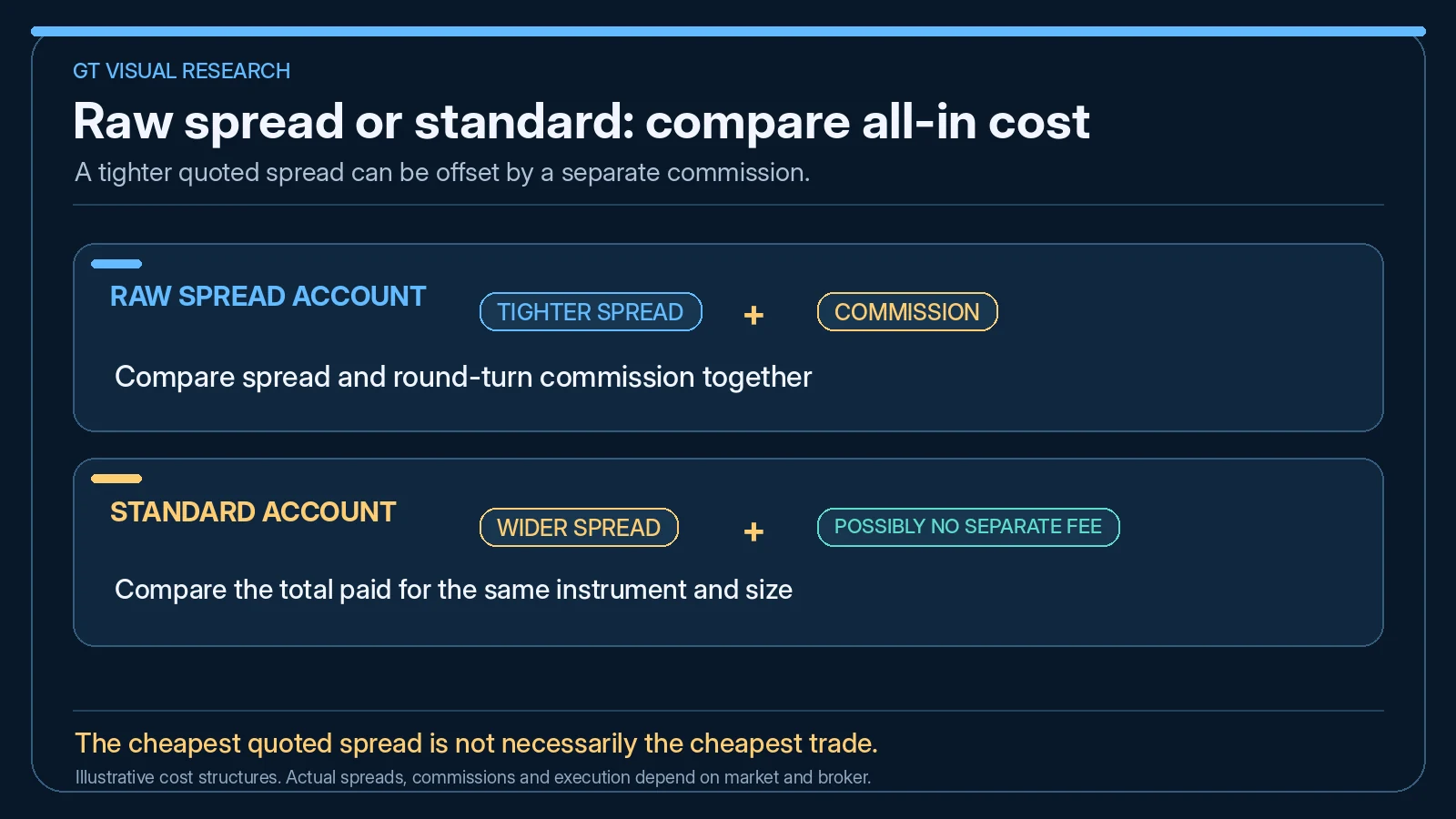
A raw spread account typically combines tighter quoted spreads with a separate commission. My comparison starts with the cost of the trade a person actually makes: spread, commission, slippage, financing and any account-specific charges. I would not recommend switching to a raw account just because the headline spread looks smaller; the full cost must suit the strategy and trading frequency.
 Matthew Jackson
Founder of GradTraders
Independent trading research backed by more than 20 years of personal market experience.
, GradTraders ·
Live trading on YouTube ·
Last updated: 11 October 2026
Matthew Jackson
Founder of GradTraders
Independent trading research backed by more than 20 years of personal market experience.
, GradTraders ·
Live trading on YouTube ·
Last updated: 11 October 2026Execution, regulation, platform fit, minimum trade size and funding terms still matter. A standard spread account can be the better choice when its total cost and practical fit are stronger.
Disclosure & Risk Notice: This article is for educational and informational purposes only and should not be considered financial advice, investment advice, tax advice or a personal recommendation. Trading CFDs, spread betting, forex, crypto CFDs and other leveraged products involves significant risk and may not be suitable for all traders. You may lose some or all of your capital. Some GradTraders articles may contain affiliate links or references to partner offers. If you sign up, purchase or open an account through certain links, GradTraders may earn a commission at no additional cost to you.
Looking for GradTraders partner offers, broker discounts, prop firm promotions and trading platform deals? You can view the current offers and join the update list here: Access GradTraders Partner Offers.
Quick Verdict
A raw spread account is designed for traders who want tighter quoted spreads and are comfortable paying a separate commission. It is most relevant to active forex traders, scalpers, algorithmic systems and higher-frequency strategies where small cost differences can compound.
“Raw spread” does not mean free trading. The broker can still earn through commission, instrument-specific mark-ups, overnight funding, swaps, conversion charges or other account costs. The headline spread is only one part of the trade.
The GradTraders decision rule is straightforward: compare spread + commission + slippage + funding + account-specific charges. If that complete number is not lower for your actual strategy, the raw account is not automatically the cheaper account.
Quoted Spread
The bid-ask gap shown for the instrument at the time you trade.
Commission
The explicit charge added to the raw pricing route, often calculated per lot or per side.
All-In Result
The practical cost after spreads, commissions, slippage, funding and other relevant charges.
Raw Spread Account Meaning
A raw spread account is a trading account where the broker aims to show a tighter spread that is closer to prices available from its liquidity sources. Instead of embedding more of its charge in the spread, the broker normally adds a separate commission when the trade is executed.
The spread is the gap between the buy price and sell price. A trader who buys at the ask and later sells at the bid must overcome that gap before the position becomes profitable. On a raw account that gap may be smaller, but the commission has to be added back when comparing costs.
This is why “spreads from 0.0 pips” should be read as a minimum pricing claim rather than a promise that every trade will cost zero. The useful number is the typical all-in cost for the market, session, size and platform you actually use.
Raw Spread vs Standard Spread Account
| Feature | Raw Spread Account | Standard Spread Account | GradTraders View |
|---|---|---|---|
| Pricing style | Tighter quoted spread, usually with a separate commission. | Wider spread, with more of the broker charge built into the quoted price on relevant products. | Raw pricing can make transaction costs easier to separate and measure. |
| Best fit | Active forex traders, scalpers, higher-volume traders and algorithmic systems. | Lower-frequency traders and traders who prefer one spread-based transaction cost on the relevant market. | Match the cost structure to trading frequency and instrument. |
| Cost visibility | Spread and commission are shown separately. | More of the trading charge is incorporated into the spread. | Separate commission is not a disadvantage if the total cost is lower. |
| Main risk | A tight headline spread can encourage traders to underestimate commission, slippage or overtrading. | A wider spread can be underestimated because the cost is less visibly separated. | The bigger problem is misunderstanding all-in cost. |
| Marketing trap | “From 0.0 pips” does not mean the average completed trade costs zero. | “Commission-free” does not mean cost-free. | Compare like-for-like completed trade costs. |
How To Calculate The Real Cost
The most useful way to judge a raw spread account is to calculate the all-in cost from entry to exit. The weight of each component changes with the strategy.
Spread
The distance between the broker’s buy and sell price when the trade is opened or closed.
Commission
The explicit execution charge, often stated per lot, per side or per transaction.
Slippage
The difference between the properly defined reference price and the price actually received.
Funding
Overnight financing, swaps or other holding charges that become more important on longer trades.
For very short-term trading, spread, commission and slippage usually dominate. For swing trading, overnight funding can become just as important. For long-term investing, a leveraged raw-spread CFD account may not be the appropriate product at all.
Where Raw Spread Accounts Fit In The GradTraders Broker Bank
Raw spread accounts sit in the active-trader part of the broker market. They are especially relevant when comparing providers that offer both commission-based raw pricing and a spread-based standard route. Official account-pricing material from Pepperstone, FP Markets and FOREX.com confirms versions of that distinction. As a specific US-market example, FOREX.com charges $7 per $100,000 of USD notional traded on each side of a RAW Pricing forex trade (a $14 round trip for $100,000 USD notional); those US account terms must not be assumed to apply to another jurisdiction.
Inside the GradTraders broker bank, raw pricing is never judged in isolation. Platform choice, execution quality, regulation, leverage, funding, withdrawals, reputation and practical trader fit remain part of the decision.
A broker can advertise a tight raw spread and still be the wrong choice if fills are weak, the platform does not suit the strategy, the legal entity is inappropriate or the trader misunderstands leverage and funding costs.
GradTraders Best Native Platform Choice: Plus500
United Kingdom
GradTraders does not promote broker services to UK customers unless the relevant UK entity is authorised and regulated by the Financial Conduct Authority (FCA). Plus500UK Ltd (FRN 509909) is authorised and regulated by the FCA, and Plus500 is a firm we’re proud to partner with for our UK audience.
UK risk reminder: CFDs are leveraged products and can result in rapid losses. The provider-specific retail loss warning is displayed within the Plus500 banner above.
United States
For United States readers, Plus500 provides a separate futures service through Plus500US Financial Services LLC d/b/a Plus500, a Futures Commission Merchant registered with the U.S. Commodity Futures Trading Commission and a member of the National Futures Association (NFA ID 0001398).
The US futures service is separate from the UK CFD service provided by Plus500UK Ltd.
US risk reminder: Futures and options involve substantial risk of loss and are not suitable for every investor. Losses may exceed the amount originally invested. Trading privileges are subject to review and approval.
Partner disclosure: Plus500 is a GradTraders affiliate partner. GradTraders may earn a commission if an eligible account is opened through these links, at no additional cost to you. This commercial relationship does not alter the editorial analysis or verdict on this page.
When A Raw Spread Account Makes Sense
Active Forex Traders
Major currency pairs are where raw pricing is most commonly promoted. If you trade frequently, small differences between spread-based and raw-plus-commission pricing can compound.
Scalpers And Short-Term Traders
Small targets make transaction costs proportionally important. Lower all-in cost can reduce the distance the market needs to move before a trade becomes profitable.
Index Traders
Do not assume raw forex pricing carries across to indices. Compare the exact instrument, session, minimum size, margin, execution and overnight funding.
Swing Traders
The spread still matters, but funding, swaps and weekend exposure can outweigh a small difference in entry cost when positions are held for longer.
Occasional New Traders
For occasional trading, platform usability, education, regulation and risk controls may matter more than chasing the tightest possible quoted spread.
Long-Term Investors
Raw-spread CFD accounts are trading products. Long-term investors may need share-dealing, ISA, SIPP or fund platforms depending on jurisdiction and tax circumstances.
Raw Spread Does Not Remove Trading Risk
A raw spread account can reduce transaction friction, but it does not make a weak strategy profitable. It does not protect against overleveraging, poor entries, emotional decisions, gap risk, slippage or overnight funding.
Tighter spreads can also make frequent trading feel cheaper than it really is. Treat lower costs as a potential efficiency improvement, not permission to increase frequency or risk.
Raw Spread Account Checklist
| Question | Why It Matters | What To Look For |
|---|---|---|
| What is the commission? | A very tight spread can be offset by commission. | Round-turn cost, per-lot charge, minimum commission and account currency. |
| What is the typical spread? | “From 0.0” is not the same as the spread normally available. | Typical spread by instrument and trading session. |
| How is execution handled? | Cheap pricing is less useful if fills are weak or slippage is consistently poor. | Execution policy, fill quality, order types and liquidity route. |
| Which markets use raw pricing? | The account label may apply differently across forex, metals, indices, shares and commodities. | Instrument-specific pricing pages and live platform spreads. |
| Does it suit your trade size? | Commission and minimum size can change the economics for smaller trades. | Minimum lot size, commission minimums and contract specifications. |
Related GradTraders Research
Broker Comparison Table
Compare the wider broker set across costs, platforms, execution and trader fit.
Slippage In Trading
See how reference price, liquidity and order handling affect the final execution cost.
Broker Execution Speed
Understand why milliseconds matter only as part of the complete execution result.
Broker Costs Research
Compare spreads, execution, leverage and trading-cost structure across brokers.
How We Review Brokers
See the research standards behind GradTraders broker analysis and comparison work.
Broker Regulation Research
Check why the exact entity and regulatory route matter alongside pricing and execution.
Final Verdict
What is a raw spread account? It is best understood as a tighter-spread, commission-based trading account whose value depends on the complete cost of the trades you actually place.
It can be a strong fit for active traders who understand how spread, commission and execution combine. It is not automatically better for every trader, and a standard spread route can be preferable when its total cost, platform or account structure is a better match.
The GradTraders verdict is to use raw pricing when it creates a measurable advantage for your strategy—not because the account carries a “raw” label or advertises a minimum spread of 0.0 pips.
Research basis: GradTraders checked current broker account-pricing material and FCA best-execution rules. On 11 October 2026 the FOREX.com source was switched from a non-production QA domain to the live official help page, and the US RAW Pricing commission calculation ($7 per $100,000 USD notional per side) was checked against provider pricing documentation. Raw and standard account structures differ by entity, platform and instrument, so traders should verify the terms that apply to their own account.
Official checks: FCA COBS 11.2A best execution · Pepperstone Standard and Razor pricing · FP Markets Standard and Raw pricing · FOREX.com RAW Pricing account · FOREX.com US RAW Pricing commission example · Plus500 fees and spread model · Plus500 regulated entities and agreements · Plus500 UK client-money protection.
Explore GradTraders Internationally
Browse GradTraders’ country pages for regional trading context and related research. These links are for site navigation only; broker availability, regulatory status, account types, product eligibility and trading protections vary by country and legal entity.
Browse all 20 country gateways
Asia: Japan · South Korea · Taiwan · Hong Kong · India · Singapore · Thailand
Europe: Italy · Sweden · Switzerland · Germany · Norway
Americas: United States · Canada · Mexico
Middle East: United Arab Emirates · Saudi Arabia
Africa: South Africa
Oceania: Australia · New Zealand
What Is A Raw Spread Account? FAQ
What is a raw spread account?
A raw spread account is a broker account where the quoted spread is typically tighter and the broker charges a separate commission. The relevant comparison is the all-in cost after spread, commission, slippage, funding and any other applicable charges.
Is a raw spread account always cheaper?
No. Raw pricing can be cheaper for active traders, but the result depends on the typical spread, commission, slippage, funding, platform route, trade size and market being traded.
What is the difference between raw spread and standard spread?
A standard spread account usually incorporates more of the transaction charge into the bid-ask spread. A raw spread account usually quotes a tighter spread and adds a separate commission on the relevant products.
Who should consider a raw spread account?
Raw spread accounts most often suit active forex traders, scalpers, algorithmic traders and higher-frequency traders for whom small transaction-cost differences can materially affect results.
Can beginners use raw spread accounts?
They can, but a new trader should not choose an account solely because the minimum spread looks smaller. Commission, trade size, slippage, margin, funding, regulation and total trading cost still need to be understood.
Does a 0.0-pip raw spread mean the trade is free?
No. A minimum quoted spread of 0.0 pips does not remove commission, slippage, funding or other applicable costs, and the typical live spread can differ from the minimum.