What Is Broker Execution Speed?
Broker execution speed measures how quickly an order receives a broker response, but I would never choose a broker on an advertised millisecond figure alone. My test is the execution outcome for the strategy: the final price, spread, slippage, rejected orders, consistency and trading costs. A fast response that repeatedly produces poor fills is not evidence of a better trading service.
 Matthew Jackson
Founder of GradTraders
Independent trading research backed by more than 20 years of personal market experience.
, GradTraders ·
Live trading on YouTube ·
Last updated: 10 October 2026
Matthew Jackson
Founder of GradTraders
Independent trading research backed by more than 20 years of personal market experience.
, GradTraders ·
Live trading on YouTube ·
Last updated: 10 October 2026Use the intended entity, platform, instrument, order type and server route. Separate normal sessions from stressed markets and record both positive and negative slippage rather than relying on a headline average.
Disclosure & Risk Notice: This article is for educational and informational purposes only and should not be considered financial advice, investment advice, tax advice or a personal recommendation. Trading CFDs, spread betting, forex, crypto CFDs and other leveraged products involves significant risk and may not be suitable for all traders. You may lose some or all of your capital. Some GradTraders articles may contain affiliate links or references to partner offers. If you sign up, purchase or open an account through certain links, GradTraders may earn a commission at no additional cost to you.
Looking for GradTraders partner offers, broker discounts, prop firm promotions and trading platform deals? You can view the current offers and join the update list here: Access GradTraders Partner Offers.
Quick Verdict
Broker execution speed matters most when a strategy depends on capturing small or rapidly changing prices. Scalpers, news traders, automated systems and active index or forex traders can be materially affected by delay. Swing and position traders still need reliable execution, but a small difference in milliseconds usually matters less than the final price and total cost.
A broker’s advertised average speed should never be treated as a complete quality score. The number may use a particular platform, entity, instrument, server location, order type or market period. It may also measure only broker processing rather than the trader’s complete end-to-end experience.
The better test is whether the broker consistently delivers competitive prices, balanced slippage, acceptable fill rates and stable order handling under the conditions in which the strategy actually trades.
Speed
How long the order takes to receive a fill, partial fill, rejection or other final response.
Quality
The price, cost, slippage, fill probability, size handling and reliability achieved.
Suitability
Whether the full execution route fits the trader’s market, order type, frequency and holding period.
Broker Execution Speed Meaning
Execution speed is an elapsed-time measurement. At its broadest, it begins when the trader submits the instruction and ends when the platform receives the result. That result may be a full fill, partial fill, rejection, cancellation or requote depending on the product, order type and broker model.
The advertised number is not always end-to-end. A broker may measure from the moment its server receives the order until its execution engine returns a result, excluding the trader’s internet connection and the return journey to the platform. Another broker may use median rather than average time, or report only successfully filled market orders.
Key measurement question: ask where the timer starts, where it stops, which orders are included, which entity and server were tested, and whether rejected or partially filled orders are part of the statistic.
The Complete Order Timeline
Trader And Device
The instruction is created in a desktop platform, mobile app, browser, charting integration or automated strategy.
Network Journey
The order travels through Wi-Fi, router, internet provider and network routes to the broker’s server.
Broker Processing
The broker validates the account, margin, market status, order fields and applicable risk controls.
Routing Or Internalisation
The order is matched internally, dealt against by the broker or routed to a venue or liquidity provider.
Price And Liquidity Response
Available price, size and queue conditions determine whether and how much can be executed.
Broker Confirmation
The broker records the fill, average price, partial quantity, rejection reason or remaining order.
Return Journey
The result travels from the broker server back to the trader’s platform or automation environment.
Platform Display
The user interface updates the position, order history, chart marker and account metrics.
Illustrative 65 Millisecond Order
A displayed execution time can be built from several components. The following example is educational rather than a benchmark or guarantee.
| Order Stage | Illustrative Time | Who Mainly Controls It? |
|---|---|---|
| Trader to broker server | 12 ms | Trader location, connection, ISP and network route |
| Broker validation and processing | 20 ms | Broker infrastructure and risk systems |
| Routing and liquidity response | 23 ms | Broker model, venue, liquidity and market conditions |
| Confirmation returned to platform | 10 ms | Broker, network and platform |
| Total observed response | 65 ms | The full execution chain |
Two orders with the same total time can receive very different fills because market price and available liquidity can change during the path.
Execution Speed Is Not The Same As Network Ping
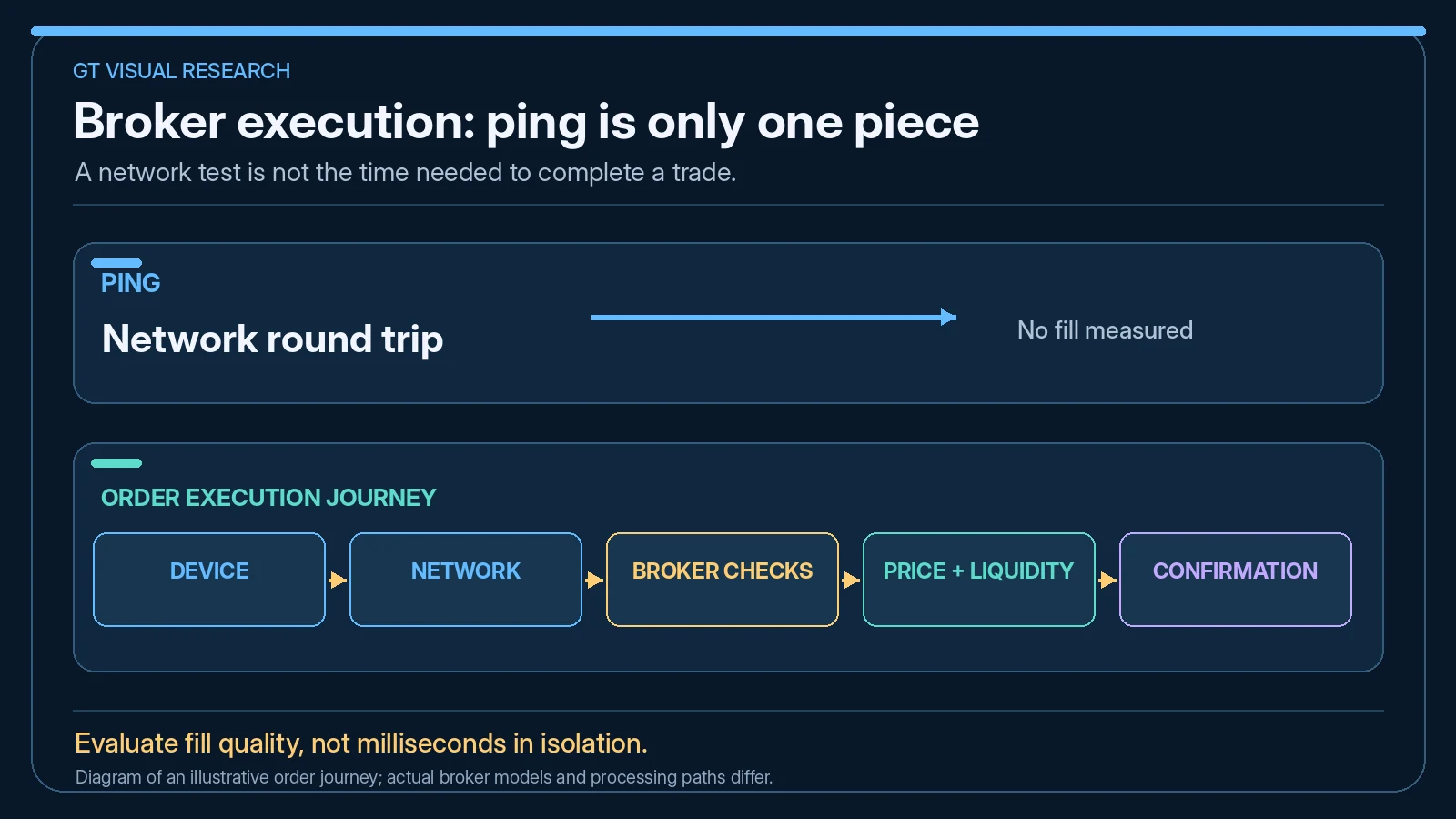
Ping
A network round-trip measurement between two endpoints. It does not normally include order validation, pricing or execution.
Broker Processing Time
The time inside the broker’s systems between receipt and the execution response.
End-To-End Experience
The complete elapsed time seen by the trader, including local, network, broker, liquidity and return stages.
Fast Execution vs Good Execution
| Factor | Fast Response | Good Execution Outcome |
|---|---|---|
| Speed | The broker returns an answer quickly. | The timing is suitable for the order and market conditions. |
| Price | The order may still fill at a materially worse price. | The price is competitive relative to available market conditions. |
| Costs | The spread, commission or mark-up may remain high. | Total consideration is competitive for the service and product. |
| Fill probability | A rapid rejection is still not an execution. | The order has a reliable chance of filling at an acceptable price. |
| Size | Only part of the quantity may be filled. | The intended size is handled transparently with reasonable market impact. |
| Consistency | A headline average can hide volatile outliers. | Results remain dependable across a meaningful sample and market states. |
Best Execution Is A Multi-Factor Duty
FCA best-execution rules require firms within scope to take all sufficient steps to obtain the best possible result, considering price, costs, speed, likelihood of execution and settlement, size, nature and other relevant factors. Speed is therefore important, but it is not legally or practically the only measure.
For retail clients, total consideration—price plus execution-related costs—usually has particular importance. Other factors can take precedence when they are instrumental in achieving the best possible result for the client.
Price
The execution price relative to available market or reference pricing.
Costs
Spread, commission, venue fees and other execution-related charges.
Speed And Likelihood
How quickly and reliably the order can be executed and settled.
Size And Nature
The instrument, quantity, order type, urgency and other order-specific characteristics.
What An Execution Policy Should Explain
A useful execution policy should do more than state that the broker seeks best execution. It should explain how orders are handled, which venues or counterparties are used, when the firm deals on its own account and which factors determine routing.
Execution Venues
The markets, counterparties, liquidity sources or internal routes used for each class of instrument.
Own-Account Dealing
Whether the broker can act as principal and how price fairness and conflicts are managed.
Order Handling
Market, limit, stop, partial-fill, aggregation, rejection, cancellation and specific-instruction procedures.
Execution Factors
How price, cost, speed, likelihood, size and nature are weighted for different clients and products.
Monitoring
How the firm tests execution quality, reviews venues and corrects identified deficiencies.
Specific Instructions
How a client’s chosen venue or order instruction can restrict the firm’s normal best-execution process.
OTC CFD Execution Requires A Price-Fairness Check
CFDs and rolling spot forex are commonly executed over the counter rather than on a central exchange. The broker may be the contractual counterparty or use selected liquidity and pricing sources.
European best-execution material requires firms dealing on own account in OTC products to explain how they ensure the fairness of the proposed price. Market prices, comparable instruments, underlying prices or reliable internal models may be used depending on what is available.
Transparent Reference
The broker can compare its execution price with reliable external or underlying market data.
Internal Pricing
Where no direct reliable price exists, the model should use accurate data reflecting market conditions.
Order Type Changes The Execution Trade-Off
| Order Type | Main Priority | Execution Risk | Speed Relevance |
|---|---|---|---|
| Market order | Immediate execution at available prices | Price can differ from the quote as liquidity changes | High in fast markets |
| Limit order | Price control | May remain partially filled or unfilled | Queue and routing can matter |
| Stop order | Activation after a trigger | Often becomes a market-style order and can slip | High around gaps and volatility |
| Stop-limit order | Trigger plus price boundary | Can fail to execute after activation | Price protection can outweigh immediacy |
| Guaranteed stop | Defined exit level under qualifying terms | Premiums, distance rules and product exclusions | Contractual guarantee matters more than raw latency |
Slippage Is The Price Result Of A Moving Market
Slippage is the difference between the requested, displayed or triggered price and the actual execution price. It can be negative or positive. A fast broker can still produce slippage if the market moves or available size changes before execution.
Negative Slippage
A buy fills higher or a sell fills lower than the requested reference price.
Positive Slippage
A buy fills lower or a sell fills higher, improving the execution outcome.
Asymmetric Slippage
Favourable movement is systematically withheld while unfavourable movement is passed to the client.
The CFTC has previously taken enforcement action where a retail forex platform used one-sided slippage settings that benefited the dealer while customers did not receive equivalent favourable movements. Historical enforcement illustrates why traders should assess slippage symmetry rather than only average speed.
Spread Widening Can Matter More Than Milliseconds
The visible spread can expand around news, market opens, rollover, thin sessions and sudden volatility. A 30-millisecond fill through a spread that has widened sharply may be more expensive than a slower fill in normal liquidity.
Normal Session
Stable pricing, deeper liquidity and relatively consistent spreads may make small latency differences less important.
News Release
Quotes can reprice, spreads can widen and available depth can vanish between order submission and fill.
Rollover Or Thin Hours
Fewer active liquidity sources can increase spreads, rejections and partial fills.
Partial Fills, Rejections And Requotes
Partial Fill
Only part of the requested quantity is available or accepted at the execution price, leaving a remainder.
Rejection
The order is declined because of price movement, invalid parameters, insufficient margin, market status or system rules.
Requote
The original price is unavailable and the trader is offered a different price, subject to the platform and model.
Execution Models And What They Really Mean
| Model | Possible Order Route | What Traders Should Verify |
|---|---|---|
| Broker as principal | The broker deals on its own account and becomes the direct counterparty. | Price construction, conflicts, execution policy, hedging and slippage treatment. |
| Agency or venue routing | The order is transmitted to an external venue, counterparty or liquidity source. | Venue selection, mark-ups, routing logic, rejection handling and total cost. |
| Internalisation plus hedging | Some client flow is internalised while net risk may be hedged externally. | Client price fairness and whether execution differs by size or market state. |
| Exchange-traded route | The order enters an exchange or central order book through the broker. | Queue priority, routing, exchange fees, market data and order controls. |
Marketing labels are not guarantees: “STP,” “ECN,” “DMA” and “no dealing desk” can be used differently. The execution policy and legal agreement are more important than the badge.
Platform Choice Can Change The Route
Native Broker Platform
Can provide the most direct integration with the broker’s own pricing, order types and risk controls.
MetaTrader
Execution depends on the broker’s server, bridge, plugins, account configuration and liquidity arrangement.
cTrader
The platform can provide detailed order information, but broker routing and liquidity still determine the fill.
TradingView Connection
The chart interface sends the order through the connected broker integration; the final execution remains broker controlled.
GradTraders Best Native Platform Choice: Plus500
United Kingdom
GradTraders does not promote broker services to UK customers unless the relevant UK entity is authorised and regulated by the Financial Conduct Authority (FCA). Plus500UK Ltd (FRN 509909) is authorised and regulated by the FCA, and Plus500 is a firm we’re proud to partner with for our UK audience.
UK risk reminder: CFDs are leveraged products and can result in rapid losses. The provider-specific retail loss warning is displayed within the Plus500 banner above.
United States
For United States readers, Plus500 provides a separate futures service through Plus500US Financial Services LLC d/b/a Plus500, a Futures Commission Merchant registered with the U.S. Commodity Futures Trading Commission and a member of the National Futures Association (NFA ID 0001398).
The US futures service is separate from the UK CFD service provided by Plus500UK Ltd.
US risk reminder: Futures and options involve substantial risk of loss and are not suitable for every investor. Losses may exceed the amount originally invested. Trading privileges are subject to review and approval.
Partner disclosure: Plus500 is a GradTraders affiliate partner. GradTraders may earn a commission if an eligible account is opened through these links, at no additional cost to you. This commercial relationship does not alter the editorial analysis or verdict on this page.
Server Location, VPS And Trading Latency
Physical and network distance can affect the time required for data to travel. A VPS located near the broker server can reduce and stabilise that network component, particularly for automated strategies that must run continuously.
A VPS cannot improve the broker’s internal processing, quoted spread, liquidity depth, slippage policy or execution fairness. It is an infrastructure tool rather than a cure for poor broker execution.
Local Home Setup
Simple and sufficient for many discretionary traders, but dependent on home power, internet and device stability.
Trading VPS
Useful for EAs, cBots, remote access and strategies that need continuous uptime near a broker server.
Professional Colocation
Exchange or venue proximity can matter for institutional latency-sensitive systems but is not equivalent to ordinary retail VPS hosting.
Who Needs The Fastest Execution?
Scalpers
Small targets and short holding periods make entry and exit slippage a large share of expected profit.
News Traders
Speed matters, but rapidly vanishing liquidity and spread expansion can dominate the outcome.
Latency-Sensitive Algorithms
Automated entries can depend on stable routing and predictable response distributions rather than a low average alone.
Active Index Traders
Market opens, futures transitions and macro events can create fast changes in price and spread.
Day Traders
Execution quality matters across repeated entries, but a few milliseconds may be less important than total cost and stability.
Swing Traders
Reliable order handling matters, while financing, gaps, spread and platform controls often outweigh ultra-low latency.
Why News Trading Is A Poor Speed Benchmark
Economic releases and central-bank announcements create abnormal market conditions. The quote visible when the order is submitted may no longer be available by the time any broker can execute it.
A rejected order, partial fill or large slippage event during news does not automatically prove poor infrastructure. The relevant question is whether the broker’s handling is consistent with its policy, market conditions and treatment of favourable versus unfavourable movement.
Useful Test
Compare repeated fills under normal liquid conditions, then separately analyse stress periods.
Misleading Test
Judge the entire broker from one market order placed at the exact second of a major release.
Average, Median, Percentile And Jitter
Average
Adds all observed times and divides by the sample count. A few extreme delays can distort it.
Median
The middle result. It better represents a typical observation but can hide the slow tail.
95th Percentile
A useful view of slower but recurring results, showing how bad the experience becomes before the most extreme outliers.
Jitter
The variability between observations. A consistent 80 ms path may be more usable than results ranging from 20 to 500 ms.
How To Test A Broker Properly
Define The Strategy
Use the actual instrument, platform, order type, trading session and typical size.
Create A Baseline
Test during normal liquid conditions before examining volatile sessions.
Record Every Order
Capture timestamps, requested and filled prices, spread, quantity, response and market conditions.
Separate Order Types
Do not combine market, limit, stop and automated orders into one average.
Measure Distribution
Calculate median, slow-tail results, variability, rejection rate and slippage in both directions.
Compare Total Cost
Add spread, commission, slippage, financing where relevant and missed-fill impact.
Test Stability
Review connection drops, platform freezes, delayed confirmations and behaviour during session changes.
Escalate Anomalies
Ask the broker for execution records and policy explanations when fills materially diverge.
Execution Log Fields
| Field | What To Record | Why It Matters |
|---|---|---|
| Order timestamps | Local send, broker receipt if available, execution and confirmation | Separates network, broker and display delay where possible |
| Instrument and size | Exact symbol, quantity, contract and account currency | Liquidity and processing differ by market and size |
| Order type | Market, limit, stop, stop-limit, guaranteed stop or algorithmic instruction | Each type has a different price-versus-fill trade-off |
| Requested reference | Displayed quote, trigger or limit at submission | Creates a consistent slippage reference |
| Execution result | Fill price, average price, filled quantity, rejection or cancellation reason | Speed without the result is incomplete |
| Spread and costs | Bid-ask spread, commission and applicable mark-up | Total consideration is the practical client outcome |
| Market state | Normal, news, open, rollover, thin session or outage | Prevents abnormal conditions distorting the baseline |
| Platform and location | App, desktop, API or VPS plus server region | The route can materially change the observed time |
Execution Red Flags
Undefined Millisecond Claim
The broker publishes a speed number without explaining the measurement point, sample or included orders.
One-Sided Slippage
Negative movement is passed through while equivalent positive price improvement rarely appears.
Frequent Unexplained Rejections
Orders are repeatedly declined in normal conditions without a clear platform or policy explanation.
Entity Mismatch
The speed claim relates to another company, platform server or account route within the group.
Unclear Own-Account Pricing
The policy does not explain how OTC prices are constructed or checked for fairness.
Platform Confirmation Disputes
The broker cannot provide server-side records when the platform display and account history conflict.
Common Execution Speed Myths
“The Lowest Millisecond Number Wins”
False. The measurement method and final price, cost and fill reliability determine the real outcome.
“Low Ping Means Fast Fills”
False. Ping excludes broker processing, risk checks, routing and liquidity response.
“STP Means No Slippage”
False. Any routed order can face changing prices, liquidity limitations and rejection rules.
“A Market Order Guarantees The Quote”
False. It prioritises execution at available prices rather than guaranteeing the displayed reference.
“A Limit Touch Guarantees A Fill”
False. Available size and queue priority can leave the order unfilled even if the market displays the level.
“A VPS Fixes Broker Execution”
False. It can improve network stability but cannot change the broker’s pricing, liquidity or policy.
Three Trader Scenarios
Discretionary Swing Trader
Places a few limit and stop orders each week. Stability, financing, gap handling and order controls matter more than a 20 ms difference.
Active Index Scalper
Targets small moves around liquid sessions. Spread, median response, slow-tail latency and slippage materially affect results.
Automated MT5 Strategy
Runs continuously and submits frequent orders. A nearby VPS can improve uptime and network consistency, but broker-side execution remains decisive.
Broker Execution Checklist
Before Opening
- Read the execution and conflicts policies.
- Identify the exact legal entity and server route.
- Check order types, partial fills and rejection terms.
- Confirm whether the broker acts as principal.
During Testing
- Use the intended platform and instrument.
- Record normal and stressed conditions separately.
- Include rejections and missed fills.
- Measure positive and negative slippage.
Before Scaling
- Test larger order sizes gradually.
- Review slow-tail response and outages.
- Calculate all-in execution cost.
- Keep an alternative route for critical positions.
Related GradTraders Research
What Is Slippage?
Understand why requested and executed prices differ and how to evaluate positive and negative slippage.
Trading Server Latency
See how location, network routes, broker servers and VPS hosting affect the order path.
Raw Spread Accounts
Compare spread, commission and execution trade-offs rather than judging an account from its minimum spread.
Best VPS For Automated Trading
Compare uptime, platform support, server region and latency considerations for automated systems.
Brokers For Scalping And Day Trading
Compare active-trader platforms, pricing, regulation and execution suitability.
Compare Broker Routes
Review platforms, regulation, costs and strengths across the complete GradTraders broker table.
Final Verdict
Broker execution speed matters because prices, spreads and available liquidity can change between order submission and execution. Its importance rises as the strategy becomes shorter-term, more frequent and more dependent on small price movements.
Speed should never be separated from price, cost, fill probability, slippage, size handling and stability. A rapid poor fill is not better execution, while a slightly slower but consistently fair route can deliver the stronger overall result.
Read the execution policy, test the exact account route with live data and measure the complete distribution of outcomes. Choose the broker that produces dependable execution for your strategy—not the broker displaying the smallest isolated millisecond number.
Research basis: GradTraders reviewed current official material from the Financial Conduct Authority, European Securities and Markets Authority and US Commodity Futures Trading Commission. Execution rules, platform routes, broker policies and technical infrastructure can change.
Official checks: FCA COBS 11.2A best execution · ESMA 2025 execution-policy report · MiFID II Article 27 · CFTC slippage enforcement example · FCA CFD expectations · Plus500 regulated entities · Plus500 UK client-money protection · Plus500UK order execution policy.
Explore GradTraders Internationally
Browse GradTraders’ country pages for regional trading context and related research. These links are for site navigation only; broker availability, regulatory status, account types, product eligibility and trading protections vary by country and legal entity.
Browse all 20 country gateways
Asia: Japan · South Korea · Taiwan · Hong Kong · India · Singapore · Thailand
Europe: Italy · Sweden · Switzerland · Germany · Norway
Americas: United States · Canada · Mexico
Middle East: United Arab Emirates · Saudi Arabia
Africa: South Africa
Oceania: Australia · New Zealand
Broker Execution Speed FAQ
What is broker execution speed?
Broker execution speed is the elapsed time between an order being submitted and the trader receiving the final broker response, such as a fill, partial fill, rejection or cancellation. The precise measurement point can differ between brokers.
Is faster broker execution always better?
No. A fast response can still produce poor pricing, excessive slippage, a rejection or an unreliable fill. Execution quality combines price, costs, speed, fill probability, size handling and consistency.
What is a good execution speed in milliseconds?
There is no universal threshold. The acceptable speed depends on the strategy, instrument, order type, location, market conditions and how the broker measures the result. Consistent fill quality is more useful than one headline average.
Is ping the same as execution speed?
No. Ping normally measures network round-trip time to a server. Execution speed also includes platform handling, broker processing, risk checks, routing or internalisation, liquidity response and the return confirmation.
Does a VPS improve broker execution?
A well-located VPS can reduce and stabilise the network part of the order path for automated or continuously running systems. It cannot repair poor broker pricing, liquidity, order handling or execution policy.
What is slippage?
Slippage is the difference between the requested or triggered price and the price at which the order is executed. It can be positive or negative and usually becomes more likely when price moves quickly or liquidity is limited.
Why can a limit order remain unfilled?
A limit order controls the worst acceptable price, but execution requires sufficient available liquidity at that price and the trader’s place in the queue. The market can touch the displayed level without filling the full order.
What should I check in a broker’s execution policy?
Check the execution factors, venues or counterparties, own-account dealing, order types, slippage and requote handling, aggregation, partial fills, conflicts, specific instructions and how the firm monitors execution quality.
Who needs the fastest execution?
Scalpers, latency-sensitive algorithms, news traders and active index or forex traders usually care most. Swing and position traders still need reliable execution, but a small millisecond difference is normally less important.
How can I test execution quality?
Record order-send time, instrument, order type, requested price, fill price, spread, size, market conditions, response time, slippage, rejections and platform interruptions across a meaningful sample of live trades.