What Is Negative Balance Protection?
Negative balance protection can limit a covered retail account’s liability beyond the money in that account after an extreme leveraged loss. My first check would be the exact regulated entity and client classification, not the broker brand: the safeguard may not apply to another entity, product or professional account. Even where it applies, a trader can still lose the entire protected account balance, so it is a last-resort protection rather than a substitute for sensible position sizing.
 Matthew Jackson
Founder of GradTraders
Independent trading research backed by more than 20 years of personal market experience.
, GradTraders ·
Live trading on YouTube ·
Last updated: 10 October 2026
Matthew Jackson
Founder of GradTraders
Independent trading research backed by more than 20 years of personal market experience.
, GradTraders ·
Live trading on YouTube ·
Last updated: 10 October 2026Check the exact legal entity, regulator, client classification, product scope and account definition before relying on NBP. The broker brand alone does not establish the protection.
Disclosure & Risk Notice: This article is for educational and informational purposes only and should not be considered financial advice, investment advice, tax advice or a personal recommendation. Trading CFDs, spread betting, forex, crypto CFDs and other leveraged products involves significant risk and may not be suitable for all traders. You may lose some or all of your capital. Some GradTraders articles may contain affiliate links or references to partner offers. If you sign up, purchase or open an account through certain links, GradTraders may earn a commission at no additional cost to you.
Looking for GradTraders partner offers, broker discounts, prop firm promotions and trading platform deals? You can view the current offers and join the update list here: Access GradTraders Partner Offers.
Quick Verdict
Negative balance protection can stop a covered retail CFD account from becoming a debt beyond the funds committed to that account. It is a final liability backstop, not a substitute for position sizing, margin headroom or stop discipline.
Under FCA and ESMA-style retail CFD rules, the protection is applied on a per-account basis. The aggregate profit and loss across the CFDs connected to the protected account matters—not the outcome of one trade viewed alone.
A trader can still lose the entire account balance. Protection can also change when the customer becomes a professional client, signs with an offshore entity, trades outside the covered product set or accepts contractual terms containing exclusions.
What It Protects
Covered retail liability beyond the funds in the relevant CFD trading account.
What It Does Not Protect
The deposit itself, trading performance, a stop price or every product offered by the broker.
What Must Be Checked
The legal entity, regulator, retail or professional status, covered products and account agreement.
Negative Balance Protection Meaning
Negative balance protection—often shortened to NBP—limits the maximum aggregate liability of a covered retail client for the CFDs connected to a protected trading account. In practical terms, it is intended to prevent the broker from pursuing the customer for a remaining deficit after the covered account has been reduced below zero.
The rule is important because leveraged positions can lose more quickly than a broker’s automated controls can close them. A stop can slip, a market can reopen beyond the stop, or liquidity can disappear while the account is still exposed.
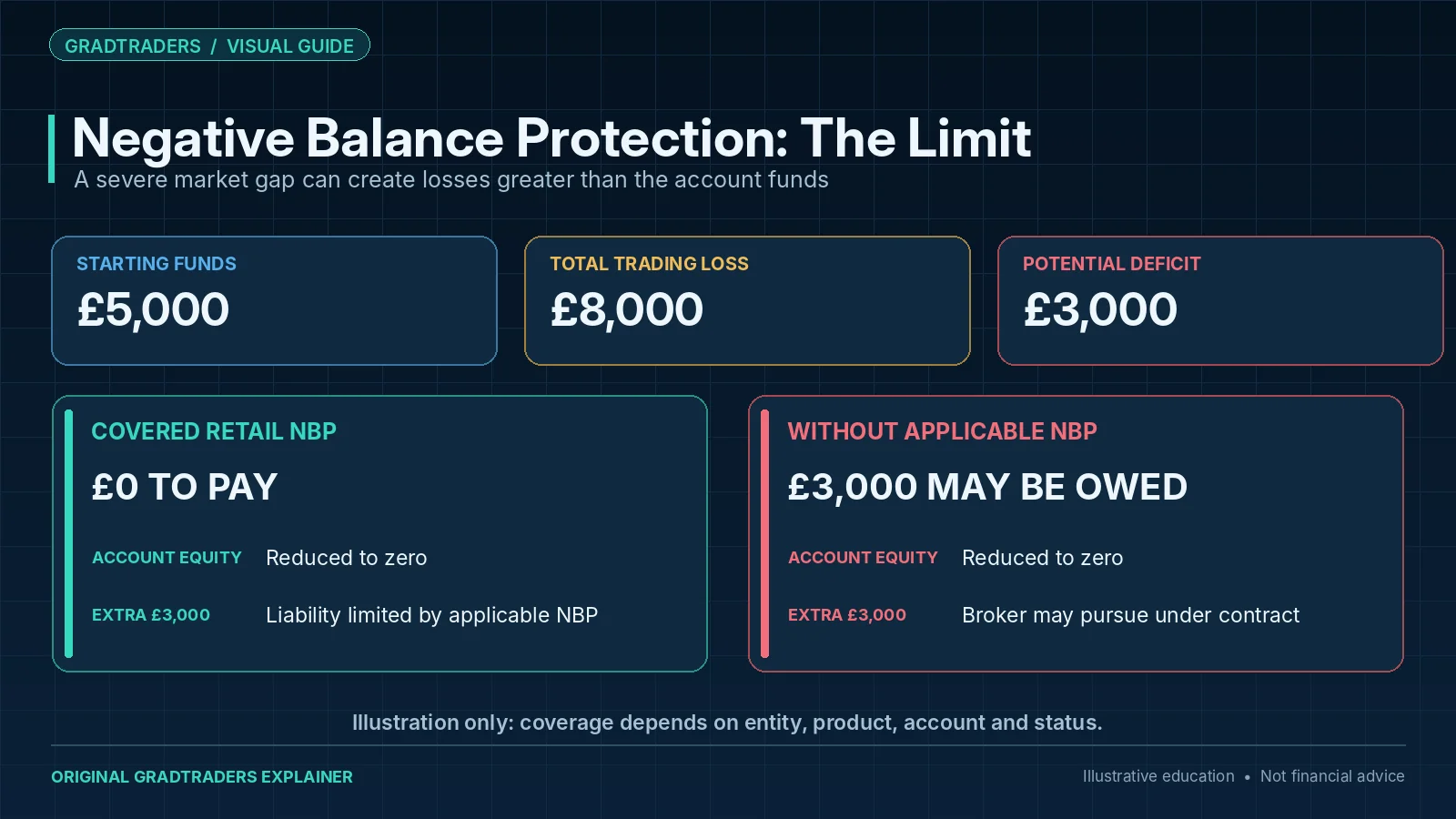
Plain-English definition: if a protected account contains £5,000 and an extreme event creates an £8,000 loss before positions can be closed, the account can lose its £5,000 balance, but the additional £3,000 liability should be limited where mandatory negative balance protection applies.
How A Trading Account Can Become Negative
Leveraged Exposure
The trader controls a position substantially larger than the cash held in the account.
Sudden Repricing
News, a weekend gap, a suspended market or a liquidity shock moves price beyond expected levels.
Exit Beyond The Trigger
The stop or margin close-out order executes at the next available price rather than the displayed trigger.
Loss Exceeds Equity
The realised loss is larger than the remaining funds, leaving a deficit before protection is applied.
Worked Example: Protected vs Unprotected Account
Assume a retail trader has £5,000 in a leveraged trading account. A severe overnight gap causes the positions to close with an £8,000 total loss before the broker can execute at the expected levels.
| Outcome | Starting Funds | Realised Trading Loss | Possible Customer Liability |
|---|---|---|---|
| Mandatory NBP applies | £5,000 | £8,000 | Account is reduced to zero; the additional £3,000 deficit is limited under the covered protection. |
| No NBP applies | £5,000 | £8,000 | The client agreement may permit the broker to pursue the remaining £3,000 debt. |
| Broker offers discretionary reset | £5,000 | £8,000 | The broker may waive or reset the deficit under its policy, but contractual wording and exclusions matter. |
Illustration only: the legal outcome depends on the jurisdiction, product, client status, account definition and contract. It is not determined solely by the balance displayed in the platform.
Protection Is Per Account, Not Per Trade
FCA and ESMA-style rules describe negative balance protection on a per-account basis. This means the aggregate liability across the CFDs connected to the protected account is limited. A profitable position can therefore offset part of a losing position before the account-level result is calculated.
Individual Trade
One position may lose more than the margin reserved for that ticket.
Connected CFD Account
Open profits, losses and available account funds are considered across the relevant protected account.
Separate Wallets Or Subaccounts
The broker’s legal terms determine whether balances are separate, connected or subject to contractual set-off.
Stop Loss vs Guaranteed Stop vs Margin Close-Out vs NBP
| Protection Layer | Purpose | Main Limitation | When It Acts |
|---|---|---|---|
| Standard stop loss | Attempts to exit a position after a selected trigger is reached. | Can fill beyond the trigger during gaps or fast markets. | Trade level |
| Guaranteed stop | Closes at the guaranteed level under the broker’s qualifying terms. | Availability, premiums, distance rules and product exclusions apply. | Trade level |
| Margin close-out | Requires or enables positions to be closed when account equity reaches the defined margin threshold. | Market execution can occur beyond the threshold. | Account level |
| Negative balance protection | Limits covered aggregate liability beyond the account funds. | The entire protected account balance can still be lost. | Final liability backstop |
NBP Is Not A Risk-Management Strategy
A trader who expects negative balance protection to rescue an oversized position has already allowed the risk process to fail. The protection exists for abnormal outcomes, not as permission to use maximum leverage.
Position Sizing
Determine exposure from acceptable account risk, stop distance and contract value.
Free Margin
Maintain enough equity for normal volatility, costs and correlated positions.
Negative Balance Protection
Limit additional liability only after the other controls fail during an extreme event.
UK FCA Retail Protection
The FCA’s current COBS 22.5 rules apply to covered restricted speculative investments marketed, distributed or sold in or from the UK to retail clients. The framework combines leverage limits, risk warnings, a 50% account-level margin close-out rule and negative balance protection.
FCA materials describe the protection as limiting retail clients’ liability to the funds in their CFD trading account. The same retail framework also covers leveraged spread bets and rolling spot forex contracts within its scope.
Client Status
The customer must be within the covered retail category rather than an elective professional or other non-retail classification.
Product Scope
Coverage applies to the restricted speculative investments within the FCA rule set; do not assume every leveraged product is included.
Entity Scope
The contracted company and the service must fall within the relevant FCA-authorised route.
GradTraders Best Native Platform Choice: Plus500
United Kingdom
GradTraders does not promote broker services to UK customers unless the relevant UK entity is authorised and regulated by the Financial Conduct Authority (FCA). Plus500UK Ltd (FRN 509909) is authorised and regulated by the FCA, and Plus500 is a firm we’re proud to partner with for our UK audience.
UK risk reminder: CFDs are leveraged products and can result in rapid losses. The provider-specific retail loss warning is displayed within the Plus500 banner above.
United States
For United States readers, Plus500 provides a separate futures service through Plus500US Financial Services LLC d/b/a Plus500, a Futures Commission Merchant registered with the U.S. Commodity Futures Trading Commission and a member of the National Futures Association (NFA ID 0001398).
The US futures service is separate from the UK CFD service provided by Plus500UK Ltd.
US risk reminder: Futures and options involve substantial risk of loss and are not suitable for every investor. Losses may exceed the amount originally invested. Trading privileges are subject to review and approval.
Partner disclosure: Plus500 is a GradTraders affiliate partner. GradTraders may earn a commission if an eligible account is opened through these links, at no additional cost to you. This commercial relationship does not alter the editorial analysis or verdict on this page.
EU And CySEC Retail Protection
ESMA’s CFD measures established negative balance protection on a per-account basis, alongside the 50% margin close-out rule and the retail leverage ladder. National regulators implemented permanent measures within their jurisdictions, including CySEC for Cyprus Investment Firms.
Per-Account Limit
The aggregate liability for all CFDs connected to the covered CFD trading account is limited.
National Entity
Confirm the investment firm through its national regulator and verify the approved website and cross-border permission.
Compensation Is Separate
Investor-compensation eligibility concerns qualifying firm-failure claims and does not replace NBP or reimburse market losses.
Australian ASIC Retail Protection
ASIC’s CFD product-intervention order includes negative balance protection, leverage limits from 30:1 to 2:1, standardised margin close-out and restrictions on certain inducements. ASIC states that the order remains scheduled to expire on 23 May 2027 unless remade.
Retail Client
The protection package applies to covered CFDs issued to retail clients under the Australian route.
Current Product Order
The order has reduced leverage and targeted features that amplify retail CFD losses.
Entity Verification
An Australian group connection is not enough; confirm the exact AFS licensee and authorised services.
US And Other Product Routes Are Different
The United States uses a different regulatory structure for retail off-exchange forex, futures and options. Traders should not assume that the FCA, ESMA or ASIC CFD protection package—including mandatory per-account negative balance protection—automatically applies.
Retail Forex
Check the registered counterparty, NFA/CFTC disclosures, security-deposit rules and account agreement.
Exchange-Traded Futures
Futures margin, liquidation and customer-protection rules differ from over-the-counter CFD arrangements.
Options And Shares
Liability depends on the product, strategy, borrowing and account type rather than CFD NBP terminology.
Professional Classification Can Remove Retail Protection
The FCA warned in October 2025 that some firms were pressuring CFD customers to claim professional status or redirecting them to third-country providers without equivalent consumer protections. Professional clients can receive higher leverage while losing important retail safeguards.
FCA categorisation rules require firms to provide a clear written warning about the protections and investor-compensation rights an elective professional client may lose.
What Can Change
- Higher maximum leverage.
- Lower initial margin.
- Access to selected products or account features.
Potential Cost
- Negative balance treatment can change.
- Retail leverage and close-out controls may no longer apply.
- Client-money, complaint or compensation rights can differ.
Offshore Negative Balance Protection
An offshore broker may advertise NBP even when local law does not require the same retail protection package. That contractual promise should not be treated as equivalent to mandatory retail protection; its effect depends on the contract, financial resources of the entity, dispute route and exclusions.
Mandatory Protection
The local regulator requires a defined liability limit for covered customers and products.
Contractual Protection
The broker promises to reset or waive deficits under its client agreement or published policy.
No Protection
The customer remains liable for deficits and the broker can seek repayment under the governing contract.
Contractual Exclusions To Look For
Client Classification
Protection may be restricted to retail clients and excluded for professional, wholesale or eligible-counterparty accounts.
Prohibited Conduct
Some policies exclude abuse, fraud, manipulation, latency exploitation or breaches of trading terms.
Connected Accounts
The broker may reserve rights to offset a deficit against positive balances held in another account or wallet.
Product Or Event Scope
Protection can differ by product, entity or circumstances outside the mandatory retail rule.
NBP, Client Money And Compensation Are Separate Protections
| Protection | Main Purpose | What It Does Not Cover |
|---|---|---|
| Negative balance protection | Limits covered trading-account liability beyond committed account funds. | The account balance, poor trades or firm insolvency by itself. |
| Client-money rules | Govern how customer funds are held, reconciled and treated by the firm. | Market losses or every insolvency shortfall. |
| Compensation scheme | May compensate eligible claims if a covered firm cannot meet certain obligations. | Ordinary market losses or ineligible products and clients. |
| Complaints body | Provides an independent dispute route where jurisdiction and eligibility requirements are met. | Every commercial disagreement or unauthorised overseas operator. |
Market Events That Can Create A Deficit
Weekend Or Overnight Gap
The market reopens beyond the stop and the next executable price creates a larger loss.
Central-Bank Surprise
A sudden policy change can remove liquidity and cause extreme currency or index repricing.
Market Suspension
Trading pauses while information changes, then resumes at a materially different price.
Flash Move
Orders disappear or spreads expand before automated close-out can complete.
Corporate Event
An earnings shock, takeover or insolvency event can gap an individual share or related CFD.
Correlated Portfolio
Several positions lose together, causing account equity to deteriorate faster than each ticket suggests.
How To Verify Negative Balance Protection
Identify The Entity
Copy the exact legal company from the application, agreement and account statement.
Confirm Client Status
Check whether the account is retail, professional, wholesale or another category.
Check Product Scope
Confirm the specific CFDs, spread bets or forex contracts are within the protection.
Read Account Definition
Understand whether subaccounts, currencies and wallets are combined or separately protected.
Find The Legal Basis
Determine whether protection is mandatory under regulation or only a broker policy.
Review Exclusions
Search the agreement for negative balance, deficit, indemnity, set-off, abnormal market and prohibited trading clauses.
Ask In Writing
Request a clear answer from support identifying the entity, product and account covered.
Recheck After Changes
Verify protection again after migration, professional opt-up, new product access or revised terms.
Questions To Ask The Broker
Coverage
- Which legal entity provides the account?
- Is NBP mandatory or contractual?
- Which products and client classes are covered?
- Is protection applied per account or across the relationship?
Account Mechanics
- What is the margin close-out percentage?
- Which positions are liquidated first?
- Can positive subaccounts offset a deficit?
- How quickly is a protected deficit reset?
Dispute Route
- Where is the complaint submitted?
- Which regulator or Ombudsman has jurisdiction?
- Which law governs the agreement?
- Can the broker pursue deficits in another country?
Negative Balance Protection Red Flags
Vague “Guaranteed” Claim
The website promises full protection but does not identify the entity, regulation, account definition or exclusions.
Professional Opt-Up Pressure
The broker promotes higher leverage without clearly explaining that retail loss protection can change.
Group-Level Regulation Claim
The broker cites FCA, ASIC or CySEC regulation while the customer agreement names another company.
Unclear Set-Off Rights
The agreement permits the broker to use funds from other wallets or accounts without clearly defining the protected balance.
Debt Collection Threat
A broker demands immediate repayment without providing the trade calculation, legal basis or complaint route.
Terms Changed After The Event
The broker relies on conditions that were not part of the agreement accepted when the positions were opened.
What To Do If Your Account Goes Negative
Stop Trading
Do not add positions or deposit more money merely to hide the deficit before understanding it.
Save The Evidence
Download statements, fills, margin records, emails, platform logs and the accepted client agreement.
Request The Calculation
Ask the broker to explain every execution price, charge, account offset and the legal basis for any debt.
Escalate Appropriately
Use the firm’s complaints process and contact the regulator, Ombudsman or qualified adviser where applicable.
Common Negative Balance Protection Myths
“My Deposit Cannot Be Lost”
False. NBP can limit liability beyond the protected account funds, but the full account balance remains at risk.
“Every Regulated Broker Offers It”
False. Regulation, client category and product scope differ. The protection package must be checked for the exact account.
“It Applies To Every Trade Separately”
False. FCA and ESMA-style CFD protection is account-based and considers aggregate connected CFD liability.
“Margin Close-Out Makes NBP Redundant”
False. Close-out can occur beyond its threshold when markets gap or execution is delayed.
“A Broker Reset Is The Same As A Legal Right”
False. A discretionary or contractual policy can be weaker and more conditional than mandatory retail protection.
“NBP Makes High Leverage Safe”
False. It may limit an additional debt, but high effective leverage can still erase the account rapidly.
Three Account Scenarios
FCA Retail CFD Account
The FCA entity and retail status are confirmed, covered products are used and account-level protection forms part of the rules.
Elective Professional Account
The trader receives higher leverage after signing a warning that retail protections and compensation rights can be lost.
Global Entity With Broker Policy
The broker promises deficit resets, but coverage depends on contractual exclusions, governing law and practical enforcement.
Related GradTraders Research
High Leverage Risk
See why low required margin does not reduce the loss created by the full market exposure.
Leverage By Country
Compare retail leverage and account structures across UK, EU, Australian, US, Japanese and global routes.
Regulators Compared
Compare FCA, ASIC, CySEC and offshore protection, complaints and compensation frameworks.
Offshore Broker Safety
Review how entity, licence, client-money and withdrawal protections differ across global accounts.
Position Sizing
Build position size from account risk and stop distance rather than relying on NBP or available margin.
Compare Broker Routes
Compare regulation, platforms, account entities and major trade-offs across the full broker table.
Final Verdict
Negative balance protection is one of the most useful retail safeguards in leveraged CFD trading because it can stop an extreme account loss becoming an additional debt. It does not make the product safe and it does not preserve the account balance.
The protection should be verified at legal-entity, client-classification, product and account-definition level. A familiar broker brand can operate several companies with materially different protection, and a professional or offshore account can change the result.
Use position sizing, modest effective leverage and free-margin headroom so that NBP remains a last legal backstop, then confirm the exact protection in writing before depositing.
Research basis: GradTraders reviewed current official material from the Financial Conduct Authority, European Securities and Markets Authority, Australian Securities and Investments Commission, Australian Moneysmart and the FCA Handbook. Rules, product scope, account definitions and broker terms can change.
Official checks: FCA Handbook COBS 22.5 · FCA CFD policy · FCA professional-client warning · ESMA CFD measures · ASIC CFD order · Moneysmart CFD warning · Plus500 regulated entities · Plus500 UK client-money protection.
Explore GradTraders Internationally
Browse GradTraders’ country pages for regional trading context and related research. These links are for site navigation only; broker availability, regulatory status, account types, product eligibility and trading protections vary by country and legal entity.
Browse all 20 country gateways
Asia: Japan · South Korea · Taiwan · Hong Kong · India · Singapore · Thailand
Europe: Italy · Sweden · Switzerland · Germany · Norway
Americas: United States · Canada · Mexico
Middle East: United Arab Emirates · Saudi Arabia
Africa: South Africa
Oceania: Australia · New Zealand
Negative Balance Protection FAQ
What is negative balance protection?
Negative balance protection limits a covered retail client’s aggregate liability for CFDs connected to the protected trading account to the funds committed to that account. It is designed to prevent an extreme loss from becoming an additional debt to the broker.
Does negative balance protection mean I cannot lose my deposit?
No. The full balance of the protected trading account can still be lost. The protection concerns liability beyond the covered account funds, not the preservation of the deposit.
Is negative balance protection applied per trade?
No. FCA and ESMA-style CFD protection is applied on a per-account basis. Profits and losses across the CFDs connected to that account are considered together.
Do stop-loss orders make negative balance protection unnecessary?
No. A non-guaranteed stop can execute beyond the requested level during a gap, fast market or liquidity disruption. Negative balance protection is a final liability backstop rather than an order-execution tool.
Does margin close-out guarantee that the account cannot go negative?
No. Margin close-out is designed to close positions when equity reaches a defined threshold, but execution can occur later or at a worse price when markets move abruptly.
Does negative balance protection apply to professional clients?
Not automatically. Professional classification can remove retail CFD protections. The firm should provide a clear written warning explaining the protections and compensation rights the client may lose.
Do offshore brokers provide negative balance protection?
Some do under local law or contractual policy, while others do not. Contractual protection may contain exclusions or be changed more easily than a mandatory retail rule, so the legal entity and terms must be checked.
Does negative balance protection apply to every product?
No. Coverage depends on the jurisdiction, regulated product, legal entity and client classification. Do not assume that CFDs, futures, options, shares, crypto products and off-exchange forex receive the same treatment.
Can several trading accounts be combined for negative-balance calculations?
Rules are generally described per CFD trading account, but brokers may structure subaccounts, wallets and set-off rights differently. The client agreement should explain which balances and positions are connected.
What should I do if a broker demands payment for a negative balance?
Request the calculation and contractual basis in writing, preserve statements and communications, stop making additional payments until the position is verified, and contact the relevant regulator, complaints body or qualified adviser.