Exness Review 2026: Is It Suitable For UK Traders Or Mainly A Global High-Leverage Broker?
Exness earns 8.2/10 in the GradTraders broker bank as an international CFD and MetaTrader specialist. Its differentiators include eligible 10-unit Standard Cent forex positions, a genuine choice of five account families, and automated payment processing. Before choosing Exness, traders should check whether it accepts customers in their country, what regulatory protections their account would have and how much their trades would actually cost. The possibility of extremely high leverage should not be the main reason to choose a broker. Exness does not currently offer a standard retail trading account to residents of the UK or European Economic Area.
By Matthew Jackson Matthew JacksonFounder of GradTradersIndependent trading research backed by more than 20 years of personal market experience., GradTraders · Live trading on YouTube · Last updated: 14 October 2026 · Last checked: 14 October 2026
The GradTraders View
Exness has more useful features than its leverage headline suggests. I would compare the smallest available live position, Raw-versus-Zero total dealing costs, margin changes on the actual instrument and the payment rules of the contracting entity before selecting it.
Disclosure & Risk Notice: This article is for educational and informational purposes only and should not be considered financial advice, investment advice, tax advice or a personal recommendation. Trading CFDs, spread betting, forex, futures, crypto CFDs and other leveraged products involves significant risk and may not be suitable for all traders. You may lose some or all of your capital. Backtests, simulations, replay results, demo results and strategy tests do not guarantee future performance. Historical testing can be misleading if spreads, slippage, commissions, execution, liquidity, psychology and changing market conditions are ignored. Some GradTraders articles may contain affiliate links or references to partner offers. If you sign up, purchase or open an account through certain links, GradTraders may earn a commission at no additional cost to you.
Looking for GradTraders partner offers, broker discounts, prop firm promotions and trading platform deals? You can view the current offers and join the update list here: Access GradTraders Partner Offers.
Quick Verdict: Exness Earns 8.2/10
Exness retains its independent GradTraders rating of 8.2/10 as an international MetaTrader and CFD broker with genuinely distinctive account mechanics, not merely an advert for unlimited leverage. Eligible traders can choose between very small Standard Cent forex positions, the spread-only Standard/Pro approach and the commission-based Raw Spread/Zero accounts. Its MT4/MT5 and Exness Terminal choice, and payment infrastructure, add real practical appeal.
Its headline leverage is not equivalent to a safer position. A $10,000 forex exposure that moves 1% against the trader loses approximately $100 whether the required margin is $100 at 1:100 or $5 at 1:2000, excluding costs. Leverage only changes the margin needed for an identical exposure; if used to trade a larger position, the potential cash loss rises. It can also be restricted by the country, account equity, instrument and news-related higher margin requirements.
For a strategy developer, I would first compare the smallest eligible live contract with XM Micro and HFM Cent, not ask which broker advertises the biggest leverage. For an active MetaTrader trader, the comparison with Tickmill should be the executed spread plus commission and slippage on the actual symbol.
UK and EEA retail readers should not assume they can use it. Exness says its FCA and CySEC companies do not serve retail traders, while its public international restrictions exclude the UK, Europe and USA, among other jurisdictions. FCA authorisation is not evidence of an Exness UK retail opening route. Exness entity and eligibility statement.
Why Exness Scores 8.2/10
The 8.2/10 score is the authoritative Exness rating in the GradTraders broker master table. It balances platforms, trading conditions, account choice, regulation, payments, market coverage and suitability. It is editorially weighted rather than calculated by averaging invented category numbers.
| Scoring Area | Assessment | Why It Matters |
|---|---|---|
| Platforms & Trading Tools | Very strong | MetaTrader and proprietary terminals support several workflows. |
| Account & Pricing Choice | Broad and specialist | Standard, Pro, Zero and Raw Spread routes serve different cost priorities. |
| Funding & Withdrawals | Strong broker-reported infrastructure | Automated 24/7 processing is a meaningful operational feature where supported. |
| Regulation & Entity Clarity | Wide but complex | Multiple offshore and regional entities produce different protection levels. |
| Leverage & Risk Controls | Powerful but hazardous | Unlimited leverage and zero stop-out settings demand exceptional discipline. |
| UK Retail Suitability | Very weak | The FCA-authorised entity does not serve retail clients and global entities exclude UK residents. |
| Overall GradTraders Rating | 8.2/10 | A globally significant specialist broker that should not be presented as a mainstream UK option. |
Comparison context: Exness sits below XM at 8.3/10 and HFM at 8.5/10. Its platform and payment features are strong, but the score is restrained by extreme leverage risk and weak UK retail relevance.
My View On Exness
I use CMC Markets for longer trades and the tax efficiency of my preferred account, and IC Markets for shorter trades where tighter spreads, lower margin requirements and higher leverage suit my approach. Together they cover almost everything I need. Exness would not be an account I could simply add as a UK retail customer, and I have no reason to present it as an alternative to my existing setup.
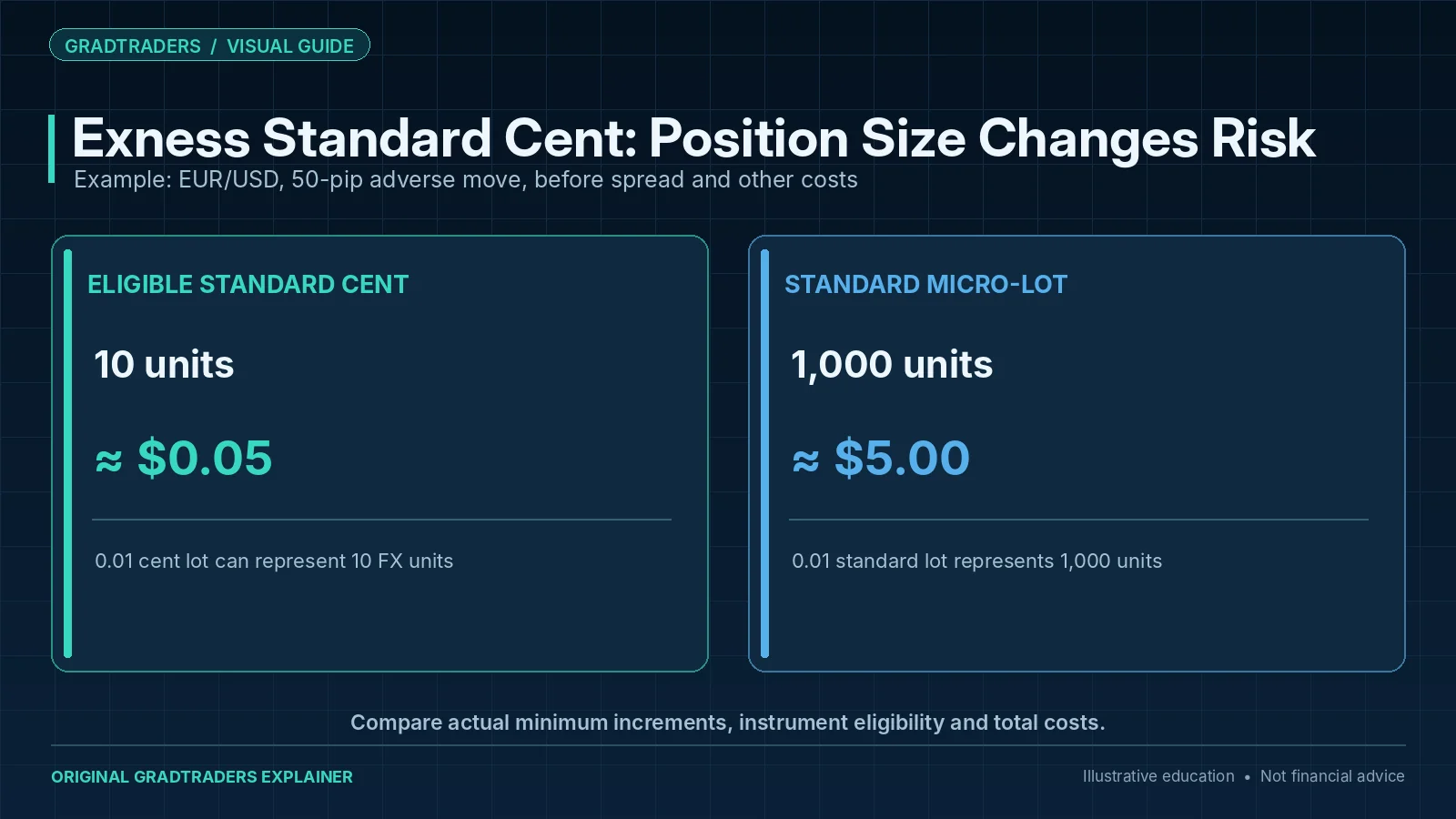
But I can see why an eligible international trader would research Exness. The surprising feature for me is not 1:Unlimited leverage. It’s the ability to use a genuinely small Standard Cent position while developing a MetaTrader strategy: Exness defines one cent lot as 1,000 currency units, making a 0.01-cent-lot forex order equivalent to just 10 currency units. On EUR/USD, a 50-pip adverse move at that size is approximately $0.05 before costs. That is a more useful way to learn the difference between simulated trading and a real market than concentrating on the smallest margin requirement.
I would compare that small-position route with the eligible micro/cent contracts at XM and HFM. When moving to a larger, more frequent strategy I would test Exness Raw Spread or Zero against Tickmill and IC Markets, using the same symbol, position exposure, session and execution method. Zero spread for much of the day is not zero total cost when the per-symbol commission and live slippage are included.
Exness’s 0% stop-out level and Stop Out Protection are worth understanding, but I would not build a trading method around an account surviving almost to zero equity. The broker itself describes exceptions and conditions. I have not used Exness as a primary live broker and have not independently tested its fills, service or withdrawal outcomes; the assessment is based on published terms and the GradTraders research bank.
MT4, MT5, Exness Terminal And Exness Trade
Exness supports MetaTrader 4 and MetaTrader 5 across desktop, browser and mobile routes. MT4 remains useful for forex-focused Expert Advisors and established custom tools, while MT5 provides a broader multi-asset environment and additional order types.
Exness Terminal is the broker’s web platform for MT5 and Exness platform accounts. It includes integrated charting, more than 100 indicators, drawing tools, one-click trading and browser access.
Exness Trade combines account management, payments and MT5-linked trading in a mobile application. The MetaTrader WebTerminal provides a separate browser route for both MT4 and MT5 accounts.
MT4 & MT5
Strong for Expert Advisors, custom indicators and existing MetaTrader workflows.
Exness Terminal
Feature-rich web trading without a desktop installation.
No cTrader
cTrader-focused users should compare IC Markets, Pepperstone, FP Markets or FxPro.
Five Exness Accounts: What Changes When You Trade?
The Exness Help Center, updated 2 October 2026, confirms five account types. They are not just different deposit amounts: they alter position increments, commissions, execution and symbol availability. All require the specific account to be offered to the trader’s legal entity and country; professional-style account minimums start around $200 on its published pages but are region-dependent.
| Eligible account | What is actually different? | Best comparison to make |
|---|---|---|
| Standard Cent | Cent-denominated balance, commission-free spread pricing from 0.3 pip; one cent lot equals 1,000 base units and the 0.01-cent-lot minimum can represent just 10 forex units. Limited instrument menu; no Standard Cent demo. | For small live forex-strategy tests, compare the minimum cash exposure with XM Micro and HFM Cent; instrument and regional availability matter. |
| Standard | Commission-free market execution; spreads advertised from 0.2 pip and standard forex volume increments from 0.01 standard lot. | Useful broad instrument access without an explicit commission; compare the executed spread and swap with the same-sized position elsewhere. |
| Pro | Commission-free spreads from 0.1 pip; instant execution with requote risk for eligible instruments, or account-currency-dependent market execution. | For active or automated trading, check whether instant execution/requotes suit the algorithm before preferring its narrow headline spread. |
| Raw Spread | Market execution, spreads from 0.0 pip; up to $3.50 per standard lot per side on many instruments (up to $7 round turn, not zero total cost). | Run an all-in spread/commission/slippage test against Tickmill and IC Markets on the actual symbol and active hours. |
| Zero | Instrument-specific commission from $0.05/lot/side; Exness advertises zero spread on its 30 most traded instruments during 95% of the day, subject to volatility and instrument rules. | Read the symbol’s real commission and active-hours spread; ‘95% of the day’ does not promise zero spread during the session a strategy trades. |
The small-position maths: one standard forex lot is ordinarily 100,000 units, so a 0.01 standard lot is 1,000 units. Exness’s 0.01 cent lot can represent 10 units. On EUR/USD where USD is the quote currency, a 50-pip adverse move is approximately $0.05 on 10 units, compared with $5 on 1,000 units, before spread, slippage or financing. It is not a universal minimum for gold, crypto or all accounts. Contract and margin specifications must still be checked on the actual symbol.
Official sources: Standard Cent lot definition; Raw Spread; Zero; Pro; and demo restrictions.
Unlimited Leverage Versus Actual Exposure: The Margin Trap
Exness’s October 2026 unlimited-leverage rules require equity below $5,000 and at least 10 closed real orders totalling 5 standard lots (or 500 cent lots) across the Personal Area. Only qualifying accounts and instruments can select the setting; there are additional entity, equity, session and news restrictions. Eligibility for unlimited leverage is not a sign that the size of the account makes the trade sensible.
For the same $10,000 EUR/USD position, leverage changes margin rather than the loss:
$100 margin
A 1% adverse price move is about $100, before costs.
$20 margin
The same position and market move still loses about $100.
$5 margin
Only $5 may be required to open the same exposure; its $100 market loss is unchanged.
These are simplified USD-notional margin examples, not live account quotes. They exclude spread, conversion, financing and any extra margin. A $100 starting account risking that same $10,000 exposure could be wiped out by the illustrative 1% adverse move regardless of which leverage setting allowed it to open. This is why I would size the position from the cash loss at a sensible stop, not the remaining ‘free margin’.
Instrument exceptions matter: Exness’s current index specifications describe US30 with 1:400 fixed leverage normally, and additional high-margin rules of 1:100–1:50. A forex account advertised at 1:Unlimited does not make the same leverage available for an index. The forex contract page also specifies higher margin of 1:200 in its special periods. For Kenyan entity accounts, Exness publishes a maximum of 1:400.
Zero-percent stop out is not zero risk: under standard Exness rules positions may remain open until equity reaches zero. Exness also publishes exceptions: Kenya/Jordan have a 20% stop-out threshold and stock market breaks can impose 100% stop-out. Its separate Stop Out Protection may delay closure but is conditional and can be unavailable, while ordinary stop-loss orders can slip. Stop Out Protection and exceptions.
The appropriate question for a trader is therefore ‘How much equity do I lose if my planned stop is hit—or jumped?’, not how much leverage the account makes available.
Where Exness Leverage Does Not Apply: Instruments And Execution
Exness covers international CFDs on forex, metals, energies, shares, indices and eligible crypto instruments. Its product list is broad, but different contracts do not inherit the account’s maximum leverage, execution or margin rules. This is the distinction I’d check before trying to move a MetaTrader system from one instrument to another.
For instance, the broker’s US30 index specifications give a one-unit contract on the ordinary US30 symbol and a ten-unit contract on US30_x10. A trader placing 0.1 lot on one and 0.1 lot on the other is not automatically taking identical exposure. Exness publishes 1:400 fixed leverage on its US30 example rather than unlimited leverage, with stricter special-period margins. On eligible stock CFDs, trading breaks can change the stop-out level to 100%.
The execution method also differs by account. Standard, Standard Cent, Raw Spread and Zero generally use market execution, while Pro can offer instant execution with possible requotes on eligible instruments and market execution on specified account currencies or products. A strategy that depends on fills at certain prices should test those two behaviours, not assume a better minimum spread means better average fills.
Exness publishes internal execution and slippage statistics. Those may explain its broker proposition, but they are not independent evidence of the price the reader will obtain. I would compare the same symbol, order size, intended trading session, news windows and actual entry/exit slips against Tickmill or IC Markets. Shares and crypto CFDs also do not give ownership of the underlying asset.
Cost Test: Why Exness Zero Is Not Automatically Cheaper Than Raw
Exness’s Raw Spread and Zero accounts both advertise spreads from zero, but the commission is instrument-specific. Raw Spread lists charges up to $3.50 per standard lot per side on most instruments (a USD $7 round turn at that rate). Zero starts at $0.05 per lot per side, but that is the bottom of the instrument-dependent schedule, not the universal cost of trading EUR/USD, gold or an index. Exness also says its advertised zero spreads apply for stated proportions of the day, not every minute when an individual trades.
Illustrative EUR/USD trade: for 100,000 currency units, a pip is approximately $10. At a $7 round-turn Raw commission, Raw would need its actual executable spread to be more than 0.7 pip tighter than a commission-free alternative to overcome that commission alone. On Zero, the relevant comparison must use the exact instrument’s listed commission, rather than inserting its $0.05 advertised floor into every calculation. Swaps, slippage and market conversion charges remain separate.
That comparison is only meaningful for somebody eligible for both accounts. For a less frequent strategy, Standard or Pro can be simpler; for a high-turnover EA, a broker with narrower executed spreads may justify a commission. The useful alternatives are the authorised, relevant accounts at Tickmill, HFM and IC Markets, measured during the actual hours the strategy operates.
Original terms: Raw Spread account, Zero spread timing and charges and commission rules.
Testing A Strategy: Demo Is Not The Same As Standard Cent
Exness offers free demo accounts for supported Standard, Pro, Raw Spread and Zero account types, but its current account-creation guidance specifically says that Standard Cent does not have a demo-account option. That is easy to overlook when treating all five account families as interchangeable testing environments. Existing MetaTrader Expert Advisors can be assessed on demo first, then tested cautiously on an eligible small live account.
The transition should be evaluated in cash-risk terms. A 0.01-cent-lot forex position, if available, can represent roughly 10 base units; a conventional 0.01-standard-lot position represents 1,000 units. Backtests must use the correct contract specification, and a test that survives at one size will not automatically survive at the other. Demo fills also do not prove future live slippage, withdrawal performance or psychological discipline.
I would record the intended symbol, contract multiplier, maximum loss at the stop, spread at the entry time and relevant margin settings before increasing the exposure. Exness official demo-account exclusions.
Exness Withdrawals: Automated Processing Versus Money Received
Exness makes payment automation a core part of its international offering, advertising high rates of automatically handled requests and funding routes around the clock where supported. For an eligible customer, that convenience has value—but the processing message inside Exness and the money arriving in a bank or wallet are two different events. A published automatic-processing statistic is not an independent GradTraders test of a payment.
Exness’s October 2026 payment-method guidance says the customer’s Personal Area shows each permitted provider, fee, transaction limit and a range from average to maximum processing time. The available payment methods depend on the original registration region and verification, and the account’s region cannot subsequently be changed. A support article on late payments explicitly warns that some withdrawals can take up to the stated maximum time, even if the average is faster.
The less obvious account risk: Exness requires deposits and withdrawals to use payment accounts in the customer’s own legal name. Its withdrawal terms also state that the maximum amount withdrawable at a given moment is the account’s free margin, not necessarily the cash balance displayed above open positions. If a trading strategy consumes margin, an apparently large balance may not be fully withdrawable until exposure is reduced. The broker may also review withdrawal requests where the account has no trading activity.
For an unfamiliar international entity, I would therefore confirm the legal company, my permitted payment method, ID verification and the exact currency, then make a small successful withdrawal before holding meaningful funds there. The same source cautions that depositing new money into an account with negative equity and open positions is not identical to the negative-balance reset after a completed stop-out. Exness negative-balance distinction.
Which Exness Entity Would Hold The Account?
Exness is not a single regulator, legal contract or protection scheme. The group’s official regulatory page lists international retail-facing operations alongside the FCA- and CySEC-authorised companies which, Exness explicitly says, do not offer retail trading services. International accounts can involve Exness (SC) Ltd under Seychelles FSA SD025, Exness (VG) Ltd under BVI FSC SIBA/L/20/1133, Exness B.V. under Curaçao CBCS 0003LSI or other regional entities.
Other listed businesses include regulated operations in South Africa, Kenya, Mauritius, Jordan and the UAE, each with its own permissions. This is not a list of countries in which every applicant can open the same account. For example, Exness’s current help guidance specifies maximum 1:400 leverage for the Kenyan entity and different stop-out arrangements in Kenya and Jordan, rather than simply promising 1:Unlimited across the group.
That difference directly changes the account decision. An internationally advertised Zero or Raw commission, a 0% stop-out level, a leverage threshold and a particular withdrawal provider may not follow the trader into a different Exness entity. A registration screen, account agreement and regulator record should match before funding. FCA authorisation of Exness (UK) Ltd does not create UK retail protections for an offshore Exness account.
Exness mentions a Financial Commission compensation/dispute service in group materials, but this is not automatically an FCA/FSCS-equivalent investor-protection scheme or insurance against a leveraged trading loss. I would compare the contracting legal company, dispute venue, segregation rules and applicable negative-balance mechanism with another eligible broker before deciding whose account terms are more protective.
Can UK Traders Use Exness?
Exness is not a normal UK retail broker route. Exness (UK) Ltd is authorised and regulated by the FCA under reference 730729, but Exness explicitly states that this entity does not offer trading services to retail clients.
The current international website also states that its retail-facing entities do not provide services to residents of the United Kingdom or Europe, among other restricted jurisdictions.
A UK resident should not try to bypass those restrictions through another address, VPN or misrepresented residence. The account could breach the agreement and complicate withdrawals or complaints.
UK traders have clearer FCA-regulated alternatives with retail CFD or spread-betting access, including Pepperstone, FxPro, IG, CMC Markets, City Index, Spreadex and Trade Nation.
UK verdict: the FCA licence is genuine, but it does not create a retail account route. Exness remains on GradTraders for global comparison and education.
GradTraders Best Native Platform Choice: Plus500
United Kingdom
GradTraders does not promote broker services to UK customers unless the relevant UK entity is authorised and regulated by the Financial Conduct Authority (FCA). Plus500UK Ltd (FRN 509909) is authorised and regulated by the FCA, and Plus500 is a firm we’re proud to partner with for our UK audience.
UK risk reminder: CFDs are leveraged products and can result in rapid losses. The provider-specific retail loss warning is displayed within the Plus500 banner above.
United States
For United States readers, Plus500 provides a separate futures service through Plus500US Financial Services LLC d/b/a Plus500, a Futures Commission Merchant registered with the U.S. Commodity Futures Trading Commission and a member of the National Futures Association (NFA ID 0001398).
The US futures service is separate from the UK CFD service provided by Plus500UK Ltd.
US risk reminder: Futures and options involve substantial risk of loss and are not suitable for every investor. Losses may exceed the amount originally invested. Trading privileges are subject to review and approval.
Partner disclosure: Plus500 is a GradTraders affiliate partner. GradTraders may earn a commission if an eligible account is opened through these links, at no additional cost to you. This commercial relationship does not alter the editorial analysis or verdict on this page.
Exness Pros And Cons
Exness Pros
- 8.2/10 position in the authoritative broker bank.
- MT4, MT5, Exness Terminal and Exness Trade.
- Five account families including eligible Standard Cent, Pro, Zero and Raw Spread.
- Tight advertised starting spreads on specialist accounts.
- Automated deposits and withdrawals on supported methods.
- Broad forex and CFD market categories.
- Broker-specific Stop Out Protection and negative-balance controls.
- Strong global relevance and multi-language infrastructure.
Exness Cons
- No ordinary UK retail account route.
- International entities explicitly exclude UK residents.
- Unlimited leverage can produce extreme losses.
- Entity protections vary significantly.
- No cTrader or direct external TradingView execution route.
- Broker-reported execution and withdrawal claims are not GradTraders testing.
- Zero stop-out settings can encourage overconfidence.
- GradTraders assessment remains research-led.
Exness Against Its Alternatives: Different Trading Problems, Different Brokers
The following comparisons retain every original GradTraders broker rating. A trader can get more from this than a simple rank if they compare the same instrument, account eligibility, contract size, cash risk and executed cost.
| Alternative and GradTraders score | Where Exness has a relevant angle | When I would compare the alternative first |
|---|---|---|
| XM 8.3/10 | For a small live forex test, eligible Exness Standard Cent minimum orders can represent 10 currency units, versus an eligible XM Micro example of 100 units. Match the instrument, margin and actual fees. | XM’s education and familiar MetaTrader workflow may be preferable for a newcomer who does not need Exness’s high-leverage infrastructure. |
| HFM 8.5/10 | Standard Cent exposure, account variants and automated payment processes merit comparison for an eligible small live strategy. | HFM’s Cent, Pro and Zero account choices, education and country-specific regulated routes may give the trader a better package once eligibility and execution costs are checked. |
| Tickmill 8.4/10 | Exness’s Zero account could be worth testing when the exact instrument has a favourable zero-spread window and its listed commission is acceptable. | Tickmill is the more direct cost-focused MT4/MT5 benchmark: compare actual Raw/Classic-style prices at the same forex or gold exposure and trading time. |
| Pepperstone 9.1/10 | Internationally eligible clients might prefer Exness’s particular cent-lot or local-payment mechanics after assessing contract protections. | For UK residents wanting an established FCA retail and spread-betting route, or cTrader, MT4/MT5 and direct TradingView execution, compare Pepperstone’s eligible UK service. Exness does not offer equivalent UK retail access. |
| IC Markets 9.2/10 | An eligible tiny-cent trade or payment method might favour Exness for preliminary strategy deployment. | For a scaled short-term index or forex method, measure raw all-in spread, order fills and available cTrader/MetaTrader routes. Matthew’s personal IC Markets use gives GradTraders direct context, unlike Exness. |
| FxPro 8.8/10 | A particular international Standard/Raw/Zero account can be a good match for an eligible MetaTrader strategy. | An eligible UK account, cTrader/TradingView workflow, or separate spread-betting decision requires FxPro’s relevant local route instead of Exness’s global advertising. |
The comparison I would run: choose the market and planned £/$ cash risk first, calculate the actual units and stop distance, then compare total live dealing cost and the protections of the contracting entity. For UK retail residents, Exness is not a usable substitute for an FCA-authorised local account, irrespective of its score.
Final Verdict: Exness Earns 8.2/10
Exness keeps its independent GradTraders rating of 8.2/10. It has a meaningful international role for eligible CFD traders, with MetaTrader, a proprietary terminal, unusually fine position increments on Standard Cent and several account pricing models. Its payment infrastructure adds practical appeal, though broker-reported automatic processing is not a guarantee of when a bank receives the money.
For a new live forex strategy, the 10-unit minimum-cent-lot example matters more to me than the maximum published leverage; it makes a controlled transition out of demo trading possible if the relevant account and instrument are offered. For an experienced strategy already trading meaningful volume, I would compare Exness’s Zero and Raw pricing with Tickmill and IC Markets using actual instrument commissions, spreads and fills.
The attraction has real limits. Exness’s unlimited-leverage option depends on trading history and low equity; it is not available on every symbol or every regional entity, and even a 0% stop-out feature can allow nearly all equity to be lost. The same-sized market position creates the same market loss whether the required margin is very small or relatively large. A broker’s willingness to let a trader open a position does not make that position safe.
CMC Markets and IC Markets already fulfil my own longer- and shorter-term trading requirements, and Exness is not a UK retail route I could recommend opening. That does not invalidate its advantages for a permitted trader elsewhere. I would choose it only after confirming the actual entity, permitted account type, symbol specifications, total costs and withdrawal path—not on the strength of an extreme leverage headline.
Explore GradTraders Internationally
These country gateways provide local market context and regulator-checking routes. They do not establish that Exness accepts residents of any country listed, or that a particular entity, leverage setting or account is available there. Check residence restrictions and the contracting Exness company.
Browse all 20 country gateways
Asia: Japan · South Korea · Taiwan · Hong Kong · India · Singapore · Thailand
Europe: Italy · Sweden · Switzerland · Germany · Norway
Americas: United States · Canada · Mexico
Middle East: United Arab Emirates · Saudi Arabia
Africa: South Africa
Oceania: Australia · New Zealand
Exness Review FAQ
Is Exness a good broker?
Exness earns 8.2/10 in the GradTraders broker bank. It is strongest for experienced eligible global traders who want MetaTrader, proprietary platforms and specialist high-leverage account conditions.
Can UK retail traders use Exness?
Exness is not a normal UK retail route. Exness UK is FCA-authorised under reference 730729, but Exness states that it does not serve retail clients, while the international entities exclude UK residents.
Does Exness offer unlimited leverage?
Eligible international accounts can offer 1:Unlimited only after at least 10 closed positions totalling 5 standard lots (or 500 cent lots) and while equity is no higher than $4,999.99. Default and maximum leverage step down with equity and can be reduced by instrument or market conditions.
Which trading platforms does Exness support?
Exness supports MT4, MT5, Exness Terminal, MetaTrader WebTerminal and the Exness Trade mobile application, depending on account and region.
What is the Exness minimum deposit?
Minimum deposits are not universal. They depend on the client’s eligible jurisdiction, account type and payment method, so the amount displayed in the verified Personal Area should be checked before funding.
Is Exness regulated?
Yes. Exness operates through multiple regulated companies, including entities in Seychelles, Curaçao, the British Virgin Islands, Belize, South Africa, Kenya, Cyprus and the United Kingdom. Protection varies by entity.
Are Exness withdrawals instant?
Exness says more than 98% of withdrawals are processed automatically. The payment provider still determines when the funds reach the receiving account, and GradTraders has not independently tested the claim.
Has Matthew Jackson used Exness?
Not as a primary live broker. My assessment focuses on Exness’s entity eligibility, platform and leverage terms, and payment rules, rather than claiming direct experience of its execution or withdrawals.
Source note: Original source checks from 31 August and 11 October 2026 were refreshed on 14 October 2026 using the authoritative GradTraders 24-broker research bank and Exness’s current October account, leverage, trading-instrument and withdrawal documentation. This substantive editorial upgrade added independently calculated position-sizing and margin comparisons, differentiated Standard Cent from standard lots, separated Zero and Raw per-instrument commissions, examined conditional 0% stop out and free-margin withdrawal limits, and reworked the broker comparisons for actual trader decisions. Exness statistics are identified as broker-reported rather than as personal live-trading or withdrawal tests. The independent 8.2/10 rating and every comparison-broker score remain unchanged.
Official Exness research: regulation and retail restrictions · platforms · Standard accounts · professional accounts · payments.
Useful GradTraders research: 24-Broker Comparison Table · Platform Coverage · Regulation & Protection.
Current eligibility checks: Exness regulation and UK retail restriction · current leverage criteria · withdrawal-processing disclosure.
Risk reminder: unlimited leverage, zero stop-out levels and offshore or international entities do not reduce market risk. Confirm the agreement and set a fixed cash-risk limit before trading.