Tickmill Review 2026: Is It A Good Low-Cost Broker For MT4, MT5 And TradingView?
Tickmill’s clearest international appeal is to forex traders who use MetaTrader and want to control the cost of each trade. Eligible clients can choose spread-only Classic, commission-based MetaTrader Raw or a separately priced TradingView Raw account. The FCA-regulated UK business also advertises listed futures/options and an IBKR-powered investment route, but those are different accounts, not extra features of its CFD platform.
By Matthew Jackson Matthew JacksonFounder of GradTradersIndependent trading research backed by more than 20 years of personal market experience., GradTraders · Live trading on YouTube · Last updated: 14 October 2026 · Last checked: 13 October 2026
The GradTraders View
For an active forex strategy, I’d compare what a complete trade costs on MetaTrader Raw against the same strategy at IC Markets, FP Markets and Pepperstone. Tickmill’s UK listed-market routes merit a separate comparison—they are not reasons to choose its CFD account.
Disclosure & Risk Notice: This article is for educational and informational purposes only and should not be considered financial advice, investment advice, tax advice or a personal recommendation. Trading CFDs, spread betting, forex, futures, crypto CFDs and other leveraged products involves significant risk and may not be suitable for all traders. You may lose some or all of your capital. Backtests, simulations, replay results, demo results and strategy tests do not guarantee future performance. Historical testing can be misleading if spreads, slippage, commissions, execution, liquidity, psychology and changing market conditions are ignored. Some GradTraders articles may contain affiliate links or references to partner offers. If you sign up, purchase or open an account through certain links, GradTraders may earn a commission at no additional cost to you.
Looking for GradTraders partner offers, broker discounts, prop firm promotions and trading platform deals? You can view the current offers and join the update list here: Access GradTraders Partner Offers.
Quick Verdict: Tickmill Earns 8.4/10
For an eligible international MetaTrader forex trader, Tickmill’s Raw account is a serious contender. Its published USD commission is $6 per standard forex lot round turn, with the spread extra. TradingView Raw is a separate chart-dealing account at $7 commission, while Classic puts the cost into the spread. That makes platform choice and trade frequency measurable decisions, not simply preferences.
Britain is a different proposition: Tickmill UK offers FCA-regulated MT4/MT5 CFDs alongside separately advertised listed futures/options and an IBKR multi-asset route. I would examine each as a different service. There is no verified UK Tickmill spread-betting account or cTrader route, so the best alternative depends on what the strategy needs.
Tickmill Worldwide: Which Legal Entity And Products Are Available?
Tickmill is an international group, not one FCA-regulated UK account with the same features everywhere. Its main CFD businesses are subject to different regulatory regimes. Their presence on a group licence page is not proof that every reader may apply or that the international TradingView and subscription terms apply to all residents.
| Entity and region | Published regulator | What the reader should distinguish |
|---|---|---|
| Tickmill Ltd — international / Seychelles | Seychelles FSA, securities-dealer licence SD008 | The international three-account comparison and conditional TradingView promotion require the correct eligible entity; neither should be imported automatically into UK or EU terms. |
| Tickmill Europe Ltd — EU/EEA | Cyprus CySEC licence 278/15 | EU/EEA CFD service governed by its own client agreement, retail leverage rules and Investor Compensation Fund conditions. |
| Tickmill UK Ltd — Britain | UK FCA, firm reference 717270 | UK Classic/Raw MT4 and MT5 CFDs plus separately advertised futures/options and IBKR multi-asset routes; don’t apply international Raw TradingView commission or promotions automatically. |
| Tickmill South Africa (Pty) Ltd | South African FSCA, FSP 49464 | A separately identified South African regulated business. Products, protections and social-trading participation must be checked under local onboarding. |
| Dubai representative office | DFSA reference F007663 (Tickmill UK Ltd representative office) | A representative-office authorisation, not evidence of a separate DFSA-licensed Tickmill retail trading account available to every UAE resident. |
The highest advertised global leverage does not override local retail restrictions. In particular, the UK and EU accounts must not be treated as offshore accounts with FCA or CySEC protection attached. The key document is the legal name on the application and client agreement; eligibility, payment methods, CFD instruments and compensation differ by jurisdiction.
Primary sources: Tickmill group licence register, UK accounts and products and international CFD accounts. This table describes named entities, not guaranteed country access or compensation eligibility.
Trading Platforms: MT4, MT5, Tickmill Trader And TradingView
International clients can choose between MetaTrader automation and an eligible Tickmill Trader/TradingView chart-dealing account. The UK Classic/Raw account matrix currently identifies MT4/MT5; I would not assume the international TradingView Raw offer extends to the UK. Across its global site Tickmill advertises more than 600 CFD instruments, including forex, indices, shares and commodities; exact symbols depend on the account.
MetaTrader backtesting is useful for establishing a repeatable process, especially with MT5’s multicurrency testing, but an EA must still be tested against realistic spreads, commission, slippage and swaps. Platform compatibility alone says nothing about its profitability.
MetaTrader 4
MT4 remains useful for forex traders, existing Expert Advisors, custom indicators and established automated strategies.
MetaTrader 5
MT5 provides the stronger built-in strategy tester, optimisation tools, broader order handling and a more modern MetaTrader workflow.
Tickmill Trader
Tickmill’s proprietary web and mobile trading environment provides an alternative to MetaTrader and supplies the credentials used for TradingView.
TradingView
Eligible Tickmill Trader Raw accounts can connect to TradingView for analysis and direct execution rather than charting alone.
Which Tickmill Account Actually Suits The Strategy?
The most useful distinction is not simply Classic versus Raw. Tickmill’s published international account matrix has three practical platform-and-pricing paths: spread-only Classic for MetaTrader, commission-based Raw for MetaTrader and a separate TradingView Raw/Tickmill Trader environment. The international TradingView Raw charge is $3.50 per lot per side, compared with $3 on MetaTrader Raw. TradingView is not just a free alternative screen for the same account: it has a different commission schedule and does not run MetaTrader Expert Advisors.
| Eligible account route | Primary workflow | Published EUR/USD spread floor | Commission per 1 standard lot, round turn | Important difference |
|---|---|---|---|---|
| Classic — MetaTrader | MT4/MT5 manual trades or Expert Advisors | 1.6 pips | $0 separately | Cost is built into the spread; simpler but can be dearer at higher trading frequency. |
| Raw — MetaTrader | MT4/MT5 EAs, scalping and cost-sensitive forex | 0.0 pips | $6 ($3 per side) | For a USD-based standard EUR/USD lot, commission is equivalent to 0.6 pip. |
| TradingView Raw — Tickmill Trader | Direct chart-based trading via TradingView or Tickmill Trader | 0.0 pips | $7 ($3.50 per side) | USD account base and separate eligible platform environment; not an MT4/MT5 EA account. |
Raw break-even: On a one-lot EUR/USD trade in a USD-priced account, one pip is approximately $10. MetaTrader Raw’s $6 round-turn commission therefore corresponds to 0.6 pip. Raw beats Classic on direct spread-plus-commission cost whenever Classic’s executable spread is more than 0.6 pip wider than Raw’s. TradingView Raw’s $7 commission moves that comparison to 0.7 pip. These are thresholds, not promises about live spreads, fills or execution quality.
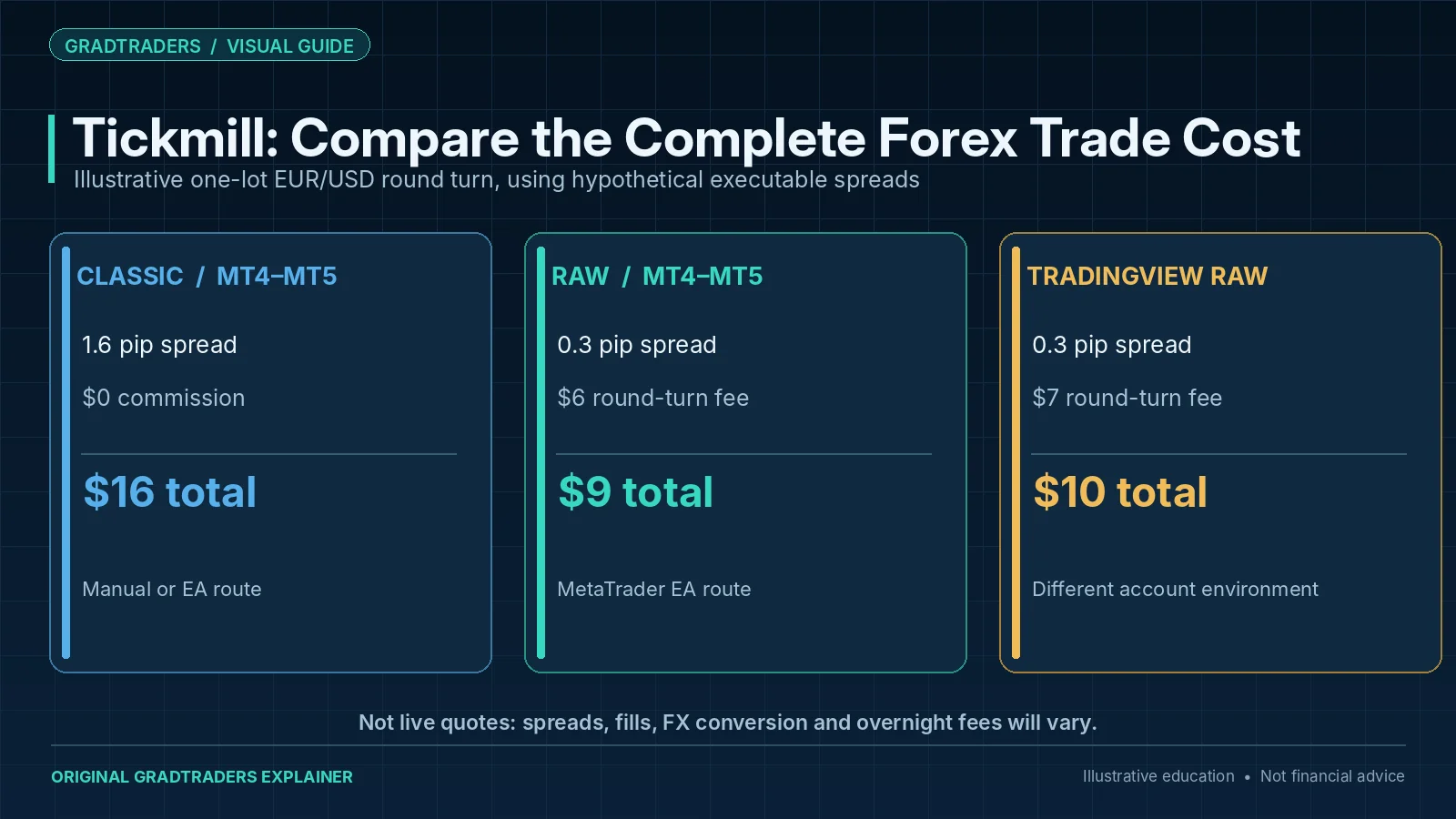
What this means in pounds and dollars: using deliberately hypothetical EUR/USD spreads of 1.6 pips on Classic and 0.3 pips on each Raw account, a standard 100,000-EUR round trip costs approximately $16 on Classic, $9 on MetaTrader Raw and $10 on TradingView Raw. Over 20 identical one-lot trades, those assumptions imply $320, $180 and $200. A backtest should model the actual spread at the time each order would have filled, not treat these examples as live quotes. Overnight charges and slippage can change the result.
A system executing 20 such one-lot round trips would accumulate illustrative spread-and-commission costs of $320, $180 or $200 respectively, if every trade received those same example spreads. That $140 gap between Classic and MetaTrader Raw illustrates why commission should be modelled inside an EA backtest. Slippage, financing, spreads at news releases and actual fills are not included. The global account table is not a guarantee that every jurisdiction offers the TradingView Raw route; Tickmill UK’s published platform FAQ separately lists MT4 and MT5 as its main CFD platforms.
Official sources: Tickmill international three-account matrix, Tickmill UK commission and swap methodology, UK platform FAQ. International figures use Tickmill’s published USD-account pricing; other base currencies and local terms can differ.
Spreads, Commission And Other Trading Costs
Tickmill’s cost proposition is the main reason it deserves attention. The current UK fee page lists variable spreads from 1.6 pips on Classic and from 0.0 pips on Raw. It lists Raw commission at $3 per lot per side, meaning $6 for the opening and closing commission on one standard lot, before spread and any other costs.
The fee applies to forex and precious-metals CFDs according to Tickmill’s published explanation. Other instruments can follow different pricing structures. Overnight financing, currency conversion, exchange fees on futures/options and platform or market-data subscriptions can materially change the total cost.
What changes against the broker bank? On the cited eligible USD forex account schedules, a standard-lot round turn carries a $6 commission with Tickmill MetaTrader Raw, $7 with Eightcap international Raw and $6 with HFM international Zero, before each broker’s actual spread. At a hypothetical 0.3-pip EUR/USD spread, those become about $9, $10 and $9 respectively. That is a like-sized illustration, not a claim that these brokers offer identical live spreads, availability or fills. Spread stability, slippage and the actual account entity determine the result.
Published commissions: Tickmill Raw, Eightcap Raw and HFM Zero. Figures compare a standard USD-priced forex lot on eligible international routes, not identical customer protections or measured spreads.
TradingView Subscription: Does It Offset The Extra Commission?
On Tickmill’s eligible international TradingView Raw route, the forex commission is $1 more per standard lot round turn than MetaTrader Raw, assuming equal spreads. Tickmill Ltd offers a conditional TradingView subscription to qualifying clients. For someone already trading five qualifying standard forex lots each month, that $5 extra commission may be reasonable in exchange for a Plus subscription they would otherwise pay for. It is not a reason to increase trading volume or a guaranteed saving; account eligibility, execution costs and whether the trader uses the subscription features matter.
Optional figures: TradingView subscription tiers and qualifying volume
Tickmill’s published offer lists Essential at 3 qualifying lots (nominal monthly value $13.99), Plus at 5 lots ($28.29) and Premium at 12 lots ($56.49). The following month’s tier is based on the current month’s qualifying turnover. It applies to eligible Tickmill Ltd clients with a connected TradingView account who do not already hold a paid TradingView subscription; unused volume does not carry forward.
For the offer, one standard lot of US30, DE40 or USTEC may count as only 0.25 qualifying lots, so index-trader turnover is not equivalent to forex turnover. At 12 qualifying one-lot forex round turns the $12 extra commission may accompany Premium eligibility; at 60 the difference would become $60, greater than the currently advertised Premium value of $56.49. These illustrative comparisons assume equal spreads and ignore execution and financing; trading extra merely for eligibility can cost more than the benefit.
Source: Tickmill eligibility rules and published tiers. These are advertised software values, not cash credits.
Tickmill Social Trading: A Second Use For A MetaTrader Account
Beyond running your own MT4 or MT5 strategies, eligible international clients can explore Tickmill Social Trading: one trader follows selected Strategy Providers, while providers can set up offers to earn performance-related fees. Followers control their allocations and risk settings. This is a different proposition from a single Expert Advisor, and could be useful to someone combining their own system with externally managed trading ideas.
But copying several providers does not automatically diversify risk. Different strategies may share the same index, currency exposure or market regime, and a follower’s results can vary because of execution, allocation and timing. Tickmill notes that an MT4 follower cannot copy stock-CFD trades from a provider whose stocks are available only through MT5; it also reports South African restrictions on new Strategy Provider registrations. Eligibility and supported symbols therefore matter as much as headline provider performance.
Official source: Tickmill social trading FAQ. This is an eligible international service; do not infer Tickmill UK availability without confirmation from the UK entity.
Three Distinct Tickmill UK Product Routes To Compare
Tickmill’s UK account overview now advertises more than CFDs. The distinction matters to a trader who wants actual exchange-traded instruments or an investment portfolio: an index CFD, an exchange-listed futures contract and a share held through an IBKR-powered multi-asset route are not versions of the same account.
| Tickmill UK route | Instruments and access | Published entry/pricing example | Best reason to investigate |
|---|---|---|---|
| Classic / Raw CFDs | Forex, indices, commodities and shares as leveraged CFDs on MT4/MT5. | Starting deposit 100 units; Raw forex/precious metals $3 per standard lot per side, with spread extra. | Familiar MetaTrader workflows and scalable automated strategies. |
| Exchange-traded futures and options | Futures access across CME, CBOT, NYMEX, COMEX and Eurex; specialist options, CQG and Trading Technologies. | Futures starting deposit $1,000 equivalent, plus exchange, platform and market-data costs as applicable. | Trading listed contracts rather than an OTC index or commodity CFD. |
| IBKR multi-asset offering | Tickmill advertises stocks, ETFs, bonds, funds, spot currencies, futures and options via Interactive Brokers Trader Workstation. | UK account page advertises no fixed starting deposit, US shares from $0.35 and UK shares from £1; other fees vary. | An entirely different listed-market and investment workflow, subject to its own agreement, execution and custody terms. |
Tickmill’s UK specialist futures service names CME, CBOT, NYMEX, COMEX and Eurex and offers CQG and Trading Technologies connectivity. Its options material focuses on Micro E-mini S&P 500 and Nasdaq 100 products. Contracts can carry expiry, exchange/data fees and different margin rules, so I would assess them against an actual listed-futures account at Interactive Brokers, not against an MT4 CFD account.
The IBKR route is especially relevant to readers who would otherwise dismiss Tickmill as CFD-only. It is advertised on Tickmill UK’s own site, but it should not be presented as Tickmill’s normal CFD account becoming a direct-share account: confirm which firm provides each product, who holds assets, pricing tiers and eligibility. Nor does the existence of this UK route establish an ISA or SIPP offering.
Source: Tickmill UK accounts and products overview; separate products have separate platform and eligibility conditions. GradTraders Interactive Brokers Review provides an independent comparison of the broader IBKR investment platform.
FCA Regulation, UK Entity And Client Protection
Tickmill UK Ltd is authorised and regulated by the Financial Conduct Authority under firm reference number 717270. The current UK legal material identifies the company as registered in England and Wales under company number 09592225.
Tickmill states that UK retail client funds are segregated from company money and that negative balance protection applies under the relevant regulatory framework. These protections are useful, but they do not remove market risk, operational risk or the need to verify the contracting entity.
The group also operates regulated entities outside the UK. A trader seeing a Tickmill logo should not assume they are automatically opening with Tickmill UK Ltd. The legal agreement, website footer and account-opening documents should identify the entity, regulator and jurisdiction.
FSCS Protection: Why The Headline Needs Care
Tickmill’s current safety-of-funds page says eligible UK clients may receive FSCS compensation up to £120,000 in the event of insolvency. That figure should not be repeated without qualification.
The FSCS states that the £120,000 limit introduced on 1 December 2025 applies to deposits held with UK-authorised banks, building societies and credit unions. Its May 2026 scam guidance says the maximum for other types of claim is generally £85,000. A broker account is not automatically the same as a bank deposit account.
Eligibility, claim category, client-money treatment and compensation amount depend on the circumstances of a failure. GradTraders therefore does not present £120,000 as a guaranteed Tickmill investment-account limit. Traders should verify the current position directly with Tickmill, the FCA and FSCS.
Deposits, Withdrawals And Account Administration
Tickmill currently lists a starting deposit of 100 units for its main CFD account types. Funding methods and supported currencies vary by entity and payment method. The broker says it does not charge withdrawal fees, although banks and payment providers can impose their own charges.
Tickmill’s support material states that withdrawal requests are processed internally within one working day. Arrival times can then vary: international bank transfers may take two to seven working days, while card withdrawals can take longer. A fast internal approval does not mean the funds will appear instantly.
The current FAQ also explains that low-balance inactive trading accounts can be archived rather than charged a conventional inactivity fee. MT4/MT5 accounts may be archived after 60 days under the stated conditions, while Tickmill Trader/TradingView accounts may be archived after 30 days. Remaining balances are transferred to the wallet and archived accounts remain visible in the inactive-account section.
Starting Deposit
100 units of the supported account base currency for Classic and Raw CFD accounts.
Withdrawal Fee
Tickmill says it charges no withdrawal fee, although third-party costs can still apply.
Account Archiving
Inactive low-balance accounts can be archived on platform-specific timelines rather than left permanently active.
GradTraders Best Native Platform Choice: Plus500
United Kingdom
GradTraders does not promote broker services to UK customers unless the relevant UK entity is authorised and regulated by the Financial Conduct Authority (FCA). Plus500UK Ltd (FRN 509909) is authorised and regulated by the FCA, and Plus500 is a firm we’re proud to partner with for our UK audience.
UK risk reminder: CFDs are leveraged products and can result in rapid losses. The provider-specific retail loss warning is displayed within the Plus500 banner above.
United States
For United States readers, Plus500 provides a separate futures service through Plus500US Financial Services LLC d/b/a Plus500, a Futures Commission Merchant registered with the U.S. Commodity Futures Trading Commission and a member of the National Futures Association (NFA ID 0001398).
The US futures service is separate from the UK CFD service provided by Plus500UK Ltd.
US risk reminder: Futures and options involve substantial risk of loss and are not suitable for every investor. Losses may exceed the amount originally invested. Trading privileges are subject to review and approval.
Partner disclosure: Plus500 is a GradTraders affiliate partner. GradTraders may earn a commission if an eligible account is opened through these links, at no additional cost to you. This commercial relationship does not alter the editorial analysis or verdict on this page.
Where I’d Choose Another Broker
Smaller live forex positions: Tickmill’s published minimum 0.01 standard EUR/USD lot represents about 1,000 euros of underlying exposure. An eligible HFM Cent trade can represent 10 base-currency units at its 0.01 cent-lot minimum, while native OANDA v20 forex orders can start at one unit. For an EA being moved from demo to live trading, that sizing difference may matter more than saving $1 per standard lot in commission. Contract and account eligibility still need checking.
Different automation or contract: a cTrader cBot will not run inside Tickmill’s MetaTrader environment; I would compare Pepperstone, IC Markets or FP Markets instead. For UK financial spread betting through TradingView, Pepperstone has an eligible route whereas I have not verified one at Tickmill. Copy-trading followers should assess the allocation and fee arrangements at Tickmill against HFM and Vantage, not simply compare advertised historical returns.
Tickmill Pros And Cons
Why I Would Consider Tickmill
- Clear MetaTrader Raw forex commission makes frequent-trading costs easier to calculate and test.
- International TradingView Raw offers direct chart trading through a separately priced account, rather than pretending it is MetaTrader in another window.
- MT4/MT5 support established Expert Advisor strategies; eligible international clients can also investigate social trading.
- The UK’s separate listed-futures/options and IBKR multi-asset routes offer alternatives to OTC CFD speculation, each under its own terms.
- Distinct regulated businesses provide local routes where clients qualify, rather than relying on a single offshore account.
Where It Would Not Be My First Choice
- There is no verified cTrader offering or UK financial spread-betting route.
- The standard 0.01-lot forex minimum may be too large for traders seeking one-unit or cent-sized live exposures.
- TradingView subscription eligibility and international platform options cannot be assumed on a UK account.
- Listed futures, options and directly held securities are not available through the normal MT4/MT5 CFD account.
- A quoted zero-pip minimum is not evidence of consistent spreads, execution speed or slippage.
My View On Tickmill
If I were choosing a broker for an established forex Expert Advisor, I would give Tickmill MetaTrader Raw a serious test. Its $6 standard-lot round-turn commission is straightforward, but I would judge the account on executable spreads when the EA trades, slippage during fast moves and the symbols actually available to me. Against IC Markets, FP Markets and Pepperstone, a good result on those measures would be more persuasive than any advertised zero-pip floor.
There’s one reason I might reject it even if the prices were competitive: position size. If I wanted to run a newly developed strategy with very small real-money risk, Tickmill’s conventional 0.01-lot minimum would push me towards comparing HFM Cent or OANDA’s one-unit forex orders. I see the value in being able to introduce live trading gradually without having to take a larger position than the system warrants.
The separate UK futures and IBKR multi-asset services interest me, but for entirely different reasons. I’d investigate a listed futures contract on its own margin, data and execution terms, or a share portfolio on its ownership and custody terms. I wouldn’t choose Tickmill’s CFD account because those other products happen to sit under the same name.
Final Verdict: Tickmill Earns 8.4/10
Tickmill earns 8.4/10 as a cost-conscious choice for an eligible MetaTrader forex trader. I would shortlist MetaTrader Raw for a strategy that needs frequent, accurately costed execution. I would only pay the extra TradingView Raw commission if direct chart dealing genuinely improved the workflow; the conditional software promotion should be secondary.
Its separately advertised UK futures/options and investment routes are worth investigating for traders whose objectives extend beyond CFDs, but they deserve their own account comparison. For cTrader, UK spread betting or unusually small forex positions, I would begin with an alternative better suited to that specific job. Tickmill is compelling for the right method—not because every trader needs all its products.
Further GradTraders Research
For MetaTrader and Raw forex accounts, the most useful direct comparisons are the IC Markets Review, Pepperstone Review and FP Markets Review. Each takes a different approach to platforms, regulation and trading costs.
If the account choice is being driven by automation or pricing, the platform comparison, broker cost and execution guide and international regulation comparison are better starting points than assuming a global brand has the same terms everywhere.
Explore GradTraders Internationally
Browse GradTraders’ country pages. These links are for site navigation only; they do not confirm broker availability, regulatory status or eligibility.
Browse all 20 country gateways
Asia: Japan · South Korea · Taiwan · Hong Kong · India · Singapore · Thailand
Europe: Italy · Sweden · Switzerland · Germany · Norway
Americas: United States · Canada · Mexico
Middle East: United Arab Emirates · Saudi Arabia
Africa: South Africa
Oceania: Australia · New Zealand
Tickmill Review 2026 FAQ
Is Tickmill a good broker?
Tickmill earns 8.4/10 for its international Classic, MetaTrader Raw and TradingView Raw CFD account choices, with useful MetaTrader automation and competitive commission pricing. Its UK business separately advertises FCA-regulated CFDs, listed futures/options and an IBKR multi-asset route. The right product depends on the legal entity and trading strategy; Tickmill is less suitable for cTrader or UK spread betting.
Is Tickmill available internationally or only in the UK?
Tickmill has separately regulated businesses in the UK (FCA), Europe (CySEC), Seychelles (FSA) and South Africa (FSCA). Each serves an account and country-eligibility framework of its own. The UAE DFSA registration relates to a representative office, not proof that every UAE resident has a separate DFSA retail account. Always confirm the contracting entity and available products.
Is Tickmill TradingView Raw priced the same as MetaTrader Raw?
Not on Tickmill’s published international account schedule. Its MetaTrader Raw account charges $3 per standard lot per side on applicable forex and metals CFDs, while eligible TradingView Raw/Tickmill Trader accounts charge $3.50 per lot per side. TradingView Raw is separate from the MetaTrader Expert Advisor environment, and product or regional terms may differ.
Does Tickmill include a TradingView subscription?
Tickmill Ltd advertises conditional TradingView Essential, Plus and Premium subscriptions for eligible clients who do not already have a paid plan and trade 3, 5 or 12 qualifying lots in a month respectively. The benefit is applied to the following month, and selected index CFDs count as only 0.25 qualifying lots per contract. It is not a universal Tickmill UK or EU offer.
Can Tickmill accounts be used for social or copy trading?
Tickmill advertises Social Trading for eligible international accounts, with Follower and Strategy Provider roles and configurable allocations. MT4 followers cannot copy MT5-only stock CFDs, and registrations can be restricted by location. Copying more than one provider does not automatically diversify trading risks.
Is Tickmill FCA regulated?
Yes. Tickmill UK Ltd is authorised and regulated by the Financial Conduct Authority under firm reference number 717270. Traders should confirm that Tickmill UK Ltd is the entity named in their agreement when they intend to use the UK route.
What platforms does Tickmill offer?
The international Tickmill CFD range includes MT4, MT5, Tickmill Trader and TradingView; TradingView requires an eligible separate TradingView Raw account. Tickmill UK’s main CFD account matrix shows MT4 and MT5, while its listed-futures services use CQG/Trading Technologies and the separately advertised IBKR multi-asset route uses Trader Workstation. Regional account availability differs.
Can I trade directly from TradingView with Tickmill?
Yes. Tickmill says eligible Tickmill Trader Raw accounts can connect to TradingView and place trades directly. Regional, account and product eligibility should be confirmed before opening.
What does the Tickmill Raw account cost?
Tickmill’s published international schedule has MetaTrader Raw at $3 per standard forex lot per side and TradingView Raw at $3.50 per lot per side, with spreads advertised from 0.0 pips. The UK Classic/Raw CFD schedule separately lists $3 per side for Raw; eligibility, spread, slippage, funding and other costs determine the real outcome.
Does Tickmill offer spread betting?
No current official UK spread-betting route was found during this review. Tickmill UK is positioned around CFDs and a separate exchange-traded futures/options service. Availability should be rechecked if spread betting is essential.
How much FSCS protection applies to Tickmill?
Tickmill’s safety page currently mentions up to £120,000, while FSCS guidance says the £120,000 limit applies to bank and building-society deposits and that other claim types are generally limited to £85,000. Eligibility and categorisation depend on the circumstances, so traders should verify the applicable limit directly with FSCS.
What is the Tickmill minimum deposit?
Tickmill currently lists a starting deposit of 100 units of the supported base currency for Classic and Raw CFD accounts. Its separate futures/options route advertises a starting deposit of $1,000 or equivalent.
Is Tickmill suitable for beginners?
Tickmill can suit careful beginners who use a demo account and learn risk management, but Raw commission, multiple platforms, leveraged products and entity checks make it more complex than a simple investing app.
Source note: Original account, commission, platform, funding and FSCS category checks were completed on 11 October 2026; additional international account, regional legal-entity, TradingView subscription, social-trading and UK IBKR multi-asset product details were checked against Tickmill’s official terms on 13 October 2026. GradTraders assesses Tickmill’s account costs and global platform distinctions, international regulated entities and separate UK CFD, listed-derivatives and multi-asset offerings using published provider terms alongside FCA and FSCS guidance. Advertised prices and funding procedures inform the comparison; they are not independent measurements of live execution or withdrawal outcomes.
Official research: UK trading costs · account overview · platform FAQ · TradingView execution · regulation · FCA register entry · safety of funds · deposits and withdrawals · futures · options · FSCS claim guidance.
Facts and provider terms were rechecked on 31 August 2026. Platforms, fees, products, compensation arrangements and jurisdictional availability can change, so confirm the current legal documents before opening or funding an account.