What Is Backtesting in Trading? Strategy Testing Explained
Backtesting applies a written trading strategy to historical price data, but I would not judge a system by its best-looking equity curve. My priority is to define the entry and exit rules before testing, include realistic costs and losing streaks, and separate the data used to develop the idea from the period used to challenge it. A convincing backtest is evidence to investigate further, not proof of future performance.
By Matthew Jackson Matthew JacksonFounder of GradTraders,
How historical testing can expose weak rules, unrealistic assumptions and hidden risk.
Core principle: backtest the strategy you wrote, not the chart you can already see.
Disclosure & Risk Notice: This article is for educational and informational purposes only and should not be considered financial advice, investment advice, tax advice or a personal recommendation. Trading CFDs, spread betting, forex, futures, crypto CFDs and other leveraged products involves significant risk and may not be suitable for all traders. You may lose some or all of your capital. Backtests, simulations, demo results and historical performance do not guarantee future results. Historical tests can be misleading when spreads, commissions, financing, slippage, missed fills, data quality, changing market conditions or execution limitations are ignored. Some GradTraders articles may contain affiliate links or references to partner offers. If you sign up or purchase through certain links, GradTraders may earn a commission at no additional cost to you.
Looking for GradTraders partner offers, broker discounts, prop firm promotions and trading-platform deals? You can view the current offers and join the update list here: Access GradTraders Partner Offers.
Quick Verdict
Backtesting is a structured attempt to see how fixed trading rules would have behaved on historical data. It is useful for rejecting weak ideas, clarifying entry and exit rules, estimating drawdown and preparing for forward testing.
It is not proof that a strategy will work. A clean test still cannot reproduce every future spread, fill, market regime, technical problem or emotional decision. I would use backtesting as one filter in a wider process, not as permission to jump straight into meaningful live risk.
This is an educational guide based on trading-workflow analysis and current official platform documentation. It is not a performance test of every backtesting product.
Backtesting At A Glance
The best testing method depends on how objective the strategy is, how much discretion the trader uses and which platform will eventually execute it.
| Testing Route | Best Suited To | Main Strength | Main Limitation |
|---|---|---|---|
| Manual chart review | Discretionary price-action, structure and context-based setups. | Lets the trader examine decisions in detail. | Slow and highly vulnerable to hindsight bias. |
| Bar or market replay | Manual practice with future candles hidden. | Makes the historical test feel closer to a live decision process. | Available history and replay behaviour depend on the platform and plan. |
| Dedicated simulator | Structured manual testing, journalling and historical practice. | Combines replay, order simulation and recorded statistics. | Data, instruments and advanced features may depend on the subscription. |
| Platform strategy tester | Expert Advisors, cBots and clearly coded strategies. | Can test many historical trades and parameter sets quickly. | The result is only as reliable as the code, data and assumptions. |
| Forward test | Checking unchanged rules in current market conditions. | Exposes live data, platform and execution behaviour. | Takes time to build a meaningful sample. |
What Backtesting Means in Practice
Backtesting begins with a trading idea that can be described clearly. The test then applies the same entry, exit, stop, target, risk and filter rules to historical market data and records every valid result.
A simple test might ask whether a breakout strategy, used only in a defined trend and with a fixed two-to-one target, produced a workable sample over 100 historical setups. A more detailed test may separate sessions, market regimes, spreads, commissions, losing streaks and maximum drawdown.
The important distinction is between testing a rule and searching old charts for attractive examples. Once the outcome is visible, it becomes easy to move the entry, ignore a losing setup or invent a new filter. Proper backtesting tries to prevent that.
Why Traders Backtest Strategies
A few recent winners can make almost any trading idea look convincing. Historical testing gives the trader a larger body of evidence and a clearer view of how the method behaved when conditions were less favourable.
Clarify The Rules
The setup must be defined precisely enough to decide whether each historical example qualifies.
Reject Weak Ideas
A strategy that repeatedly fails under consistent rules may not deserve further development.
Measure Drawdown
The test can show how deep and how long previous losing periods became.
Study Conditions
Results can be separated by trend, range, volatility, session, market or other relevant conditions.
Prepare For Rules
Prop-firm traders can compare the strategy with daily-loss, total-drawdown and consistency constraints.
Improve Review
Backtested data can later be compared with demo, forward-test and live-journal results.
A Simple Backtesting Example
Imagine testing a breakout on a major forex pair or index. Before looking at the outcome, write the rules so they cannot be adjusted whenever a trade becomes inconvenient.
| Rule Area | Example Definition | Why It Matters |
|---|---|---|
| Market condition | Trade only when price is above a defined higher-timeframe level or trend filter. | Stops every random breakout being counted as the same setup. |
| Entry | Enter only after price closes beyond a clearly defined range. | Turns the setup into something repeatable and measurable. |
| Stop loss | Place the stop below the breakout candle or previous swing, using one method throughout. | Defines risk before the result is known. |
| Target | Exit at 2R, or trail behind a precisely defined structure rule. | Prevents hindsight from choosing the best-looking exit. |
| Position risk | Use 0.5% account risk for every test trade. | Makes losing streaks and drawdown comparable. |
| Trading costs | Include realistic spread, commission and slippage assumptions. | A small historical edge may disappear after costs. |
Manual Backtesting vs Automated Backtesting
The two methods answer slightly different questions. Manual testing is often more useful when context and judgement matter. Automated testing is more useful when the rules can be coded without interpretation.
Manual Backtesting
The trader reviews historical charts or uses a replay tool, makes each decision and records the result.
- Suitable for discretionary and visual strategies.
- Useful for practising decision-making.
- Can reveal where a written rule is still subjective.
- Slow and vulnerable to skipped trades or hindsight.
Automated Backtesting
Code applies the strategy to historical data and produces trades and performance statistics.
- Suitable for Expert Advisors, cBots and objective systems.
- Can process large samples and parameter sets quickly.
- Useful for checking whether the code follows the intended rules.
- Can create false confidence when data or assumptions are unrealistic.
Backtesting, Forward Testing and Demo Trading
Backtesting should lead into a current-market test rather than straight into a large live position. Each stage checks something the previous one cannot.
| Stage | What It Tests | Useful Result | What It Cannot Prove |
|---|---|---|---|
| Backtesting | How fixed rules behaved on historical data. | A larger sample, estimated drawdown and weak conditions. | That future markets will behave the same way. |
| Forward testing | How unchanged rules behave in current conditions. | Current-market signals and platform behaviour. | How the trader will react when real money is at risk. |
| Demo trading | Execution, position sizing and platform use without capital risk. | Practical evidence that orders and risk settings work. | That live fills and emotions will match demo. |
| Small live test | Real execution and the trader’s response to actual gains and losses. | Evidence from the intended environment at controlled risk. | That a limited sample will continue indefinitely. |
The Biggest Backtesting Mistakes
Bad backtesting can create more confidence than evidence. The most common problems make historical results look cleaner than the strategy would have been in real time.
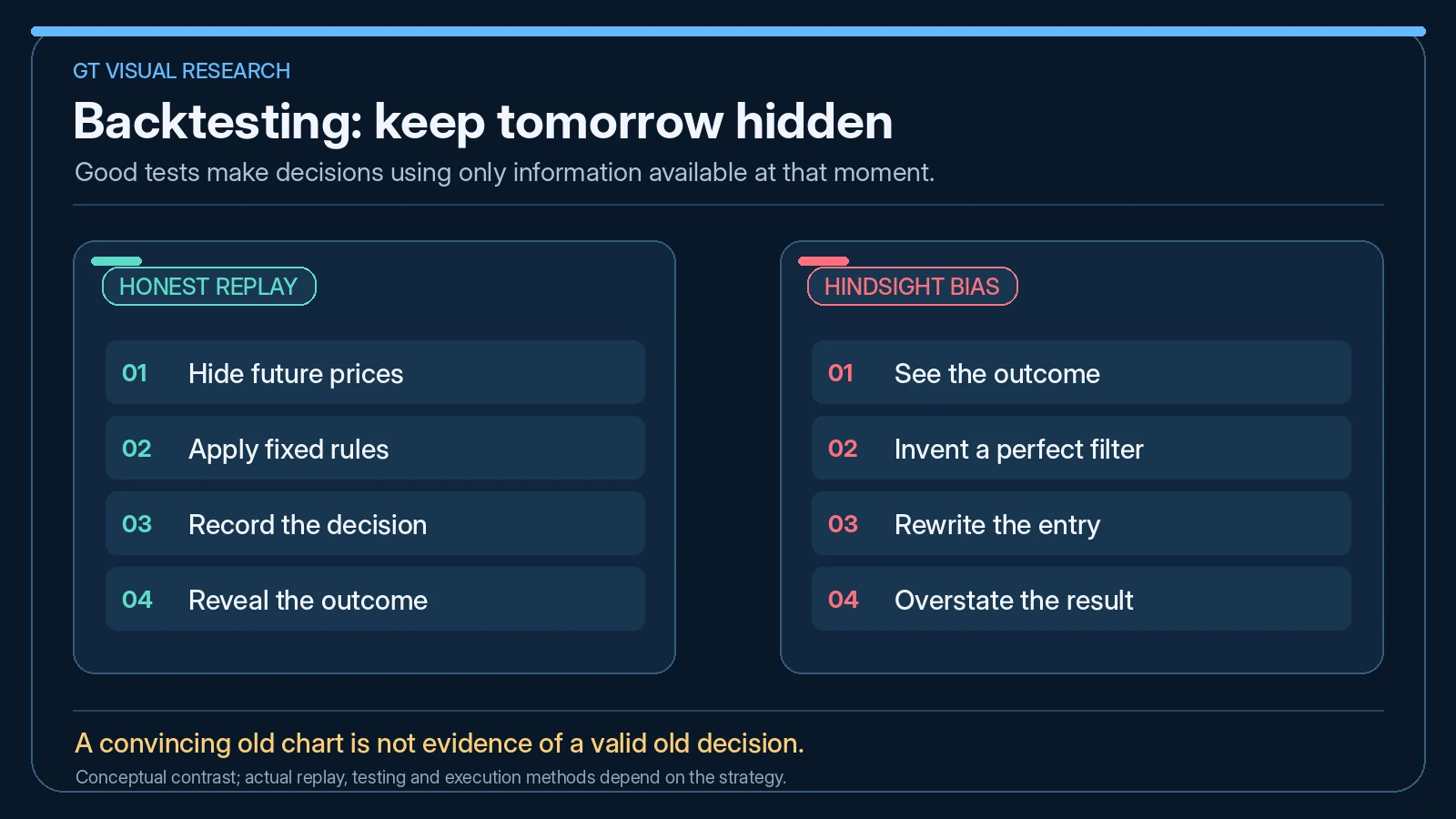
Hindsight Bias
The completed chart makes the entry, exit and best filter appear obvious after the event.
Curve Fitting
Rules are changed repeatedly until they fit one historical sample rather than a durable trading idea.
Ignoring Costs
Spread, commission, financing, slippage and missed fills are left out of the result.
Small Samples
A few attractive trades are treated as proof without enough losing or difficult periods.
Changing Rules Mid-Test
Stops, targets or filters are altered after an inconvenient result appears.
Bad Or Incomplete Data
The test assumes the historical data, session times and symbol specifications match the intended live environment.
Backtesting Tools and Platform Routes
The useful choice depends on whether the strategy is discretionary, replay-based or coded. A more expensive tool is not automatically a better fit.
Forex Tester
A dedicated historical-testing route for traders who want replay, simulated orders and a structured manual backtesting workflow.
TradingView Bar Replay
A visual replay route for chart practice and discretionary testing. Historical access and replay features depend on the symbol, timeframe and account plan.
Platform Strategy Testers
MetaTrader 5 and cTrader provide testing routes for coded Expert Advisors and cBots, with results depending on the code, data and selected settings.
How To Backtest a Trading Strategy Properly
A clean test uses the same process from the first example to the last. The exact software can change, but the discipline should not.
1. Define The Setup
Write the market, timeframe, entry, invalidation, stop, target, filters and time window before testing.
2. Fix The Risk Model
Set the risk per trade, maximum exposure and whether the test uses fixed or compounding position size.
3. Choose The Sample
Use enough historical data to include different regimes, volatility levels, sessions and difficult periods.
4. Hide Future Data
Use replay or another process that prevents later candles from influencing the decision.
5. Record Every Trade
Include winners, losers, break-even trades, missed entries and rule breaches. Do not delete the ugly examples.
6. Include Realistic Costs
Apply assumptions for spread, commission, financing, slippage and order fills that suit the intended market.
7. Review The Distribution
Study average results, drawdown, losing streaks and weak conditions rather than one headline profit figure.
8. Forward-Test Unchanged Rules
Move the same strategy into current conditions before considering meaningful live risk.
Backtesting Metrics That Matter
A profitable historical total is not enough. The result needs to show how the return was produced and whether the risk would have been realistic to tolerate.
| Metric | What It Shows | Why It Matters |
|---|---|---|
| Sample size | How many valid trades or signals were tested. | A small sample can make chance look like an edge. |
| Win rate | The percentage of recorded trades that won. | It only becomes meaningful when compared with average win and loss. |
| Average win and loss | The typical size of profitable and losing trades. | A lower win rate can still work when winners are meaningfully larger. |
| Expectancy | The average historical result per trade under the test assumptions. | It summarises the relationship between win rate, winners and losses. |
| Maximum drawdown | The largest peak-to-trough decline in the tested equity curve. | It helps judge account risk and whether prop-firm limits could be breached. |
| Longest losing streak | The worst sequence of consecutive recorded losses. | It tests whether the risk model and trader expectations are realistic. |
| Condition breakdown | How results varied by session, regime, market, direction or volatility. | The overall average may hide conditions where the method consistently struggled. |
Do Not Optimise Away Every Losing Trade
A historical test should expose the strategy’s weaknesses, not erase them. Adding more filters after every loss can produce an impressive old equity curve that has no useful flexibility when future conditions change.
I would rather see a simpler strategy with understandable losing periods than a complicated set of parameters designed to explain every historical move. Any change should have a clear trading reason and should be checked on data that was not used to design it.
A Practical Backtesting Record
The journal should make it possible to compare the historical test with the later forward test. Record the information needed to understand why a trade qualified and how it was managed.
| Field | What To Record | Purpose |
|---|---|---|
| Setup version | The exact rule set or parameter version. | Stops results from different strategies being mixed together. |
| Market and time | Instrument, timeframe, session and date. | Allows condition and session comparisons later. |
| Entry and exit | Planned and simulated prices, stop, target and exit reason. | Shows whether the rules were followed consistently. |
| Risk result | Result in R, percentage or another consistent risk unit. | Makes trades with different prices or sizes comparable. |
| Costs | Spread, commission, financing and slippage assumptions. | Prevents gross results being mistaken for realistic net results. |
| Notes and screenshot | Context, rule uncertainty, mistake and chart image. | Helps refine definitions without silently rewriting the result. |
Final Verdict
Backtesting is one of the most useful ways to examine a trading idea before capital is at risk, provided the test is honest. It can define the rules, reveal weak conditions, estimate drawdown and prepare the strategy for forward testing.
The value comes from the process, not from producing the smoothest historical equity curve. I would keep the rules fixed, include realistic costs, record every qualifying trade and treat the result as evidence to investigate rather than a promise about the future.
Source note: I built this GradTraders guide from editorial judgement, practical trading-workflow analysis and current official documentation. Historical data access, replay limits, platform testers, pricing and product features can change, so check the current provider information before subscribing or relying on a particular testing workflow.
Official documentation checked: Forex Tester Online · TradingView Bar Replay · MetaTrader 5 Strategy Tester · cTrader cBot backtesting.
Useful next reads: Best Backtesting Software · Forex Tester Review · TradingView Review · Best Trading Journals · Trading Automation Checklist.
Explore GradTraders Internationally
Browse GradTraders’ country pages for regional trading context and related research. These links are for site navigation only; software access, market data, pricing, broker connections and eligibility can differ by country and provider.
Browse all 20 country gateways
Asia: Japan · South Korea · Taiwan · Hong Kong · India · Singapore · Thailand
Europe: Italy · Sweden · Switzerland · Germany · Norway
Americas: United States · Canada · Mexico
Middle East: United Arab Emirates · Saudi Arabia
Africa: South Africa
Oceania: Australia · New Zealand
Backtesting FAQ
What is backtesting in trading?
Backtesting in trading is the process of applying a defined strategy or rule set to historical market data to examine how it would have behaved in the past.
Does backtesting guarantee profits?
No. Backtesting can help traders test ideas and understand risk, but historical results do not guarantee future performance. Market conditions, execution, costs and trader behaviour can all change.
How do you backtest a trading strategy?
Write the entry, exit, stop, target, risk and filter rules before viewing the outcome. Then test those same rules across historical data, record every valid trade, include realistic costs and review the results without changing the method halfway through.
How many trades should I backtest?
There is no universal number. A handful of examples is not enough, so the sample should be large and varied enough to include winning periods, losing periods, different market conditions, drawdown and losing streaks.
What is the difference between backtesting and forward testing?
Backtesting applies rules to historical data. Forward testing follows the same rules in current market conditions. I would use both before considering meaningful live risk.
Is manual backtesting useful?
Yes. Manual backtesting is useful for discretionary strategies because it helps traders practise applying rules and reading context. Replay tools and a written process can reduce hindsight bias.
Can backtesting be misleading?
Yes. Results can be misleading when the sample is too small, costs are ignored, future data influences decisions, rules change during the test or a strategy is fitted too closely to the historical sample.
Should trading costs be included in a backtest?
Yes. Spreads, commissions, financing, slippage and missed fills can materially change a strategy result. The test should use assumptions that are realistic for the market, platform and account being considered.
What is the best software for backtesting?
The best choice depends on the strategy. Forex Tester is a dedicated historical testing route, TradingView Bar Replay suits visual chart practice, and platform testers such as MetaTrader 5 or cTrader are more suitable for coded Expert Advisors and cBots.
What should I do after backtesting a strategy?
After a useful backtest, keep the rules unchanged and forward-test them in current conditions. Then practise on demo and only consider very small live risk after execution, position sizing and risk controls have behaved as expected.