Algorithmic Trading Explained: Rules, Bots And Trading Systems
Algorithmic trading turns trading decisions into rules that software can analyse or execute. My starting point is simpler than choosing a bot: can the entry, exit, position size and failure conditions be defined clearly enough to test? From there, traders can choose alerts, MetaTrader Expert Advisors, cTrader cBots or fuller automation to suit the process.
 , GradTraders
A quick guide to algorithmic trading, trading bots, rule-based systems and the role of testing, execution and risk controls.
A workflow, not a magic-money bot
Current MetaTrader and cTrader documentation supports the same core principle: trading robots execute predefined algorithms. Testing and monitoring remain separate jobs that the trader still has to perform.
A clearly defined strategy, a testing plan and risk limits matter more than the label attached to a trading bot.
Disclosure & Risk Notice: This article is for educational and informational purposes only and should not be considered financial advice, investment advice, tax advice or a personal recommendation. Trading CFDs, spread betting, forex, futures, crypto CFDs and other leveraged products involves significant risk and may not be suitable for all traders. You may lose some or all of your capital. Algorithmic trading systems, trading bots, Expert Advisors, cBots and automated strategies can fail, disconnect, overtrade, behave differently in live markets and breach broker or prop firm rules. Backtested or simulated results do not guarantee future performance. Some GradTraders articles may contain affiliate links or references to partner offers. If you sign up, purchase or open an account through certain links, GradTraders may earn a commission at no additional cost to you. Commercial relationships do not determine the editorial conclusion or ranking.
Looking for GradTraders partner offers, broker discounts, prop firm promotions and trading platform deals? You can view the current offers and join the update list here: Access GradTraders Partner Offers.
Quick Verdict
Algorithmic trading is the process of expressing trading decisions as rules that software can analyse or execute. The rules may power alerts, position sizing, trade management or a fully automated strategy.
The sensible workflow is idea → explicit rules → backtest → forward test → monitored deployment. The algorithm is not the edge by itself; it is the mechanism that applies the edge and the risk controls you designed.
Algorithmic Trading In Simple Terms
An algorithm is a set of instructions. In trading, that means the trader defines what the system should look for and what it should do when conditions are met. The rules might be simple, such as buying when one moving average crosses another, or more complex, such as combining trend, volatility, spread, session, liquidity and risk filters.
Algorithmic trading does not always mean fully automated trading. Some algorithms only scan markets and create alerts. Others calculate position sizes or manage exits. Fully automated systems may open, manage and close trades without manual clicks.
The important distinction is that algorithmic trading starts with rules. If the rules are vague, unstable or based on hindsight, the system may look impressive but still fail when used in real conditions.
Algorithmic Trading Vs Automated Trading
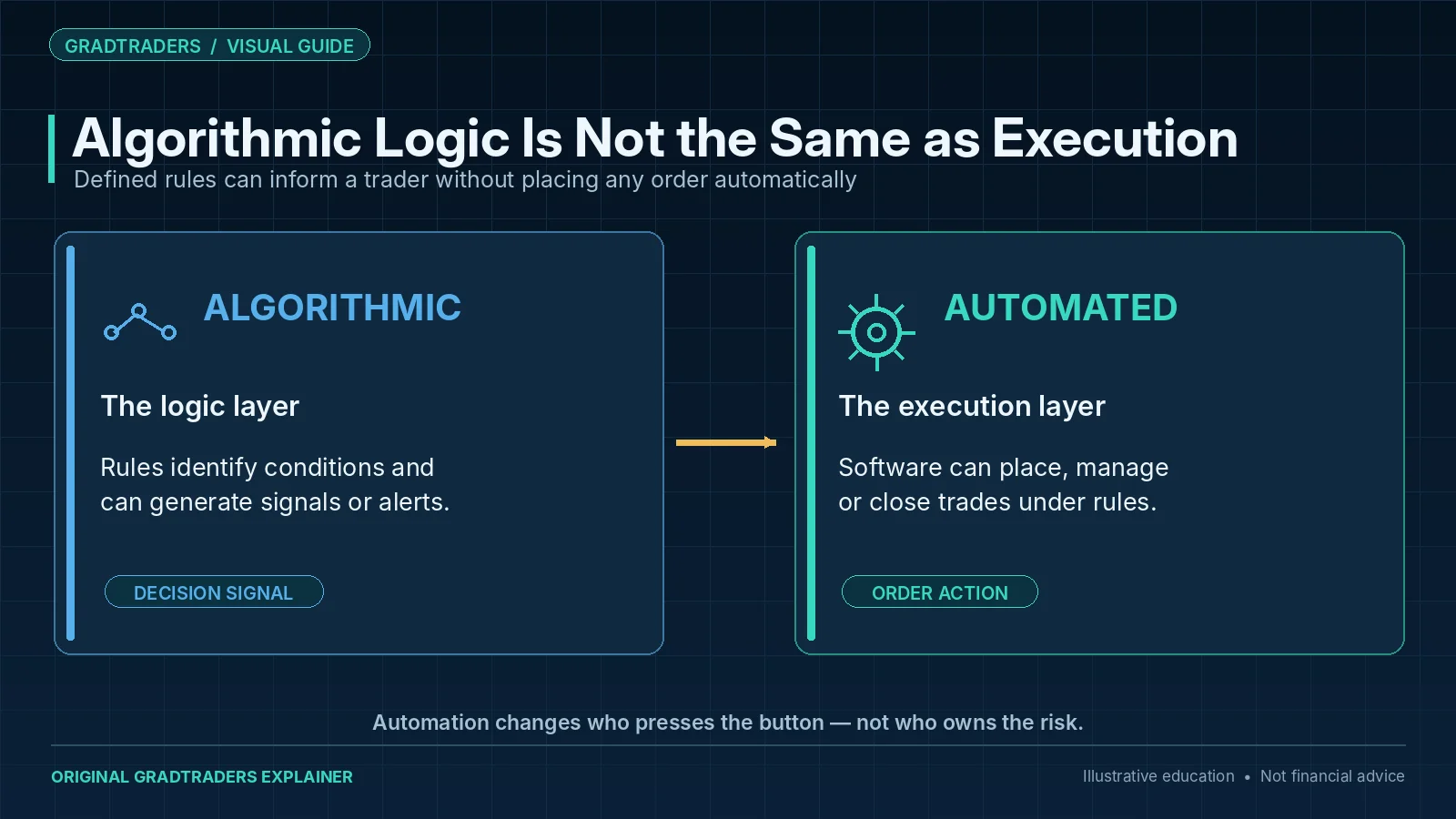
The terms overlap, but they are not always identical. Algorithmic trading is about using rule-based logic. Automated trading is about the software executing some or all of the trading process automatically.
| Term | Meaning | Example | GradTraders View |
|---|---|---|---|
| Algorithmic Trading | Using defined rules or code to analyse markets or generate decisions | A rule that signals long trades only when trend, pullback and volatility conditions align | The logic layer of the system. |
| Automated Trading | Software places, manages or closes trades automatically | An Expert Advisor opens and manages trades on MT5 | The execution layer of the system. |
| Semi-Automated Trading | Software assists, but the trader still approves or manages trades | An alert triggers, the trader checks the chart, then manually enters | Often a sensible middle ground for developing traders. |
| Trading Bot | A software tool that follows programmed trading instructions | A bot that enters, exits and sizes positions according to rules | Only useful if the underlying strategy and risk controls are sound. |
How Algorithmic Trading Works
Most algorithmic trading workflows follow a similar structure, whether the trader uses MetaTrader, cTrader, TradingView alerts, Python, a no-code builder or a broker API.
1. Strategy Idea
The trader starts with a market idea, such as trend continuation, mean reversion, breakout, pullback or volatility expansion.
2. Rule Definition
The idea is converted into specific rules for entry, stop, target, position size, session filters and invalidation.
3. Backtesting
The rules are tested on historical data to see how they behaved in previous market conditions.
4. Build Or Configure
The system is coded, created in a no-code builder, or configured inside a platform or automation tool.
5. Forward Testing
The algorithm is tested in current market conditions on demo or very small risk to check live-like behaviour.
6. Monitoring
The trader monitors execution, platform stability, drawdown, rule breaks and whether the strategy still behaves as expected.
Common Algorithmic Trading Strategies
Algorithmic trading can be built around many different ideas. The categories below are simplified, but they help explain the main types of rule-based logic.
| Strategy Type | Basic Idea | Typical Risk | Retail Trader Warning |
|---|---|---|---|
| Trend Following | Trade in the direction of an established trend | Whipsaws during sideways markets | Needs filters to avoid poor conditions. |
| Mean Reversion | Trade the idea that price has moved too far and may revert | Strong trends can keep moving against the trade | Dangerous if stops or risk limits are weak. |
| Breakout | Trade when price breaks a range, level or volatility band | False breakouts and slippage | Execution assumptions matter. |
| Scalping | Target small moves over short holding periods | Spread, commissions and latency can destroy edge | Often harder than it looks in backtests. |
| News / Volatility | Trade around high-impact market events or volatility changes | Slippage, widening spreads and restrictions | Often restricted by brokers or prop firms. |
The Main Risks Of Algorithmic Trading
Algorithmic trading can make a strategy look more professional, but it can also make mistakes happen faster and more consistently. The system may follow its rules perfectly while the rules themselves are flawed.
Over-Optimisation
The system may be fitted too closely to old data and fail when future market conditions change.
Poor Data Quality
Bad historical data, missing ticks, unrealistic spreads or incomplete sessions can create misleading backtests.
Execution Assumptions
Live fills, slippage, commissions and broker routing can make results worse than the model suggests.
Platform Failure
Servers, VPS connections, broker platforms and software tools can freeze, disconnect or behave unexpectedly.
Hidden Risk Scaling
Small changes in lot size, compounding or multiple open positions can create larger drawdowns than expected.
Rule Breaches
Prop firm traders must check whether the algorithm, copier, EA or strategy type is allowed before using it.
Tools Used In Algorithmic Trading
Retail algorithmic trading usually sits on top of a software stack. The tools do different jobs, so it helps to separate them clearly.
| Tool Type | Purpose | Example Route | GradTraders Use Case |
|---|---|---|---|
| Charting Platform | Analyse markets, build ideas and set alerts | TradingView | Researching and visually checking strategy logic. |
| Backtesting Software | Test strategy behaviour against historical data | Forex Tester or platform strategy tester | Checking whether the idea survives more than a few examples. |
| No-Code EA Builder | Turn defined rules into MT4 or MT5 Expert Advisors | EA Builder Pro | Later-stage automation for tested rules. |
| VPS Hosting | Keep platforms, bots and EAs running remotely | ForexVPS (primary) or FXVM (second) | Infrastructure for automation, not a replacement for edge. |
| Trading Journal | Review live performance, drawdown and rule behaviour | TraderSync | Comparing backtests with demo and live results. |
Is Algorithmic Trading Suitable For Beginners?
Beginners should be cautious. Algorithmic trading can sound attractive because it appears to remove emotion from the process. But if a trader does not understand risk, market behaviour, backtesting and execution, automation can hide problems rather than solve them.
A better beginner route is to learn the trading basics first, practise with demo accounts, understand risk management, keep a trading journal, then explore rule-based systems later. Automation should be an upgrade to a tested process, not a replacement for learning.
Beginner-Friendly Uses
- Setting alerts when price reaches key levels.
- Using position size calculators.
- Backtesting simple rule ideas.
- Keeping a journal of rule-following behaviour.
Riskier Beginner Uses
- Running unknown bots on live accounts.
- Using martingale or grid systems without understanding drawdown.
- Buying strategies based only on backtest screenshots.
- Using automation on prop firms without checking rules.
Algorithmic Trading And Prop Firms
Prop firm traders need extra caution with algorithmic systems. Some firms allow certain EAs or automation tools, while others restrict third-party systems, copy trading, high-frequency behaviour, latency arbitrage, news trading, martingale risk or strategies that appear to exploit platform conditions.
Before using any algorithmic strategy on a prop firm account, check the firm’s current rules directly. The question is not only whether the bot is profitable. It is whether the method is permitted and whether the risk profile fits the firm’s drawdown and daily loss conditions.
A Sensible Algorithmic Trading Workflow
A disciplined workflow is more important than the software used. A trader should be able to explain the strategy before automating it.
Define The Edge
Explain why the strategy should work and which market behaviour it is trying to capture.
Write The Rules
Document entries, exits, stops, targets, filters, risk size, trade limits and invalidation rules.
Backtest Carefully
Test enough examples while including costs, spread assumptions, slippage and losing periods.
Build Or Configure
Convert the strategy into code, a no-code EA, a cBot or a semi-automated workflow.
Demo And Journal
Run the system in current market conditions and record whether behaviour matches the backtest.
Monitor Live Risk
Use strict limits, alerts, kill switches, VPS checks and ongoing review if any real capital is used.
Final Verdict
Algorithmic trading is best understood as a method for turning market ideas into explicit, testable instructions. The benefit is consistency: software can apply the same logic repeatedly without fatigue or hesitation.
The concluding rule is to automate only after the strategy can be explained without the software. If the entry, exit, risk and invalidation logic are unclear on paper, adding a bot, API or VPS only makes the uncertainty harder to see.
Source note: GradTraders distinguishes documented platform capabilities from its own assessment of how traders should design, test and supervise rule-based strategies. Current MetaTrader 5 documentation describes algorithmic or automated trading as trading operations performed by Expert Advisors according to preset algorithms. Current cTrader documentation likewise describes cBots as programs that analyse conditions, place orders and manage risk according to coded rules.
Primary references: MetaTrader 5 algorithmic trading · MetaTrader 5 Strategy Tester · cTrader cBots documentation.
Useful next reads: Automated Trading Explained · EA Builder Pro Review · Best VPS For Automated Trading · What Is Backtesting? · Best Trading Journals.
Explore GradTraders Internationally
GradTraders has 20 dedicated international gateways with local livestream times, market context and country-specific routes into the wider research site.
These country links are for site navigation only; trading software availability, broker connections, account eligibility and applicable terms must be checked separately.
Browse all 20 country gateways
Asia: Japan · South Korea · Taiwan · Hong Kong · India · Singapore · Thailand
Europe: Italy · Sweden · Switzerland · Germany · Norway
Americas: United States · Canada · Mexico
Middle East: United Arab Emirates · Saudi Arabia
Africa: South Africa
Oceania: Australia · New Zealand
Algorithmic Trading FAQ
What is algorithmic trading?
Algorithmic trading means using rules, formulas or code to analyse markets, generate signals, manage orders or execute trades through software.
Is algorithmic trading the same as automated trading?
Not always. Algorithmic trading is about rule-based logic. Automated trading means software executes part or all of the trade process automatically. The two often overlap.
Can beginners use algorithmic trading?
Beginners can learn simple rule-based systems, alerts and backtesting, but they should be careful with live bots. Risk management, testing and basic trading skill should come first.
What software is used for algorithmic trading?
Retail traders may use MetaTrader Expert Advisors, cTrader cBots, TradingView alerts, no-code EA builders, broker APIs, backtesting software, VPS hosting and trading journals.
Is algorithmic trading profitable?
Algorithmic trading is not automatically profitable. Results depend on the strategy, data quality, execution, costs, risk controls, market conditions and whether the system is monitored properly.