Best Trading Journals 2026: Track Trades, Risk And Performance
My test of a trading journal is whether it helps the trader find the same mistake twice and then change the process. I would start with consistent trade records, risk figures and screenshots; automation and advanced analytics earn their cost only when the journal is actually reviewed.
 , GradTraders
Live trading on YouTube
, GradTraders
Live trading on YouTubeA quick guide to choosing a trading journal for tracking trades, risk, behaviour and performance.
TraderSync is my first specialist comparison when trade volume makes review difficult. TradeZella, Edgewonk, Tradervue and even a spreadsheet can be better fits when the trader needs a different analysis method, level of complexity or budget.
Disclosure & Risk Notice: This article is for educational and informational purposes only and is not financial, investment, tax or personal advice. Trading CFDs, spread betting, forex, futures, crypto CFDs and other leveraged products involves significant risk and may not be suitable for all traders. Trading journals and analytics can improve review quality, but they do not make a strategy profitable or remove trading risk. Some links are commercial partner links; GradTraders may earn a commission from eligible purchases at no additional cost to you. Commercial relationships do not determine the editorial conclusion.
Current partner offers and important offer changes are maintained on GradTraders Exclusive Discounts & Updates.
Quick Verdict
The best trading journal is the one that makes review easier to repeat. Entries, exits and P&L matter, but the more useful questions are whether the setup matched the plan, risk was controlled, rules were followed and the same mistakes keep appearing.
For active traders who want dedicated software, TraderSync remains the strongest GradTraders fit in this shortlist. TradeZella is a strong alternative for traders who want automated journaling, replay, backtesting and AI-assisted review; Edgewonk leans heavily into behaviour and psychology; Tradervue remains relevant for detailed reporting and sharing. A spreadsheet can still be enough for lower-frequency or developing traders.
Current product features were checked against the providers’ official public information for this update.
Best Trading Journals At A Glance
Trading journals vary widely. Some focus on analytics and automated importing. Others focus on trader psychology, playbooks, mentoring, screenshots or manual review. The right choice depends on how often you trade, which markets you trade and whether you need advanced reporting.
| Trading Journal | Best For | Main Strength | GradTraders View |
|---|---|---|---|
| TraderSync | Active traders who want analytics and structured review. | Trade tracking, reports, tagging, notes, charts and performance analysis. | Best overall fit for many active retail traders. |
| TradeZella | Traders who want journaling, playbooks, replay and AI-assisted workflow. | Modern trading workflow, broker imports, reports and playbook-style review. | Strong alternative if you want a more coaching-style platform. |
| Edgewonk | Traders who care about behaviour, execution mistakes and process review. | Performance analytics, mental journal features and process-focused review. | Good for traders who want to understand patterns beyond simple P&L. |
| Tradervue | Stocks, options, futures and forex traders who want reporting and sharing tools. | Trade imports, reports, broker sync and chart-based review features. | Established journal, especially relevant for traders who like detailed trade records. |
| Spreadsheet Journal | Beginners, budget-conscious traders and simple strategy tracking. | Low cost, flexible and easy to customise. | Enough for many beginners if used consistently. |
| Manual Screenshot Journal | Discretionary traders who need visual review of setups and trade decisions. | Simple visual evidence of what the trader saw at the time. | Useful when combined with notes, risk data and mistake tracking. |
What Is A Trading Journal?
A trading journal is a structured record of trades and decision-making. At a basic level, it records entries, exits, position size, stop loss, profit or loss and notes. A better journal goes further by tracking setup quality, emotional state, rule breaks, screenshots, trade management and recurring behavioural patterns.
The purpose is not to make trading look professional. The purpose is to create feedback. Without a journal, many traders rely on memory, and memory is usually selective. Winners feel clearer than they were, losers feel more unlucky than they were, and repeated errors can hide inside a messy trading history.
A useful journal shows whether losses came from strategy failure, poor position sizing, late exits or rule breaks.
The value appears after the trade, when the trader compares intention, execution and outcome honestly.
Over time, good journaling can reveal which setups, markets, times and behaviours actually produce results.
What Should A Good Trading Journal Track?
A basic journal can be useful, but a high-quality trading journal should help a trader understand both numbers and behaviour. Profit and loss alone is not enough because two traders can make the same amount of money for completely different reasons.
Trade Data
Market, direction, size, entry, exit, stop, target, fees, risk, reward and final result.
Setup Quality
The reason for the trade, the setup type, the market condition and whether the idea matched the plan.
Execution Quality
Whether the entry, stop, exit and trade management followed the rules or drifted into improvisation.
Behaviour
Emotions, hesitation, revenge trading, fear of missing out, overconfidence and poor trade selection.
Screenshots
Charts before, during and after the trade so the trader can review the actual decision context later.
Patterns
Performance by setup, time of day, market, session, direction, account type and trader behaviour.
1. TraderSync: Best Overall Trading Journal For Active Traders
TraderSync is the strongest GradTraders pick for active traders who want a purpose-built journal rather than a spreadsheet. Its current product offering combines trade imports, analytics, journal notes, planning tools and replay features across multiple markets.
The practical value is not the dashboard itself. It is being able to review performance by strategy, account, market and behaviour instead of relying on memory. TraderSync’s current plans also separate more advanced replay and AI-coaching features by tier, so traders should check the live plan comparison before paying.
Where TraderSync Looks Strong
- Structured trade imports and performance analytics.
- Useful for active traders managing enough trades for patterns to matter.
- Replay and planning tools can support deeper post-trade review.
- Multiple-market support makes it relevant beyond one asset class.
Where To Be Careful
- A paid journal is wasted if trades are imported but never reviewed.
- Higher-tier features should solve a real problem before you pay for them.
- Beginners may be better building the journaling habit in a spreadsheet first.
- Plan limits and features can change, so check TraderSync directly.
2. TradeZella: Strong For Replay, Backtesting And Structured Review
TradeZella has expanded beyond a basic trading journal into a broader review workflow. Its current plans include automated journaling, strategy tracking, analytics, manual backtesting and, on higher tiers, expanded replay and AI-assisted review features.
That makes TradeZella a credible alternative for traders who want journaling, replay and testing inside one ecosystem. The trade-off is cost and complexity: the current plan structure differs materially by account limits, replay access, backtesting allowances and AI features, so the right tier depends on how much of that workflow you will actually use.
Potential Strengths
Automated journaling, strategy tracking, analytics, replay and backtesting can put several review jobs in one place.
Potential Watchout
Do not pay for the highest tier simply because the feature list is longer. Match the plan to your account count, replay needs and review routine.
3. Edgewonk: Strong For Behaviour And Process Review
Edgewonk is particularly interesting for traders who want to connect trading statistics with discipline and psychology. Its current feature set includes performance analytics, mistake tracking, periodic reports and a dedicated psychology/diary layer.
That makes it a strong fit for traders who already know that their biggest problem is not necessarily finding another setup, but identifying when execution quality and behaviour drift away from the plan.
Potential Strengths
Detailed analytics, mistake tracking, discipline review and psychology-focused journaling.
Potential Watchout
Traders mainly looking for a lightweight visual log or an all-in-one replay environment may prefer a different workflow.
4. Tradervue: Established Journal With Reporting And Sharing Tools
Tradervue remains an established choice for traders who value imports, detailed reporting, tags, charts and the ability to share selected trade notes. Its reporting tools cover areas such as time, instrument, market behaviour, risk and win/loss analysis.
The platform can make sense for traders who want a detailed record and strong reporting rather than a newer AI-led workflow. As always, broker support, plan limits and current pricing should be checked directly before subscribing.
Potential Strengths
Trade imports, detailed reports, tags, chart review and controlled sharing with other traders or mentors.
Potential Watchout
Check that the current integrations and reporting workflow fit the markets and brokers you actually use.
5. Spreadsheet Journals: Best Free Option For Beginners
Not every trader needs paid journal software immediately. A spreadsheet can be enough for a beginner if it is structured properly and used consistently. In fact, a simple spreadsheet may be better than a paid subscription if the trader is still learning basic risk management and does not yet know what they need from a journal.
The weakness of spreadsheets is that they require discipline. The trader has to enter trades, update formulas, add screenshots manually and build their own review process. That can work well for organised traders, but many traders eventually outgrow it.
| Spreadsheet Strength | Spreadsheet Weakness | GradTraders View |
|---|---|---|
| Free or very low cost. | Manual entry can become time-consuming. | Good starting point for beginners. |
| Flexible and customisable. | No automatic analytics unless you build them. | Works best for organised traders. |
| Forces a trader to understand the numbers. | Can become messy as trade volume grows. | Upgrade later if manual review becomes a bottleneck. |
How To Choose The Right Trading Journal
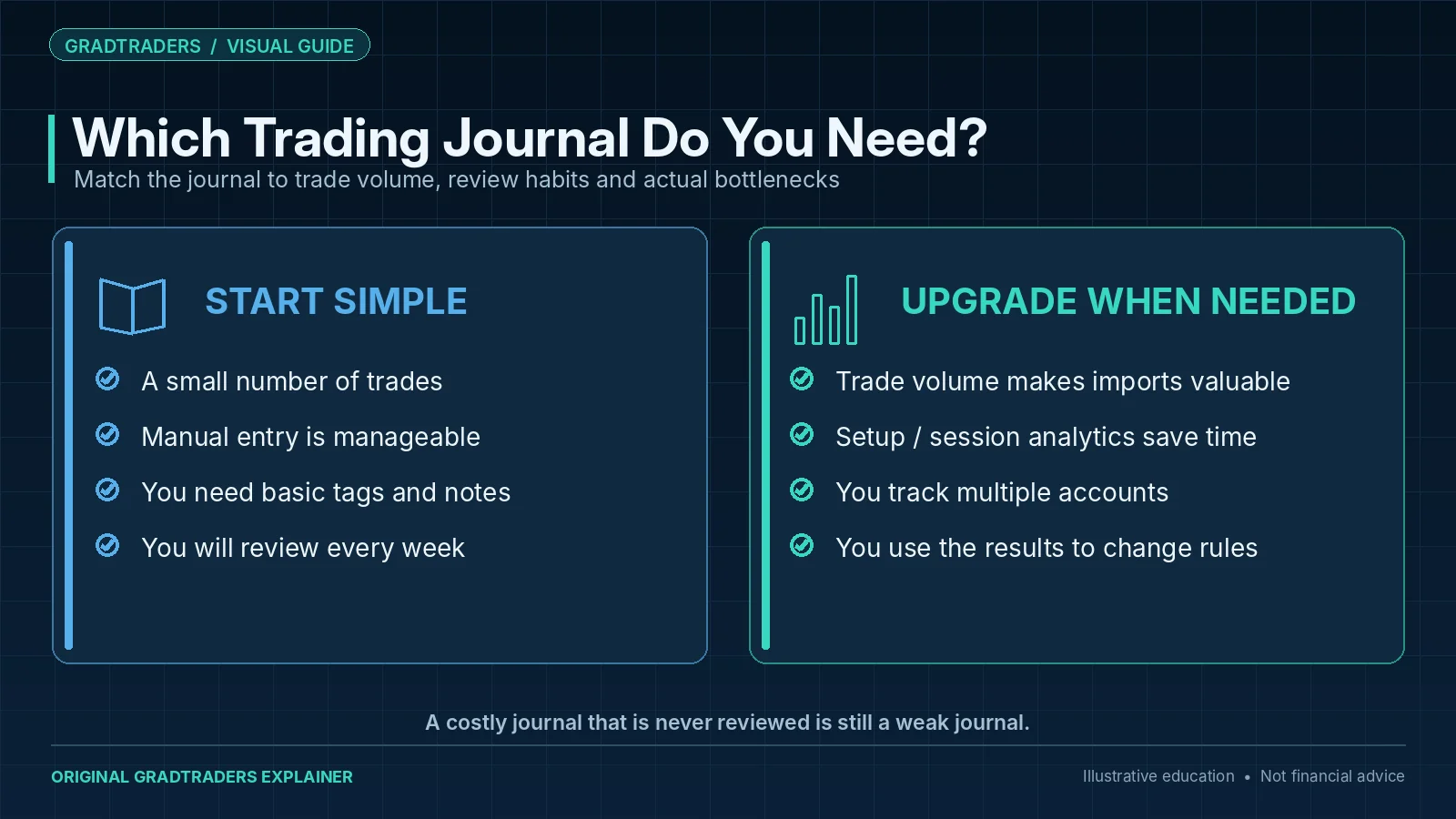
Before choosing a trading journal, traders should decide what problem they are trying to solve. A scalper with hundreds of trades per month needs a different review system from a swing trader who takes a handful of trades per week.
Choose Paid Journal Software If…
- You trade frequently and manual tracking is becoming messy.
- You want analytics by setup, market, time, behaviour or account.
- You need better review discipline for prop firm or active trading.
- You want to connect trade data to screenshots, notes and tags.
Choose A Simple Journal If…
- You are a beginner still learning position sizing and stop losses.
- You only place a small number of trades each month.
- You do not yet know what analytics you actually need.
- You want to build the habit before paying for software.
Best Trading Journal For Prop Firm Traders
Prop firm traders have a specific journaling problem: they are not only trying to make money, they are trying to stay inside rules. Daily drawdown, maximum loss, consistency expectations, prohibited behaviour and payout requirements can all affect how a trader should review performance.
For prop firm traders, the best journal should help answer questions such as: did I follow my risk cap, did I overtrade after a loss, did I take trades outside the plan, did I trade differently near a rule limit, and did my behaviour change after passing a challenge?
Risk Rule Tracking
Prop traders should track daily risk, maximum drawdown pressure and whether trades were taken near rule limits.
Behaviour Review
Revenge trading, oversizing and forcing trades after a failed setup are especially dangerous in prop firm accounts.
Consistency
A journal can help traders see whether results come from repeatable setups or from occasional oversized wins.
GradTraders Trading Journal Checklist
Whichever trading journal you choose, make sure it helps you answer the questions that actually matter. A journal that only records profit and loss is not enough for serious improvement.
| Checklist Item | Why It Matters | Good Journal Behaviour |
|---|---|---|
| Risk Per Trade | Shows whether losses were controlled or oversized. | Record planned risk and actual risk. |
| Setup Tag | Helps identify which trade ideas actually work. | Use consistent tags, not random notes. |
| Rule Followed? | Separates strategy problems from discipline problems. | Mark rule breaks honestly. |
| Screenshot | Shows the actual chart context at the time of the decision. | Capture before and after where possible. |
| Emotional State | Reveals patterns such as fear, revenge trading and overconfidence. | Use simple, repeatable labels. |
| Weekly Review | Turns individual trade data into actual improvement. | Review patterns, not just results. |
Do Not Buy A Journal To Avoid Doing The Review
A trading journal does not improve performance automatically. It only helps if the trader uses it honestly. There is no point importing trades, adding tags and generating reports if the trader refuses to confront the mistakes shown by the data.
The best journal is not the one with the most features. It is the one that helps you build a repeatable review habit. For some traders, that will be TraderSync or another paid platform. For others, it may be a spreadsheet and a folder of screenshots.
Final Verdict
The decision is less about finding the journal with the longest feature list and more about matching the review system to the amount and complexity of trading data you produce.
TraderSync is the strongest GradTraders fit for many active traders, while TradeZella, Edgewonk and Tradervue each solve the review problem differently. A spreadsheet remains completely valid when trade volume is low and the trader is still building the habit.
The decision rule is simple: choose the least complicated journal that makes honest review easier to repeat every week.
Explore GradTraders Internationally
GradTraders has 20 dedicated international gateways with local livestream times, market context and country-specific routes into the wider research site.
Browse all 20 country gateways
Asia: Japan · South Korea · Taiwan · Hong Kong · India · Singapore · Thailand
Europe: Italy · Sweden · Switzerland · Germany · Norway
Americas: United States · Canada · Mexico
Middle East: United Arab Emirates · Saudi Arabia
Africa: South Africa
Oceania: Australia · New Zealand
Best Trading Journals FAQ
What is the best trading journal for active traders?
TraderSync is the GradTraders top pick for many active retail traders because it combines trade tracking, analytics, tagging and structured review features. The best choice still depends on markets traded, trade frequency and workflow.
Do beginners need paid trading journal software?
Not always. Beginners can start with a spreadsheet or simple manual journal. Paid software becomes more useful when trade volume increases or when the trader needs better analytics, tagging and performance review.
Is a trading journal useful for prop firm traders?
Yes. Prop firm traders can use a journal to track rule discipline, daily risk, drawdown pressure, overtrading, consistency and behaviour around challenge or funded account limits.
What should I track in a trading journal?
A useful trading journal should track entry, exit, position size, risk, result, setup type, rule compliance, screenshots, emotional state, trade management and weekly review notes.
Can a trading journal make me profitable?
No journal can guarantee profitability. A journal can help identify mistakes, strengths and patterns, but the trader still needs risk management, discipline, a tested process and realistic expectations.
Source note: this independent GradTraders comparison weighs trader workflow, review depth and software complexity, without claiming personal subscription tests of every journal. Official public product information from TraderSync, TradeZella, Edgewonk and Tradervue was checked on 10 October 2026. Features, integrations and plan limits can change.
Useful checks: TraderSync Review · What Is A Trading Journal? · Software & Tools Map · Risk Management.