Prop Firm Drawdown Explained 2026: Daily Loss, Max Drawdown And Trailing Drawdown
The headline prop-firm balance is not the trader’s usable risk budget. My first question is how much room the strategy has before a breach, once daily loss, maximum loss, trailing or static drawdown, equity-based calculations and reset times are taken into account. A trader who cannot calculate that remaining buffer should not buy the evaluation yet; even a profitable approach can fail if normal losing streaks or open-trade fluctuations exceed the programme’s limits.

What To Calculate Before Paying
- Daily loss formula, reset time and whether floating equity counts.
- Maximum-loss floor: static, trailing, dynamic or end-of-day.
- Current equity minus the closest active breach boundary.
- A personal safety margin inside the provider’s formal limit.
The usable account is the distance between live equity and the nearest breach floor. If a normal losing sequence does not fit inside that room, the programme does not fit the strategy.
Disclosure & Risk Notice: This article is educational and informational content, not financial advice, investment advice, tax advice or a personal recommendation. Retail prop-firm evaluations commonly use simulated accounts. Challenge fees can be lost, accounts can be breached, and passing an evaluation or receiving a performance reward is never guaranteed.
Some GradTraders links are affiliate links. GradTraders may earn commission at no additional cost when an eligible purchase is completed through one of those links. Commercial relationships do not determine the guidance, scores or drawdown conclusions on this page.
Traders researching a widely used benchmark can review the FTMO partner route. Confirm the exact challenge, loss objectives, reset time, platform and country eligibility before paying.
Compare before paying: use the GradTraders Prop Firm Comparison Table for the controlling firm scores and roles, then read the drawdown formula for the exact programme. A single provider can offer both static and moving loss structures.
Quick Verdict: Drawdown Is The Real Account Size
Drawdown is the account’s survival boundary. It decides how much adverse movement, normal variance and trading error can occur before the evaluation or funded-style account is closed.
The headline balance, advertised split and challenge fee are secondary. A $100,000 account with a tight moving loss floor can provide less practical room than a smaller account with a wider static boundary.
The main rules to understand are daily loss, maximum loss, static drawdown, trailing drawdown, equity monitoring, balance monitoring and the provider’s reset time.
The GradTraders position is simple: a trader who cannot calculate the current breach boundary and remaining equity buffer should not buy the challenge yet.
Current Breach Floor
Identify the exact equity level that would close the account now.
Usable Buffer
Measure the distance between current equity and the breach floor.
Risking The Limit
The formal boundary is not a sensible personal trading budget.
Prop Firm Drawdown At A Glance
| Rule | General Meaning | Main Failure Risk |
|---|---|---|
| Daily loss limit | Maximum permitted decline during one provider-defined trading day. | Closed loss, floating loss, commissions and reset timing combine unexpectedly. |
| Static maximum loss | Overall breach floor remains fixed against a defined starting level. | Position sizing leaves too little room for a normal losing streak. |
| Trailing drawdown | Overall breach floor can move upward as balance or equity reaches new highs. | The trader assumes realised or unrealised gains created permanent extra room. |
| End-of-day trailing loss | The floor updates from a defined end-of-day balance or equity reference. | A strong closing result raises the next session’s boundary. |
| Equity-based monitoring | Open trade profit and loss affects compliance immediately. | The account breaches before the losing position is closed. |
| Balance-based reference | Closed results provide the main calculation reference. | The trader assumes floating equity is irrelevant when another rule still monitors it. |
What Is Drawdown In Prop Trading?
Drawdown is the decline from a defined reference point. In a prop-firm programme, it becomes a contractual failure boundary rather than merely a performance statistic.
The reference can be the starting balance, current balance, previous day’s balance or equity, highest recorded equity, or another high-water mark defined by the provider.
This is why the percentage alone is not enough. Two accounts can both advertise a 5% loss rule while producing different breach levels because their reference points and reset calculations differ.
Simple definition: Drawdown is the distance an account may decline before it fails. The provider’s formula determines where that distance begins and whether it moves.
The Three Numbers Every Trader Should Know
Current Equity
Balance plus the live profit or loss from open positions, adjusted for applicable fees and swaps.
Current Breach Boundary
The equity level at which the relevant daily or maximum-loss rule would be violated.
Remaining Buffer
Current equity minus the higher and more immediate of the applicable breach boundaries.
Safety Margin
Additional unused room kept between the trading plan and the provider’s formal failure level.
Daily Loss Limit Explained
The daily loss limit controls how far the account can decline during one provider-defined trading day. It can include realised losses, floating losses, commissions and swaps.
Some providers calculate the boundary from the day’s starting balance. Others use the higher of starting balance or starting equity. The exact reset time can also differ from the trader’s local midnight.
FTMO’s current 1-Step route uses a 3% Maximum Daily Loss amount and its 2-Step route uses 5%; both monitor equity and recalculate the daily limit at 00:00 CE(S)T. The5ers High Stakes currently uses a 5% daily drawdown based on the higher of the previous day’s closing equity or balance, recalculated at 00:00 server time. Check the platform’s live server clock rather than assuming a fixed UTC offset. These examples show why traders must read the formula rather than assume every ‘daily loss’ percentage behaves the same way.
| Starting Reference | Illustrative Daily Limit | Closed Loss | Open Loss | Remaining Room |
|---|---|---|---|---|
| $100,000 | $5,000 | $2,000 | $1,250 | $1,750 before fees or further movement |
This is a generic calculation, not a statement of any provider’s current account terms. The trader must also account for the live rule formula, commissions, swaps and reset timing.
Critical mistake: Treating the remaining daily allowance as money available to risk. A personal stop should normally sit well before the formal boundary.
Daily Reset Times And Overnight Positions
A provider’s trading day may reset in a different time zone from the trader, broker platform or local clock. This matters when a position remains open across the reset.
At the boundary, the new day’s reference can be recalculated while the trade is still carrying floating profit or loss. The position may therefore consume a different amount of daily room after the reset.
Before holding through the boundary, confirm the exact time zone, daylight-saving treatment and whether the new reference uses balance, equity or the higher of the two.
Maximum Drawdown Explained
Maximum drawdown is the overall account loss boundary. It remains relevant across multiple trading days and can terminate the account even when the current day’s loss is small.
The structure matters as much as the percentage. FTMO’s current 2-Step Maximum Loss is a static 10% boundary from initial simulated capital, while FTMO 1-Step uses a 10% end-of-day trailing Maximum Loss that can rise with the highest qualifying midnight balance.
The strategy must fit inside the maximum-loss structure over a realistic sample. A system that normally experiences a deep drawdown is poorly matched with an account offering less usable room, even when the average trade remains profitable.
GradTraders rule: Historical drawdown should fit comfortably inside a personal limit, not merely scrape under the firm’s formal boundary.
Static Drawdown Explained
Static drawdown keeps the overall failure floor at a fixed level relative to the defined starting reference.
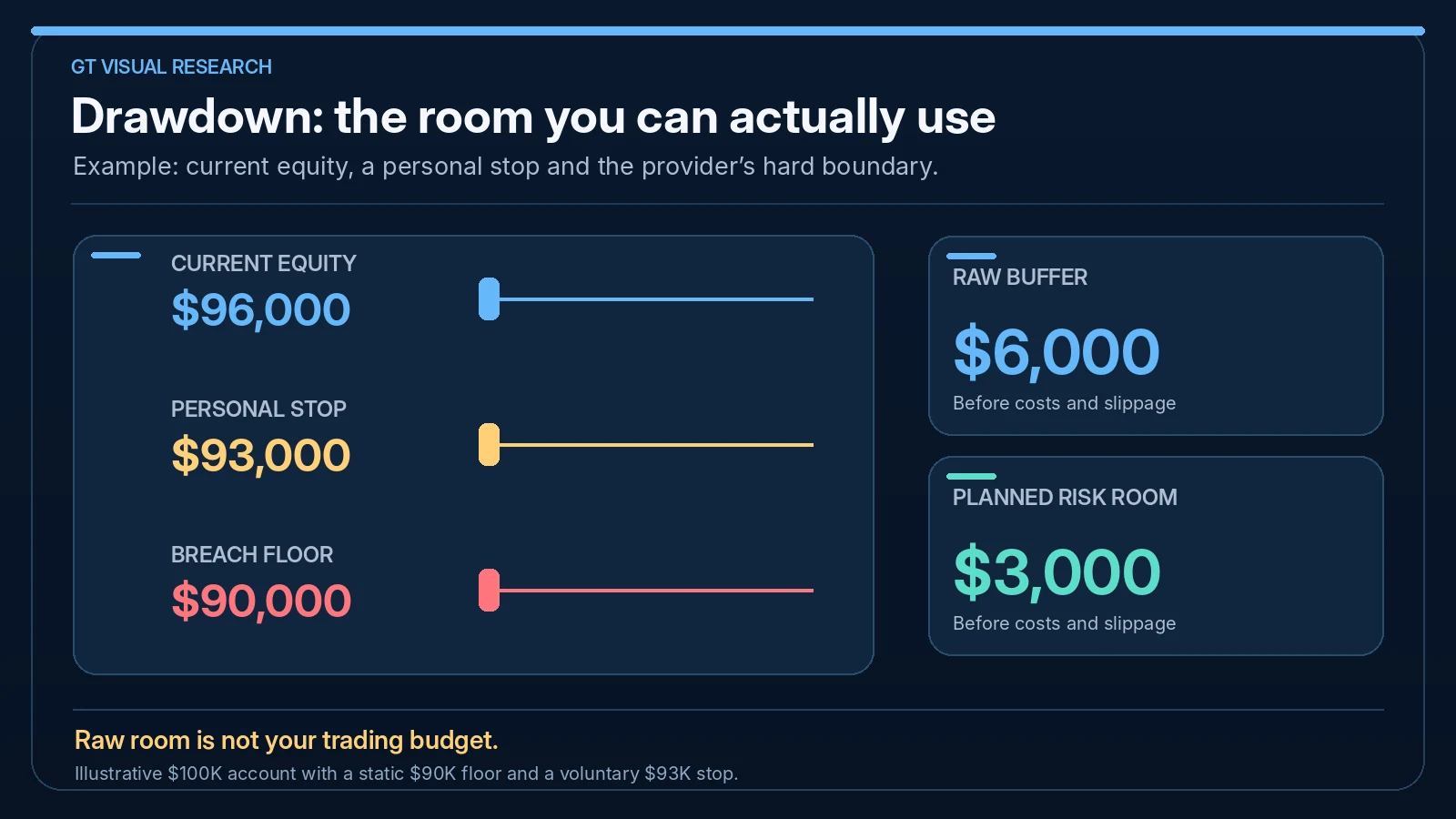
Consider a generic $100,000 account with a 10% static maximum loss. The overall floor would remain at $90,000. If current equity were $96,000, the raw buffer above that floor would be $6,000.
Static drawdown is generally easier to model because profitable days do not move the overall floor upward. The daily rule can still recalculate separately, so the trader must monitor both boundaries.
Trailing Drawdown Explained
Trailing drawdown moves the failure floor upward as the account reaches new balance or equity highs. The distance, update frequency and locking behaviour depend on the programme.
In a generic example, a $100,000 account with a $5,000 trailing distance may begin with a $95,000 floor. If the applicable high-water mark reaches $103,000, the floor may rise to $98,000. A later decline can then breach the account even though equity remains above the original starting balance.
Some trailing rules stop moving when they reach the initial balance. Others continue, use end-of-day values or trail equity intraday. Never assume one provider’s explanation applies to another.
Main challenge: Profit can raise the breach floor before it becomes a safely withdrawable or permanent buffer.
Static vs Trailing vs End-Of-Day Drawdown
| Structure | Does The Floor Move? | Main Advantage | Main Caution |
|---|---|---|---|
| Static drawdown | No, not under the overall static rule. | Clear and easier to model. | Daily equity rules can still create an earlier breach. |
| Intraday trailing drawdown | Potentially with live equity or balance highs. | Can reward controlled early progress on suitable programmes. | Unrealised profit may move the floor before the trade closes. |
| End-of-day trailing drawdown | Usually updates from a defined closing reference. | Less reactive than continuous intraday trailing. | A strong close can reduce future pullback room. |
| Trailing drawdown with lock | Moves until a defined level, then stops. | Can become static after sufficient progress. | The trader must know exactly when and how the lock occurs. |
Equity vs Balance Drawdown
Balance normally reflects closed trading results. Equity reflects balance plus the live profit or loss from open positions.
When a rule monitors equity, the account can breach while a position remains open. Closing the trade later or seeing the market recover does not reverse a boundary that has already been touched.
FTMO’s current loss objectives explicitly monitor account equity, including open positions, swaps and commissions. FundingPips Zero likewise uses real-time equity for its daily and trailing loss controls, and also publishes a separate maximum open-risk rule. The practical lesson is to monitor live equity, not just the closed balance shown after a trade ends.
Balance-Only Thinking
- Looks mainly at completed trades.
- Can hide the risk carried by open positions.
- May underestimate swaps and commissions.
- Can create false confidence near a breach level.
Equity-Aware Thinking
- Tracks open and closed risk together.
- Uses the live account value for buffer calculations.
- Includes costs and correlated exposure.
- Stops before the provider’s boundary becomes relevant.
How To Calculate A Drawdown Buffer
The raw buffer is the distance between current equity and the applicable breach floor.
Raw buffer = current equity − current breach boundary.
The usable buffer should be smaller because it preserves a personal safety margin for spread expansion, slippage, commissions, fast movement and calculation error.
Usable buffer = raw buffer − personal safety margin.
When daily and maximum-loss rules are both active, use whichever boundary leaves the smaller remaining distance.
| Current Equity | Daily Breach Floor | Maximum-Loss Floor | Immediate Raw Buffer |
|---|---|---|---|
| $98,500 | $97,000 | $92,000 | $1,500 because the daily boundary is closer |
Position Size And Losing-Streak Capacity
Position size should be tested against the usable buffer rather than the nominal account balance.
A trader risking $1,000 per full loss has a very different survival profile from a trader risking $250, even though both are trading the same displayed account size.
The educational calculation is straightforward:
Approximate full-loss capacity = usable buffer ÷ planned loss per trade.
This does not guarantee survival because correlated positions, slippage, gaps and daily rules can reduce the actual capacity. It does reveal whether the plan is obviously too aggressive.
Warning sign: A challenge that can absorb only two or three ordinary losing trades under the normal strategy may be structurally unsuitable.
Why Traders Fail Drawdown Rules
Common Failure Patterns
- Risking from the headline account size rather than usable buffer.
- Continuing after the personal daily stop.
- Ignoring floating loss across correlated positions.
- Misreading the provider’s reset time.
- Assuming profit permanently increases trading room.
- Trying to recover the fee or target in one session.
Better Control Process
- Record the breach floor before opening a position.
- Use a personal stop inside the formal limit.
- Aggregate risk across related positions.
- Reduce size as the usable buffer contracts.
- Recalculate after the daily reset.
- Stop trading when the written plan says to stop.
Drawdown For Swing Traders
Swing traders need enough room for normal floating movement, overnight gaps, swaps and weekend exposure where permitted.
A strategy can be profitable over completed trades while repeatedly approaching an equity boundary during the holding period. Backtesting only closed results may therefore understate prop-firm risk.
Compare maximum adverse excursion, not only the final profit or loss of each trade. Also verify whether the daily reference changes while the position remains open.
Drawdown For Scalpers And Active Traders
Active traders can accumulate small losses, spread, slippage and commission quickly. The daily rule may become the controlling boundary even when individual positions are small.
The main defence is a hard personal stop covering the complete session, not merely each trade. Once reached, another setup is irrelevant.
Traders using automation or rapid execution should also confirm whether the provider groups correlated orders, applies concentration reviews or restricts certain execution practices.
Drawdown For Futures Prop Firms
Futures prop programmes often use trailing or end-of-day drawdown, contract limits, consistency policies and account-specific activation or reward buffers.
The value of one tick, the number of contracts and the position of a moving floor can change practical risk quickly. Traders familiar with CFD-style static loss limits should treat a futures programme as a separate rule set rather than carrying assumptions across.
Current futures offerings, including FTMO’s separate futures programmes, publish their own daily-loss and maximum-drawdown mechanics. The correct process is to model the exact futures account rather than use a CFD or forex challenge formula as a proxy.
How The Main GradTraders Firms Fit This Comparison
The scores and roles below preserve the current GradTraders framework. The drawdown examples are programme-level snapshots checked against current official material on 10 October 2026; a firm-level score does not make every account model from that provider equally suitable.
| Firm | GradTraders Score | Master Role | Current Drawdown Example |
|---|---|---|---|
| FTMO | 8.5/10 | Best Benchmark | 1-Step: 3% daily and 10% end-of-day trailing maximum loss. 2-Step: 5% daily and 10% static maximum loss. |
| The5ers | 9/10 | Patient / Scaling Route | High Stakes: 5% daily drawdown and 10% absolute maximum loss, with the daily reference taken from the prior day closing equity or balance. |
| Funded Trading Plus | 8.7/10 | Flexible Partner Route | 1-Step Express: 4% daily and 6% relative trailing maximum drawdown that locks at the starting balance. 2-Step Classic: 4% daily and 8% static maximum drawdown. |
| E8 Markets | 9/10 | Modern Challenger | Product-level rules differ: E8 One uses dynamic drawdown, while E8 Pro publishes static-drawdown structures for relevant routes. |
| FXIFY | 8.5/10 | Flexible Modern Route | Programme-specific mix of trailing and static models; current examples include 1-Phase trailing drawdown and 2-Phase Pro static drawdown. |
| FundingPips | 8.4/10 | Major Modern Alternative | Zero currently uses a 3% daily loss from the higher opening balance/equity and a 5% maximum trailing loss based on peak equity that locks at breakeven after 5% profit. |
Traders researching a patient, scaling-focused structure can review the The5ers partner route. GradTraders code UR06YMJ currently provides 10% off eligible purchases, subject to live checkout terms.
Static And Trailing Routes Under One Provider
One provider can offer materially different drawdown mechanics across its account range. Selecting the brand first and the rule structure second is therefore backwards.
Funded Trading Plus currently describes 1-Step Express as a 6% relative trailing maximum-drawdown route that locks at the starting balance, while 2-Step Classic uses an 8% static maximum drawdown. FXIFY also publishes a mix of trailing and static programmes, including a 2-Phase Pro route built around static drawdown. The Maven Trading Review provides a further example: Maven’s standard 2-Step structure uses static maximum loss, while its standard 1-Step and Instant routes use trailing maximum-loss structures.
Traders researching Funded Trading Plus can review the Funded Trading Plus partner route. Code GRADTRADERS10 currently provides 10% off eligible challenges; Instant Funding and resets are excluded.
Drawdown vs Reward Eligibility
Drawdown remains important after the evaluation. The Master or funded-style account may use different boundaries, consistency rules or risk reviews.
A profitable account can still lose reward eligibility if the trader breaches a rule, violates a prohibited strategy policy or allows equity to touch the formal floor.
The relevant question is not only whether the challenge can be passed. It is whether the same strategy can operate safely through the reward cycle.
Prop Firm Drawdown vs Broker Account Drawdown
In a broker account, drawdown reduces the trader’s own capital. The account normally continues until margin, broker or personal risk limits intervene.
In a prop-firm programme, touching the contractual boundary can end the account immediately even when the nominal balance remains large.
| Route | What Declines? | Main Advantage | Main Trade-Off |
|---|---|---|---|
| Prop firm challenge | Simulated equity inside a contractual risk framework. | Initial financial exposure is mainly the fee. | Strict boundaries can close the account immediately. |
| Funded-style prop account | Simulated account equity and reward eligibility. | Potential performance-based rewards without depositing the nominal balance. | Ongoing programme and conduct rules. |
| Broker account | The trader’s personal capital. | Direct ownership and control. | Losses directly reduce personal funds. |
| Demo account | Practice equity only. | Useful for testing rule calculations. | Limited emotional and financial pressure. |
Drawdown Checklist Before Buying A Challenge
Provider Formula
- What is the exact daily-loss percentage and reference?
- When and in which time zone does the day reset?
- What is the exact maximum-loss structure?
- Does the floor trail balance, equity or end-of-day values?
- Does the trailing rule lock, and at what level?
- Do commissions, swaps and floating losses count?
Strategy Compatibility
- What was the strategy’s worst historical drawdown?
- What maximum adverse excursion occurs before winning trades?
- How many normal losses fit inside the usable buffer?
- What personal daily stop will be used?
- When will position size be reduced?
- Do the rules change after passing?
Related GradTraders Research
Final Verdict: Drawdown Decides Whether The Account Fits
Prop firm drawdown is not a minor rule. It is the practical account. The displayed balance matters far less than the current equity buffer above the closest breach boundary.
Static drawdown is usually easier to model. Trailing and end-of-day structures require closer attention because profitable performance can move the floor.
Daily loss rules must be calculated separately, including floating positions, fees and the provider’s reset time. The smaller of the daily and maximum-loss buffers controls the immediate risk.
GradTraders verdict: Find the current floor, calculate the usable buffer, keep a personal safety margin and reject any account that cannot survive the strategy’s normal losing sequence.
Source note: This guide was rechecked on 10 October 2026 against current official drawdown and loss-rule material from FTMO, The5ers, Funded Trading Plus, E8 Markets, FXIFY and FundingPips. Programme names, percentages, reset calculations and trailing behaviour can change, so reopen the exact rule page before purchasing.
Official research: FTMO Trading Objectives · The5ers High Stakes Rules · Funded Trading Plus 1-Step Express · Funded Trading Plus 2-Step Classic · E8 Dynamic Drawdown · E8 Static Drawdown · FXIFY Max Trailing Drawdown · FundingPips Zero.
Useful GradTraders research: Prop Firm Comparison Table · Review Methodology · Prop Firm Challenge Explained · Prop Firm Payouts Explained.
Explore GradTraders Internationally
Browse GradTraders’ country pages for regional trading context and related research. These links are for site navigation only; prop-firm programme availability, trading permissions, terms and eligibility may differ by country and provider.
Browse all 20 country gateways
Asia: Japan · South Korea · Taiwan · Hong Kong · India · Singapore · Thailand
Europe: Italy · Sweden · Switzerland · Germany · Norway
Americas: United States · Canada · Mexico
Middle East: United Arab Emirates · Saudi Arabia
Africa: South Africa
Oceania: Australia · New Zealand
Prop Firm Drawdown FAQ
What is prop firm drawdown?
Prop firm drawdown is the loss boundary that controls how far an evaluation or funded-style account may decline before a breach. The exact calculation can use balance, equity, a fixed starting level, a moving high-water mark or an end-of-day reference.
What is the difference between daily loss and maximum drawdown?
Daily loss controls the permitted decline during one provider-defined trading day. Maximum drawdown controls the account’s overall loss boundary. A trader can remain above the maximum-loss floor and still fail by breaching the daily limit.
What is trailing drawdown?
Trailing drawdown is a loss floor that can move upward as the account reaches new balance or equity highs. Some versions stop moving at a defined level, while others use end-of-day updates. The exact provider formula must be checked.
Can an open trade breach a prop firm account?
Yes. When the provider monitors equity, unrealised losses, commissions and swaps can count before the position is closed. A trade can therefore touch a daily or maximum-loss boundary while the closed account balance still appears safe.
When does a prop firm daily loss limit reset?
The reset occurs at the time defined by the provider, not necessarily at the trader’s local midnight or the platform clock they expect. Traders should confirm the exact time zone and how open positions affect the new day’s calculation.
How should traders calculate their usable drawdown buffer?
Start with the current breach boundary, then subtract it from current equity rather than relying only on balance. Apply a personal safety margin and compare the remaining room with normal trade risk and historical losing sequences.
Is static drawdown better than trailing drawdown?
Static drawdown is usually easier to understand because the overall floor remains fixed. Trailing drawdown may suit traders who understand the moving calculation. Neither is universally better; strategy variance and account rules decide the fit.
What should be checked before buying a prop firm challenge?
Check the daily-loss formula, maximum-loss type, equity treatment, reset time, trailing or lock behaviour, commissions and swaps, post-pass rule changes, personal risk buffer, country eligibility and whether the full fee is affordable to lose.