Are Prop Firms Worth It In 2026? The Honest GradTraders View
My test of whether a prop firm is worth paying for starts with the trader’s process, not the advertised account size. If the trader can document a repeatable strategy, typical drawdowns and discipline under comparable loss limits, a challenge may provide a useful route to performance rewards. If the trader is still learning risk control or relying on a future payout to relieve financial pressure, buying evaluations adds fees and rules without fixing the underlying problem.
By Matthew Jackson Matthew JacksonFounder of GradTraders,
Disclosure & Risk Notice: This article is for educational and informational purposes only and should not be considered financial advice, investment advice, tax advice or a personal recommendation. Trading CFDs, spread betting, forex, crypto CFDs and other leveraged products involves significant risk and may not be suitable for all traders. Prop firm challenges also involve risk because challenge fees can be lost if account rules are breached. You may lose some or all of your capital. Some GradTraders articles may contain affiliate links or references to partner offers. If you sign up, purchase or open an account through certain links, GradTraders may earn a commission at no additional cost to you.
Traders researching a widely used benchmark can review the FTMO partner route. Confirm the selected challenge, simulated-account structure, objectives, reward conditions, country eligibility and current fee before purchasing.
Looking for GradTraders partner offers, broker discounts, prop firm promotions and trading platform deals? View the current offers and join the update list through GradTraders Exclusive Discounts & Updates.
Compare before paying: Start with the GradTraders prop firm comparison table, then read the precise programme documents. A firm can offer several account models with materially different drawdown, news, consistency and reward conditions.
Quick Verdict: Are Prop Firms Worth It?
Prop firms can be worth it for a disciplined but undercapitalised trader. They are usually not worth it for a trader trying to purchase a shortcut around poor performance.
The useful candidate already knows the strategy’s risk, drawdown, trade frequency and losing-streak behaviour. The challenge adds access to a reward structure; it does not provide the missing trading process.
The poor candidate is attracted mainly by the nominal account size, repeatedly buys after failing and relies on a future payout to cover current financial pressure.
The honest decision is conditional rather than universally positive or negative. Compare the fee, probability of reaching an approved reward, behavioural pressure, programme dependency and broker-account alternative.
Skill Exists, Capital Does Not
The strategy is tested, risk is controlled and the account rules fit normal trading.
Process Is Still Unstable
The trader is changing systems, breaking stops or relying on one large trade.
Challenge-Rebuy Loop
Failure is followed by another purchase rather than review, testing and behaviour change.
Are Prop Firms Worth It At A Glance?
| Trader Situation | Likely Decision | Reason |
|---|---|---|
| Tested process, limited capital | Potentially worth researching | The route may solve a capital constraint without requiring a new strategy. |
| Complete beginner | Usually not yet | Education and evidence should come before paid evaluation pressure. |
| Emotionally breaks personal rules | Usually no | Formal drawdown limits will expose the same behaviour quickly. |
| Enough personal capital | Compare with a broker account | Direct ownership and withdrawals may outweigh the prop route. |
| Infrequent swing trader | Model-dependent | Equity drawdown, news, overnight and weekend rules must fit. |
| US futures trader | Potentially, with separate research | Futures programmes use different contract, drawdown and payout mechanics. |
| Income needed urgently | Usually no | Financial pressure encourages oversizing and emotional rebuys. |
What “Worth It” Actually Means
A prop firm is not worthwhile merely because the fee is smaller than the displayed account balance. The nominal balance is normally simulated capital governed by loss limits and programme terms.
The correct question is whether the route improves the trader’s realistic position after costs, restrictions and failure probability are considered.
A useful decision has five parts:
- Strategy fit: Can normal trading comply without distortion?
- Economic fit: Is the likely reward worth the fee and opportunity cost?
- Behavioural fit: Can the trader handle targets and hard boundaries?
- Contract fit: Are payout, conduct and country terms acceptable?
- Alternative fit: Would demo or broker trading produce a better long-term result?
The Simulated-Account Reality
Many modern retail prop programmes operate through simulated accounts. The displayed capital is not the trader’s deposit and may not be traded directly in a live market.
FTMO states that its accounts use fictitious funds and real market quotes, while eligible simulated performance can lead to real-money rewards. Funded Trading Plus states that its programmes use simulated funds and that rewards are paid according to its programme terms.
This does not make the reward meaningless. It changes the legal and economic relationship. The trader is paying for an assessment and contractual reward opportunity rather than receiving ownership of a large cash account.
Key distinction: The account size is a risk framework and performance environment—not personal capital available for withdrawal.
The Strongest Case For Using A Prop Firm
The strongest case is a trader whose process is already credible but whose personal capital is too small to produce meaningful returns without excessive leverage.
A controlled fee can provide access to a larger simulated risk framework and a performance-reward route. The trader can test whether the process survives formal boundaries without depositing the nominal account size.
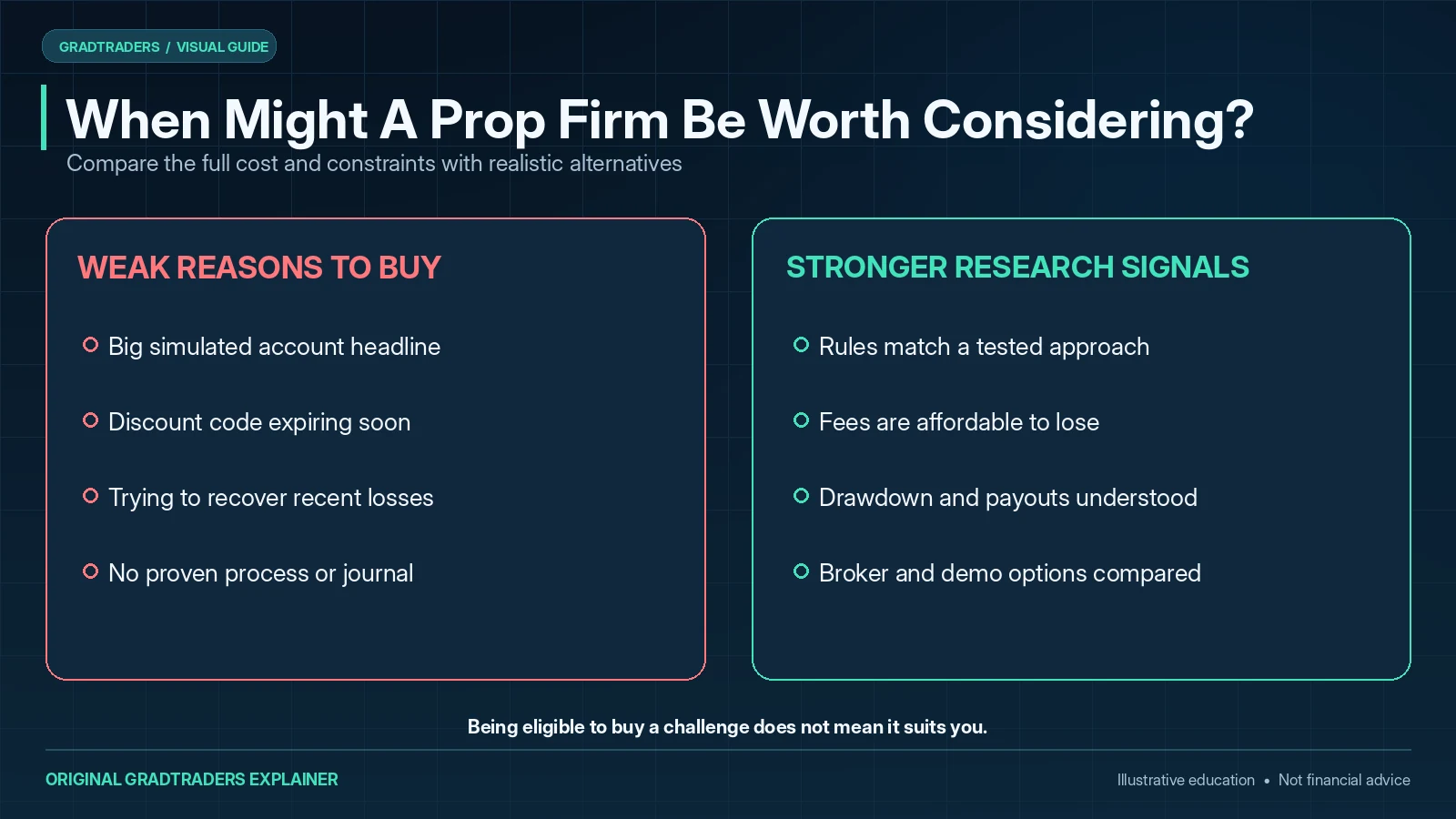
This works only when the strategy naturally fits the target, drawdown, holding and consistency rules. A strategy should not be rebuilt around the challenge after purchase.
Evidence The Route May Fit
- A written strategy and risk plan exist.
- Several months of journal data are available.
- Normal drawdown fits inside a personal safety limit.
- The trader can stop after the daily risk budget.
- The fee can be lost without affecting bills or savings.
- The selected rules match normal holding and execution.
What The Firm Actually Adds
- A structured performance assessment.
- A larger simulated risk framework.
- A contractual route to performance rewards.
- Hard external risk boundaries.
- Potential scaling after compliant performance.
- Lower initial cash exposure than funding the nominal balance.
When Prop Firms Are Usually Poor Value
A prop firm is poor value when the trader is paying to discover problems that are already visible in demo results, journals or a small account.
Targets and fixed breach levels often amplify emotional weaknesses. The trader may force setups near the target, increase risk after a loss or become too defensive near payout eligibility.
Repeated challenges can also hide the true cost. Each individual fee feels manageable, while the annual total becomes larger than the capital the trader was unwilling to place in a controlled personal account.
Warning Signs
- No stable strategy or journal evidence.
- Risk changes according to recent wins or losses.
- The trader needs a payout for living expenses.
- Challenges are purchased after emotional failures.
- The account size creates excitement or urgency.
- Rules are read only after a breach.
Better Next Step
- Return to structured demo testing.
- Use fixed risk over a meaningful sample.
- Review the largest losing streak.
- Set a cooling-off period after failure.
- Build personal capital gradually.
- Reassess only when behaviour is stable.
The Real Economics Of A Challenge
The fee is only the visible cost. The complete cost can include resets, repeat purchases, platform charges, payment fees, currency conversion, tax obligations and the time spent adapting to programme rules.
A conceptual expected-value test is:
Expected value ≈ probability of approved rewards × expected net rewards − total challenge and rebuy costs − associated charges.
This is not a forecast. It forces the trader to include the possibility of failing before a payout rather than comparing the fee with the nominal account balance.
| Factor | Possible Benefit | Possible Cost Or Risk |
|---|---|---|
| Challenge fee | Caps initial cash committed to the attempt. | Usually lost after failure or rule breach. |
| Nominal account size | Provides a larger simulated risk framework. | Can create unrealistic expectations because it is not personal cash. |
| Profit target | Provides a clear completion condition. | Can encourage forced trades and oversizing. |
| Hard drawdown | Limits programme risk and forces discipline. | A normal strategy losing streak can terminate access. |
| Reward split | Creates real-money upside from eligible performance. | Headline split may not reflect consistency, minimums or charges. |
| Rebuys and resets | Allow another attempt. | Can turn one controlled fee into an expensive habit. |
| Provider dependency | The firm supplies infrastructure and reward processing. | Access and payment depend on continuing programme operation and terms. |
The Challenge-Rebuy Trap
One failed attempt does not prove that the model is bad, but an immediate repurchase can prevent useful analysis.
Before another challenge, identify the exact failure: strategy variance, incorrect position size, rule misunderstanding, execution error or emotional override.
A sensible policy is to set a maximum challenge budget and a mandatory cooling-off period. No new purchase should occur until the failed account has been reviewed trade by trade.
Hard rule: A discount should never override a failed-process review. A cheaper repeat of the same mistake is still a loss.
Prop Firms vs Broker Accounts vs Demo Trading
The correct alternative depends on what the trader is trying to learn or achieve.
A demo account is best for testing mechanics without financial pressure. A small broker account introduces genuine capital and direct ownership. A prop programme adds formal performance boundaries and third-party reward conditions.
| Route | Capital And Ownership | Main Advantage | Main Trade-Off | Best Fit |
|---|---|---|---|---|
| Prop firm programme | Usually simulated capital under provider terms. | Reward opportunity with limited initial fee. | Targets, breaches, conduct and payout dependency. | Disciplined but undercapitalised traders. |
| Small broker account | Personal deposited capital. | Direct ownership, control and withdrawals. | Personal funds are directly exposed to loss. | Traders building real-money discipline gradually. |
| Larger broker account | Personal capital with direct market-account control. | No evaluation target or prop payout rules. | Requires sufficient capital and risk tolerance. | Established traders prioritising control. |
| Demo account | Fictitious practice balance. | Free testing and process development. | Does not reproduce all emotional effects of money. | Beginners and strategy testing. |
Benefits And Limitations Side By Side
| Potential Benefit | Matching Limitation |
|---|---|
| Lower initial cash commitment than funding the nominal account size. | The fee buys an assessment and reward opportunity, not ownership of the displayed capital. |
| Formal risk limits can improve discipline. | A single breach can terminate the account even when the strategy later recovers. |
| A clear target can create structure. | Targets can distort behaviour and encourage forced trades. |
| Eligible performance can generate real rewards. | Rewards depend on splits, cycles, KYC, conduct and provider approval. |
| Scaling can increase the simulated account framework. | Scaling conditions can reset timers or introduce new thresholds. |
| Multiple models allow strategy matching. | More models increase the chance of selecting the wrong rulebook. |
Current Examples Show Why The Model Matters
FTMO currently describes its accounts as simulated and advertises rewards of up to 90% of simulated profit. The 2-Step fee may be refunded with the first reward withdrawal, while the 1-Step fee is not refunded.
The5ers currently states that funded High Stakes traders can request a first withdrawal after 14 days and later requests every two weeks, with a minimum amount after the split and method-specific charges.
Funded Trading Plus currently states that its programmes are simulated and lists an 80% standard reward split for 1-Step Express, with a first eligible request from day one and subsequent requests on a seven-day cycle. A 90% split is available through an optional paid add-on. E8’s current documentation shows how best-day rules, payout caps and required buffers can vary materially by model.
These are not reasons to select one firm automatically. They demonstrate that value depends on the exact contract and account model rather than the headline brand.
Traders comparing a patient, scaling-focused route can research the The5ers partner route. GradTraders code UR06YMJ currently provides 10% off eligible purchases, subject to live checkout terms.
Are Prop Firms Worth It For Beginners?
For most complete beginners, the answer is not yet. The beginner is still discovering whether the strategy, risk size and market choice are stable.
Paying for strict rules too early can confuse process development with challenge completion. A lucky pass can reinforce poor risk, while a normal losing streak can be mistaken for proof that the strategy does not work.
A stronger sequence is education, demo evidence, journaling, then carefully controlled real-money or evaluation exposure when the rules are already familiar.
Beginner test: Complete a meaningful sample under the intended prop-firm limits before paying to repeat the same process.
Are Prop Firms Worth It For Experienced Traders?
An experienced trader is more likely to know the strategy’s maximum adverse movement, normal losing streak and response to pressure. That makes account selection more rational.
The prop route can be useful when capital is the genuine constraint. It becomes less compelling when the trader already has enough capital and prefers direct account ownership, flexible withdrawals and freedom from third-party conduct rules.
Experience does not remove provider dependency. The trader should still diversify operational risk, retain records and avoid building all expected income around one programme.
Are Prop Firms Worth It For Swing, News And Automated Traders?
Strategy compatibility is more important than general reputation.
Swing Traders
Check equity drawdown, overnight and weekend holding, swaps and whether news restrictions apply to positions already open.
News Traders
Check event windows, affected instruments, permitted order actions and whether profitable restricted trades are removed.
Automated Traders
Check expert-adviser ownership, order frequency, copying, VPS access and prohibited execution practices.
Scalpers
Check commissions, spreads, platform stability, slippage assumptions and latency or high-frequency restrictions.
UK, US And International Considerations
The central decision is global, but available products and alternatives differ by jurisdiction.
UK traders can compare prop programmes with broker accounts, CFDs and—where suitable—spread betting. US traders often need a futures-first comparison and must verify platform and country access. EU and international traders should check local eligibility, identity documents, payment routes and tax treatment.
Do not use another address, identity or location method to bypass restrictions. A successful challenge can still become ineligible during KYC or payout review.
How The Main GradTraders Firms Fit The Decision
The scores and roles below match the controlling GradTraders framework. They identify useful research routes, not guaranteed suitability.
| Firm | GradTraders Score | Master Role | Why Research It? |
|---|---|---|---|
| FTMO | 8.5/10 | Best Benchmark | Useful reference for comparing objectives, simulated rewards and established programme structure. |
| The5ers | 9/10 | Best Patient-Trader Route | Relevant for traders prioritising patience, progression and a bi-weekly funded reward route. |
| Funded Trading Plus | 8.7/10 | Best Flexible Partner Route | Broad simulated programme menu and currently advertised weekly rewards. |
| E8 Markets | 9/10 | Best Modern Challenger | Modern model range demonstrates how consistency, buffers and payout caps can vary. |
| FXIFY | 8.5/10 | Flexible Modern Route | Multiple account structures for traders willing to perform model-level checks. |
| Funding Pips | 8.4/10 | Major Modern Alternative | Useful example of materially different payout and drawdown conditions across models. |
Provider And Contract Risk
A trader is not evaluating only the strategy. The provider must continue operating, maintain its platform, process rewards and apply its terms fairly.
Due diligence should identify the legal entity, physical contact information, programme agreement, refund policy, payment methods, restricted countries and the process for complaints or account reviews.
Marketing testimonials and payout screenshots can be useful signals, but they do not replace the written contract or prove how future cases will be handled.
Traders comparing a flexible partner-backed route can research the Funded Trading Plus partner route. Code GRADTRADERS10 currently provides 10% off eligible challenges; Instant Funding and resets are excluded, and current checkout terms should be confirmed.
| Check | Healthier Sign | Warning Sign |
|---|---|---|
| Legal entity | Company identity and contracting party are clearly stated. | The customer cannot identify who receives the fee. |
| Programme terms | Objectives, breaches and rewards are documented by model. | Important rules exist only in social posts or support chat. |
| Simulated-account disclosure | The nature of the capital and rewards is explained clearly. | Marketing implies ownership of cash that the terms contradict. |
| Payout process | Cycles, minimums, KYC and methods are documented. | Approval is described as automatic while broad discretion remains hidden. |
| Rule changes | Updates are dated and communicated. | Material conditions change without a clear notice process. |
| Support and review | There is a traceable support and appeal route. | No written channel exists for disputed breaches. |
The Payout Question
A prop-firm payout is a performance reward under programme terms. It is not the same as withdrawing personal capital from a broker account.
Eligibility can depend on the profit split, reward cycle, minimum amount, consistency, profitable days, conduct review, KYC and post-payout buffer.
The reward can be valuable, but its value should be judged only after the complete route from purchase to approved payment is understood.
A Practical Readiness Scorecard
This scorecard is not a guarantee. It is designed to expose obvious reasons to delay a purchase.
| Question | Ready Evidence | Delay Signal |
|---|---|---|
| Is the strategy stable? | One defined process tested over a meaningful sample. | Frequent system changes after losses. |
| Is risk fixed? | Position size follows a written formula. | Risk rises to recover losses or finish targets. |
| Is drawdown understood? | Daily and overall floors can be calculated without guessing. | Only the profit target is known. |
| Do the rules fit? | Normal news, holding and automation behaviour is permitted. | The strategy must be changed to stay compliant. |
| Is the fee affordable? | The full amount can be lost without pressure. | A payout is needed to repay the purchase. |
| Is there a failure plan? | Cooling-off and review steps are written before purchase. | The default response is an immediate rebuy. |
| Was the broker route compared? | Ownership, costs and capital needs were assessed. | The prop route was chosen only for the displayed balance. |
GradTraders threshold: A trader who cannot provide evidence for most of the “ready” column should delay the purchase rather than search for an easier challenge.
Build An Exit Plan Before The First Challenge
A prop firm should not automatically become a permanent dependency. The trader can use approved rewards to build reserves, fund education or gradually increase personally controlled capital.
An exit plan reduces the pressure to keep every account alive indefinitely. It can include a target for personal savings, a broker-account allocation and a limit on how much annual spending goes to challenge fees.
The strongest long-term position may combine selective prop access with increasing ownership of personal trading capital rather than choosing one route forever.
GradTraders Decision Checklist
Trading Evidence
- One strategy is defined and tested.
- Risk per trade is fixed.
- Normal losing streaks are documented.
- The trader can stop after the daily limit.
- Performance does not rely on one exceptional trade.
Programme Fit
- The target and drawdown relationship is acceptable.
- News and holding rules fit the strategy.
- Automation and access methods are permitted.
- The payout path is fully understood.
- The legal entity and country access are clear.
Financial Control
- The complete fee can be lost safely.
- A maximum challenge budget is set.
- No payout is needed for immediate expenses.
- Rebuys require a documented review.
- A broker-account alternative was costed.
Long-Term Plan
- Rewards have a defined use.
- Personal capital will be built over time.
- Provider dependency is limited.
- Records are retained for tax and disputes.
- The route can be abandoned if it harms behaviour.
Related GradTraders Reviews And Guides
| Guide | Why Read It? |
|---|---|
| Prop Firm Comparison Table 2026 | Compare the controlling scores, roles and review routes. |
| Prop Firm vs Broker Account | Compare simulated reward access with direct capital ownership. |
| Prop Firm Challenge Explained 2026 | Understand the full evaluation path before purchasing. |
| Prop Firm Rules Explained 2026 | Review loss, conduct, holding and inactivity conditions. |
| Prop Firm Payouts Explained 2026 | Understand reward cycles, KYC, consistency and buffers. |
| Prop Firm Drawdown Explained 2026 | Calculate the true usable account room. |
| Instant Funding vs Prop Firm Challenge | Compare evaluation pressure with immediate account-preservation pressure. |
| Best Prop Firms For Beginners 2026 | Assess whether a beginner should delay a paid challenge. |
| Best Prop Firms For US Traders 2026 | Compare country access and futures-first considerations. |
| Broker Reviews | Research direct-account alternatives. |
Final Verdict: Are Prop Firms Worth It?
Prop firms are potentially worthwhile tools, not automatic trading opportunities.
They make the strongest sense when the trader already has skill, evidence and discipline but lacks enough personal capital. The fee then purchases a structured assessment and possible reward route.
They make weak sense when the trader is still searching for a strategy, needs urgent income or repeatedly buys challenges after failing. In that situation, the model monetises the trader’s impatience rather than solving the trading problem.
The exact programme matters. Simulated-account terms, loss rules, consistency, payout conditions and provider dependency should all be understood before purchase.
GradTraders verdict: Use a prop firm only when it solves a genuine capital problem without damaging a proven process. Otherwise, keep building skill and personal control through demo or broker-led trading.
Source note: This guide was rechecked on 10 October 2026 against current official information from FTMO, The5ers, Funded Trading Plus and E8 Markets. Simulated-account disclosures, reward percentages, fees, payout cycles, consistency rules, buffers and programme availability can change.
Official research: FTMO How It Works · FTMO Account Technical Structure · FTMO Reward Withdrawals · The5ers Withdrawals · The5ers Payout Methods · Funded Trading Plus Simulated Trading Notice · Funded Trading Plus Programme Terms · E8 Signature Payout Buffers · E8 One Rules.
Useful GradTraders research: Prop Firm Comparison Table · Review Methodology · Prop Firm Rules Explained · Prop Firm vs Broker Account.
Explore GradTraders Internationally
Browse GradTraders’ country pages for regional trading context and related research. These links are for site navigation only; prop-firm programme availability, trading permissions, terms and eligibility may differ by country and provider.
Browse all 20 country gateways
Asia: Japan · South Korea · Taiwan · Hong Kong · India · Singapore · Thailand
Europe: Italy · Sweden · Switzerland · Germany · Norway
Americas: United States · Canada · Mexico
Middle East: United Arab Emirates · Saudi Arabia
Africa: South Africa
Oceania: Australia · New Zealand
Are Prop Firms Worth It FAQ
Are prop firms worth it in 2026?
They can be worth researching for a disciplined trader who already has a tested process, understands the exact account rules and lacks enough personal capital to make broker-account trading meaningful. They are usually poor value for traders who are still learning risk control or repeatedly buying challenges after emotional failures.
Are prop firms suitable for complete beginners?
Usually not as a first step. A beginner generally benefits more from education, demo testing, journaling and carefully controlled personal-capital experience before paying to trade under strict evaluation and payout rules.
Is a prop firm account real trading capital?
Many modern retail prop programmes use simulated accounts with fictitious or simulated funds. Eligible performance can still lead to real-money rewards under the programme terms, but the nominal account balance is not the trader’s personal cash and may not represent orders placed in a live market.
Are prop firm payouts the same as broker withdrawals?
No. A broker withdrawal normally removes available money from an account funded with the trader’s own capital. A prop-firm payout is a contractual performance reward that depends on account status, profit split, rule compliance, identity checks and the provider’s reward process.
How many prop firm challenges should a trader buy?
There is no universal number. A sensible approach is to set a hard budget, use the smallest suitable account and avoid immediate emotional rebuys. Repeated failures should trigger a return to testing and review rather than another purchase.
What makes a prop firm challenge good value?
Good value requires more than a low fee. The rules must fit the strategy, the target must be realistic relative to drawdown, the payout route must be clear, the provider and legal entity must be identifiable, and the trader must be able to lose the full fee without financial pressure.
When is a broker account better than a prop firm?
A broker account may be better when the trader has sufficient personal capital, wants direct ownership and withdrawals, dislikes third-party performance rules or is building a long-term track record without evaluation targets and payout conditions.
What should be checked before paying for a challenge?
Check whether the accounts are simulated, the legal entity, country eligibility, all fees, profit target, daily and maximum loss, drawdown type, news and holding permissions, prohibited strategies, payout cycle, consistency rules, payment methods, refund terms and what happens if the programme changes or closes.