Prop Firm Rules Explained 2026: Drawdown, Payouts And Hidden Mistakes
The prop-firm rulebook is the product. My first comparison is the set of rules that could end the account or block a reward—not the headline balance or advertised discount. Before paying I would work through daily and maximum loss, equity versus balance calculations, reset times, permitted trading methods and the rules for the reward-bearing stage. A programme is only a suitable match if the trader’s normal strategy can operate inside those limits without being forced into unnatural behaviour.

Check These Before Paying
- Profit target, daily-loss formula, maximum-loss floor and reset time.
- Static, trailing or end-of-day drawdown and whether open equity counts.
- News, overnight, weekend, automation, copying and account-access rules.
- Post-pass conditions, consistency, payout eligibility, KYC and country access.
A large nominal balance is not useful when the strategy cannot fit inside the loss boundaries or the normal trading method conflicts with the programme’s conduct rules.
Disclosure & Risk Notice: This article is educational and informational content, not financial advice, investment advice, tax advice or a personal recommendation. Retail prop-firm evaluations commonly use simulated accounts. Challenge fees can be lost, accounts can be breached, and passing an evaluation or receiving a performance reward is never guaranteed.
Some GradTraders links are affiliate links. GradTraders may earn commission at no additional cost when an eligible purchase is completed through one of those links. Commercial relationships do not determine the rulebook conclusions, scores or firm roles on this page.
Traders researching an established benchmark can review the FTMO partner route. Confirm the exact 1-Step or 2-Step objectives, Standard or Swing account type, platform and country eligibility before paying.
Compare before paying: use the GradTraders Prop Firm Comparison Table for the controlling firm scores and roles, then open the exact programme rules. One provider can apply different targets, drawdown formulas, news permissions, holding rules and payout conditions across its account models.
Quick Verdict: Start With The Breach Rules
The fastest way to judge a prop-firm programme is to ignore the headline balance initially and identify the rules that can end the account. Daily loss, maximum loss, trailing mechanics and prohibited conduct define the hard boundaries; targets and reward terms only matter if the account survives.
Then check whether normal trading behaviour fits. A swing trader needs compatible overnight and weekend rules. A news trader needs event-window clarity. An automated trader needs written permission for the exact EA, copier or VPS setup. A profitable method can still be unsuitable when the programme forces the trader to change how it is executed.
Finally, read the reward-bearing stage before buying the evaluation. FTMO is a clear example: Standard and Swing restrictions differ after passing, while 1-Step and 2-Step use different loss structures. The firm name does not identify the rulebook.
Hard Boundaries
Daily loss, maximum loss, trailing drawdown and account-access breaches can end the route.
Trading Conduct
News, holding, automation, copying and execution rules determine whether normal trading is permitted.
Reward Eligibility
Consistency, KYC, payout timing and post-payout buffer decide whether profitable performance becomes an approved reward.
Prop Firm Rules At A Glance
| Rule | What It Controls | Typical Hidden Mistake |
|---|---|---|
| Profit target | Required performance for an evaluation phase. | Trading the target instead of the strategy. |
| Daily loss | Maximum permitted decline during one provider-defined day. | Ignoring floating loss, costs or reset time. |
| Maximum loss | Overall account failure boundary. | Sizing from the nominal balance rather than usable buffer. |
| Trailing drawdown | A moving loss floor linked to balance or equity highs. | Assuming profit created permanent extra room. |
| Trading days | Minimum activity or profitable-day requirements. | Forcing low-quality trades to complete a calendar condition. |
| Consistency | How concentrated the total profit can be. | One oversized day delays completion or reward eligibility. |
| News and holding | When orders can be opened and positions retained. | Assuming evaluation permissions continue after passing. |
| Prohibited strategies | Execution and conduct the provider will not accept. | Using copying, automation or arbitrage without checking details. |
| Payout conditions | When profitable performance becomes an approved reward. | Treating dashboard profit as automatically withdrawable. |
Rule Hierarchy: Hard Breaches, Soft Conditions And Reviews
Not every prop-firm rule operates in the same way. Traders should separate immediate failure boundaries from conditions that delay progress or trigger a review.
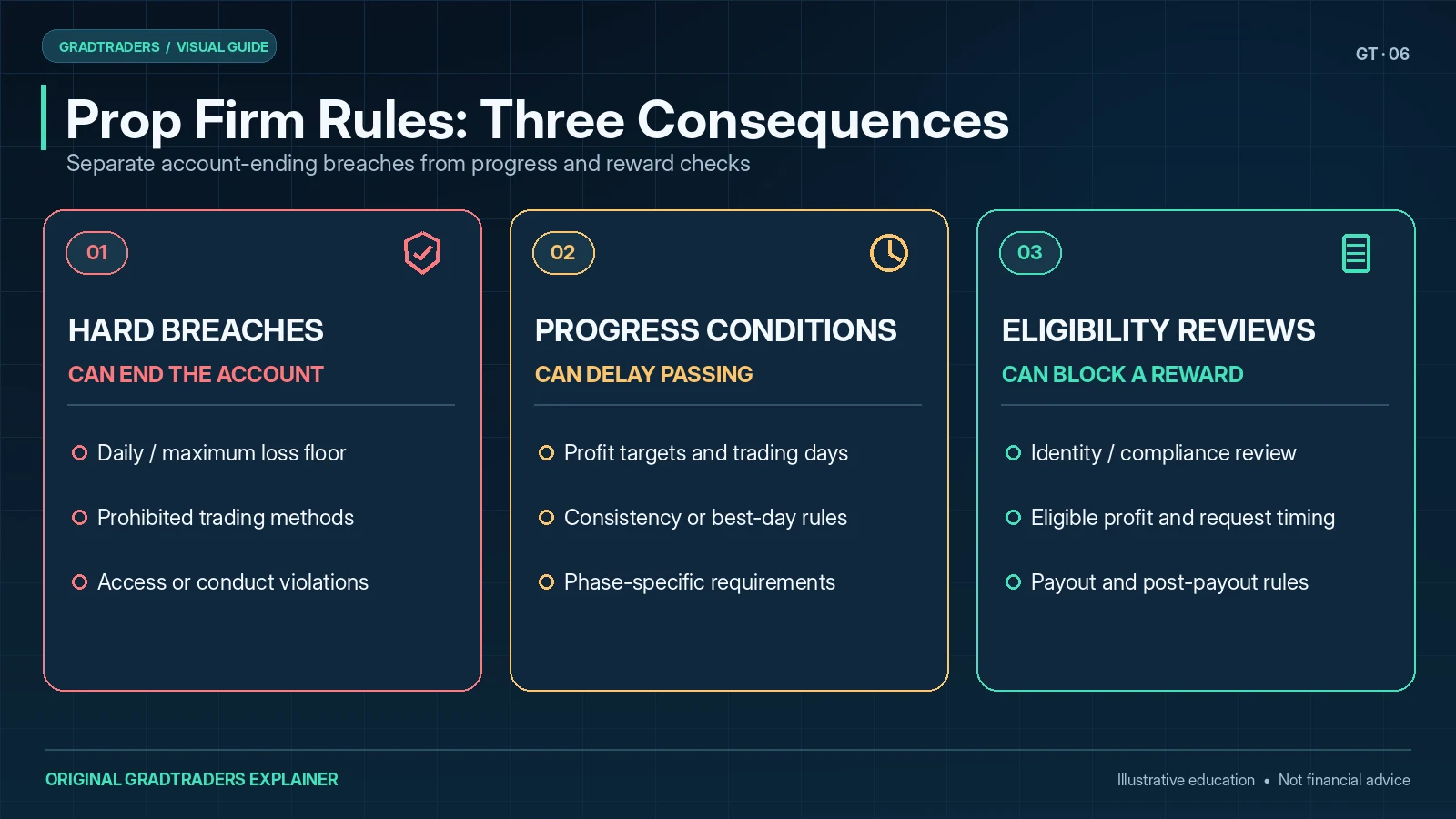
| Rule Type | Possible Effect | Examples |
|---|---|---|
| Hard breach | Immediate failure or termination. | Daily loss, maximum loss, unauthorised account access. |
| Progress condition | Target is not yet completed. | Minimum profitable days, required trading days. |
| Reward condition | Payout remains unavailable or is reduced. | Best-day consistency, minimum reward, payout buffer. |
| Conduct review | Trading activity is examined before approval. | Copy trading, latency exploitation, coordinated activity. |
| Administrative condition | Activation or payment is delayed. | KYC, contractor documents, unsupported payment details. |
1. Profit Targets
The profit target is the performance required to complete an evaluation phase. It is an outcome condition, not a recommended pace or position-size instruction.
The psychological mistake is converting the remaining target into a deadline. Traders begin calculating how much must be earned today, then increase risk or accept poor setups.
Compare the target with maximum loss and normal strategy expectancy. A 10% target with 10% static maximum loss creates a different challenge from a 10% target with 6% trailing loss.
GradTraders rule: Trade the written process. Let the target measure the outcome rather than control each decision.
2. Daily Loss Limits
The daily loss rule controls the permitted decline during one provider-defined trading day. The calculation can include closed loss, open loss, commissions and swaps.
FTMO currently shows why account model matters. Its 1-Step route uses a 3% Maximum Daily Loss, while 2-Step uses 5%. Both are monitored through account equity and recalculated at 00:00 CE(S)T from the applicable balance reference.
The5ers High Stakes currently uses a 5% daily drawdown and 10% maximum loss. Its published High Stakes rules also require three profitable days per evaluation phase, so the percentage cannot be read in isolation from the rest of the rulebook.
A personal daily stop should sit comfortably inside the provider limit. The formal boundary is an emergency level, not a trading budget.
Reset-time risk: An overnight position can enter a new provider day with a different loss reference. Local midnight may be irrelevant.
3. Maximum Loss And Usable Buffer
Maximum loss is the overall account failure boundary. It can be static, trailing or subject to another high-water-mark formula.
The usable account is not the displayed balance. It is the distance between current equity and the nearest active breach floor after a personal safety margin is removed.
Raw buffer = current equity − current breach boundary.
Usable buffer = raw buffer − personal safety margin.
A strategy that requires most of the provider’s maximum loss to survive normal variance is structurally mismatched, even when its long-term expectancy is positive.
4. Static, Trailing And End-Of-Day Drawdown
A static maximum-loss floor remains fixed against a defined starting reference. A trailing floor rises with a balance or equity high. An end-of-day trailing floor updates from a defined closing reference.
Trailing rules require three exact answers: what value trails, when the floor updates and whether it stops at a lock level.
A trader can make a large unrealised or realised gain, move the floor upward and then lose the account during a pullback that would have remained safe under the original boundary.
| Structure | Does The Floor Move? | Main Risk |
|---|---|---|
| Static drawdown | No under the overall static rule. | The daily boundary can still become the closer limit. |
| Intraday trailing | Potentially with live equity or balance highs. | Unrealised profit may tighten the account before the trade closes. |
| End-of-day trailing | Updates from a provider-defined closing value. | A strong close reduces future pullback room. |
| Trailing with lock | Moves until a defined level, then becomes fixed. | Misunderstanding exactly when the lock occurs. |
5. Equity, Balance, Costs And Open Positions
Balance reflects closed results. Equity includes the live profit or loss from open positions. Commissions and swaps can reduce equity further.
When a rule is equity-based, the account can breach before the trade is closed. A later recovery does not undo a failure boundary that has already been touched.
Correlated positions should be assessed as one combined risk. Three separate trades on related markets can create one large equity event even when each individual stop looks small.
Practical habit: Record current equity, the daily floor and the overall floor before every new position.
6. Minimum Trading Days And Profitable Days
A minimum trading-day rule requires activity across a specified number of days. A profitable-day rule normally requires a defined positive result rather than merely opening a token position.
The5ers High Stakes currently requires three profitable trading days in each evaluation phase. A profitable day is defined using a minimum 0.5% positive result against the initial balance, so a near-flat day does not automatically count. FTMO 2-Step separately requires four Trading Days in each evaluation phase.
The correct response is not to force trades. The trader should choose a programme whose time and day conditions naturally fit the normal trade frequency.
7. Consistency And Best-Day Rules
A consistency rule limits how much of the total result can come from one day, position or pattern. It may apply during evaluation, scaling or reward qualification.
Consider a generic 40% best-day rule. If the best day produced $800, total eligible profit may need to reach at least $2,000 before the ratio falls to 40%.
E8 One currently applies a 40% Best Day rule on its Performance stage: the best day must represent no more than 40% of total generated profit for payout eligibility. Exceeding the ratio does not itself terminate the account; more qualifying profit is needed.
Do not deliberately reduce good trading merely to satisfy a formula. Select a route whose consistency requirement matches the strategy’s natural distribution.
8. News Trading Rules
News rules can control opening orders, closing orders, holding positions or the eligibility of profit around high-impact events.
The5ers High Stakes currently allows positions to remain open over high-impact news but prohibits order execution from two minutes before until two minutes after the relevant event. Its current guidance says affected profit can be removed while losses remain the trader’s responsibility.
Funded Trading Plus currently lists news trading as allowed on its Instant, 1-Step Express and 2-Step Classic routes, subject to its risk policies. That broad permission still does not replace the exact programme terms.
News traders should identify the provider’s calendar source, affected instruments, event classification, time zone and whether restrictions differ after passing.
Traders comparing a patient, scaling-focused route can research the The5ers partner route. GradTraders code UR06YMJ currently provides 10% off eligible purchases, subject to live checkout terms.
9. Overnight, Weekend And Market-Closure Rules
Holding permission can change between evaluation and funded stages or between account types.
FTMO currently applies overnight and weekend restrictions only to Standard FTMO Accounts after the Evaluation Process. Swing accounts do not use those restrictions, and the Swing account type is available only through FTMO 2-Step.
Funded Trading Plus is model-specific: its current 1-Step Express and 2-Step Classic routes allow weekend holding, while Instant Funding does not. The firm’s comparison material currently lists news trading as allowed across those three routes.
A swing strategy should never be compressed into intraday trading merely to fit an unsuitable account.
10. Prohibited Strategies And Conduct Rules
Providers normally prohibit activity designed to exploit pricing, technology or the simulated account environment rather than demonstrate ordinary trading skill.
Common categories include latency or price-feed arbitrage, exploiting platform errors, unauthorised account sharing, coordinated trading, reverse trading, excessive copying and activity intended to bypass risk controls.
The5ers’ current prohibited-practices guidance explicitly includes exploitation of price discrepancies. Other providers use different wording, so traders should never rely on an industry summary instead of the actual agreement.
Higher-Risk Questions
- Is the strategy copied across unrelated accounts?
- Does it depend on feed delay or pricing mismatch?
- Are positions coordinated with another trader?
- Does the method create unrealistic fills?
- Is another person accessing the account?
Safer Process
- Use only documented permitted methods.
- Keep evidence of strategy ownership and settings.
- Use the account from authorised locations and devices.
- Ask support before relying on ambiguous conduct.
- Retain the written response with the account records.
11. Expert Advisers, Bots And Trade Copiers
Automation is not one rule category. A provider may permit ordinary expert advisers while prohibiting high-frequency exploitation, third-party account management or identical trades copied across a group.
Check whether the software is commercially shared, whether multiple users can generate identical orders and whether the provider limits order frequency or execution style.
A trader should be able to explain the logic, risk settings and ownership of any automated method used on the account.
12. Platforms, Devices, IP Addresses And Account Access
Platform choice affects execution and risk control. Account-access rules determine who may log in, from which locations and through which tools.
Travel, virtual private servers and changing internet connections are not automatically misconduct, but unusual access can trigger security checks. Account sharing or third-party control is commonly prohibited.
Before using a VPS, trade copier or remote workstation, read the provider’s current access policy and keep KYC details consistent.
13. Inactivity And Time Limits
Unlimited evaluation time does not always mean unlimited inactivity. An account can expire after a defined period without trading.
The5ers currently states that High Stakes evaluation accounts expire after 30 consecutive inactive days, while funded accounts use a 60-day inactivity limit. E8 One separately requires at least one opened-and-closed trade every 60 days.
Traders with infrequent setups should compare inactivity rules before purchase rather than place unnecessary trades to keep an account open.
14. Payout Rules And Post-Payout Risk
A payout or reward requires eligible profit, an open request cycle, compliant trading, KYC and any model-specific consistency or minimum-profit conditions.
The requested amount may reduce the account buffer. On trailing or dynamic structures, the loss floor may not move down after a reward is removed.
E8 Signature currently uses a model-specific payout buffer linked to its end-of-day dynamic drawdown. This illustrates why withdrawing the largest possible amount is not always the safest account decision.
Read the complete Prop Firm Payouts Explained guide before treating displayed profit as available cash.
15. Rules Can Change After Passing
Evaluation rules and funded-style account rules may differ. Holding restrictions, news permissions, reward cycles, consistency checks and scaling conditions can change after completion.
The post-pass agreement should be read before the challenge is purchased. Otherwise, a trader may pass under one set of assumptions and discover that the normal strategy cannot operate on the reward-bearing account.
Hidden mistake: Studying only the evaluation objectives while ignoring the account used after passing.
How Rules Interact: Five Common Failure Chains
| Situation | Rule Interaction | Better Control |
|---|---|---|
| Overnight losing position | Daily reset changes the reference while equity remains exposed. | Calculate the new-day floor before holding through reset. |
| Large winning day | Target is reached but consistency ratio remains too concentrated. | Choose a model compatible with the strategy’s normal variance. |
| Profitable news trade | Profit target improves while conduct rules make the gain ineligible. | Map restricted events and instruments in advance. |
| Large payout request | Reward is approved but remaining drawdown buffer becomes too small. | Recalculate post-request equity and the active loss floor. |
| Automated copied strategy | Trading remains inside risk limits but triggers prohibited-conduct review. | Confirm automation and copying rules before use. |
Rule Priorities For Different Trader Types
| Trader Type | First Rules To Check | Reason |
|---|---|---|
| Beginner | Daily loss, maximum loss and personal stop. | Oversizing usually causes the earliest failure. |
| Swing trader | Equity drawdown, overnight, weekend and news holding. | Normal open-trade movement can become a rule breach. |
| Scalper | Execution, automation, order frequency and prohibited conduct. | Short holding times can overlap with technology restrictions. |
| News trader | Event window, affected instruments and profit eligibility. | A profitable trade can still be disallowed. |
| Futures trader | Trailing floor, contract limits and reward buffer. | The moving loss boundary can dominate risk. |
| Automated trader | EA ownership, copying, VPS and execution policy. | Permitted automation can still breach conduct rules. |
| Infrequent trader | Inactivity and time limits. | A valid strategy may not trade often enough to preserve access. |
Current Official Rule Examples
These examples were rechecked against current official provider material on 10 October 2026. They show why programme-level rules matter and are not promises that the terms will remain unchanged.
| Provider / Model | Current Example | Lesson |
|---|---|---|
| FTMO 1-Step | 10% target, 3% Maximum Daily Loss, 10% end-of-day trailing Maximum Loss and 50% Best Day rule. | A one-step route can simplify the evaluation while introducing a different loss structure and consistency condition. |
| FTMO 2-Step / Standard vs Swing | 10% then 5% targets, 5% Maximum Daily Loss and 10% static Maximum Loss; Standard and Swing holding/news rules differ on the FTMO Account. | Evaluation structure and post-pass account type both matter. |
| The5ers High Stakes | New High Stakes currently uses 10% then 5% targets, three profitable days, 5% daily drawdown, 10% maximum loss and a ±2-minute high-impact-news execution restriction. | Target, day, drawdown and conduct rules must be read together. |
| Funded Trading Plus | Instant, 1-Step Express and 2-Step Classic currently differ on targets and drawdown; weekend holding is allowed on 1-Step Express and 2-Step Classic but not Instant, while news trading is listed as allowed. | The same provider can contain materially different rulebooks. |
| E8 One | E8 One documentation describes a 3% Daily Drawdown and 4% Dynamic Drawdown example, but limits are configurable at checkout; it also requires activity within 60 days and applies a 40% Best Day rule at the Performance stage. | Loss, activity and payout-consistency rules can affect different parts of the journey. |
How The Main GradTraders Firms Fit This Guide
The scores and roles below preserve the controlling GradTraders framework. A firm-level score does not make every programme equally suitable; the exact account model still controls the rulebook.
| Firm | GradTraders Score | Master Role | Rulebook Research Angle |
|---|---|---|---|
| FTMO | 8.5/10 | Best Benchmark | Useful benchmark for comparing 1-Step, 2-Step, Standard and Swing rule differences. |
| The5ers | 9/10 | Patient / Scaling Route | High Stakes is useful for profitable-day, inactivity, holding and news-window research. |
| Funded Trading Plus | 8.7/10 | Flexible Partner Route | Programme choice materially changes drawdown, weekend holding and reward timing. |
| E8 Markets | 9/10 | Modern Challenger | Modern account menu illustrates product-specific dynamic drawdown, activity and payout-consistency rules. |
| FXIFY | 8.5/10 | Flexible Modern Route | Broad programme choice requires exact account-level checks rather than a brand-level assumption. |
| FundingPips | 8.4/10 | Major Modern Alternative | Multiple account and reward models show how consistency, cycles and drawdown can vary. |
Traders comparing a flexible partner-backed route can research the Funded Trading Plus partner route. Code GRADTRADERS10 currently provides 10% off eligible challenges; Instant Funding and resets are excluded, subject to current checkout terms.
Prop Firm Rules vs Broker Rules
A broker account uses the trader’s deposited capital and the broker’s trading, margin and withdrawal terms. A prop-firm programme uses a challenge fee, simulated capital and additional performance conditions.
A prop route can reduce the capital committed upfront, but access can disappear immediately after a contractual breach. A broker route provides more direct control but exposes personal funds to trading loss.
The right comparison is not “strict rules versus no rules.” It is contractual programme risk versus personal-capital risk.
GradTraders Rulebook Checklist
Account Survival
- What is the exact daily-loss formula and reset time?
- What is the maximum-loss floor?
- Is drawdown static, intraday trailing or end-of-day trailing?
- Do open losses, commissions and swaps count?
- How many normal losses fit inside the personal buffer?
- What inactivity or phase time limits apply?
Trading Conduct
- Can orders be opened around high-impact news?
- Can positions remain open overnight and over weekends?
- Are expert advisers, VPSs and trade copiers permitted?
- What copying, hedging or arbitrage conduct is prohibited?
- Can the account be accessed while travelling?
- Do rules change after passing?
Completion And Rewards
- What target and trading-day conditions apply?
- Is there a consistency or best-day rule?
- When can the first reward be requested?
- What KYC and payment methods are required?
- How much buffer remains after a payout?
- Is the challenge fee refundable, and at what milestone?
Personal Fit
- Does the strategy naturally satisfy every rule?
- Is the platform familiar and suitable?
- Is the trader’s country currently eligible?
- Can the full fee be lost without financial pressure?
- Is a demo or broker account a better next step?
- Has the live rulebook been saved before purchase?
Related GradTraders Research
Further research: How To Pass A Prop Firm Challenge · Instant Funding vs Prop Firm Challenge · Best Prop Firms For Beginners · Best Prop Firms For Swing Traders.
Final Verdict: Prop Firm Rules Matter More Than Marketing
Choose the rulebook before the account size. A programme is only useful when its hard loss boundaries, trading-conduct rules and reward conditions fit the strategy the trader already knows how to execute.
Map the daily and overall breach floors first. Then confirm news, holding, automation, platform and access permissions. Finally, read the post-pass agreement and payout conditions before paying for the evaluation.
GradTraders verdict: choose the smallest sensible route whose complete rulebook fits normal trading behaviour, and keep personal risk limits comfortably inside the provider’s formal boundaries.
Source note: This guide was rechecked on 10 October 2026 against current official rule material from FTMO, The5ers, Funded Trading Plus and E8 Markets. Targets, drawdown formulas, trading-day definitions, news and holding permissions, inactivity rules, payout conditions and account-stage restrictions can change.
Official research: FTMO Trading Objectives · FTMO Overnight And Weekend Rules · FTMO News Rules · The5ers High Stakes Rules · The5ers High Stakes Programme · Funded Trading Plus Challenge Comparison · Funded Trading Plus 1-Step Express · Funded Trading Plus 2-Step Classic · E8 One · E8 40% Best Day Rule.
Useful GradTraders research: Prop Firm Comparison Table · Review Methodology · Prop Firm Drawdown Explained · Prop Firm Payouts Explained.
Explore GradTraders Internationally
Browse GradTraders’ country pages for regional trading context and related research. These links are for site navigation only; prop-firm programme availability, trading permissions, terms and eligibility may differ by country and provider.
Browse all 20 country gateways
Asia: Japan · South Korea · Taiwan · Hong Kong · India · Singapore · Thailand
Europe: Italy · Sweden · Switzerland · Germany · Norway
Americas: United States · Canada · Mexico
Middle East: United Arab Emirates · Saudi Arabia
Africa: South Africa
Oceania: Australia · New Zealand
Prop Firm Rules FAQ
What are the most important prop firm rules?
The most important rules are normally the profit target, daily loss limit, maximum loss, static or trailing drawdown, minimum or profitable trading days, consistency requirements, news and holding restrictions, prohibited strategies, inactivity rules, payout conditions and country eligibility.
Can a profitable trade still breach a prop firm account?
Yes. A profitable trade can still create a breach if an order is opened during a restricted news window, a prohibited strategy is used, an equity limit is touched before recovery, or the trade violates a holding, platform or conduct rule.
Do floating losses count toward prop firm drawdown?
They often do. When the provider monitors equity, open losses, commissions and swaps can affect the daily or maximum-loss calculation before a trade is closed. The exact formula must be checked for the selected account model.
Are news trading and weekend holding always allowed?
No. Permissions can differ between providers, programmes and even evaluation versus funded stages. Traders should verify order-opening restrictions, affected instruments, high-impact event windows, overnight rules and weekend holding for the exact account.
What is a prop firm consistency rule?
A consistency rule limits how concentrated the trader’s profit can be in one day, one position or one trading pattern. It can affect challenge completion or payout eligibility even when the total result is positive.
Can expert advisers and trade copiers be used?
Sometimes, but permission is model-specific. Providers may allow normal automation while prohibiting latency exploitation, account sharing, copied trades across unrelated users, coordinated group trading, reverse trading or strategies designed to exploit the simulated environment.
Do prop firm rules change after passing the challenge?
They can. Evaluation and funded-style accounts may use different holding restrictions, reward cycles, drawdown calculations, scaling conditions or conduct rules. Traders should read the post-pass agreement before purchasing.
What should be checked before buying a prop firm challenge?
Write down the exact target, daily and maximum-loss formulas, reset time, drawdown type, trading-day requirements, news and holding rules, permitted platforms and strategies, inactivity policy, payout conditions, KYC, country access and the personal risk limits that will sit inside the provider’s boundaries.