Prop Firm Payouts Explained 2026: How Funded Trader Payouts Really Work
A profitable prop-firm dashboard does not automatically mean money can be withdrawn. I would assess a programme by the whole route from eligible trading results to a requested, approved and actually paid reward. Before paying for an evaluation, check consistency conditions, payout cycles, minimums, identity checks, profit splits and how a withdrawal affects the account’s remaining drawdown buffer. Those practical restrictions matter more than the highest advertised split.

What To Check Before Paying
- Earliest request date and how the reward cycle is measured.
- Profit split, minimum request and any profitable-day or consistency rule.
- KYC, payment method, processing time and model-specific fee refund.
- The drawdown buffer that remains after the reward is removed.
The useful payout is the reward a trader can request repeatedly without breaking programme rules or stripping the account of the buffer needed for the next trading cycle.
Disclosure & Risk Notice: This article is educational and informational content, not financial advice, investment advice, tax advice or a personal recommendation. Retail prop-firm evaluations commonly use simulated accounts. Challenge fees can be lost, accounts can be breached, and a displayed profit does not guarantee an approved performance reward.
Some GradTraders links are affiliate links. GradTraders may earn commission at no additional cost when an eligible purchase is completed through one of those links. Commercial relationships do not determine the guidance, scores or payout conclusions on this page.
Traders researching a widely used benchmark can review the FTMO partner route. Confirm the exact challenge, current reward ratio, first-request timing, payment method, fee-refund rule and country eligibility before paying.
Compare before paying: use the GradTraders Prop Firm Comparison Table for the controlling firm roles, then read the reward rules for the exact programme. One provider can offer different splits, request cycles, minimums and buffer mechanics across different account models.
Quick Verdict: Profit Does Not Automatically Mean Payout
A prop firm payout becomes available only when the trader’s profit is eligible under the complete programme rules. A positive dashboard balance alone is not enough.
The provider may check drawdown compliance, trading conduct, consistency, profitable days, open positions, KYC, payment details and account status before approving a request.
Different account models can also offer different reward cycles and splits. A higher possible split may require a longer waiting period, more profitable days or a stricter consistency threshold.
The GradTraders position is that traders should compare the entire payout path before purchasing: qualification, first request, approval, payment, account buffer and the conditions for later rewards.
Is The Profit Eligible?
Confirm that every trade and account condition complies with the live programme rules.
Can A Request Be Made?
Check the cycle, minimum amount, profitable days and consistency requirements.
Withdrawing Too Much
A large request can leave the account with too little buffer for the next trading cycle.
Prop Firm Payouts At A Glance
| Payout Element | What It Means | Why It Matters |
|---|---|---|
| Eligible profit | Performance that satisfies the account and conduct rules. | Displayed profit can be reduced or rejected when it comes from restricted activity. |
| Profit split | The percentage of eligible reward allocated to the trader. | A high split can be offset by longer cycles or stricter conditions. |
| Reward cycle | The earliest schedule on which a request may be submitted. | Weekly, bi-weekly, monthly and on-demand routes are not directly equivalent. |
| Minimum request | The smallest eligible reward or profit required. | Small profitable results may remain below the request threshold. |
| Consistency rule | A limit on how much of the total result can come from one day or trade pattern. | One exceptional day can delay eligibility. |
| KYC and review | Identity, conduct and account verification before payment. | Incomplete or inconsistent information can delay approval. |
| Post-payout buffer | The remaining distance above the drawdown floor after the request. | Removing too much can make the account difficult to continue safely. |
| Payment processing | The provider and payment network’s delivery stage. | Approval and receipt are separate events. |
What Is A Prop Firm Payout?
A prop firm payout is normally a performance-based reward issued under a contractual funded-trading programme. The trader earns eligibility by trading a simulated Master Account or another reward-bearing account stage within the provider’s rules.
The terminology varies. Providers may use payout, reward, withdrawal, profit share or performance reward. Traders should read the legal and account documents to understand what the payment represents.
This distinction matters because the nominal account balance is not personal cash deposited by the trader. The trader normally cannot withdraw the displayed balance; only an eligible share of qualifying performance may be requested.
Simple definition: A prop firm payout is a rule-dependent performance reward, not a withdrawal of the nominal account balance.
How The Payout Process Works Step By Step
Reach A Reward-Bearing Account
Complete the evaluation or enter the relevant direct programme and receive the Master or performance account.
Generate Eligible Profit
Trade within drawdown, conduct, news, holding and strategy rules.
Complete Cycle Conditions
Satisfy the waiting period, profitable days, minimum profit and consistency requirements.
Close Required Positions
Some programmes require all trades and pending orders to be closed before a request.
Submit The Request
Select the eligible amount and approved payment route through the provider dashboard.
Complete KYC And Review
The provider checks identity, account status and trading compliance.
Receive The Approved Reward
Delivery time then depends on the payment method and financial network.
Recalculate The Account Buffer
Confirm the new balance, drawdown floor and safe position size before trading again.
Prop Firm Payouts vs Broker Withdrawals
A broker withdrawal normally returns money from an account funded with the trader’s own capital. A prop firm payout is a performance reward governed by a programme agreement.
Broker withdrawals can still involve KYC, payment-method and anti-money-laundering checks, but they do not normally depend on a prop-firm profit split, consistency formula or Master Account rulebook.
| Feature | Prop Firm Payout | Broker Withdrawal |
|---|---|---|
| Underlying account | Usually a simulated or funded-style programme account. | A trading account containing the trader’s deposited capital. |
| Amount available | Eligible performance reward after the provider’s split and rules. | Available personal balance subject to margin and broker conditions. |
| Main restrictions | Cycles, drawdown, conduct, consistency, KYC and account reviews. | KYC, funding-source, settlement and payment-method conditions. |
| Main financial risk | Challenge fees and loss of programme access. | Direct loss of personal trading capital. |
| Control | Dependent on the provider’s continuing programme terms. | Greater direct ownership and withdrawal control. |
Profit Split vs Realistic Reward
The profit split is the trader’s percentage of eligible performance. It is easy to compare because providers advertise it prominently, but it does not show the complete economics of the route.
A 100% monthly split is not automatically better than an 80% weekly split. The answer depends on how quickly the strategy produces eligible profit, whether consistency conditions apply and how much account buffer must remain.
The useful calculation is:
Realistic net reward = eligible profit × applicable split − payment charges − tax obligations.
This is still incomplete unless the trader considers the challenge fee, reset or rebuy costs and the drawdown room left after the payout.
GradTraders rule: Compare the complete reward path, not the largest advertised percentage.
First Payout Timing And Reward Cycles
The reward cycle states when a request can become available. It does not guarantee that approval and delivery happen at the same moment.
Current programmes use daily, weekly, bi-weekly, monthly and on-demand structures. The start point can be account activation, the first trade, the previous approved reward or a model-specific eligibility event.
The5ers states that the first funded withdrawal can be requested 14 days after activation, with later requests every two weeks from the last approved withdrawal. Its general $150 minimum refers to the payout amount after the profit split, not a universal $150 gross-profit threshold. The September 2026 High Stakes policy also sets a $300 minimum P&L for payout on a $50,000 account and $500 on a $100,000 account, with respective payout caps of $3,000 and $4,000. Approved requests are typically processed within up to three business days; payment delivery can take longer depending on the method.
Traders researching that patient, scaling-focused route can review the The5ers partner route. GradTraders code UR06YMJ currently provides 10% off eligible purchases, subject to live terms.
| Cycle | Potential Advantage | Potential Trade-Off |
|---|---|---|
| Weekly | Frequent access to eligible rewards. | The split may be lower or the account may have less time to build a buffer. |
| Bi-weekly | Balanced waiting period and reward frequency. | Two weeks of clean trading may be required after activation or the previous request. |
| Monthly | Some models offer a higher split for waiting longer. | More time is exposed to drawdown and rule risk before the request. |
| On demand | Flexible request timing after qualification. | Consistency, minimum-profit or profitable-day requirements may apply. |
Minimum Payouts And Minimum Profit
A minimum payout is the smallest reward amount that the provider will process. A minimum profit condition is the result that must exist before the request becomes available.
These values may be stated before or after the profit split, so the wording matters. Payment-method minimums can also differ from the programme minimum.
FTMO currently requires enough closed profit to cover the transfer cost: at least $20 for bank wire and $50 for cryptocurrency. FundingPips currently uses a 1% minimum reward request including its split for Card, Crypto and Tradin Transfer, while Rise and Bank Transfer require at least $500.
Consistency Rules, Profitable Days And Best-Day Limits
Consistency rules control how concentrated the result can be. A provider may compare the best day with total profit, require a number of profitable days or impose another repeatability measure.
FundingPips 2 Step Standard currently offers Weekly 60%, Bi-Weekly 80%, Monthly 100% and On Demand 90% reward cycles. The On Demand route uses a 35% consistency score and a 2% minimum reward; the Monthly 100% route, for eligible newer Master Accounts, adds a 35% consistency score and at least seven profitable days of 0.5% or more.
The practical lesson is not to memorise one provider’s current percentages. It is to understand whether the normal trading style naturally satisfies the chosen model.
Better approach: Select the reward structure that matches normal trade frequency and variance rather than changing position size to force eligibility.
KYC, Contractor Details And Payment Methods
KYC checks verify identity, address and country eligibility. Some providers or payment platforms may also require tax, contractor or business-status information.
The account name, identity documents and payment details should be consistent. Using another person’s card, wallet or bank account can create review problems.
Common reward methods include bank transfer, specialist contractor-payment platforms and cryptocurrency. Availability, limits, charges and delivery times can vary by country.
Complete verification as early as the provider allows. Reaching reward stage before discovering that a country, document or payment route is unsupported creates avoidable delay.
Payment Charges And Currency Conversion
A provider may charge no internal fee while the bank, cryptocurrency network or payment platform still deducts a transaction or conversion cost.
Compare the currency in which the reward is calculated with the currency received. A conversion spread can reduce the final amount even when the advertised profit split is unchanged.
The5ers currently lists a 3.5% commission for Rise, crypto and bank-transfer withdrawals, while Hub Credits carry no withdrawal commission but are not withdrawable cash. This is why payment method belongs in the net-reward calculation.
Fee Refunds Are Model-Specific
Some providers return the original evaluation fee after a qualifying reward. Others refund it later, only on selected models or not at all.
FTMO currently refunds the one-time fee with the first Reward withdrawal on the 2-Step route, while the 1-Step fee is not refunded. FundingPips currently refunds the original registration fee at the fourth reward on 2 Step Standard only; 1 Step Flex, 2 Step Flex, 2 Step Pro and Zero are excluded.
Do not include a fee refund in expected value until the exact account and milestone are confirmed in the current terms.
Common mistake: Treating an advertised refund as guaranteed cash back at purchase rather than a later conditional benefit.
Why Payout Size Can Affect Account Survival
The reward request normally reduces the programme balance or removes profit that previously separated the account from its loss floor.
On some dynamic or trailing models, the drawdown boundary does not move down after a payout. The same account can therefore become much more fragile immediately after a large request.
E8 currently illustrates this clearly. Signature requires a permanent payout buffer equal to the EOD Dynamic Drawdown, while E8 One guidance warns that a requested payout reduces the account balance but does not reset the Dynamic Drawdown loss level. E8 Pro uses a different built-in mechanism, so the exact product controls.
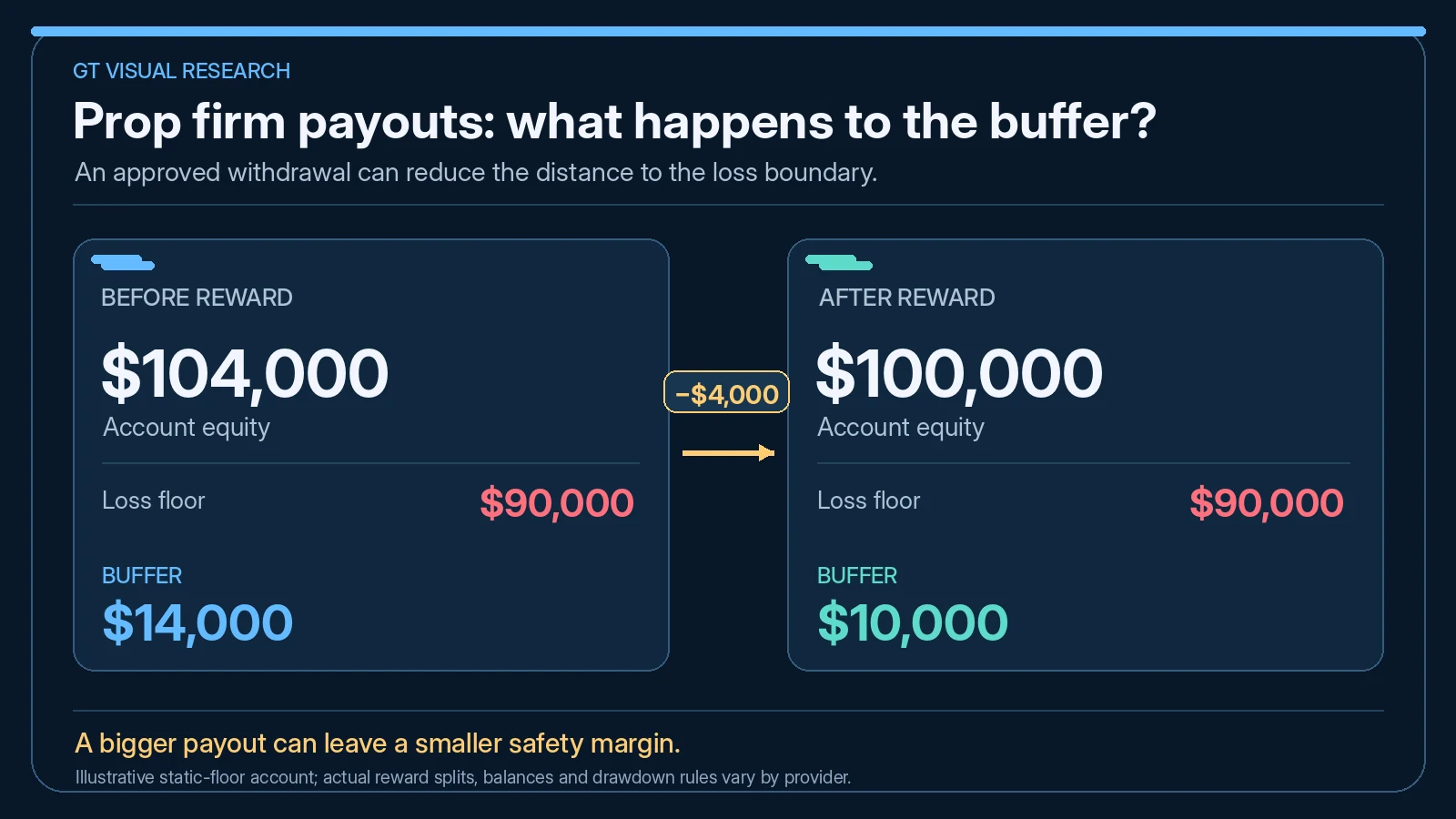
| Balance Before Request | Drawdown Floor | Requested Reward | Balance After Request | Remaining Buffer |
|---|---|---|---|---|
| $105,000 | $100,000 | $4,000 | $101,000 | $1,000 before further costs or losses |
This is a generic illustration, not the terms of a specific provider. The trader must calculate the live post-request balance and loss floor for the chosen model.
Open Positions And Pending Orders
Some programmes require all positions and pending orders to be closed before a reward request. Others may allow a request only after a waiting period following the final trade.
This prevents the account value from changing while the reward is being calculated. It can also mean that a swing trader must alter the timing of a request rather than interrupt a valid position.
Check whether closing trades for a reward request conflicts with the normal strategy before purchasing the account.
Why Payouts Are Delayed Or Denied
Common Problems
- Incomplete or inconsistent KYC information.
- Request submitted before the cycle opens.
- Minimum profit or profitable days not completed.
- Best-day or consistency condition not satisfied.
- Open positions or pending orders remain.
- Trading conduct is under review.
- Country or payment method is unsupported.
- The account touched a loss boundary.
Better Process
- Read the complete reward policy before purchase.
- Verify identity and payment access early.
- Track the cycle date in the trading journal.
- Monitor consistency and profitable days.
- Keep a clear post-payout drawdown buffer.
- Use only documented permitted strategies.
- Retain account statements and request records.
- Contact support before relying on an ambiguous rule.
Current Firm Examples And Reward Structures
The examples below show why payout comparisons must be programme-specific. They were rechecked against current official provider material on 10 October 2026 and can change. For another firm analysed separately, our FundedNext Review examines differences in reward timing and eligibility across its Stellar programmes.
| Provider | Current Research Example | Main Lesson |
|---|---|---|
| FTMO | 1-Step currently pays 90% of eligible simulated profit. 2-Step starts at 80% and can rise to 90% through scaling or premium conditions; requests become available from the 14th day after the first trade, with open positions and pending orders closed. | Reward ratio, request timing, transfer minimum and fee-refund route must be checked together. |
| The5ers | First funded withdrawal after 14 days, then every two weeks; $150 minimum payout after the split. High Stakes also sets model-size payout P&L minimums and caps. Rise, crypto and bank methods carry a 3.5% commission. | A clear cycle can still have method costs and a practical minimum. |
| Funded Trading Plus | 1-Step Express currently allows a request from day one once in profit, with a $50 minimum and later requests every seven days at an 80% split. 2-Step Classic currently uses a 10-day first window, a 50% consistency condition and an 80% split. | The same provider can have very different first-request and consistency rules by programme. |
| E8 Markets | E8 One and Signature use on-demand structures once product-specific conditions are met; E8 Pro and E8 Zero currently use daily payout structures. Buffers and caps are model-specific. | On-demand does not mean rule-free, and the safest request may be smaller than the available amount. |
| FundingPips | 2 Step Standard currently offers Weekly 60%, Bi-Weekly 80%, Monthly 100% and On Demand 90%. Minimums and profitable-day or consistency requirements change with the selected cycle. | Choose the reward cycle before comparing the headline split. |
How The Main GradTraders Firms Fit This Guide
The scores and roles below preserve the controlling GradTraders framework. A strong firm-level score does not make every reward model equally suitable; compare the exact programme and payout path.
| Firm | GradTraders Score | Master Role | Payout Research Angle |
|---|---|---|---|
| FTMO | 8.5/10 | Best Benchmark | Useful benchmark for reward ratios, first-request timing, transfer minimums and 2-Step fee refund. |
| The5ers | 9/10 | Patient / Scaling Route | Bi-weekly funded route with a clear minimum and method-specific charges. |
| Funded Trading Plus | 8.7/10 | Flexible Partner Route | Programme choice materially changes first-request timing, consistency and withdrawal cadence. |
| E8 Markets | 9/10 | Modern Challenger | Model-specific on-demand or daily structures, buffers and caps make account selection important. |
| FXIFY | 8.5/10 | Flexible Modern Route | Broad account menu means payout conditions should be checked at product level rather than brand level. |
| FundingPips | 8.4/10 | Major Modern Alternative | Multiple reward cycles and splits make it a strong example of route-level complexity. |
Traders comparing a flexible partner-backed route can research the Funded Trading Plus partner route. Code GRADTRADERS10 currently provides 10% off eligible challenges; Instant Funding and resets are excluded, subject to current checkout terms.
Payouts For Beginners
Beginners often see reward screenshots before they understand the account path. That reverses the correct order.
The first objective should be learning risk control, drawdown, execution and journaling. A payout is the result of surviving those rules, not a substitute for them.
Most complete beginners should build evidence through education, demo trading or carefully controlled personal-capital trading before purchasing repeated challenges.
Beginner view: Do not choose a challenge because the payout looks exciting. Choose only after the trading process can survive the account rules.
International Access, Tax And Record Keeping
Country eligibility, contractor status, payment platforms and tax treatment vary internationally. A provider that accepts a purchase may still have model or payment restrictions for a particular jurisdiction.
UK, US, EU and international traders should verify the legal relationship, accepted documents and available payment methods before purchase. US traders should also compare futures-specific programmes because their payout, activation and drawdown mechanics can differ from global CFD-style firms.
Keep copies of challenge invoices, account agreements, reward confirmations, payment statements, currency-conversion records and related expenses. Tax treatment should be confirmed with a qualified professional in the trader’s jurisdiction.
Payout Checklist Before Buying A Challenge
Reward Mechanics
- When does the first reward cycle begin?
- What weekly, bi-weekly, monthly or on-demand options exist?
- What split applies to the selected cycle?
- Is there a minimum profit or reward amount?
- Are profitable days or consistency conditions required?
- Does the challenge fee become refundable?
Approval And Account Safety
- Must trades and pending orders be closed?
- What KYC and contractor documents are needed?
- Which payment methods, fees and limits apply?
- What conduct can invalidate eligible profit?
- How much drawdown buffer remains after the request?
- Do the rules change after the first payout?
Related GradTraders Research
Final Verdict: How Should Traders Judge Prop Firm Payouts?
A prop firm payout should be judged by eligibility, repeatability and account survival—not the largest advertised split.
The trader needs to understand the first reward date, cycle, minimum amount, consistency conditions, KYC, payment methods, processing stage and the drawdown buffer that will remain afterwards.
A lower split with a clear and compatible route can be more useful than a higher split that requires behaviour the strategy does not naturally produce.
GradTraders verdict: Read the reward rules before buying, earn only eligible profit, request an amount that preserves the account and keep complete records of every payment.
Source note: This guide was rechecked on 10 October 2026 against current official reward, withdrawal and payout material from FTMO, The5ers, Funded Trading Plus, E8 Markets and FundingPips. Reward ratios, cycles, minimums, payment methods, processing times, consistency rules, buffers and fee-refund conditions can change.
Official research: FTMO Reward Withdrawal · FTMO Fee Refund Rules · The5ers Withdrawals · The5ers September High Stakes Payout Policy · Funded Trading Plus 1-Step Express · Funded Trading Plus 2-Step Classic · E8 Payout Overview · E8 Signature Caps And Buffers · FundingPips 2 Step Standard · FundingPips Reward Methods.
Useful GradTraders research: Prop Firm Comparison Table · Best Prop Firms · Prop Firm Drawdown Explained · Prop Firm Rules Explained.
Explore GradTraders Internationally
Browse GradTraders’ country pages for regional trading context and related research. These links are for site navigation only; prop-firm programme availability, trading permissions, terms and eligibility may differ by country and provider.
Browse all 20 country gateways
Asia: Japan · South Korea · Taiwan · Hong Kong · India · Singapore · Thailand
Europe: Italy · Sweden · Switzerland · Germany · Norway
Americas: United States · Canada · Mexico
Middle East: United Arab Emirates · Saudi Arabia
Africa: South Africa
Oceania: Australia · New Zealand
Prop Firm Payout FAQ
What is a prop firm payout?
A prop firm payout is a performance-based reward paid under a funded-trading programme after the trader satisfies the provider’s account, risk, conduct, identity and reward-request conditions. It is not the same as withdrawing personal capital from a conventional broker account.
Does making a profit guarantee a prop firm payout?
No. Profit must normally be eligible under the live programme terms. A trader can show a positive account result but remain ineligible because of a drawdown breach, consistency rule, minimum profitable-day requirement, prohibited strategy, incomplete KYC or an account review.
What is a prop firm profit split?
The profit split is the percentage of eligible performance reward allocated to the trader. The useful comparison is not the headline percentage alone, but the split together with the reward cycle, minimum request, buffer, consistency rules and account-survival conditions.
When can a trader request the first payout?
The first possible request depends on the provider and account model. Some routes use weekly or bi-weekly cycles, some require a minimum number of profitable days, and some allow on-demand requests only after a consistency or minimum-profit condition is met.
Why can a payout request reduce account safety?
The requested amount is normally deducted from the programme balance or reward calculation. On some models, the drawdown floor does not reset after the payout, so withdrawing too much can leave very little trading buffer for the next session.
Can KYC delay a prop firm payout?
Yes. Identity, address, tax, contractor and payment-method checks can delay or block a request when information is incomplete or inconsistent. Country eligibility and supported payment methods should be checked before purchasing a challenge.
Are prop firm payouts taxable?
Tax treatment depends on the trader’s country, legal status and circumstances. A prop-firm reward may not be treated in the same way as investment gains or broker withdrawals. Traders should keep records and obtain qualified local tax advice.
What should be checked before buying a prop firm challenge?
Check the first reward date, available cycles, profit split, minimum request, consistency and profitable-day rules, payout buffer, prohibited strategies, KYC, payment methods, processing times, fee-refund conditions, country eligibility and whether the full challenge fee is affordable to lose.