What Is A Trading Journal? Track Trades, Risk And Performance
A trading journal records the trade, its planned risk, the decision behind it and what actually happened. My view is that its real value is separating a well-executed losing trade from a profitable trade taken for the wrong reasons. Start with a consistent record and review habit; pay for more sophisticated analytics only when the volume of trades makes that worthwhile.
 , GradTraders
Spreadsheet first, dedicated journal when it earns its place
Beginners can start with a spreadsheet and screenshots. Dedicated software such as TraderSync becomes more useful when imports, analytics and larger trade samples make manual review inefficient.
My choice is a spreadsheet first for a manageable trade log; specialist software earns its place when imports, tagging and repeated analysis save genuine review time. The TraderSync partnership does not change that test.
Disclosure & Risk Notice: This article is for educational and informational purposes only and should not be considered financial advice, investment advice, tax advice or a personal recommendation. Trading CFDs, spread betting, forex, futures, crypto CFDs and other leveraged products involves significant risk and may not be suitable for all traders. You may lose some or all of your capital. A trading journal can improve review and discipline, but it cannot guarantee profitable trading. Some GradTraders articles may contain affiliate links or references to partner offers. If you sign up, purchase or open an account through certain links, GradTraders may earn a commission at no additional cost to you.
Looking for GradTraders partner offers, broker discounts, prop firm promotions and trading platform deals? You can view the current offers and join the update list here: Access GradTraders Partner Offers.
Quick Answer
A trading journal is a structured record of trades and trading decisions. It usually tracks the market traded, entry, exit, stop loss, position size, risk, result, setup type, screenshots, notes and emotional state.
The GradTraders view is that a trading journal is not just a diary. It is a feedback system. It shows whether losses came from strategy weakness, poor execution, bad risk control, emotional decisions or simply normal losing trades inside a valid plan.
Trading Journal Explained
A trading journal records the facts behind each trade. That matters because traders are often poor judges of their own behaviour. After a good trade, they may overestimate their skill. After a bad trade, they may blame the market. A journal creates a clearer record.
A useful trading journal does not only ask whether a trade won or lost. It asks whether the trade followed the plan, whether the risk was correct, whether the entry made sense, whether the exit was disciplined and whether the trader repeated a known mistake.
Over time, the journal becomes a map of trader behaviour. It may show that a trader performs well in one session, loses money on certain markets, overtrades after the first loss, or takes better trades when waiting for alerts rather than staring at charts all day.
What Should A Trading Journal Include?
A beginner journal does not need to be complicated, but it should capture enough information to make review useful. The more active the trader, the more structure the journal usually needs.
| Journal Field | Example | Why It Matters |
|---|---|---|
| Market | EUR/USD, Japan 225, NASDAQ, Gold | Shows which markets perform best or worst for the trader. |
| Setup | Breakout, pullback, reversal, continuation | Separates strategy performance from random trade taking. |
| Entry And Exit | Entry price, stop loss, target, exit reason | Shows whether the trader followed the plan or improvised. |
| Risk | Risk per trade, position size, R multiple | Helps identify oversized trades and dangerous loss patterns. |
| Emotion | Calm, rushed, frustrated, revenge trade, FOMO | Highlights behaviour that may not appear in profit and loss alone. |
| Screenshot | Before and after chart images | Makes review visual and reduces memory-based excuses. |
Why Trading Journals Matter
Many traders focus on finding more setups, more indicators or more signals. A journal forces the trader to look at execution and behaviour. That is often where the real problem sits.
Find Repeated Mistakes
A journal can show when the same error appears again and again, such as chasing price, moving stops or adding risk after a loss.
Measure Setups
Recording setup type helps traders see which ideas deserve more attention and which should be removed.
Improve Risk Control
Journals expose oversized trades, weak stops, poor reward-to-risk and damage caused by breaking daily risk limits.
Support Prop Firm Discipline
Prop firm traders can use a journal to track drawdown pressure, daily loss behaviour and rule-breaking patterns.
Compare Sessions
Some traders perform better at certain times of day. A journal can reveal whether one session creates most losses.
Build Accountability
Writing down decisions makes it harder to pretend a poor trade was part of the plan after it goes wrong.
Trading Journal Example
A useful journal entry is short, clear and honest. It does not need to be a long essay. The purpose is to create enough information for proper review later.
| Field | Example Entry | Review Question |
|---|---|---|
| Market | Japan 225 | Is this market consistently suitable for the strategy? |
| Setup | Pullback into previous support after trend confirmation | Was the setup clearly defined before entry? |
| Risk | 0.5% risk, stop below structure | Was the position size acceptable before the trade? |
| Result | +1.6R | Was the exit planned or emotional? |
| Emotion | Calm at entry, tempted to exit early after first pullback | Did emotion affect management? |
| Lesson | Setup was valid, but early exit temptation remains a pattern | What should be watched next time? |
Spreadsheet Vs Trading Journal Software
A spreadsheet is often enough for beginners. It is cheap, flexible and forces the trader to think about what they are recording. Dedicated trading journal software becomes more useful when trade volume increases or when deeper analytics are needed.
Spreadsheet Journal
A spreadsheet can track date, market, setup, risk, result, notes and screenshots. It is a good first step for traders who are still building discipline.
- Low cost.
- Easy to customise.
- Good for beginners.
- Can become messy as trade volume grows.
Dedicated Journal Software
Journal software can import trades, create reports, analyse performance and help traders review patterns across large samples.
- Better analytics.
- Cleaner reports.
- Useful for active traders.
- Subscription cost may not suit every beginner.
Common Trading Journal Mistakes
A trading journal only works if the trader is honest. Recording trades after changing the story is not journaling. It is just reputation management with yourself.
Only Recording Winners
Skipping losing trades destroys the usefulness of the journal and hides the exact behaviour that needs review.
Writing Too Much
A journal that takes too long to fill in is less likely to be maintained. Keep fields practical and repeatable.
Ignoring Emotions
Profit and loss data alone may not show revenge trading, FOMO, hesitation, frustration or overconfidence.
Never Reviewing It
A journal that is never reviewed becomes an archive, not a tool. Weekly and monthly review matter.
Changing The Setup Label
Calling every winner a valid setup and every loser a mistake ruins the data.
Tracking Too Many Metrics
Too much detail can make journaling feel impossible. Start with the fields that actually change behaviour.
What Metrics Should A Trading Journal Track?
The best metrics are the ones that help a trader make better decisions. A journal should reveal both strategy performance and trader behaviour.
| Metric | What It Shows | Why It Matters |
|---|---|---|
| Win Rate | How often trades win | Useful only when compared with average win and average loss. |
| Average R | Average return measured against initial risk | Shows whether trades are worth the risk taken. |
| Setup Performance | Which setups make or lose money | Helps remove weak setups and focus on stronger ones. |
| Session Performance | Results by time of day or market session | Reveals whether certain sessions create poor decisions. |
| Rule Breaks | Trades taken outside the plan | Separates strategy losses from discipline losses. |
| Drawdown | Account decline from peak to trough | Critical for risk management and prop firm rule survival. |
How To Start A Trading Journal
The easiest way to start is to make journaling part of the trade process, not an extra task at the end of the week.
Step 1: Choose A Format
Start with a spreadsheet, notebook, screenshots folder or dedicated trading journal software.
Step 2: Define Your Fields
Track market, setup, entry, exit, stop, risk, result, notes and emotional state.
Step 3: Add Screenshots
Save before and after chart images so review is based on what was visible at the time.
Step 4: Record Every Trade
Journal winners, losers, scratches, missed trades and rule breaks consistently.
Step 5: Review Weekly
Look for repeated errors, strong setups, weak sessions and changes in behaviour.
Step 6: Change One Thing
Do not overhaul everything at once. Use the journal to improve one behaviour at a time.
Trading Journals For Prop Firm Traders
A trading journal is especially useful for prop firm traders because prop firms often have strict daily loss, drawdown, consistency and risk rules. One emotional trade can do more damage than several normal losing trades.
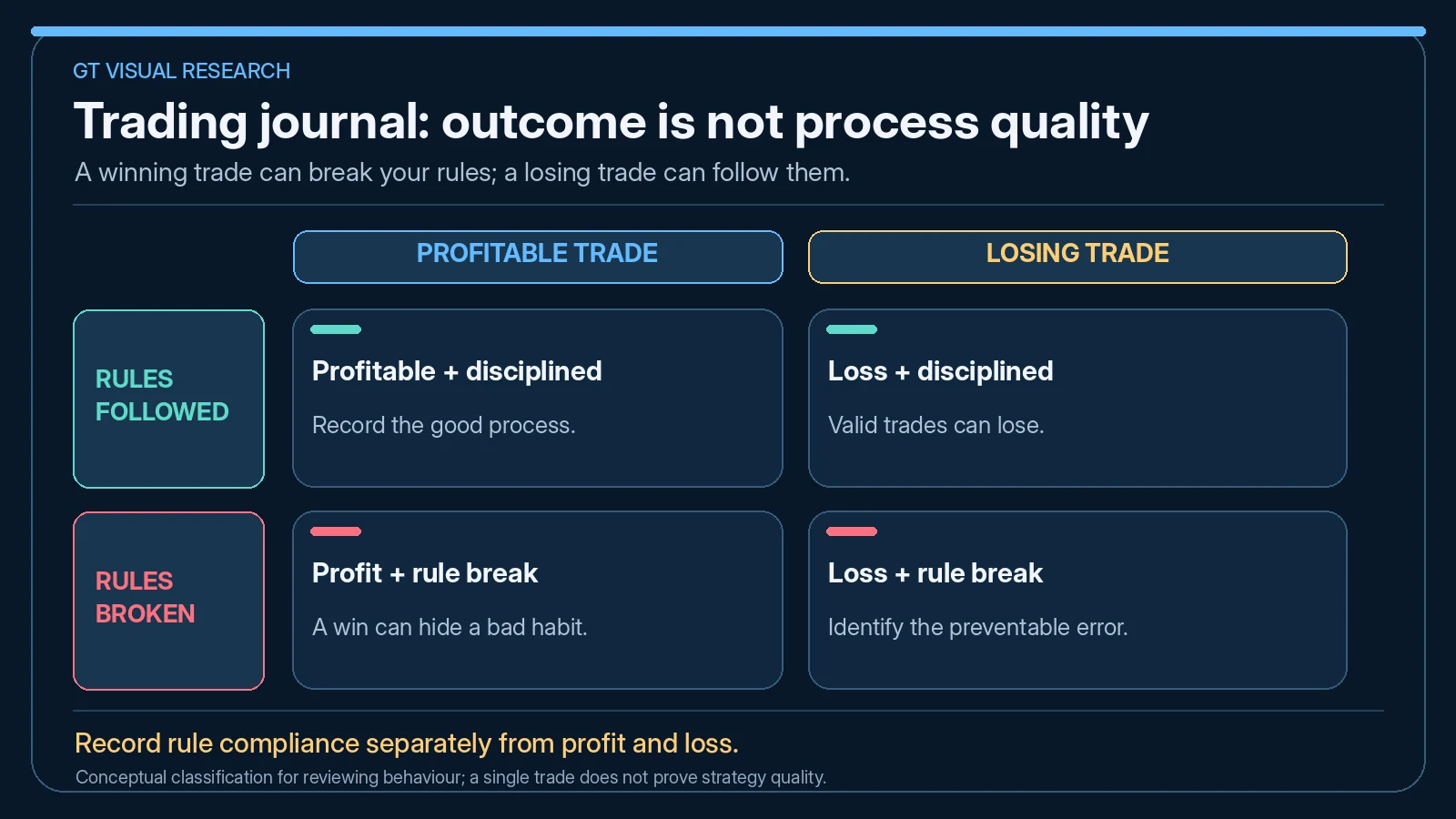
A prop firm journal should track rule breaks separately from losing trades. A trade can lose money and still be valid. A trade can win money and still be a dangerous rule break. That distinction matters because traders who reward bad behaviour with “it worked this time” often repeat the same mistake under pressure.
Useful Prop Firm Journal Fields
- Daily loss remaining before the trade.
- Total drawdown buffer.
- Risk per trade as account percentage.
- Rule followed or broken.
- News, session and holding-period notes.
Prop Firm Review Questions
- Was the trade inside the plan?
- Was the account already near a daily limit?
- Was the loss caused by strategy or behaviour?
- Did the trader stop after the first mistake?
- Would this behaviour pass a funded-stage review?
Final Verdict
A trading journal is useful because it turns memory into evidence. It should make it possible to see whether a result came from the strategy, the risk taken, execution quality or a repeated behavioural mistake.
Start with the simplest format you will maintain consistently. Move from a spreadsheet to dedicated journal software only when imports, analytics or trade volume genuinely improve the review process. The decision rule is simple: the journal should change what you do next, not merely store what already happened.
Source note: GradTraders evaluates trading journals by the quality of the review process they enable, distinguishing the value of a consistent trade record from documented software features. A journal can be kept manually or with specialist software. Current TraderSync documentation confirms supported workflows for syncing, file import and manual trade entry, but software features and integrations can change. The value of journaling still depends on consistent recording and review rather than the software alone.
Primary references: TraderSync trade management.
Useful next reads: Best Trading Journals · TraderSync Review · What Is Backtesting? · Risk Management In Trading · Trading Software & Tools Map.
Explore GradTraders Internationally
GradTraders has 20 dedicated international gateways with local livestream times, market context and country-specific routes into the wider research site.
These country links are for site navigation only; trading software availability, broker connections, account eligibility and applicable terms must be checked separately.
Browse all 20 country gateways
Asia: Japan · South Korea · Taiwan · Hong Kong · India · Singapore · Thailand
Europe: Italy · Sweden · Switzerland · Germany · Norway
Americas: United States · Canada · Mexico
Middle East: United Arab Emirates · Saudi Arabia
Africa: South Africa
Oceania: Australia · New Zealand
Trading Journal FAQ
What is a trading journal?
A trading journal is a record of trades, decisions, risk, results, screenshots, emotions and review notes. It helps traders analyse performance and behaviour.
Do beginner traders need a trading journal?
Yes. Beginners can start with a simple spreadsheet or notebook. The important part is recording trades honestly and reviewing repeated mistakes.
What should I put in a trading journal?
A trading journal should include the market, setup, entry, exit, stop loss, risk, result, trade reason, emotional state, screenshots and review notes.
Is trading journal software worth it?
Trading journal software may be worth it for active traders who need better analytics, imports, reports and performance review. Beginners can often start with a spreadsheet first.
How often should traders review their journal?
Many traders review after each session, then do a weekly and monthly review to find patterns in setups, risk, sessions, emotions and rule breaks.