Automated Trading Vs Manual Trading: Which Approach Suits You?
Manual trading keeps decisions with the trader; automated trading turns defined rules into software actions. My view is to start with the strategy, not the technology: if entries, exits and risk decisions still need judgement that cannot be described consistently, keep that discretion. Automate only the parts that can be tested, repeated and supervised.
 , GradTraders
Let the strategy decide what to automate
MetaTrader, cTrader and TradingView documentation describes what the software can do; GradTraders weighs whether those features solve a real trading-process problem. Alerts or position-sizing aids may suit a discretionary trader, while automatic execution calls for clearly tested rules, risk limits and active oversight.
Execution, platform behaviour and broker or prop-firm restrictions can change.
Disclosure & Risk Notice: This article is for educational and informational purposes only and should not be considered financial advice, investment advice, tax advice or a personal recommendation. Trading CFDs, spread betting, forex, futures, crypto CFDs and other leveraged products involves significant risk and may not be suitable for all traders. You may lose some or all of your capital. Automated systems, Expert Advisors, cBots and trade copiers can fail, disconnect, overtrade, behave differently in live markets and breach broker or prop firm rules. Manual trading also carries emotional, execution and risk-management risks. Some GradTraders articles may contain affiliate links or references to partner offers. If you sign up, purchase or open an account through certain links, GradTraders may earn a commission at no additional cost to you. Commercial relationships do not determine the editorial conclusion or ranking.
Looking for GradTraders partner offers, broker discounts, prop firm promotions and trading platform deals? You can view the current offers and join the update list here: Access GradTraders Partner Offers.
Quick Verdict
Automated trading vs manual trading comes down to where judgement should sit. Manual trading is usually better for traders who rely on context, price action and discretion, while automated trading better suits clear rules that can be tested, coded and monitored.
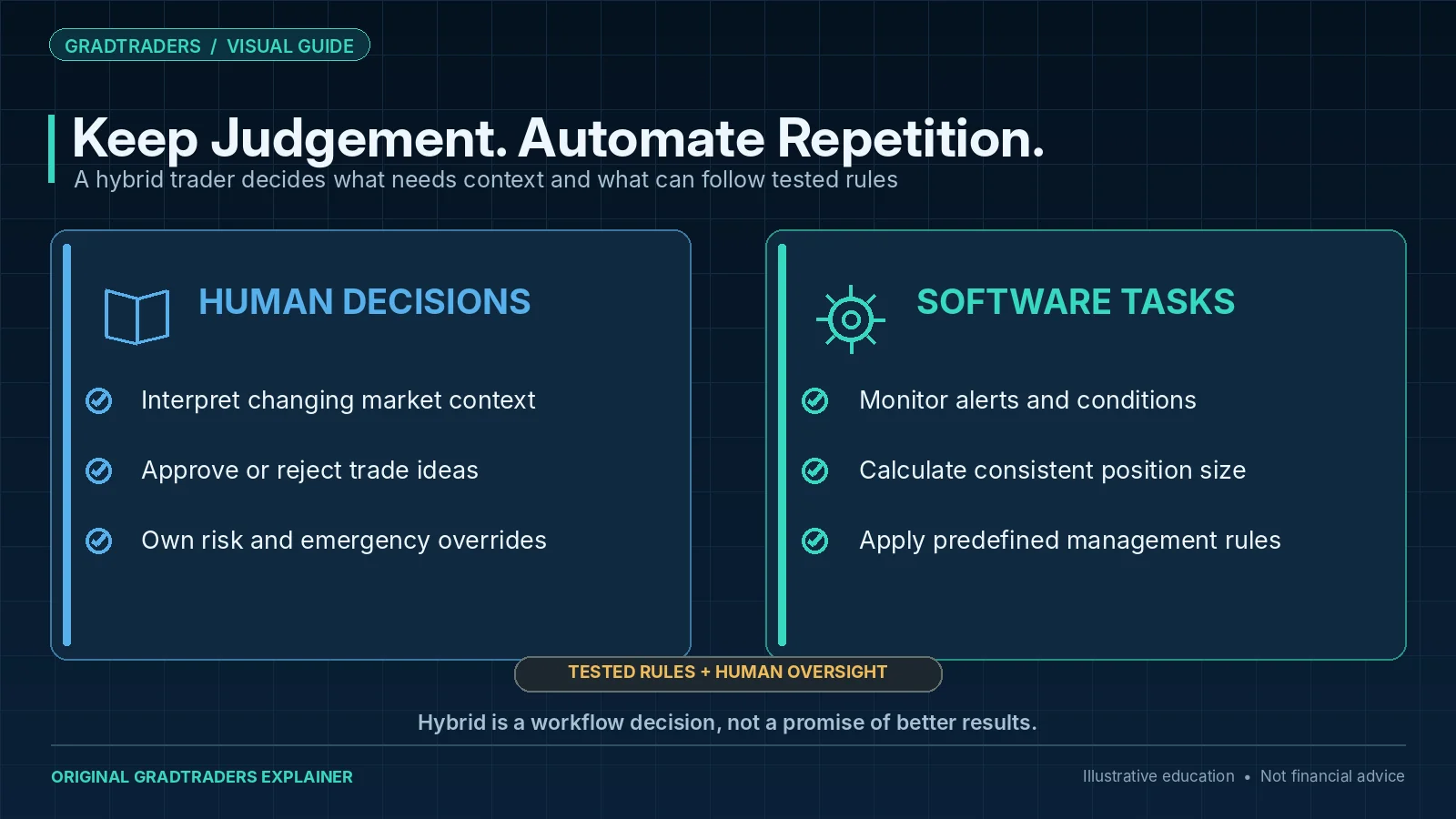
The GradTraders view is that most developing traders should learn manual risk, chart reading, trade review and backtesting before relying on full automation. A hybrid approach can work well: use software for alerts, journaling, backtesting, position sizing and VPS infrastructure, while keeping the final decision manual until the rules are genuinely tested.
Automated Trading Vs Manual Trading At A Glance
The table below shows the core difference. Manual trading gives the trader more judgement and flexibility. Automated trading gives the system more consistency and speed, but only if the rules are strong.
| Feature | Manual Trading | Automated Trading | GradTraders View |
|---|---|---|---|
| Decision-Making | Trader interprets the market and decides | Software follows predefined rules | Manual suits context; automation suits repeatable rules. |
| Speed | Limited by human reaction and screen time | Can react instantly when conditions are met | Speed only helps when the strategy needs it. |
| Emotion | Can be affected by fear, greed, revenge and hesitation | Removes some emotional execution errors | Automation removes hesitation, not bad rules. |
| Flexibility | Can adapt to changing context | Follows rules even when conditions feel unusual | Flexibility can help, but it can also become excuse-making. |
| Testing | Can be backtested manually or through replay | Can often be tested systematically in software | Both need evidence, not just confidence. |
| Main Risk | Emotional mistakes and inconsistency | Bad rules, over-optimisation and technical failure | Different risks, not no risk. |
What Is Manual Trading?
Manual trading means the trader makes the trading decision themselves. They analyse the chart, assess the market context, choose whether to enter, manage the trade and decide when to exit.
Manual trading can be rule-based or discretionary. A rule-based manual trader may still have strict entries, stops and targets, but they click the trade themselves. A discretionary trader may place more weight on context, price action, news, session behaviour or market feel.
The strength of manual trading is adaptability. The weakness is inconsistency. A trader can see context that a bot may miss, but they can also talk themselves into poor trades, ignore stops, move targets, revenge trade or break their own rules.
What Is Automated Trading?
Automated trading means software carries out part or all of the trading process. It may generate alerts, calculate position size, open trades, manage stops, close positions or run a complete strategy.
In MetaTrader, automated systems are commonly called Expert Advisors. In cTrader, they are known as cBots. Other platforms may call them bots, algorithms, strategies or automated systems.
The strength of automated trading is consistency. The weakness is that the software does not know whether the strategy logic is sensible. A bot can follow bad rules perfectly.
Manual Trading Pros And Cons
Manual trading remains valuable because markets are complex and not every useful decision can be reduced neatly into code. But the trader’s behaviour becomes part of the system.
Manual Trading Pros
- Can adapt to market context and changing conditions.
- Useful for price action, structure and discretionary setups.
- Lower technical complexity than full automation.
- Allows the trader to override poor conditions.
- Good for learning market behaviour directly.
Manual Trading Cons
- Emotions can affect entries, exits and risk.
- Requires screen time and focus.
- Harder to execute consistently under pressure.
- Easy to bend rules after seeing the market move.
- Journaling and review are essential but often skipped.
Automated Trading Pros And Cons
Automated trading can remove some human errors, but it creates a different set of problems. The trader becomes a system designer, tester and risk manager.
Automated Trading Pros
- Can execute rules consistently without hesitation.
- Useful for strategies that need speed or continuous monitoring.
- Can be backtested more systematically when rules are precise.
- May reduce impulsive manual trades.
- Can run on VPS infrastructure when continuous uptime matters.
Automated Trading Cons
- Bad logic can be executed repeatedly and quickly.
- Over-optimised systems may fail in live markets.
- Requires testing, monitoring and technical maintenance.
- Platform, broker, VPS or connection issues can affect execution.
- Some brokers or prop firms may restrict certain automated methods.
The Trap: Thinking Automation Removes Risk
Automation can reduce emotional clicking, but it does not remove market risk. It can even increase risk if the trader trusts the system too early.
A manual trader might stop after seeing unusual volatility. A bot may keep trading because the rules still technically allow it. A manual trader might hesitate after two losses. A bot may take the third, fourth and fifth trade without hesitation. That can be good if the system is robust, or dangerous if the strategy is breaking down.
The question is not whether automated trading is safer. The question is whether the rules, risk model, execution environment and monitoring plan are stronger than the manual alternative.
When Manual Trading Makes More Sense
Manual trading may be the better route when the strategy relies on context, judgement or flexible interpretation.
Price Action Traders
Traders using structure, context, candles and levels may prefer manual decision-making.
News-Aware Traders
Manual traders may avoid uncertain conditions that are hard to define in code.
Beginners Learning Markets
Manual practice helps beginners understand order flow, risk, execution and emotion directly.
Low-Frequency Traders
Swing traders or selective traders may not need full automation if they take few trades.
Prop Firm Rule-Conscious Traders
Manual control may reduce the risk of a bot breaching firm rules unexpectedly.
Developing Traders
Manual trading can reveal whether the trader actually understands the strategy before automating it.
When Automated Trading Makes More Sense
Automated trading may be the better route when the strategy is rule-based, repeatable and testable.
Clear Rules
The strategy can be described with precise entry, exit, filter and risk rules.
Repetitive Execution
The same process needs to be repeated without emotional variation.
Fast Signals
The strategy requires speed that a manual trader may not deliver consistently.
Continuous Monitoring
The system needs to watch markets while the trader is away from the screen.
Backtestable Logic
The idea can be tested across historical data without relying heavily on subjective interpretation.
Infrastructure Ready
The trader has VPS, monitoring, alerts, kill switches and risk controls in place.
The Hybrid Approach
Many traders do not need to choose pure manual or pure automation. A hybrid workflow can be more realistic.
| Hybrid Tool | How It Helps | Example | Risk Check |
|---|---|---|---|
| Alerts | Reduces screen-staring and setup chasing | TradingView alert near a key level | The trader still needs a plan before entry. |
| Position Size Tools | Standardises risk before each trade | Risk calculator or platform add-on | Incorrect inputs still create bad sizing. |
| Semi-Automated Exits | Can manage stops, break-even or partial exits | EA manages exits after manual entry | Exit rules must be tested and understood. |
| Backtesting Software | Tests manual or automated rules before live risk | Forex Tester or strategy tester | Avoid hindsight and over-fitting. |
| Trading Journal | Compares plan, execution, emotion and result | TraderSync or spreadsheet | Review honestly, not just when results are good. |
Prop Firm Traders: Manual Or Automated?
Prop firm traders need to be especially careful. Some firms allow certain automated tools, while others restrict EAs, trade copiers, account management tools, third-party systems, news trading, high-frequency behaviour or strategies that appear to exploit platform conditions.
Manual trading gives the trader direct control, but emotional rule breaks can still fail an account. Automated trading can enforce consistency, but a bot may breach rules quickly if configured poorly.
The safest view is that prop firm traders should understand the firm’s rules first, then choose the workflow that best protects daily loss, total drawdown, trade frequency and risk control.
Which Approach Should You Choose?
Use the questions below as a practical guide.
| Question | Manual Trading May Suit If… | Automated Trading May Suit If… |
|---|---|---|
| Are your rules precise? | The setup depends heavily on context and visual judgement | The rules can be defined clearly enough for software |
| Do you struggle with emotion? | You are still learning and need journaling, not full automation | The system can enforce tested rules without emotional interference |
| Do you understand risk? | You need more practice with stops, sizing and losses | Risk rules are already defined, tested and monitored |
| Does the strategy need speed? | The strategy is slower and selective | Fast execution or continuous monitoring genuinely matters |
| Have you tested it? | You are still collecting examples and learning the setup | Backtesting and demo testing support the rules |
Final Verdict
Automated trading vs manual trading is ultimately a choice between keeping judgement and context with the trader and moving repeatable decisions or execution into software. Neither is automatically superior.
The decision rule is to automate only what can be defined, tested and monitored. For many traders, a hybrid workflow is the practical middle ground: software handles alerts, sizing, testing, journaling or trade management while the trader keeps discretion where context still matters.
Source note: GradTraders compares discretionary decision-making with rule-based execution using documented platform capabilities and independent workflow analysis. The cited platform documentation was checked on 10 October 2026. MetaQuotes documents Expert Advisors as automated trading programs developed for MetaTrader, while cTrader documents cBots as automated programs that can analyse conditions, place or manage trades and apply coded risk rules. TradingView documents alerts across prices, indicators, strategies and drawings. Platform capabilities, broker execution conditions, VPS terms and prop-firm automation rules can change, so check each provider directly before relying on a workflow.
Useful next reads: Automated Trading Explained · Algorithmic Trading Explained · EA Builder Pro Review · Best VPS For Automated Trading · Best Trading Journals.
Explore GradTraders Internationally
GradTraders has 20 dedicated international gateways with local livestream times, market context and country-specific routes into the wider research site.
These country links are for site navigation only; broker availability, regulatory status and account eligibility must be checked separately.
Browse all 20 country gateways
Asia: Japan · South Korea · Taiwan · Hong Kong · India · Singapore · Thailand
Europe: Italy · Sweden · Switzerland · Germany · Norway
Americas: United States · Canada · Mexico
Middle East: United Arab Emirates · Saudi Arabia
Africa: South Africa
Oceania: Australia · New Zealand
Automated Trading Vs Manual Trading FAQ
Is automated trading better than manual trading?
Not always. Automated trading can improve consistency and speed, but manual trading may be better for strategies that rely on context, judgement and discretion.
Is manual trading better for beginners?
Manual trading is usually better for beginners because it helps them learn market behaviour, risk management, execution and trading psychology before relying on automation.
Can automated trading remove emotions?
Automated trading can reduce some emotional execution mistakes, but it does not remove risk. The trader can still make emotional decisions when building, changing or stopping the system.
Can manual traders use automation tools?
Yes. Manual traders can use automation for alerts, position sizing, journaling, backtesting and trade management without fully automating entries and exits.
Which is better for prop firm trading?
It depends on the firm’s rules and the trader’s process. Manual trading gives more direct control, while automation can enforce rules if configured properly. Always check prop firm restrictions first.