HFM / HotForex Review 2026: Is It A Good Global Forex And CFD Broker?
HFM, formerly widely known as HotForex, is the global MetaTrader route in the GradTraders broker bank. Its 8.5/10 GradTraders Rating reflects MT4, MT5, HFM WebTrader, the HFM App, 500+ international CFD instruments, varied account structures, copy trading and a recognised FCA-authorised group entity—balanced against heavy jurisdiction dependence, no cTrader or UK spread betting and a UK-facing route that is not currently presented as ordinary retail onboarding.
 Matthew Jackson
Founder of GradTraders
Independent trading research backed by more than 20 years of personal market experience.
, GradTraders ·
Live trading on YouTube ·
Last updated: 13 October 2026 · Last checked: 11 October 2026
Disclosure & Risk Notice: This article is for educational and informational purposes only and should not be considered financial advice, investment advice, tax advice or a personal recommendation. Trading CFDs, spread betting, forex, futures, crypto CFDs and other leveraged products involves significant risk and may not be suitable for all traders. You may lose some or all of your capital. Backtests, simulations, replay results, demo results and strategy tests do not guarantee future performance. Historical testing can be misleading if spreads, slippage, commissions, execution, liquidity, psychology and changing market conditions are ignored. Some GradTraders articles may contain affiliate links or references to partner offers. If you sign up, purchase or open an account through certain links, GradTraders may earn a commission at no additional cost to you.
Looking for GradTraders partner offers, broker discounts, prop firm promotions and trading platform deals? You can view the current offers and join the update list here: Access GradTraders Partner Offers.
Quick Verdict: HFM Earns 8.5/10
HFM has a particularly interesting offering for those who have automated trading strategies. Someone using MT4 or MT5 (or looking to use either platform) who trades forex or gold regularly can compare spread-only pricing with an account that charges commission. Automated strategies may benefit from the Cent account because it allows much smaller live positions than a conventional micro-lot. Combine this with the ability to copy trade, perhaps for diversification purposes, and HFM becomes distinctive. The HFM copy-trading service can also be used by those who prefer only to follow another trader’s strategy.
I would recommend matching the account to the trading method before looking at promotional spreads. For a frequent forex or gold trader, the important comparison is the full cost during the sessions they actually trade; HFM’s published minimums show that Pro and Zero can work out at the same price once commission is included. For somebody moving a strategy from demo to live trading, controlling exposure through Cent could matter much more than a fraction of a pip. Copy trading is a different proposition again, where the provider’s fees and the size of the copied positions can make a real difference to the follower’s results.
HFM isn’t the answer for every trader. I’d look elsewhere for cTrader, UK spread betting or long-term ownership of shares and ETFs, and its services aren’t available in every country. For traders who can open a suitable account and prefer working with MetaTrader, though, HFM deserves serious consideration.
Where HFM Is Available — And Where It Isn’t
HFM’s footprint is not one worldwide account with a choice of flags. The US, Canada and UAE are restricted. South Africa and Kenya have identifiable local group businesses. Britain has an FCA-regulated company and account-application route, while several international countries have separate offshore offerings. You should contact HFM directly to confirm the exact offering and onboarding process for your country, as different regulatory authorities and legal entities may offer different products, trading conditions and protections.
| Reader or region | HFM position | Practical shortlist |
|---|---|---|
| United States | HFM does not accept US citizens or residents. Its international high-leverage CFD and MetaTrader account pages are not an opening route for US retail clients. | For US retail forex, start with the separately US-regulated OANDA Corporation and FOREX.com routes. For listed shares or futures, Interactive Brokers serves a different need. |
| Canada | HFM lists Canada as restricted. A non-Canadian HF Markets entity is not a Canadian onboarding shortcut. | For Canadian forex compare OANDA’s Canadian service under its own CIRO-regulated agreement; for broader investments, compare properly available brokerage accounts. |
| United Kingdom | HF Markets (UK) Ltd, FCA FRN 801701, has a live UK account-application page. It is a real local route, not permission to use international Pro/Zero/Cent prices. | HFM’s UK application is available to inspect. Compare its actual product terms against Pepperstone or FxPro; for UK spread betting consider IG or CMC Markets. |
| Cyprus and eligible European clients | HF Markets (Europe) Ltd, CySEC 183/12. EU retail margin, protections and product rules differ from international 1:2000-leverage promotions. | Compare the CySEC/EEA account you can actually open with relevant locally eligible FxPro, Pepperstone or XTB routes, not UK ISA or offshore terms. |
| South Africa | HF Markets SA (Pty) Ltd, FSCA FSP 46632 is an identified local regulated route. | This makes HFM more relevant than a generic offshore-only comparison. Compare actual South African entity pricing, leverage, payment options and safeguards against permitted IC Markets or FxPro account routes; do not assume either competitor has equivalent local protection. |
| Kenya | HFM Investments Ltd, CMA licence 155, described by HFM as a non-dealing online forex broker. | Ask which entity executes or holds the trading relationship and how the CMA-authorised intermediary functions. This is more useful than assuming it duplicates the South African or Seychelles service. |
| Eligible international countries | HF Markets (Seychelles) Ltd, FSA SD015, and other international HF Markets arrangements appear in the group’s disclosures; availability is residence-specific. | This is where Pro, Zero, Premium and Cent pricing may be relevant. Compare the actual $6-per-lot Zero commission, Cent contract sizes, live spreads, leverage tiers and local protections with eligible specialist brokers. |
| UAE and other restricted jurisdictions | HFM’s published global restrictions include the UAE, as well as the US, Canada, Türkiye and several others. A translated web page is not evidence of acceptance. | UAE readers can research the distinct DFSA-regulated XTB MENA proposition or other locally authorised services, provided actual eligibility is confirmed. Do not attempt to use an HFM offshore route to bypass stated restrictions. |
Primary sources: HFM published restricted countries, HFM regional licences, HFM group companies, OANDA US and Canadian entities. Each route must be assessed on current residence acceptance and contractual terms.
HFM’s Platforms: Good For MetaTrader, Less Convincing Outside It
For someone already working with MT4 or MT5, HFM’s familiar terminals are a strength. Expert Advisers, custom indicators and VPS-based systems remain usable in the appropriate account. HFM also has WebTrader and its own app, which are useful for checking positions and managing the account when away from a computer. They are not a replacement for the terminal or hosting environment running an automated strategy.
The comparison becomes more revealing when an existing EA is moved from another broker. A strategy that trades 0.01 lot on HFM Cent would be dealing in 10 base-currency units, not the 1,000 units of a conventional micro-lot. Even on standard contracts, the symbol specification, spread at entry time, stop-distance rules, server and slippage may change. I’d compare all five before being reassured by a successful backtest.
Nor would I move a working cTrader cBot or a TradingView-execution workflow to HFM simply because I liked its pricing. FxPro and Pepperstone provide more natural eligible comparisons for those platforms. HFM makes most sense when MetaTrader already fits the method, rather than asking the trader to change methods to fit the broker.
One useful product distinction: HFM’s published platform matrix makes certain ETFs and DMA-style instruments available through MT5, WebTrader or its app, not every MT4 account. A trader planning to use those markets should check the precise instrument before deciding that an MT4 login covers the whole offering.
GradTraders Best Native Platform Choice: Plus500
United Kingdom
GradTraders does not promote broker services to UK customers unless the relevant UK entity is authorised and regulated by the Financial Conduct Authority (FCA). Plus500UK Ltd (FRN 509909) is authorised and regulated by the FCA, and Plus500 is a firm we’re proud to partner with for our UK audience.
UK risk reminder: CFDs are leveraged products and can result in rapid losses. The provider-specific retail loss warning is displayed within the Plus500 banner above.
United States
For United States readers, Plus500 provides a separate futures service through Plus500US Financial Services LLC d/b/a Plus500, a Futures Commission Merchant registered with the U.S. Commodity Futures Trading Commission and a member of the National Futures Association (NFA ID 0001398).
The US futures service is separate from the UK CFD service provided by Plus500UK Ltd.
US risk reminder: Futures and options involve substantial risk of loss and are not suitable for every investor. Losses may exceed the amount originally invested. Trading privileges are subject to review and approval.
Partner disclosure: Plus500 is a GradTraders affiliate partner. GradTraders may earn a commission if an eligible account is opened through these links, at no additional cost to you. This commercial relationship does not alter the editorial analysis or verdict on this page.
HFM Pro, Zero, Premium And Cent: What The Trades Really Cost
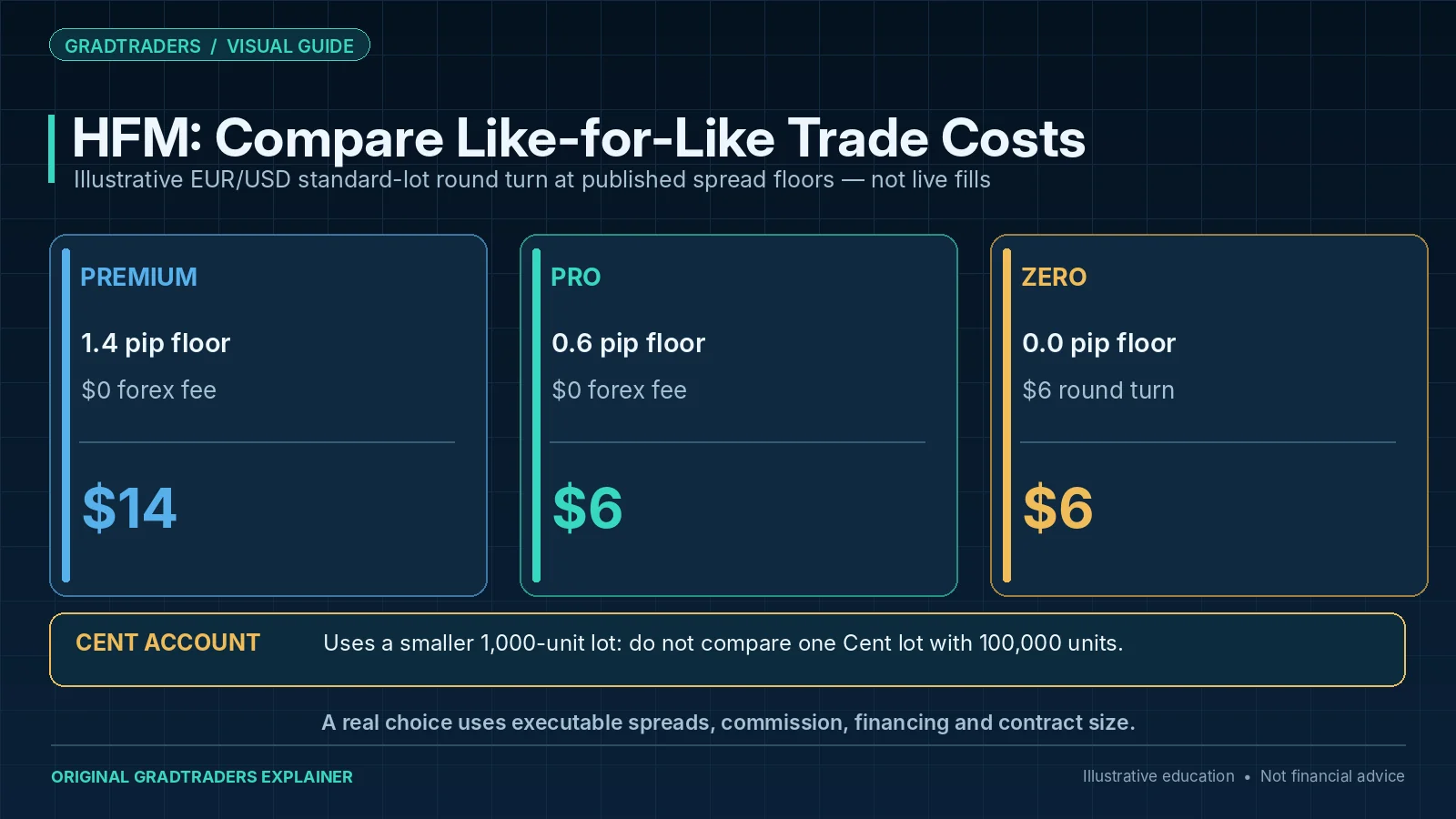
Choosing between HFM’s international accounts comes down to two separate questions: what will the trade cost, and how large is the position? Premium and Pro use spread-only pricing, while Zero combines a lower quoted spread with commission. Cent is different because its smaller contract changes the exposure represented by each lot. I’d compare the first three on the full cost of an equivalent trade, and Cent on whether that smaller position size suits the strategy.
| Account | Advertised EUR/USD floor | Forex commission | Theoretical one-lot round turn | Who it serves |
|---|---|---|---|---|
| Premium | From 1.4 pips | No separate forex commission | $14 at quoted minimum spread | Simple spread-only route; may be easier for traders who do not want a separate commission line. |
| Pro | From 0.6 pip | No separate forex commission | $6 at quoted minimum spread | A published tighter-spread route with a minimum opening deposit of $100/€100 on the referenced international page. |
| Zero | From 0.0 pip on selected symbols | $6 round turn per standard 100,000-unit major-FX lot | $6 at zero spread; more if spread widens | A commission route for traders willing to track both spreads and fees; published opening-deposit descriptions differ. |
| Cent | From 1.4 pips | No separate forex commission | Not directly comparable: lot is 1,000 units, not 100,000 | Suitable for tiny forex/gold orders; compare the lot contract and pip value before position sizing. |
Here’s the calculation that changed my view. On a standard EUR/USD lot, one pip is worth about $10. Pro’s advertised 0.6-pip minimum therefore costs $6. Zero starts at zero spread but adds $6 in round-turn commission. At those minimums they cost the same. In live trading, Zero beats Pro only when its quoted spread is more than 0.6 pip tighter. At 0.9 pips on Pro against 0.1 on Zero, the costs would be $9 and $7. Reverse the spread difference and Pro can win.
Gold tells the same story. HFM advertises a minimum $0.16-per-ounce spread on Pro, against $0.06 on Zero plus a $10 commission for a 100-ounce lot. That gives each a theoretical $16 round turn.
| One standard-lot round trip | HFM Pro published floor | HFM Zero published floor plus commission | What it tells me |
|---|---|---|---|
| EUR/USD, 100,000 EUR | 0.6 pip × $10 = $6 | 0.0 pip + $6 commission = $6 | Both tie at the published minimum; trade-hour spread differences decide. |
| XAUUSD, 100oz | $0.16/oz × 100 = $16 | $0.06/oz × 100 + $10 commission = $16 | The commission can consume all of Zero’s headline spread advantage. |
I like this comparison because it exposes the weakness in selecting an account by the word Zero. Neither example tells us which spread is actually available at the London open, during US data or through a quiet session. It tells us precisely what would need to happen for one account to beat another—and that’s a more useful place to start.
The current international Zero page is also inconsistent about its minimum opening deposit: its account table indicates zero, while an FAQ refers to $25. Pro’s published minimum is $100/€100. Those terms—and any swap-free treatment—belong to the eligible account named in the contract, not automatically to HFM UK.
HFM specifications: EUR/USD, XAUUSD, Zero account commissions, Pro account and Cent contract details. The examples use published minimums, not observed averages; exclude swaps, slippage and non-standard commission arrangements.
Which HFM Markets Are Actually Useful?
HFM advertises more than 500 international CFD markets across forex, gold, indices, commodities, shares, bonds and eligible ETFs or cryptocurrency-linked instruments. But its Cent account is essentially a forex-and-gold proposition. Anyone hoping to test an index-CFD strategy with those tiny Cent contracts would be comparing the wrong account.
There is a second distinction between trading a share CFD and owning shares or ETFs. HFM can suit active derivative exposure; it isn’t the investing account I’d use as a substitute for a portfolio of directly owned holdings. For that purpose, I’d read the local options from XTB, Interactive Brokers or Saxo. HFM’s published platform matrix also limits some ETF and DMA-style access to MT5, WebTrader or the app. The account and contract list matter more than the advertised market total.
Leverage Changes Margin — Not The Loss On The Same Trade
Consider a standard 0.01 EUR/USD lot—1,000 euros—at an exchange rate of 1.10. The position is worth about $1,100. At 1:30 leverage its initial margin would be around $36.67; at a hypothetical 1:2000 it would be about $0.55, before dynamic margin rules. A 50-pip move against that position still costs roughly $5 in either account, excluding fees and slippage.
That example is how I’d read HFM’s international high-leverage marketing. The lower margin can be convenient for a properly sized position; the danger is what happens when a system starts opening more positions because so little margin is required. A strategy driven by free-margin thresholds can behave very differently under the two account structures. UK and EU retail traders should not treat an eligible offshore 1:2000 advertisement as their account terms.
For jurisdiction limits and account comparisons see leverage by country and the GradTraders execution-cost bank. The worked margin figures are illustrative, not the broker’s live requirement for every symbol or balance.
HFM Copy Trading vs eToro, Vantage And AvaTrade
Copy trading is where HFM deserves a closer look. It offers more control over how a follower’s position is sized than the familiar idea of simply clicking “copy” might suggest. The follower can use an equity-based allocation, and some strategies also permit a fixed multiplier. That flexibility has a catch: the follower can end up with different percentage risk from the provider.
Take a provider trading one standard lot with $2,000 of equity. A follower with $400, using 50% proportional allocation and equal leverage, copies 0.10 lot under HFM’s published formula. But if the provider trades 0.05 lot, the calculation produces only 0.005 lot. That’s below HFM’s 0.01 minimum; opening the minimum-sized copy requires the follower’s approval. It’s the sort of small-account detail I’d want to understand before trusting a performance chart.
| Provider | What is actually copied | Fee model | Why I would choose it |
|---|---|---|---|
| HFM | Forex/CFD strategy-provider trades, copied proportionally to equity and leverage or by a fixed multiplier where enabled. | Provider performance fees, up to 50%, subject to high-water-mark rules; normal trading costs also apply. | A credible fit for eligible MT4/MT5 followers prepared to understand margin, copied lot sizes and fees. |
| Vantage | Signal-provider trading within Vantage’s copy system; copied orders can reflect the provider’s subsequent stop-loss changes. | Profit-sharing percentage can be 0–50%, with high-water-mark and margin conditions; normal costs still apply. | The closest fee-structure comparison to HFM, rather than assuming every copy provider works like eToro. |
| eToro | CopyTrader allocates money to another investor’s portfolio; positions follow the investor proportionally. | No additional CopyTrader performance or subscription fee; ordinary dealing, spread, CFD and other applicable fees remain. | Worth comparing for a multi-asset investor following portfolios rather than an MT4 forex strategy. Its $200 minimum allocation and $1 position minimum have sizing implications. |
| AvaTrade | AvaSocial is a social trading app; DupliTrade and MT4/MT5 signals provide different forms of strategy copying. | AvaTrade advertises no AvaSocial/DupliTrade subscription fee, but regular dealing costs and possible third-party provider fees need checking. | A different choice for readers who value social interaction or a dedicated automated strategy service rather than one HFM-style provider programme. |
The fee difference is substantial. Suppose a follower makes an eligible $200 profit. At a hypothetical 20% strategy-provider performance fee, $40 goes to the provider, leaving $160 before other costs. HFM and Vantage can charge that kind of profit share; eToro doesn’t add a CopyTrader performance fee. That doesn’t automatically make eToro cheaper for every trade—its ordinary trading and financing charges still apply—but it makes it a different proposition.
HFM’s high-water-mark approach is another detail I like: a provider is not supposed to collect a new performance fee simply for recovering a previous loss. Even so, I would look at the provider’s worst drawdown, the follower’s actual position sizes, and whether an account-wide rescue level can close positions earlier than the provider expects. Someone copying a forex scalper is taking on execution and spread risks that a portfolio investor using eToro may not be taking in the same way.
Provider documentation: HFM follower sizing and minimum lots, HFM fees and high-water mark, Vantage copy terms, eToro CopyTrader, AvaTrade’s three copy systems and AvaSocial/DupliTrade fee guidance. Features and eligibility depend on the provider and the reader’s country; the figures above are illustrations, not observed follower results.
Funding And Withdrawals
HFM says supported international deposits and withdrawals carry no fee charged by HFM itself. That doesn’t rule out bank charges, conversion costs or delays during identity checks. I’d look at the account currency, payment route and named legal company before being impressed by the word free.
For an account I intended to use regularly, I would complete verification early and test a modest withdrawal before committing much more capital. That won’t prove every future withdrawal will be smooth, but it is a better test of the actual account than another promise about support availability. The GradTraders funding comparison gives the broader context.
HFM In The UK: What You Can Actually Apply For
HF Markets (UK) Ltd is FCA-regulated (FRN 801701) and has an active UK live-account application. Its UK service advertises CFD trading and publishes a retail risk warning. So British traders have a genuine domestic HFM route to consider—not just the group’s offshore website.
The distinction is in the account terms. HFM’s internationally advertised Pro, Zero and Cent pricing and 1:2000 leverage should not be treated as the terms offered to UK retail customers. For someone wanting MetaTrader-based CFD trading with FCA oversight, I’d compare the UK HFM account’s available instruments, spreads and commissions directly with Pepperstone and FxPro. If the priority is UK spread betting, cTrader or TradingView execution, those alternatives—and IG or CMC Markets for spread betting—make more sense as the starting point.
Sources: HF Markets UK’s application and risk disclosure and the FCA’s identification of the authorised firm. The application page does not identify a verified UK Pro/Zero/Cent price schedule or guarantee account acceptance.
Where HFM Beats The Alternatives — And Where It Doesn’t
Once the account and price differences are clear, the shortlist becomes simpler. These are the six comparisons I’d actually use from the GradTraders research bank; they tell me more than putting the same brokers into another numerical ranking.
| The job | HFM case | Worth comparing |
|---|---|---|
| Trade live with very small forex exposure | International Cent permits 0.01 lot of just 10 base-currency units; a conventional micro-lot is 100 times bigger. | OANDA v20 permits one-unit orders where eligible. The size needed and the domestic account determine the choice. |
| Run an existing MT4 or MT5 EA | HFM offers eligible MetaTrader accounts with spread-only and commission structures; check symbols, session costs and the actual server. | FxPro, Tickmill, IC Markets or Pepperstone on the same symbols and hours. |
| Use cTrader cBots or TradingView execution | A MetaTrader-led setup makes HFM the wrong starting point if either of these is essential. | FxPro and Pepperstone offer appropriate platform alternatives to eligible clients. |
| Trade XAUUSD frequently | HFM Pro and Zero both reach a theoretical $16 per 100-ounce gold lot at their published spread floors after Zero commission. | Compare actual contract size, spreads and commissions with FP Markets or Pepperstone. |
| Own shares or build a long-term ETF portfolio | Most HFM markets are CFDs, not ownership. Neither high leverage nor a 500-market catalogue changes that. | Look at real-share and ETF accounts from XTB, Interactive Brokers or Saxo where available. |
| Use UK spread betting or US retail forex | HFM has no verified UK spread-betting route and excludes US residents from its global forex service. | UK: IG or Pepperstone. US forex: the separately regulated OANDA or FOREX.com. |
There isn’t one rival that replaces HFM on every point. OANDA’s tiny forex orders address position size; Tickmill or IC Markets are natural raw-pricing tests in eligible regions; FxPro and Pepperstone solve different platform needs. Matching a broker to the actual method is more useful than expecting an 8.5/10 rating to mean the same thing to every trader.
See the GradTraders 24-broker bank, all-in cost research and platform comparison. Country and client-entity eligibility applies throughout.
HFM Pros And Cons
What Stands Out
- Cent accounts permit unusually small live forex and gold exposure in eligible markets.
- Pro, Zero and Premium provide genuinely different pricing structures for MetaTrader users.
- Copy trading offers configurable position sizing and a high-water-mark performance-fee model.
- Identifiable UK, South African and Kenyan regulated group businesses, alongside other international routes.
Where I’d Think Twice
- Not available to US, Canadian or UAE residents under HFM’s published restrictions.
- UK product availability is not identical to the international Zero/Pro/Cent marketing.
- No native cTrader or direct TradingView execution route in the researched offering.
- Minimum spread headlines conceal commission differences; copy-provider fees can change the follower’s return.
My View On HFM / HotForex
HFM wouldn’t automatically be my first choice for a main forex trading account. With brokers such as Pepperstone, FxPro and IC Markets competing for active traders, I would need a particular reason to choose it. A long instrument list or a high leverage headline wouldn’t be enough.
Where I do see an opening is as a specialist account alongside an established trading setup. For an eligible MetaTrader user who wants to test a method with very small live positions, HFM’s Cent option is worth a closer look. It isn’t the same as making a conventional EA trade smaller with a standard micro-lot, and the contract settings need to be right. But there’s a practical use for that kind of flexibility which some more conventional accounts don’t serve as neatly.
The copy-trading business interests me for a different reason. HFM lets followers take a relatively hands-on approach to allocation, but I wouldn’t select a provider solely because its past returns looked impressive. I’d compare the actual follower experience with Vantage, eToro and AvaTrade: how much exposure follows each trade, how the provider earns money, and what a poor run does to the follower’s balance. Those differences are more important to me than which service has the larger selection of traders.
So I see HFM as a broker with some genuinely useful niches rather than the obvious all-round winner. If I wanted wider platform choice or UK spread betting, I’d look elsewhere first. If I wanted fine control over small forex exposure or a particular MetaTrader copying arrangement, HFM would earn a closer comparison—provided the account was available where I lived.
Final Verdict: HFM Earns 8.5/10
HFM’s 8.5/10 is built on a genuine specialism. For an eligible MetaTrader trader, the combination of very small Cent contracts, a choice between spread-only and commission pricing, and configurable trade copying can be more useful than a broker with twice as many instruments. The trade-off is that each advantage comes with mechanics the trader needs to understand.
If I were comparing HFM for forex or gold, I’d start with the contract size and the all-in cost during my trading session. If I wanted to follow a provider, I’d compare HFM’s fees and copied risk directly with Vantage, eToro and AvaTrade. And if I wanted UK spread betting, cTrader or a directly owned investment portfolio, I’d give other brokers the first look rather than trying to turn HFM into something it isn’t.
One condition comes before all of that: the account must actually be available in the reader’s country. HFM is not a US, Canadian or UAE retail route. UK readers have an FCA-authorised HFM application, but need the local product terms. South African and Kenyan readers have identifiable local group businesses. Where an HFM account is open to the trader and its real costs make sense, it deserves a place on the shortlist. Where it isn’t, the comparisons in this review provide somewhere more appropriate to begin.
Explore GradTraders Internationally
These country gateways provide local market context and regulator-checking routes. They do not establish that HFM accepts residents of a country or that any particular product or leverage is available there.
Browse all 20 country gateways
Asia: Japan · South Korea · Taiwan · Hong Kong · India · Singapore · Thailand
Europe: Italy · Sweden · Switzerland · Germany · Norway
Americas: United States · Canada · Mexico
Middle East: United Arab Emirates · Saudi Arabia
Africa: South Africa
Oceania: Australia · New Zealand
HFM / HotForex Review FAQ
Is HFM a good broker?
HFM earns 8.5/10 in the GradTraders broker bank. Its distinctive strengths are very small Cent forex contracts, the Pro-versus-Zero account choice and detailed copy-trading options for eligible MetaTrader traders. It is not available to residents of every country.
Is HFM the same as HotForex?
Yes. HFM is the current brand used by the broker group previously widely known as HotForex.
Can US, Canadian or UAE residents open an HFM account?
HFM currently lists the USA, Canada and UAE as restricted jurisdictions. US forex traders can compare locally regulated OANDA Corporation and FOREX.com; Canadian readers can research OANDA Canada. UAE readers should check locally permitted alternatives.
Is HFM regulated and available in the UK?
HF Markets (UK) Ltd is FCA authorised (FRN 801701) and has an active UK Open Live Account application page. The terms for international Pro, Zero and Cent accounts should not be treated as UK retail quotes; verify the actual local offer.
Does HFM have regulated businesses in South Africa and Kenya?
HFM identifies HF Markets SA (Pty) Ltd under South Africa’s FSCA licence 46632 and HFM Investments Ltd under Kenya’s CMA licence 155. These are separate legal services; confirm the entity holding the client agreement and the applicable protections.
Does HFM offer MT4, MT5, cTrader or TradingView execution?
HFM’s eligible accounts support MT4, MT5, WebTrader and its app. The researched HFM platform stack does not include a native cTrader or direct TradingView execution route; compare brokers with those platforms if your strategy requires them.
What is different about an HFM Cent lot?
HFM’s international Cent contract is 1,000 currency units per lot. The smallest displayed 0.01 Cent lot represents 10 units, versus 1,000 units for a conventional 0.01 standard lot. Cent is mainly for forex and gold, not the full global CFD range.
Is HFM Zero always cheaper than HFM Pro?
No. At published international minimums, a standard EUR/USD lot costs about $6 with Pro or Zero after Zero commission; a 100-ounce gold lot costs about $16 on either route using the stated minimum spreads and gold commission. Actual executable costs vary.
What should I check before copying trades with HFM?
Check the provider’s drawdown, the proportional or multiplier lot-sizing rule, the 0.01-lot minimum, follower leverage and the provider performance fee. HFM allows fees up to 50% of eligible profits and uses high-water-mark rules. Regional availability varies.
How does HFM copy trading compare with eToro, Vantage and AvaTrade?
HFM and Vantage allow eligible strategy providers to receive performance-based profit shares under high-water-mark rules. eToro charges no extra CopyTrader performance fee, though normal trading fees apply. AvaTrade offers AvaSocial, DupliTrade and MetaTrader signals with different workflows and possible third-party charges. Availability varies by entity.
Does HFM offer UK spread betting?
No verified UK spread-betting route is documented in the GradTraders HFM research. UK readers seeking spread betting should compare eligible providers such as Pepperstone, FxPro, IG or CMC Markets.
Does HFM charge withdrawal fees?
HFM says it does not charge fees for supported withdrawal requests on published international routes. Banks and payment intermediaries may impose fees, and methods and terms vary by account entity.
Sources and fact-checking: Verified 13 October 2026 using the GradTraders 24-broker research bank, HFM’s country restrictions and licences, the FCA-authorised UK application route, international EUR/USD and gold contract specifications and HFM’s copy-trading agreement. Copy-trading comparisons use Vantage’s profit-sharing terms, eToro’s CopyTrader guide and AvaTrade’s copy-platform comparison. Worked prices are published theoretical minimums, not independently measured live fills; the legal entity determines the actual products, permissions and protections.
Official research: platform comparison · account comparison · markets · demo account · withdrawals · FCA authorised-firm details.
Useful GradTraders research: 24-Broker Comparison Table · Platform Coverage · Regulation & Protection.
Risk reminder: HFM entities, account names, leverage and protection differ. Confirm the exact company and legal documents before depositing or trading.