Why Do Brokers Offer Different Leverage In Different Countries?
When a broker advertises different leverage by country, my first question is which legal company would actually provide the account. A single trading brand can operate through different regulators, client classifications and product rules, so the permitted leverage and protections can change without the underlying market changing. I would compare the entity, available safeguards, margin requirements and practical account terms before treating the largest leverage figure as an advantage.
 Matthew Jackson
Founder of GradTraders
Independent trading research backed by more than 20 years of personal market experience.
, GradTraders ·
Live trading on YouTube ·
Last updated: 10 October 2026 · Last checked: 11 October 2026
Matthew Jackson
Founder of GradTraders
Independent trading research backed by more than 20 years of personal market experience.
, GradTraders ·
Live trading on YouTube ·
Last updated: 10 October 2026 · Last checked: 11 October 2026Choose the legal entity and protection framework first. Compare maximum leverage only after you know which company holds the account and what happens if the trade, broker or withdrawal process goes wrong.
Disclosure & Risk Notice: This article is for educational and informational purposes only and should not be considered financial advice, investment advice, tax advice or a personal recommendation. Trading CFDs, spread betting, forex, futures, crypto CFDs and other leveraged products involves significant risk and may not be suitable for all traders. You may lose some or all of your capital. Backtests, simulations, replay results, demo results and strategy tests do not guarantee future performance. Historical testing can be misleading if spreads, slippage, commissions, execution, liquidity, psychology and changing market conditions are ignored. Some GradTraders articles may contain affiliate links or references to partner offers. If you sign up, purchase or open an account through certain links, GradTraders may earn a commission at no additional cost to you.
Looking for GradTraders partner offers, broker discounts, prop firm promotions and trading platform deals? You can view the current offers and join the update list here: Access GradTraders Partner Offers.
Quick Verdict
Brokers offer different leverage in different countries because a broker group normally operates through multiple regulated companies. Each company must follow the rules applying to its jurisdiction, product set and customer category.
UK, European and Australian retail CFD accounts broadly use a product-based leverage ladder running from 30:1 down to 2:1. The United States takes a different route for retail off-exchange forex, using minimum security deposits rather than a general retail CFD framework. Japan generally requires individual FX accounts to maintain at least 4% margin, equivalent to 25:1 leverage.
The important question is therefore not, “Which broker offers the highest number?” It is, “Which legal entity gives me the right balance of margin efficiency, regulation, negative-balance treatment, platform access, withdrawals and dispute protection?”
Same Brand, Different Company
A UK, European, Australian, US or offshore customer may contract with a completely different legal company inside the same broker group.
Leverage Is Product-Specific
Major forex, indices, shares, commodities and crypto-linked products can all have different maximum leverage under the same account.
Higher Is Not Automatically Better
High leverage lowers required margin, but it can also make severe overexposure easier and may sit behind a weaker protection route.
Leverage, Margin And Exposure Are Different
These three terms are connected, but they should not be treated as interchangeable.
Leverage
The ratio between the market exposure controlled and the margin or equity supporting it. A maximum of 30:1 means the broker may allow £30 of exposure for each £1 of required initial margin on an eligible product.
Margin
The amount the broker requires to open or maintain the position. Margin is a deposit against exposure; it is not the maximum possible loss and it is not the true size of the trade.
Exposure
The full market value controlled by the position. Exposure is the figure against which market movement acts, so it matters more than the small margin number shown on the ticket.
Core formula: required margin is approximately the notional exposure divided by the leverage ratio. A £10,000 position at 20:1 therefore requires about £500 of initial margin before broker-specific adjustments.
Why Brokers Offer Different Leverage In Different Countries: The Main Routes
This is a practical comparison of the main routes relevant to GradTraders readers. It is not a substitute for checking the current regulator, broker product schedule and account agreement.
| Country Or Route | Typical Retail Structure | Protection Framework | Main Practical Point |
|---|---|---|---|
| United Kingdom | FCA retail CFDs and leveraged spread bets generally use limits from 30:1 to 2:1 according to the underlying asset. | Account-level margin close-out, negative-balance protection and restrictions on trading inducements. | Clear local protection route, but lower margin flexibility than many global entities. |
| European Union / EEA | National measures commonly follow the ESMA-style 30:1-to-2:1 product ladder. | Retail leverage limits, margin close-out, negative-balance protection and standardised warnings. | Check the national regulator and exact broker entity rather than relying only on a CySEC or EU marketing label. |
| Australia | ASIC retail CFD caps run from 30:1 to 2:1 depending on the underlying asset. | Margin close-out, negative-balance protection and restrictions on inducements. | Modern Australian retail accounts are much closer to the UK/EU model than older 500:1 Australian marketing suggested. |
| United States Retail Forex | NFA security deposits are generally at least 2% for designated major currency groups and 5% for other currency transactions. | CFTC/NFA registration, capital, disclosure and conduct requirements for permitted retail forex counterparties. | This is a retail forex regime, not a normal UK-style retail CFD or spread-betting route. |
| Japan Retail FX | Individual FX accounts generally require at least 4% margin, equivalent to maximum leverage of 25:1. | Domestic margin rules and supervision of registered financial instruments firms. | Japan is highly active in retail FX but does not use the very high leverage associated with many offshore accounts. |
| Offshore / Global Entity | No universal cap. Broker policies can range from conservative limits to 100:1, 500:1 or higher on selected products. | Varies materially by regulator, licence, account document and broker policy. | Higher leverage must be assessed together with client money, negative balance, withdrawals and the available complaints route. |
| Professional / Wholesale Classification | Higher leverage may become available because retail product-intervention caps no longer apply in the same way. | Some retail protections, compensation rights or standard disclosures may cease to apply. | Professional status is a protection trade-off, not a prestige upgrade. |
The UK, EU And Australian Product Ladder
The exact legal wording differs, but the familiar retail CFD structure in these routes broadly links permitted leverage to the volatility of the underlying asset.
| Underlying Category | Common Maximum Leverage | Approximate Initial Margin | Why The Limit Changes |
|---|---|---|---|
| Major FX pairs | 30:1 | 3.33% | Generally deeper liquidity and lower expected volatility than more speculative products. |
| Non-major FX, gold and major indices | 20:1 | 5% | More movement or gap potential than the major-currency category. |
| Other commodities and non-major indices | 10:1 | 10% | Thinner liquidity, sharper repricing or greater product-specific volatility. |
| Individual shares and similar references | 5:1 | 20% | Single-company gaps, earnings events and idiosyncratic risk. |
| Crypto-linked CFDs | 2:1 | 50% | High volatility, weekend movement, rapid repricing and gap risk. |
Important: the 2:1 crypto-CFD category applies only where those products may legally be sold to retail clients. The FCA prohibits UK retail sales of derivatives referencing certain unregulated cryptoassets, including crypto CFDs. Separately, a broker may apply a higher margin requirement than the regulatory minimum. Volatile markets, large positions, concentrated exposure and weekend risk can all lead to tighter broker-level limits.
Why The Same Broker Brand Can Show Three Different Numbers
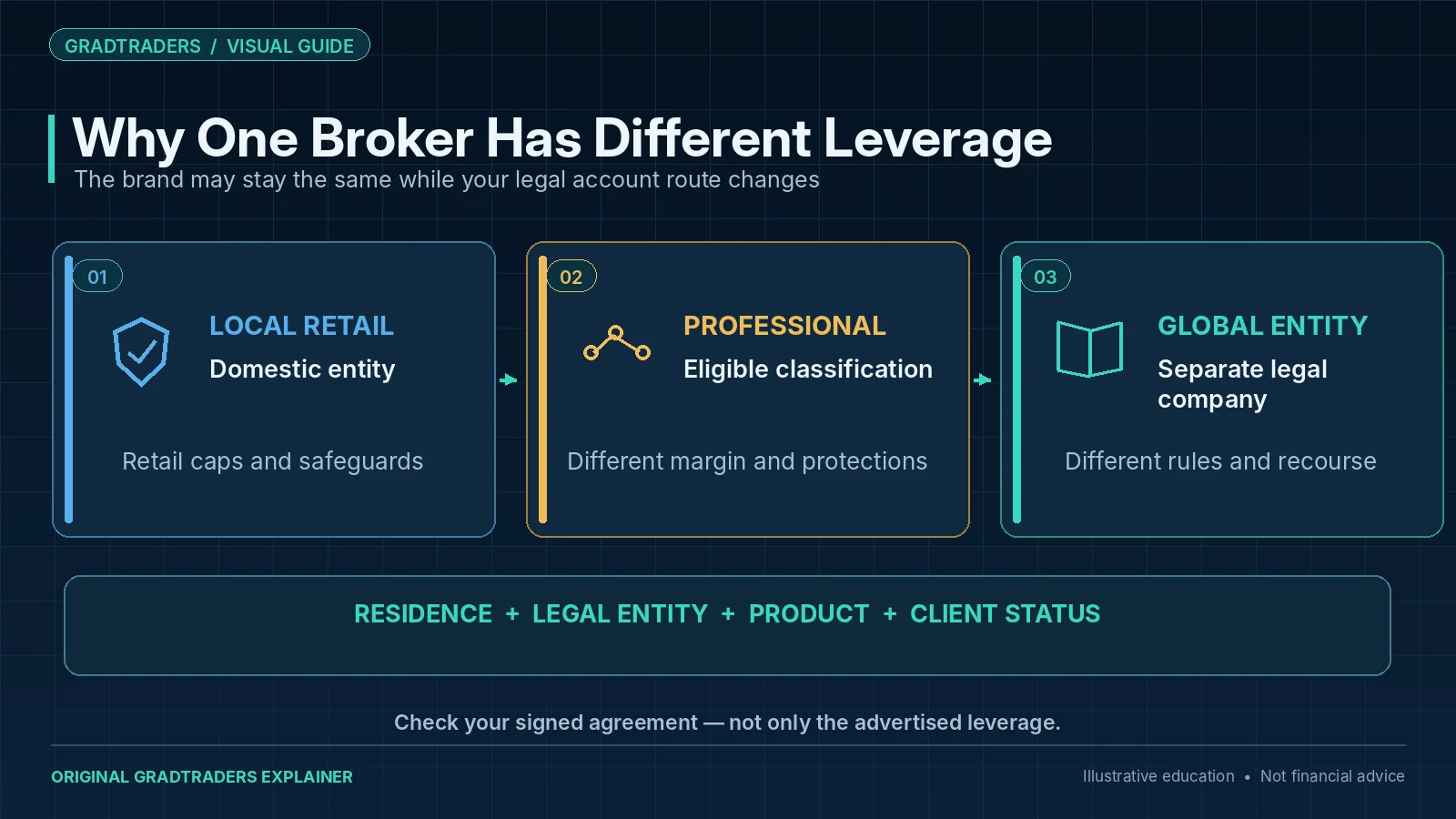
Local Retail Entity
The customer is onboarded to the broker’s local regulated company. Leverage is constrained by local retail rules and usually comes with the clearest domestic complaints route.
Professional Or Wholesale Route
The customer meets classification criteria and opts out of parts of the retail framework. The broker may then offer a different margin schedule.
Global Or Offshore Entity
The account contract sits with a separate international company whose local rules allow a different leverage policy and protection structure.
The footer, terms page, application form and client agreement matter more than the logo. Traders should record the company name, licence number, regulator and dispute body before funding an account.
How Brokers Decide Which Entity You Receive
The process is normally driven by residency and eligibility, not simply by which homepage the trader happens to visit.
Residential Address
Proof of address and declared tax residence usually determine which legal company is permitted to onboard the customer.
Country Eligibility
Some entities cannot accept residents from particular countries, while other group companies may have the relevant local permission.
Client Classification
Retail, professional, wholesale and eligible-counterparty categories can receive materially different leverage and protection terms.
Product And Platform
A spread-betting account, CFD account, retail forex account or listed-futures account may sit behind a separate product agreement or company.
Professional Status Is Not A Free Upgrade
Professional or wholesale classification can unlock higher leverage and sometimes different products, but the account may lose protections designed for retail clients. The FCA warned again in October 2025 that CFD investors should not give up important protections merely to obtain greater leverage or incentives.
Depending on jurisdiction and terms, the changes can affect leverage caps, risk warnings, negative-balance protection, compensation eligibility, suitability protections and the way complaints are handled.
Potential Benefits
- Higher leverage or lower margin requirements.
- Access to selected professional products or execution routes.
- Potentially different pricing or account services.
- Greater capital efficiency for an experienced trader who deliberately keeps exposure controlled.
Potential Losses
- Retail leverage restrictions may no longer protect the account.
- Negative-balance protection may change or disappear.
- Compensation or complaint rights may be different.
- The broker may assume a higher level of knowledge and self-reliance.
The United States Is A Different Product Route
US retail traders should not assume that a UK or international CFD comparison applies to them. Ordinary retail CFDs and UK-style financial spread betting are not the standard US retail route.
For permitted off-exchange retail forex, CFTC rules delegate currency-group security-deposit settings to the NFA within regulatory parameters. The current framework generally requires at least 2% of notional value for designated major currency groups and 5% for other currency transactions—equivalent to 50:1 and 20:1.
Major Currency Groups
A 2% minimum security deposit corresponds to maximum leverage of 50:1 before any stricter dealer requirement.
Other Currency Transactions
A 5% minimum security deposit corresponds to maximum leverage of 20:1 before any higher firm-level requirement.
Broker Verification
US customers should verify CFTC registration and NFA membership rather than opening an overseas account that is unlawfully soliciting US residents.
Japan Uses A Distinct Retail FX Margin Rule
Japan’s retail FX market is large, but individual accounts do not operate with unrestricted leverage. The Financial Futures Association of Japan explains that firms must accept margin of at least 4% of the trading amount for individual customers, creating a maximum leverage level of 25:1.
This is another example of why a global statement such as “regulated brokers only offer 30:1” is inaccurate. Different countries can set different product-specific rules while still maintaining a serious supervisory framework.
Product warning: Japan’s margin requirements can differ across FX, securities CFDs and other leveraged instruments. The 25:1 figure should not be copied automatically to every product sold in Japan.
A Worked Margin Example
Assume the trader opens the same £10,000 market exposure through three different leverage routes. The underlying position and its market movement are identical; only the required initial margin changes.
| Maximum Leverage | Margin On £10,000 Exposure | Loss If Market Falls 1% | What Actually Changed? |
|---|---|---|---|
| 30:1 | About £333.33 | £100 before costs | More capital is tied up as margin. |
| 100:1 | £100 | £100 before costs | The same exposure requires less margin. |
| 500:1 | £20 | £100 before costs | The ticket looks cheap, but the market exposure is unchanged. |
The Real Danger
The danger begins when the trader uses the extra capacity to increase exposure. At 500:1, a £1,000 account might technically be offered enormous notional capacity. Using that capacity is very different from merely having it available.
Maximum Leverage Versus Effective Leverage
Maximum leverage is the broker’s limit. Effective leverage is the exposure the trader is actually using relative to account equity.
Maximum Available Leverage
A broker may permit 500:1 on a particular instrument. This describes the maximum account capacity, not what a disciplined trader must use.
Effective Account Leverage
A trader with £10,000 equity and £20,000 total exposure is using effective leverage of approximately 2:1, even if the broker permits 500:1.
The safest way to think about leverage is therefore to separate what the broker allows from what the risk plan permits.
Why Higher Leverage Can Appeal To Experienced Traders
High leverage is not automatically irrational. An experienced trader may use it to reduce idle broker margin while deliberately keeping the same small position size.
Capital Efficiency
Less money may need to sit inside a trading account to support the same controlled exposure.
Short-Term Trading
Some active traders prefer not to immobilise large balances for positions held briefly, particularly when using strict risk limits.
Capital Segregation
A trader may keep part of their capital outside the broker, reducing operational concentration—but this does not fix weak regulation or poor withdrawal reliability.
Why Regulators Restrict Retail Leverage
Rapid Losses
High leverage allows a small adverse move to consume a large percentage of account equity when the position is oversized.
Behavioural Pressure
Low required margin can encourage overtrading, repeated deposits and the mistaken belief that an unaffordable position is affordable.
Gap And Execution Risk
Stops, close-out systems and negative-balance policies cannot prevent every loss during extreme gaps, outages or illiquid conditions.
Leverage Is Only One Part Of The Protection Package
Retail frameworks may require positions to be closed when account equity falls to a defined percentage of required margin. This can limit further deterioration but may close positions during temporary volatility.
Protected retail accounts may be limited to losing the funds in the trading account. The exact scope can differ by jurisdiction, client classification and product terms.
Segregation rules deal with how customer funds are held. They do not remove market losses and do not mean every entity has the same insolvency protection.
A compensation scheme may apply only to eligible claims against a particular regulated company. It is not insurance against an unsuccessful trade.
A local ombudsman or regulator can materially improve the dispute route. An overseas entity may require the trader to pursue a complaint in another jurisdiction.
Offshore Leverage: What Must Be Checked
“Offshore” is not one regulatory grade. A well-run international entity and an unlicensed website can both market high leverage, so the number itself says almost nothing about quality.
Legal Identity
- Exact company name and registered address.
- Licence number and regulator register entry.
- Which company signs the client agreement.
- Whether the payment recipient matches the broker entity.
Financial Protections
- Client-money segregation wording.
- Negative-balance policy and exclusions.
- Margin close-out and stop-out rules.
- Insolvency or compensation arrangements.
Operational Evidence
- Small deposit and withdrawal test.
- Fees, conversion and withdrawal limits.
- Platform stability during volatile sessions.
- Support response and complaint escalation.
Common Mistakes When Comparing Leverage
Comparing Homepage Numbers
The global homepage may advertise leverage unavailable to the reader’s residence, product or legal entity.
Ignoring Asset Differences
A broker may offer 30:1 on major FX but only 5:1 on a share CFD or 2:1 on a crypto-linked CFD.
Assuming Margin Equals Risk
A £20 margin requirement does not mean the position can only lose £20. Market movement applies to the full exposure.
Using Every Available Pound
Maximum capacity is not a position-sizing target. Filling the account’s available margin leaves little room for volatility.
Opting Up For Status
Professional classification should not be pursued merely because the marketing page presents higher leverage as a reward.
Forgetting Broker Risk
A trader can manage market exposure carefully and still face withdrawal, insolvency, legal or operational risk at the broker level.
How To Choose The Right Leverage Route
Choose The Stronger Retail Route First When…
- You are new to leveraged trading.
- You have not yet built a reliable position-sizing process.
- You value a local regulator, ombudsman and clearer complaint route.
- Negative-balance protection is important to you.
- You do not have a specific operational reason for higher leverage.
Only Compare Higher-Leverage Routes When…
- You understand exposure, margin, stop-out and gap risk.
- You intend to keep position size fixed rather than expand it.
- You have checked the legal entity and withdrawal process.
- You understand exactly which retail protections are absent.
- The capital-efficiency benefit solves a real trading need.
GradTraders Best Native Platform Choice: Plus500
United Kingdom
GradTraders does not promote broker services to UK customers unless the relevant UK entity is authorised and regulated by the Financial Conduct Authority (FCA). Plus500UK Ltd (FRN 509909) is authorised and regulated by the FCA, and Plus500 is a firm we’re proud to partner with for our UK audience.
UK risk reminder: CFDs are leveraged products and can result in rapid losses. The provider-specific retail loss warning is displayed within the Plus500 banner above.
United States
For United States readers, Plus500 provides a separate futures service through Plus500US Financial Services LLC d/b/a Plus500, a Futures Commission Merchant registered with the U.S. Commodity Futures Trading Commission and a member of the National Futures Association (NFA ID 0001398).
The US futures service is separate from the UK CFD service provided by Plus500UK Ltd.
US risk reminder: Futures and options involve substantial risk of loss and are not suitable for every investor. Losses may exceed the amount originally invested. Trading privileges are subject to review and approval.
Partner disclosure: Plus500 is a GradTraders affiliate partner. GradTraders may earn a commission if an eligible account is opened through these links, at no additional cost to you. This commercial relationship does not alter the editorial analysis or verdict on this page.
Broker Leverage Due-Diligence Checklist
Before Opening
- Confirm the exact legal company.
- Check its regulator register entry.
- Read leverage by product, not one maximum.
- Confirm retail or professional classification.
Before Funding
- Read client-money and negative-balance terms.
- Confirm withdrawal methods and fees.
- Check margin close-out and stop-out levels.
- Confirm the complaint and dispute route.
Before Scaling
- Test a small withdrawal.
- Observe spreads and execution in live conditions.
- Calculate effective leverage across all positions.
- Keep unused margin for volatility and gaps.
Related GradTraders Research
What Is Leverage?
Start with the plain explanation of leverage, exposure and why gains and losses are magnified.
What Is Margin?
Understand initial margin, maintenance margin and why required margin is not the maximum loss.
High Leverage: Good Or Dangerous?
Compare legitimate capital-efficiency uses with the ways high leverage can destroy an account.
Compare Regulation
Review the practical differences between FCA, ASIC, CySEC and offshore account routes.
Negative Balance Protection
See what the protection does, what it does not do and why it can change by entity and client status.
Compare Broker Routes
Use the full broker decision table to compare regulation, platforms, UK routes and key trade-offs.
Final Verdict
Brokers offer different leverage in different countries because the customer may be seeing a different legal entity, product regime or client classification. The changing number is therefore usually an account-structure difference, not the broker contradicting itself.
For most retail traders, a lower-leverage regulated route is not a defect. The margin caps, close-out rules and negative-balance framework are designed to reduce the speed and severity of losses. A higher-leverage entity may provide useful capital efficiency for an experienced trader, but only when position size remains controlled and the legal and operational trade-offs are fully understood.
Choose the account entity first, decide the acceptable exposure second and treat maximum leverage as a ceiling—not a target. That sequence keeps regulation and real position risk ahead of the headline leverage number.
Research basis: GradTraders reviewed the current official leverage and margin materials published by the FCA, ESMA, ASIC, CFTC, NFA and the Financial Futures Association of Japan. An additional 11 October 2026 primary-source check confirmed FCA and ASIC retail CFD leverage ladders, the NFA’s March 2026-updated 2%/5% forex-security-deposit rule, and Japan’s 4% margin rule for individual FX customers. No substantive factual correction was needed. Regulatory rules, designated currency groups, broker margin schedules and client-classification terms can change.
Official checks: FCA CFD rules · ESMA CFD measures · ASIC intervention order · NFA forex security-deposit rules · CFTC forex advisory · Japan retail FX margin rules · FCA professional-status warning · Plus500 regulated entities · Plus500 UK client-money protection.
Explore GradTraders Internationally
Browse GradTraders’ country pages for regional trading context and related research. These links are for site navigation only; broker availability, regulatory status, account types, product eligibility and trading protections vary by country and legal entity.
Browse all 20 country gateways
Asia: Japan · South Korea · Taiwan · Hong Kong · India · Singapore · Thailand
Europe: Italy · Sweden · Switzerland · Germany · Norway
Americas: United States · Canada · Mexico
Middle East: United Arab Emirates · Saudi Arabia
Africa: South Africa
Oceania: Australia · New Zealand
Broker Leverage By Country FAQ
Why do brokers offer different leverage in different countries?
Because the account is usually opened through a different legal entity, regulator, client category or product regime. The brand may be the same, but the rules governing margin, leverage and protection can be different.
What is the maximum retail CFD leverage in the UK?
For UK retail CFDs and leveraged spread bets, FCA rules generally cap leverage between 30:1 and 2:1 depending on the underlying asset. Major foreign-exchange pairs sit at the top of the standard ladder, while more volatile products receive lower limits.
Is European retail CFD leverage the same as the UK?
The common EU framework follows the ESMA-style leverage ladder of 30:1 to 2:1, although the legal measure is applied through national regulators. Traders should confirm the current rule and product treatment in their own country.
What leverage can Australian retail CFD traders use?
ASIC’s retail CFD intervention framework applies leverage caps from 30:1 to 2:1 depending on the underlying asset, together with margin close-out and negative-balance protections.
Why is US forex leverage different?
The United States regulates retail off-exchange forex through CFTC and NFA security-deposit requirements. The standard minimum is generally 2% for designated major currency groups and 5% for other currency transactions, equivalent to 50:1 and 20:1 respectively.
What is the retail forex leverage limit in Japan?
Japan generally requires individual FX customers to maintain margin of at least 4% of the transaction amount, which is equivalent to maximum leverage of 25:1.
Can a professional account offer higher leverage?
It may, depending on the jurisdiction and broker. Professional classification can remove retail leverage caps, but it may also remove or weaken retail protections, compensation rights, standard risk warnings or negative-balance treatment.
Does higher leverage increase the size of a market move?
No. Leverage does not change how far the market moves. It changes how much margin is required and how much exposure a trader can take relative to account equity.
Is an offshore high-leverage account automatically unsafe?
No, but there is no single offshore standard. Traders must check the exact legal entity, regulator, client-money wording, negative-balance policy, withdrawal record and dispute route rather than relying on the broker brand alone.
Should beginners choose the lowest available margin requirement?
Usually not. A low margin requirement can make an oversized position look affordable. Beginners are generally better served by strong protections, conservative position sizing and a clear understanding of exposure before seeking greater leverage.