FCA vs ASIC vs CySEC vs Offshore Regulation
My starting point when comparing FCA, ASIC, CySEC and offshore regulation is the exact company named in the account agreement, not the broker’s marketing brand. I would verify that company on the relevant regulator’s register, then compare the protections that matter if a trade, withdrawal or complaint goes wrong: client-money arrangements, leverage and margin rules, negative-balance terms, dispute routes and eligibility for any compensation. Higher available leverage is not a substitute for those checks.
 Matthew Jackson
Founder of GradTraders
Independent trading research backed by more than 20 years of personal market experience.
, GradTraders ·
Live trading on YouTube ·
Last updated: 10 October 2026 · Fact-checked: 10 October 2026
Matthew Jackson
Founder of GradTraders
Independent trading research backed by more than 20 years of personal market experience.
, GradTraders ·
Live trading on YouTube ·
Last updated: 10 October 2026 · Fact-checked: 10 October 2026For UK retail traders, the starting point should be a firm authorised by the FCA to provide the relevant service. Overseas or offshore entities have different permissions and protections and should not be treated as substitutes for FCA-authorised UK access.
Disclosure & Risk Notice: This article is for educational and informational purposes only and should not be considered financial advice, investment advice, tax advice or a personal recommendation. Trading CFDs, spread betting, forex, crypto CFDs and other leveraged products involves significant risk and may not be suitable for all traders. You may lose some or all of your capital. Some GradTraders articles may contain affiliate links or references to partner offers. If you sign up, purchase or open an account through certain links, GradTraders may earn a commission at no additional cost to you.
Looking for GradTraders partner offers, broker discounts, prop firm promotions and trading platform deals? You can view the current offers and join the update list here: Access GradTraders Partner Offers.
Quick Verdict
FCA vs ASIC vs CySEC vs offshore regulation is not a simple best-to-worst ranking. FCA, ASIC and CySEC are all established regulatory frameworks, but they are not interchangeable. Their retail CFD controls are broadly similar in several important areas, yet their registers, complaint systems, compensation arrangements and territorial reach are different.
For most traders, the properly authorised local entity is the sensible starting point. A UK retail trader will usually have the clearest local protections through an FCA-authorised entity; an Australian retail trader through an ASIC-licensed company; and an eligible EU client through an appropriately authorised European investment firm.
An offshore entity can provide higher leverage, different platforms or broader products, but “offshore” is not a single quality category. The trader must verify the licence, client agreement, client-money rules, negative-balance treatment, complaint route and practical enforceability.
FCA
UK authorisation, retail CFD controls, Firm Checker/Register verification and possible UK complaint or compensation routes where eligible.
ASIC
Australian Financial Services licensing, retail CFD intervention rules and an internal-dispute/AFCA framework for covered retail complaints.
CySEC
Cyprus investment-firm supervision within the EU framework, with public registers, approved-domain checks and an Investor Compensation Fund.
Offshore
A broad category covering many jurisdictions and standards, from genuine global licences to lightly supervised or unauthorised operators.
FCA vs ASIC vs CySEC vs Offshore Regulation At A Glance
| Decision Area | FCA | ASIC | CySEC / EU Route | Offshore Entity |
|---|---|---|---|---|
| Primary region | United Kingdom | Australia | Cyprus within the EU investment-services framework | Varies by legal company and jurisdiction |
| Retail CFD leverage | Generally 30:1 to 2:1 by underlying asset | Generally 30:1 to 2:1 by underlying asset | ESMA-style 30:1 to 2:1 framework | Can be substantially higher |
| Margin close-out | 50% account-level rule for covered retail CFD accounts | Standardised retail CFD close-out protection | 50% account-level retail CFD rule | Broker and regulator dependent |
| Negative balance | Retail account protection under the CFD rules | Required for covered retail CFD accounts | Per-account retail protection | May be mandatory, contractual, limited or absent |
| Complaint route | Firm complaints process and possible Financial Ombudsman jurisdiction | Internal dispute resolution and possible AFCA jurisdiction | Firm complaint process, CySEC reporting and Cyprus Financial Ombudsman route where applicable | Local regulator, arbitration, courts or no practical independent route |
| Compensation | Eligible investment claims can be covered by FSCS up to £85,000 per person per firm | Do not assume a UK-style investment compensation scheme; assess the exact legal protection and AFCA route | ICF can cover eligible claims up to the lower of 90% or €20,000 | May be limited, unavailable or difficult to enforce |
| Best default | Most UK retail clients | Most Australian retail clients | Eligible EU clients using the correct authorised entity | No UK default — verify local permission and protections |
Why Regulation Must Be Checked At Entity Level
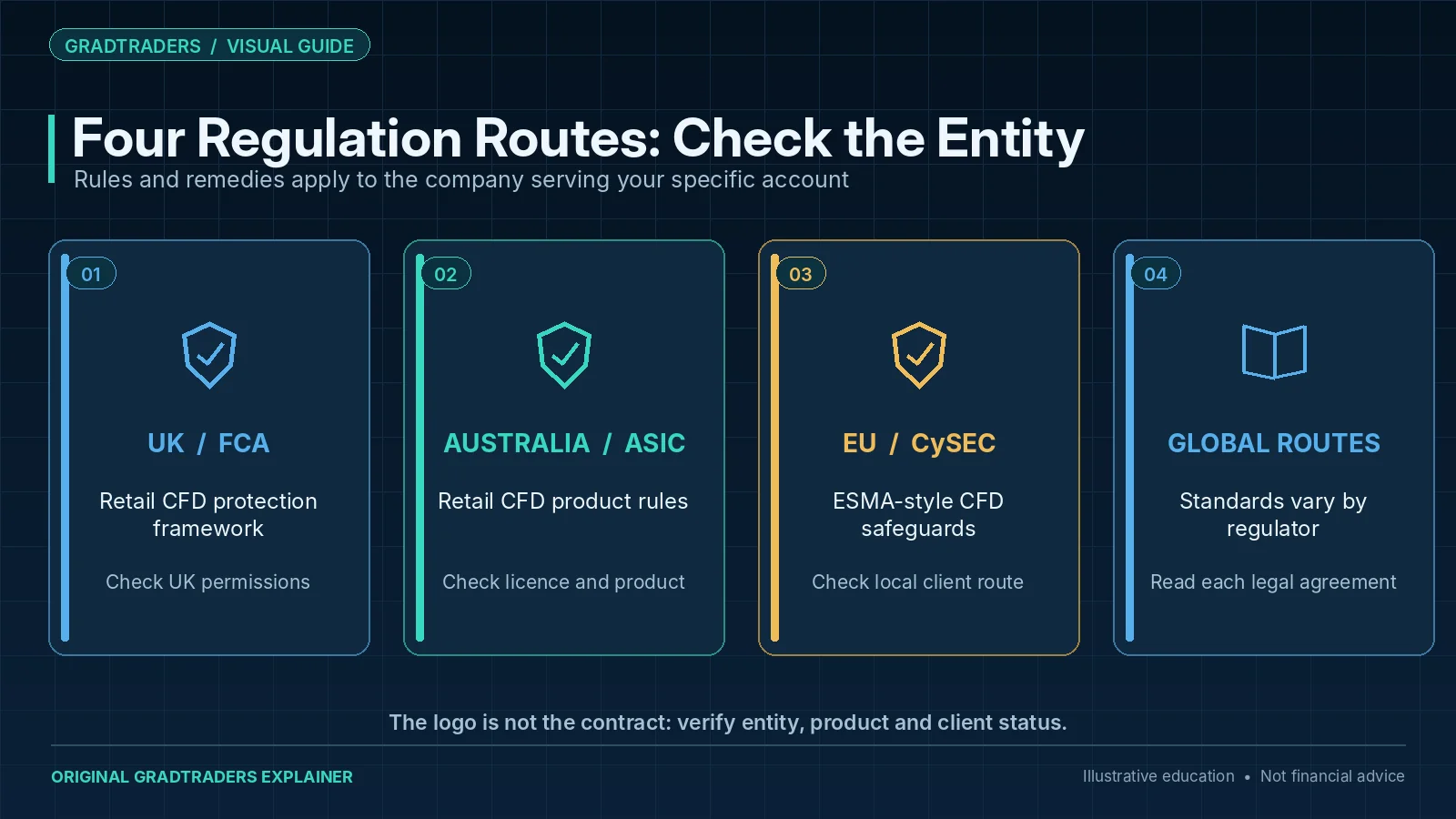
A broker group can operate several companies. Each company can have a different licence, website domain, client agreement, product range, margin schedule and complaints route.
Brand
The public-facing name, logo, platform and marketing identity shared across the group.
Legal Entity
The company named in the application, terms, statements and deposit agreement. This is normally the contractual counterparty.
Account Route
The combination of entity, client classification, product, country and protections actually applied to the customer.
What FCA Regulation Means
The Financial Conduct Authority authorises and supervises financial-services firms operating within the UK perimeter. Its consumer Firm Checker helps confirm whether a company is authorised and has permission to provide the service being considered; the full Financial Services Register contains the wider regulatory record.
Retail CFD Controls
For covered retail CFD products, the FCA applies leverage limits from 30:1 to 2:1 by asset class, 50% account-level margin close-out, negative-balance protection, inducement restrictions and standardised risk warnings. This does not mean UK retail clients may trade cryptoasset CFDs: the FCA continues to prohibit retail access to cryptoasset derivatives referencing unregulated transferable cryptoassets. Retail access to certain qualifying cryptoasset exchange-traded notes on UK recognised exchanges reopened on 8 October 2025, but those notes are different products from CFDs.
Verification
Firm Checker is designed for current consumer checks, while the Register gives fuller permission, restriction and historical information.
Local Recourse
Eligible complaints and firm-failure claims may fall within Financial Ombudsman or FSCS scope, but coverage is not automatic.
FSCS: Investment Protection Is Not The Bank-Deposit Limit
The UK bank-deposit protection limit increased to £120,000 on 1 December 2025. That figure concerns eligible deposits with banks, building societies and credit unions—not ordinary CFD trading balances or losses.
FSCS states that eligible investment claims for firms that failed after 1 April 2019 can be covered up to £85,000 per eligible person per firm. Whether a broker-related claim qualifies depends on the legal company, regulated activity, product and nature of the failure.
Eligible Bank Deposit
Potential protection up to £120,000 per eligible person per authorised banking firm from 1 December 2025.
Eligible Investment Claim
Potential protection up to £85,000 per eligible person per firm. It does not reimburse ordinary poor trading performance.
What ASIC Regulation Means
The Australian Securities and Investments Commission administers the Australian Financial Services licensing framework. ASIC’s CFD product-intervention order applies retail protections and has been extended to 23 May 2027.
Retail CFD Controls
Maximum leverage ranges from 30:1 to 2:1 by asset class, with standardised margin close-out, negative-balance protection and inducement restrictions.
AFS Licence
The exact company and authorised services should be confirmed through ASIC’s official registers rather than inferred from an Australian address.
Dispute Resolution
Retail-facing AFS licensees generally need internal dispute-resolution procedures and AFCA membership.
ASIC Is Not A UK FCA Substitute
An ASIC licence can represent a serious regulatory route, but it does not automatically provide UK Financial Ombudsman, FSCS or spread-betting treatment. A UK trader routed to an Australian company should assess whether the service is lawfully offered, which jurisdiction governs the agreement and what cross-border complaint rights remain.
Real Licence
ASIC authorisation can be genuine and meaningful.
Different Jurisdiction
The governing law, complaints process and product terms remain Australian rather than automatically UK-based.
No Protection Transfer
A broker group’s FCA permissions do not automatically cover a contract signed with its ASIC company.
What CySEC Regulation Means
The Cyprus Securities and Exchange Commission authorises Cyprus Investment Firms within the EU investment-services framework. CySEC publishes a regulated-entity register and a separate list of approved domains, both of which should be checked before funding an account.
EU Retail CFD Framework
Retail CFD rules use the familiar 30:1 to 2:1 leverage ladder, 50% account-level close-out, negative-balance protection and inducement restrictions.
Public Verification
Check the Cyprus Investment Firm entry, licence status, company details and approved website domains.
Investor Compensation Fund
Covered non-professional clients of an eligible member may receive the lower of 90% of covered claims or €20,000 when the required conditions are met.
CySEC Is Not The Same As “Offshore”
CySEC is an EU national competent authority, not an unregulated offshore registration. However, that does not make a CySEC account identical to an FCA account after Brexit or guarantee that every UK consumer can use every CySEC service.
What CySEC Can Provide
- EU investment-firm authorisation and supervision.
- Retail CFD product controls.
- Public entity and domain verification.
- Investor Compensation Fund coverage where eligible.
What Must Not Be Assumed
- Automatic FCA authorisation or UK permissions.
- UK Financial Ombudsman or FSCS coverage.
- Identical client-money and complaint outcomes.
- Eligibility for every country or product.
What Offshore Regulation Means
“Offshore” is a description, not a single regulatory framework. A broker may operate through a recognised international licence with published rules, or through a jurisdiction offering limited supervision and weak customer recourse. An unauthorised or clone website is a separate and more serious category again.
Licensed Global Entity
A real overseas company and licence exist, but leverage, client-money rules and compensation can be weaker than the local retail route.
Lightly Supervised Entity
Registration or licensing may exist without equivalent prudential, conduct, complaint or enforcement standards.
Unauthorised Or Clone Firm
The operator lacks required permission or impersonates a genuine regulated company. This is not a legitimate high-leverage alternative.
A Regulation Badge Is Not Proof
Clone firms can copy a genuine legal name, licence number, address and logo. Group websites can also advertise several licences while routing the customer to only one company.
Open The Regulator
Navigate independently to the official register rather than following the broker’s certificate link.
Match The Company
Compare the legal name, licence number, address and authorised services.
Match The Domain
Confirm the website and contact details against the regulator’s record or approved-domain list.
Read The Agreement
The contracted entity and governing law should match the regulation being advertised.
Retail CFD Protections Compared
| Protection | FCA | ASIC | CySEC / EU Framework | Offshore |
|---|---|---|---|---|
| Leverage limits | 30:1 to 2:1 | 30:1 to 2:1 | 30:1 to 2:1 | Varies; can exceed 100:1 or 500:1 |
| Margin close-out | 50% of required margin at account level | Standardised account close-out protection | 50% of minimum required margin at account level | Broker terms and local rules |
| Negative balance | Required for covered retail CFD accounts | Required for covered retail CFD accounts | Required per retail CFD account | May be voluntary, restricted or absent |
| Trading incentives | Restricted | Certain inducements prohibited | Restricted | Bonuses may be permitted, sometimes with withdrawal conditions |
| Risk warning | Standardised firm-specific warning | Mandatory disclosure framework | Standardised firm-specific warning | Quality and prominence vary |
Complaint Routes Are Not The Same
FCA-Authorised Firm
Complain to the firm first. An eligible unresolved complaint may then fall within Financial Ombudsman jurisdiction.
ASIC-Licensed Firm
Use the firm’s internal dispute-resolution process. Covered retail complaints can then be considered by AFCA under its rules.
CySEC Investment Firm
Use the firm’s complaint process and the applicable Cyprus or EU route. CySEC supervision and the Financial Ombudsman perform different functions.
Compensation Schemes Do Not Cover Bad Trades
Compensation schemes generally address eligible claims arising from firm failure or failure to return protected assets—not losses caused by market movement, poor strategy, slippage within the contract or an unsuccessful leveraged position.
FSCS
Eligible UK investment claims can be covered up to £85,000 per person per firm.
CySEC ICF
Eligible covered claims can be compensated up to the lower of 90% or €20,000.
Offshore Scheme
A scheme may be absent, narrow or difficult for a foreign client to use. Confirm the rules before deposit.
Client Money Needs A Separate Check
A licence does not mean every cash balance is protected in the same way. Review whether the firm is permitted to hold client money, how accounts are segregated, where banks are located, whether money can be transferred to affiliates and what insolvency process applies.
Permission
Confirm the entity is authorised for the relevant dealing and client-money activities.
Segregation
Read how client funds are separated, reconciled and treated if the company fails.
Bank And Currency
Identify the bank jurisdiction, payment processor, base currency and conversion risk.
Professional Status Changes The Comparison
A trader may remain with an FCA, ASIC or European entity but be classified outside the ordinary retail category. Higher leverage can become available while some retail protections, warnings or compensation rights change.
What Can Change
- Higher leverage and lower margin.
- Access to selected products or services.
- Different execution or active-trader arrangements.
Possible Protection Loss
- Retail leverage and close-out controls can change.
- Negative-balance treatment may differ.
- Warnings, complaint rights or compensation eligibility can be reduced.
Do Not Choose A Regulator For Leverage Alone
Higher leverage changes required margin, not the price movement applied to the full position. Choosing an offshore or professional route merely to open a larger position can exchange useful protections for greater account-destruction risk.
Possible Trade-Off
Some overseas or professional arrangements may offer different margin or product terms, but availability does not establish that the firm may lawfully provide the service to a UK resident.
Dangerous Motive
The trader wants to turn a small account into a much larger market position.
Required Question
For a UK resident, first establish that the firm is authorised or otherwise permitted to provide the relevant service in the UK and identify which protections apply.
Cross-Border Regulation: Home Country Still Matters
A genuine licence in one country does not automatically permit a firm to market every product into another. The customer’s location, the firm’s solicitation, the regulated activity and the account contract all matter.
Broker-Country Check
Is the company genuinely licensed for the product and client-money activities?
Customer-Country Check
Can the firm lawfully offer the service to residents of the customer’s country?
Enforcement Check
Which regulator, Ombudsman, court or arbitration body can deliver a practical remedy?
UK Trader Decision
FCA Retail Account
The natural first comparison for UK residents seeking local verification, retail controls, spread betting and possible UK redress.
ASIC Or CySEC Entity
Potentially genuine regulation, but not an automatic substitute for FCA permissions or UK complaint and compensation coverage.
Offshore / Non-FCA Entity
A UK resident should not assume an overseas licence permits the firm to provide or promote the service in the UK. Check FCA authorisation and permissions before opening or funding an account.
GradTraders Best Native Platform Choice: Plus500
United Kingdom
GradTraders does not promote broker services to UK customers unless the relevant UK entity is authorised and regulated by the Financial Conduct Authority (FCA). Plus500UK Ltd (FRN 509909) is authorised and regulated by the FCA, and Plus500 is a firm we’re proud to partner with for our UK audience.
UK risk reminder: CFDs are leveraged products and can result in rapid losses. The provider-specific retail loss warning is displayed within the Plus500 banner above.
United States
For United States readers, Plus500 provides a separate futures service through Plus500US Financial Services LLC d/b/a Plus500, a Futures Commission Merchant registered with the U.S. Commodity Futures Trading Commission and a member of the National Futures Association (NFA ID 0001398).
The US futures service is separate from the UK CFD service provided by Plus500UK Ltd.
US risk reminder: Futures and options involve substantial risk of loss and are not suitable for every investor. Losses may exceed the amount originally invested. Trading privileges are subject to review and approval.
Partner disclosure: Plus500 is a GradTraders affiliate partner. GradTraders may earn a commission if an eligible account is opened through these links, at no additional cost to you. This commercial relationship does not alter the editorial analysis or verdict on this page.
Australian Trader Decision
ASIC Retail Account
The natural local route with Australian licensing, product-intervention protections and AFCA access where eligible.
Foreign Major-Regulator Entity
A real FCA or CySEC licence does not automatically create Australian permission or AFCA coverage.
Global High-Leverage Entity
Higher leverage must be weighed against lost Australian protections and potentially foreign recovery.
EU Trader Decision
Authorised EU Investment Firm
Use the correct national register, verify cross-border permissions and confirm the compensation scheme attached to the entity.
CySEC Firm
Check the CIF register, licence status and approved domain rather than relying on the broker’s footer.
Non-EU Entity
Confirm whether the firm may lawfully serve the country and which EU retail rights are surrendered.
Practical Broker-Regulation Checklist
| Check | Evidence To Find | Red Flag |
|---|---|---|
| Legal company | Exact name and company number in the client agreement | Only a brand name is disclosed |
| Licence | Active regulator entry and correct permission scope | Certificate image without a live register record |
| Website | Domain and contact details match official records | Different URL, telephone number or email |
| Customer eligibility | The entity lawfully accepts residents of the customer’s country | Sales staff dismiss local restrictions |
| Client classification | Retail or professional status and written protection comparison | Pressure to opt up solely for leverage |
| Client money | Segregation, bank jurisdiction and insolvency wording | Vague “secure funds” claim |
| Complaints | Firm process, independent body and governing law | No external escalation route |
| Compensation | Named scheme, member status, limit and eligible claims | “Fully insured” without scheme details |
Regulator Verification Tools
FCA Firm Checker
Check current authorisation and permission for the required consumer service.
ASIC Registers
Search the Australian Financial Services licensee and professional-register records.
CySEC CIF Register
Check the investment firm, licence status, contact details and approved domains.
IOSCO I-SCAN
Search international alerts concerning unauthorised firms, clones and false association claims.
Warning Signs That Override Any Licence Claim
Clone Details
The licence number is genuine, but the domain, telephone number or payment recipient differs from the official record.
Pressure To Change Entity
Sales staff push the customer into a global or professional route without a clear written comparison of lost protections.
Withdrawal Payments
The firm demands tax, insurance, release fees or another deposit before returning account funds.
Common Regulation Myths
“The Brand Is FCA-Regulated”
A group can own an FCA company while your account is contracted with a different entity.
“ASIC Means Offshore”
ASIC is Australia’s principal financial regulator. It remains a different local route from FCA or EU regulation.
“CySEC Is Unregulated”
CySEC authorises Cyprus Investment Firms within the EU framework. The licence and domain still need verification.
“FSCS Covers My Trading Losses”
FSCS is a firm-failure protection scheme for eligible claims, not insurance against losing trades.
“A High Leverage Licence Is Better”
Higher leverage is an account feature, not evidence of stronger supervision or better execution.
“No Warning Means Safe”
IOSCO itself cautions that the absence of an alert does not prove a firm is authorised or legitimate.
Three Broker-Entity Scenarios
UK Resident, FCA Retail Account
The agreement names the FCA company, the service appears on Firm Checker and retail CFD controls apply.
EU Resident, CySEC Entity
The company and approved domain are on the CySEC lists, EU retail rules apply and ICF coverage is checked.
Global Account Under Same Brand
The platform looks identical, but the agreement names an overseas company with higher leverage and different complaints terms.
Related GradTraders Research
FCA Broker vs Offshore Broker
Compare FCA-authorised UK access with the permissions, protections and trade-offs that can apply to overseas entities.
Are Offshore Brokers Safe?
Review licence, client-money, withdrawal and clone-firm checks for international entities.
Leverage By Country
See why leverage changes between UK, EU, Australian, US, Japanese and global accounts.
High Leverage Risk
Separate capital efficiency from the danger of filling all available margin.
Negative Balance Protection
Understand how account entity and client status change negative-balance coverage.
Compare Broker Routes
Review platforms, regulation, account structures and suitability across the comparison table.
Final Verdict
FCA vs ASIC vs CySEC vs offshore regulation is best understood as an entity-level comparison, not a universal ranking. FCA, ASIC and CySEC are credible regulatory frameworks serving different local and regional markets, but their permissions, registers, complaint systems and compensation arrangements remain distinct.
For most retail traders, the properly authorised local company is the best starting point because the legal rights and escalation process are easier to verify and use. Global and offshore entities can have different platforms, products and margin terms, but UK residents should first establish whether the relevant firm is authorised or otherwise permitted to provide the service in the UK and understand the protections they would not receive.
Do not rank a broker from the strongest licence somewhere in its group. Rank the exact entity holding your account, the rules applied to your classification and the remedy available if the firm fails or refuses to resolve a dispute.
Research basis: GradTraders reviewed current official material from the Financial Conduct Authority, Financial Services Compensation Scheme, Australian Securities and Investments Commission, European Securities and Markets Authority, Cyprus Securities and Exchange Commission and IOSCO. Regulation, permissions, compensation limits and product-intervention rules can change.
Official checks: FCA Firm Checker · FCA CFD rules · FSCS investment protection · ASIC CFD order · ASIC dispute resolution · ESMA CFD measures · CySEC CIF register · CySEC ICF · IOSCO I-SCAN · Plus500 regulated entities · Plus500 UK client-money protection.
Explore GradTraders Internationally
Browse GradTraders’ country pages for regional trading context and related research. These links are for site navigation only; broker availability, regulatory status, account types, product eligibility and trading protections vary by country and legal entity.
Browse all 20 country gateways
Asia: Japan · South Korea · Taiwan · Hong Kong · India · Singapore · Thailand
Europe: Italy · Sweden · Switzerland · Germany · Norway
Americas: United States · Canada · Mexico
Middle East: United Arab Emirates · Saudi Arabia
Africa: South Africa
Oceania: Australia · New Zealand
FCA vs ASIC vs CySEC vs Offshore FAQ
Is FCA regulation better than ASIC or CySEC?
FCA vs ASIC vs CySEC vs offshore regulation is not a universal best-to-worst ranking. FCA is usually the clearest local framework for UK retail clients, ASIC is the principal Australian framework and CySEC operates within the EU investment-services framework. The exact legal entity, permissions, product and customer location matter more than the regulator’s name alone.
Do FCA, ASIC and CySEC use the same CFD leverage limits?
Their retail CFD frameworks broadly use the same 30:1 to 2:1 leverage ladder by underlying asset, together with account-level margin close-out and negative-balance protection. The legal basis, complaint route and compensation arrangements remain jurisdiction-specific.
Does FCA authorisation guarantee FSCS compensation?
No. FSCS eligibility depends on the authorised firm, regulated activity, product and type of claim. Eligible investment claims can be protected up to £85,000 per person per firm, but ordinary trading losses are not compensated.
What compensation applies to a CySEC investment firm?
Covered non-professional clients of an eligible Investor Compensation Fund member may claim when the required conditions are met. CySEC states that compensation is the lower of 90% of covered claims or €20,000.
What complaint route applies to an ASIC-regulated broker?
Australian financial firms serving retail clients generally need internal dispute-resolution procedures and membership of the Australian Financial Complaints Authority. AFCA coverage still depends on its rules and the specific complaint.
Is offshore regulation always weaker?
Offshore regulation is not one standard. Some jurisdictions operate genuine licensing and supervision, while others provide limited client-money, complaint or enforcement protection. Each legal entity and regulator must be assessed separately.
Can the same broker brand use several regulators?
Yes. One group can operate FCA, ASIC, CySEC and global entities with different contracts, leverage, product access and protection. The company named in the client agreement is the relevant counterparty.
Should UK traders use a CySEC or ASIC entity?
UK residents should normally start by checking whether the firm is FCA-authorised and has permission for the relevant service. ASIC or CySEC authorisation does not itself permit a firm to target UK customers or provide FCA, Financial Ombudsman or FSCS protection. GradTraders does not recommend opening an account with an overseas entity merely to obtain higher leverage or different trading conditions.
Does professional status change regulatory protection?
Yes. Professional classification can increase leverage but may remove retail product limits, warnings and other protections. Firms must explain the protections and compensation rights the client may lose.
How do I verify a regulated broker?
Use the regulator’s own register, match the exact legal company, licence, permissions, website and contact details, read the client agreement and search official warning databases. Do not rely on a badge, screenshot or group-level regulation claim.