IC Markets vs Pepperstone: Which Broker Is Better In 2026?
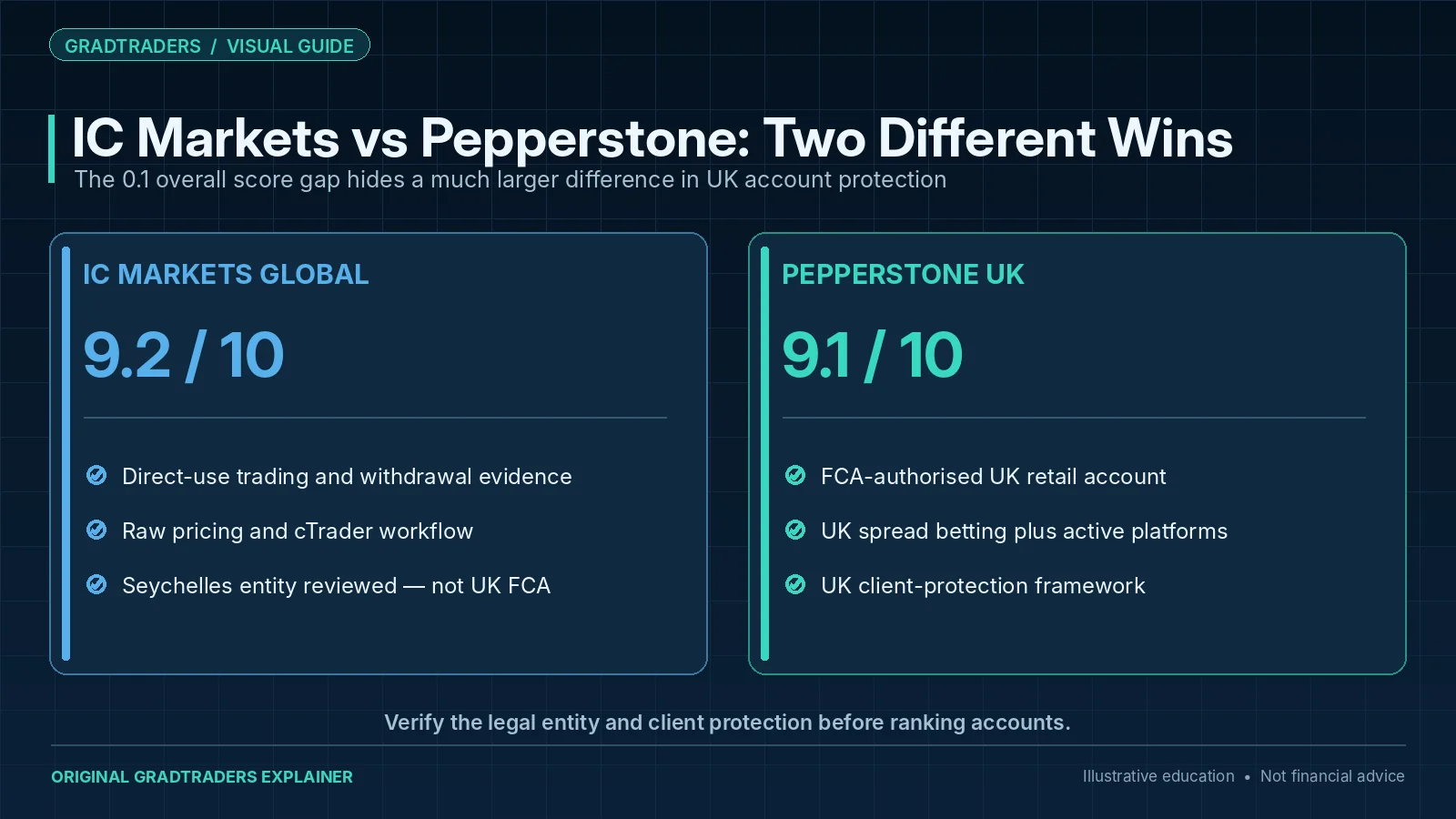
IC Markets wins this comparison at 9.2/10 versus 9.1/10 for Pepperstone. IC Markets remains the GradTraders direct-use active-trader benchmark for Raw pricing, cTrader, TradingView and completed withdrawals. Pepperstone is the stronger practical choice for many UK traders because it combines FCA-regulated access, spread betting and five serious platforms. IC is now used as the international brand, while IC Markets remains a regional trading name; the applicable legal entity matters more than the headline branding.
 Matthew Jackson
Founder of GradTraders
Independent trading research backed by more than 20 years of personal market experience.
, GradTraders ·
Live trading on YouTube ·
Last updated: 11 October 2026
Matthew Jackson
Founder of GradTraders
Independent trading research backed by more than 20 years of personal market experience.
, GradTraders ·
Live trading on YouTube ·
Last updated: 11 October 2026For eligible traders where the relevant IC Markets entity is available, IC Markets leads when direct-use evidence, Raw pricing and the tested cTrader/TradingView workflow matter most. Choose Pepperstone when FCA-regulated UK access, spread betting and stronger retail protections are the priority.
Disclosure & Risk Notice: This article is for educational and informational purposes only and should not be considered financial advice, investment advice, tax advice or a personal recommendation. Trading CFDs, spread betting, forex, crypto CFDs and other leveraged products involves significant risk and may not be suitable for all traders. You may lose some or all of your capital. Some GradTraders articles may contain affiliate links or references to partner offers. If you sign up, purchase or open an account through certain links, GradTraders may earn a commission at no additional cost to you.
Partner disclosure: IC Markets is a GradTraders affiliate partner for eligible jurisdictions. Some GradTraders pages may contain tracked IC Markets links where such promotion is available; if an eligible account is opened through one of those links, GradTraders may earn commission at no additional cost to you. Availability, legal entity and protections depend on country. Pepperstone is included on editorial merit and the Pepperstone links in this comparison are not affiliate links. The commercial relationship does not determine the independent 9.2/10 rating or the comparison verdict.
Looking for GradTraders partner offers, broker discounts, prop firm promotions and trading platform deals? Access GradTraders Partner Offers.
Quick Verdict: IC Markets vs Pepperstone
IC Markets wins the full GradTraders comparison by 9.2/10 to 9.1/10. The deciding evidence is direct account use, cTrader and TradingView suitability, Raw pricing, multiple completed withdrawals and the trading conditions that best fit my Japan 225 workflow.
Pepperstone is the better practical answer for many UK traders. It provides an FCA-regulated UK account, possible FSCS protection for eligible clients, spread betting, Razor pricing, cTrader, TradingView, MT4, MT5 and its own platform.
The 0.1-point gap is deliberately small. IC Markets is stronger for the direct-use, Raw-pricing active-trader case. Pepperstone is stronger when FCA-regulated UK access, spread betting and retail protections carry more weight.
Wins through direct-use evidence, withdrawals, Raw pricing and the strongest fit for my own active index trading.
Wins for FCA regulation, spread betting, potential FSCS protection and the cleaner account option for a typical UK trader.
Both support MT4, MT5, cTrader and TradingView; Pepperstone also provides its own web and mobile platform.
IC Markets Global offers greater flexibility but materially weaker UK-style protection and no conventional spread betting.
IC Markets vs Pepperstone At A Glance
| Category | IC Markets Global | Pepperstone UK | Winner |
|---|---|---|---|
| GradTraders rating | 9.2/10 · Active-Trader Broker Benchmark | 9.1/10 · Best UK Active-Trader Route | IC Markets Overall |
| Review evidence | Direct trading, platform and multiple-withdrawal evidence. | Independent comparison of FCA-regulated account terms and documented trading features; no direct Pepperstone execution test is implied. | IC Markets |
| UK protection | Raw Trading Ltd, Seychelles FSA licence SD018; no UK FCA retail framework. | Pepperstone Limited, FCA registration 684312, segregated money and possible eligible FSCS protection. | Pepperstone |
| Platforms | MT4, MT5, cTrader and TradingView through the compatible cTrader account. | Pepperstone platform, MT4, MT5, cTrader and TradingView. | Pepperstone Narrowly |
| Raw pricing | Raw Spread MetaTrader and cTrader Raw accounts with strong direct-use relevance. | Razor CFD pricing on forex and spot gold, plus Standard and spread-betting accounts. | IC Markets |
| Spread betting | No conventional UK spread-betting account. | Available to eligible UK clients across supported platforms. | Pepperstone |
| Leverage flexibility | Very high, dynamic headline leverage subject to account, instrument and tiers. | UK retail limits under the FCA framework. | Flexibility vs Restraint |
| Negative-balance position | The completed review records that Global clients are responsible for negative balances. | UK retail protection framework is materially stronger. | Pepperstone |
| Best for | Experienced CFD, forex, index, scalping and platform-focused traders. | UK active traders wanting regulation, spread betting and specialist platforms. | Different Traders |
How The 9.2 And 9.1 Ratings Should Be Read
The current GradTraders 24-broker comparison table places IC Markets at 9.2/10 and Pepperstone at 9.1/10. The category scores below explain why the overall result is narrow even though the two brokers have very different strengths.
| Evidence Area | IC Markets | Pepperstone | What It Means |
|---|---|---|---|
| Platforms | 9.8/10 · Active-Trader Platforms | 9.8/10 · Platforms & Trading Tools | Both are elite platform brokers; Pepperstone adds its proprietary platform, while IC has the tested cTrader/TradingView fit. |
| Pricing And Account Choice | 9.4/10 | 9.2/10 | IC wins through Raw account pricing and the direct evidence behind the rating. |
| Direct Evidence | 9.7/10 · Direct-Use Evidence | Research-led; no equivalent direct-use score | This is the decisive reason IC remains 0.1 ahead overall. |
| Withdrawals / Reliability | 9.2/10 · Withdrawal Experience | 8.8/10 · Support, Funding & Reliability | IC has completed personal withdrawals; Pepperstone remains supported mainly by published infrastructure. |
| Protection Framework | 7.2/10 · Entity & Client Protection | 9.3/10 · Safety & Regulation | Pepperstone wins decisively for a UK reader prioritising FCA and possible FSCS protection. |
| Beginner Suitability | 6.8/10 | Not separately scored; materially simpler UK protection framework | Pepperstone is the more defensible starting shortlist, but neither is a substitute for risk education. |
| Overall GradTraders Rating | 9.2/10 | 9.1/10 | IC wins narrowly for the intended active-trader use case. |
Evidence And Pricing
Protection And UK Fit
Read The Individual Reviews
The standalone reviews provide the full account, platform, entity, protection and first-hand evidence behind the comparison.
IC Markets Review 2026
Read the detailed first-hand review covering the Standard, Raw Spread and cTrader accounts, TradingView integration, dynamic leverage, negative-balance treatment and multiple completed withdrawals.
Pepperstone Review 2026
Read the standalone review covering the FCA-regulated UK account, Standard and Razor accounts, spread betting, cTrader, TradingView, MT4, MT5, market coverage and the research-led evidence limitation.
Platform Comparison: cTrader, TradingView, MT4 And MT5
Both brokers deserve a place on any serious cTrader or TradingView shortlist. The difference is how those platforms connect to the account and protection framework.
IC Markets
- cTrader is my preferred discretionary execution environment.
- Direct TradingView trading specifically requires IC’s cTrader Raw account; MetaTrader Raw Spread logins cannot be used for that TradingView connection.
- MT4 and MT5 support Raw Spread and Standard workflows.
- Raw pricing is available through both MetaTrader and cTrader accounts.
- Platform reliability is supported by my own live use.
Winner when: direct-use cTrader and TradingView evidence is the deciding platform factor and the relevant IC Markets entity is available to the trader.
Pepperstone
- Pepperstone proprietary web and mobile platform.
- MT4 and MT5 for MetaTrader automation.
- cTrader with depth of market and C# automation.
- TradingView trading through Razor CFD or eligible spread-betting accounts; Standard CFDs are excluded.
- Spread betting across supported platform choices.
Winner when: the widest platform choice is required within a familiar FCA-regulated UK account.
Platform verdict: the individual reviews score both brokers 9.8/10. Pepperstone wins on breadth because it adds its own platform. IC Markets wins for my direct platform confidence and the cTrader-plus-TradingView workflow I actually use.
GradTraders Best Native Platform Choice: Plus500
United Kingdom
GradTraders does not promote broker services to UK customers unless the relevant UK entity is authorised and regulated by the Financial Conduct Authority (FCA). Plus500UK Ltd (FRN 509909) is authorised and regulated by the FCA, and Plus500 is a firm we’re proud to partner with for our UK audience.
UK risk reminder: CFDs are leveraged products and can result in rapid losses. The provider-specific retail loss warning is displayed within the Plus500 banner above.
United States
For United States readers, Plus500 provides a separate futures service through Plus500US Financial Services LLC d/b/a Plus500, a Futures Commission Merchant registered with the U.S. Commodity Futures Trading Commission and a member of the National Futures Association (NFA ID 0001398).
The US futures service is separate from the UK CFD service provided by Plus500UK Ltd.
US risk reminder: Futures and options involve substantial risk of loss and are not suitable for every investor. Losses may exceed the amount originally invested. Trading privileges are subject to review and approval.
Partner disclosure: Plus500 is a GradTraders affiliate partner. GradTraders may earn a commission if an eligible account is opened through these links, at no additional cost to you. This commercial relationship does not alter the editorial analysis or verdict on this page.
Raw Spread vs Razor: Which Pricing Setup Is Better?
IC Markets provides Standard MetaTrader, Raw Spread MetaTrader and cTrader Raw accounts. The completed review records $3.50 per standard lot per side on Raw Spread MetaTrader and a notional-value commission on the cTrader and TradingView account.
Pepperstone provides Standard CFD, Razor CFD and spread-betting accounts. Its current UK account material advertises raw spreads from 0.0 on eligible Razor FX pricing and commission from £2.25 per lot per side on forex and spot gold.
The account names do not decide the result. A Raw or Razor account can be cheaper for frequent forex trading but more expensive on another instrument once commission, financing, conversion and slippage are included.
IC Markets wins the category because its 9.4/10 pricing score is supported by my direct use. Pepperstone’s 9.2/10 score remains excellent and can be the better all-in practical choice when spread betting or the FCA-regulated account has meaningful value.
Regulation, Entity And Negative-Balance Risk
This is the largest structural difference. The IC Markets account reviewed is held through Raw Trading Ltd, regulated by the Seychelles Financial Services Authority under Securities Dealer licence SD018. It is a regulated account, but it is not equivalent to a UK FCA retail account.
The completed IC Markets review records that Global clients are responsible for negative balances and that headline leverage can be extremely high and dynamic. IC also advertises insolvency insurance for Raw Trading Ltd clients, but this is not the same as statutory UK compensation or FCA complaint protection.
Pepperstone Limited is FCA authorised under registration number 684312. Pepperstone states that UK client money is segregated and explains that eligible clients may receive FSCS protection up to £85,000 if the firm fails and segregated money cannot be returned.
Pepperstone therefore wins protection decisively. IC Markets retains separate active-trader advantages for eligible traders who understand the relevant entity, complaint route and protection differences.
Regulation verdict: Pepperstone’s 9.3/10 safety score versus IC Markets Global’s 7.2/10 entity-and-protection score is the clearest numerical difference in the comparison. Do not allow a 0.1 overall score gap to hide it.
Spread Betting, CFDs And UK Tax Treatment
IC Markets Global is primarily a CFD and forex account. It does not provide the conventional UK spread-betting structure available through Pepperstone Limited.
Eligible Pepperstone UK clients can use spread betting, where gains are generally free from UK Capital Gains Tax and Stamp Duty under current rules. Tax treatment depends on individual circumstances and can change.
This does not make Pepperstone automatically cheaper or safer to trade. Spread betting remains leveraged, and financing, spread width and position sizing remain central. It does make Pepperstone structurally more practical for many UK traders.
Leverage And Margin: Flexibility vs Protection
IC Markets Global advertises very high headline leverage on core accounts, subject to platform, position size, instrument, tiers and dynamic margin rules. This can reduce the capital required to open a position, but it also makes dangerous exposure easier to create.
Pepperstone’s normal UK retail account operates under FCA leverage limits. That can feel restrictive to experienced traders, but it also limits the speed at which an oversized position can exhaust an account.
IC Markets offers greater available leverage on relevant Global routes, while Pepperstone provides the more constrained UK retail framework with stronger protection. Greater available leverage is not, by itself, a quality advantage.
My Direct Experience: Why IC Markets Retains The Win
I use IC Markets Global for short-term CFD and index trading. My main focus is the Japan 225, especially around the Sunday futures open and Monday morning session. In my experience, the spread and cTrader/TradingView workflow have been stronger than the alternatives I previously used.
I have also completed multiple withdrawals. The first sequence was confusing because deposited funds had to return through the original payment method before profits could move through another eligible method. Once understood, later withdrawals were straightforward.
Pepperstone does not have equivalent first-hand GradTraders evidence. The 9.1/10 score is research-led and supported by a compelling UK account structure, not by a personal Pepperstone trading and withdrawal history.
This is the final reason IC Markets remains 0.1 ahead. Without direct-use weighting, Pepperstone could reasonably win for a UK reader because the protection and spread-betting advantages are substantial.
Which Broker Should You Choose?
For Eligible International Traders
- The relevant IC Markets entity is available to you in your country.
- You are an experienced CFD or forex trader.
- You prioritise Raw pricing and cTrader.
- You value Matthew Jackson’s direct account evidence.
- You understand the Seychelles entity and complaint framework.
- You can manage dynamic leverage and negative-balance risk.
- Spread betting is not essential.
For The UK Active Account
- You want an FCA-regulated UK account.
- You want spread betting.
- You still require cTrader or TradingView.
- You value MT4, MT5 and a proprietary platform too.
- You prefer UK retail leverage limits and stronger protections.
- You accept a research-led rather than direct-use review.
Research Further
- You are a complete beginner.
- You need an ISA, SIPP or long-term portfolio platform.
- You do not understand CFDs or spread betting.
- You have not checked the legal entity.
- You intend to use the maximum leverage available.
- You have not compared the exact instruments you trade.
Other Active-Trader Brokers Worth Comparing
| Broker | GradTraders Position | Why Compare It? |
|---|---|---|
| FP Markets | 9.0/10 · Flexible Active Route | Strong global platforms and Raw pricing, with a different entity structure and specialist workflow. |
| IG | 8.8/10 · Established UK All-Rounder | Wider markets, investing and professional platform options for users less focused on cTrader. |
| CMC Markets | 8.7/10 · UK Platform Leader | Next Generation and the stronger proprietary-platform identity. |
| FxPro | 8.8/10 · Established Multi-Platform Route | Another cTrader and UK spread-betting option with different pricing and platform trade-offs. |
Related GradTraders Reviews And Guides
| Guide | Why Read It? |
|---|---|
| Broker Comparison Table 2026 | See the authoritative 9.2 and 9.1 scores inside the full broker bank. |
| Pepperstone vs FP Markets | Compare the FCA spread-betting account with another strong global active broker. |
| FP Markets vs IC Markets | Compare IC’s direct-use evidence with FP Markets’ wider specialist platform proposition. |
| Best Active-Trader Brokers | Place both brokers inside the wider active-trader shortlist. |
| Support, Funding & Reliability | Compare the evidence behind IC’s withdrawal advantage and Pepperstone’s research-led score. |
| Regulation & Client Protection | Understand the most important structural difference in this comparison. |
Final Verdict: IC Markets Wins 9.2 To 9.1
IC Markets remains the overall GradTraders winner and the Active-Trader Broker Benchmark. Its Raw pricing accounts, cTrader and TradingView fit, multiple completed withdrawals and direct use for my Japan 225 trading justify the narrow 9.2/10 lead.
Pepperstone remains the Best UK Active-Trader Route. Its FCA-regulated entity, spread betting, potential FSCS protection, Razor account and five-platform ecosystem may make it the better real-world choice for many British readers.
The ratings should not be read as IC Markets being safer or more appropriate for everyone. Pepperstone wins the protection comparison by a wide margin. IC wins overall because the GradTraders methodology gives meaningful weight to direct-use evidence and the intended experienced active-trader use case.
GradTraders verdict: IC Markets retains the overall international comparison win for eligible traders where the relevant entity provides the tested Global active-trading setup. Choose Pepperstone when you want most of the platform and pricing advantages inside the stronger UK regulatory and spread-betting framework.
Source note: This comparison draws on GradTraders’ existing broker ratings, the two dedicated reviews and Matthew Jackson’s genuine IC Markets account and withdrawal experience. Published platform, account and regulatory terms inform the UK-versus-global distinction. The international IC name does not remove IC Markets entity-specific branding or change each trader’s legal protections. On 11 October 2026, the comparison was corrected to distinguish IC’s cTrader Raw-only TradingView integration from MetaTrader Raw Spread, and Pepperstone’s Razor CFD / eligible UK spread-betting TradingView routes from its unsupported Standard CFD account.
Official IC Markets Global research: IC cTrader Raw-only TradingView integration ·regulation · platforms · accounts · spreads.
Official Pepperstone UK research: UK TradingView Razor and spread-betting eligibility ·legal entity · platforms · accounts · client protection.
Official Plus500 UK research: regulated entities and agreements · client-money protection.
Useful GradTraders research: 24-Broker Comparison Table · Costs, Spreads, Execution & Leverage · Regulation & Protection.
Risk reminder: spread betting, CFDs, leverage, margin, tax treatment, negative-balance exposure and investor protection vary by entity, product, country and classification. Confirm the exact legal entity, account and current documents before funding an account.
Explore GradTraders Internationally
Browse GradTraders’ country pages for regional market context and related research. These links are for site navigation only; broker availability, regulatory status and account eligibility must be checked separately.
Browse all 20 country gateways
Asia: Japan · South Korea · Taiwan · Hong Kong · India · Singapore · Thailand
Europe: Italy · Sweden · Switzerland · Germany · Norway
Americas: United States · Canada · Mexico
Middle East: United Arab Emirates · Saudi Arabia
Africa: South Africa
Oceania: Australia · New Zealand
IC Markets vs Pepperstone FAQ
Is IC Markets better than Pepperstone?
IC Markets ranks slightly higher at 9.2/10 because it is the GradTraders direct-use active-trader benchmark. It has stronger personal evidence for Raw pricing, cTrader, TradingView, platform reliability and completed withdrawals.
Is Pepperstone better than IC Markets for UK traders?
Pepperstone can be better for many UK traders because Pepperstone Limited is FCA regulated and offers spread betting, stronger UK client protection and potential FSCS eligibility while still supporting cTrader, TradingView, MT4 and MT5.
Which broker is safer, IC Markets or Pepperstone?
Pepperstone has the stronger UK protection framework. The comparison focuses on IC Markets Global through Raw Trading Ltd in Seychelles, while Pepperstone’s UK account is FCA regulated. Traders must verify the exact entity in their own agreement.
Which broker is better for cTrader?
Both brokers score very strongly for cTrader. IC Markets has the advantage of direct GradTraders use and the tested TradingView workflow, while Pepperstone combines cTrader with an FCA-regulated UK spread-betting route.
Which broker is better for TradingView?
Both support TradingView through specific account types. The international IC / IC Markets Global route requires a cTrader Raw account for direct TradingView trading. Pepperstone UK supports its Razor CFD and eligible spread-betting routes on TradingView, but not Standard CFD accounts.
Which broker has lower spreads?
IC Markets receives the higher GradTraders pricing score and has the stronger direct-use evidence. The cheaper broker still depends on the instrument, observed spread, commission, financing, slippage, account and trading session.
Which broker is better for spread betting?
Pepperstone is the clear winner because it offers spread betting to eligible UK clients. IC Markets Global is primarily a CFD and forex account rather than a conventional UK spread-betting provider.
Which broker would Matthew Jackson choose?
Matthew Jackson uses IC Markets for his own active CFD and index trading. He considers Pepperstone the more practical choice for many UK traders who value FCA protection and spread betting.