Strategy Backtesting Checklist 2026: Before You Trust A Trading System
My strategy-backtesting checklist begins with a challenge: can another trader follow the written rules without guessing, and would the apparent edge survive costs, drawdowns and trades that did not work? I would record every eligible setup, avoid changing parameters to flatter the results and test on data that was not used to build the strategy. Whether the tool is manual replay, MetaTrader, cTrader or specialist software matters less than the integrity of the test.
 , GradTraders
Test The Process, Not The Outcome
A backtest is useful when it reveals how a strategy behaves, including the uncomfortable parts. It is weak when the rules are adjusted after the trader already knows what happened.
- Historical profit is not proof of future performance.
- Small samples deserve small confidence.
- Execution assumptions should be realistic.
Disclosure & Risk Notice: This article is for educational and informational purposes only and is not financial, investment, tax or personal advice. Trading CFDs, spread betting, forex, futures and other leveraged products involves significant risk and may not be suitable for all traders. Backtests, simulations, replay results, demo results and strategy tests do not guarantee future performance; results can be distorted by data quality, spread, commission, slippage, execution, liquidity, psychology and changing market conditions.
Commercial disclosure: GradTraders may earn a commission if you purchase or sign up through certain links, including Forex Tester, TradingView or TraderSync links on this page, at no additional cost to you. Commercial relationships do not determine the editorial conclusions. Current partner offers are listed at GradTraders Partner Offers.
Quick Verdict
The strongest strategy backtesting checklist is simple: define the rules first, collect enough trades to expose both good and bad conditions, include realistic trading friction, measure drawdown, keep a journal and then forward-test before treating the idea as ready for live risk.
Backtesting should help you understand a strategy rather than prove it is perfect. The useful questions are where it fails, how losses cluster, whether costs weaken the edge, and whether the rules can be followed without hindsight edits.
The Strategy Backtesting Checklist
Run these checks before you trust a backtest or use the result to justify larger risk.
| Checklist Area | Question | Pass Standard | Risk If Ignored |
|---|---|---|---|
| Rules | Are entry, exit, stop and filter rules written before testing? | The same rule set is used consistently from first trade to last. | The test becomes hindsight fitting. |
| Sample | Is the sample large and varied enough to show difficult periods? | The test contains winners, losers, quiet periods and changing conditions. | A few good examples can look like a durable edge. |
| Costs | Are spread, commission, slippage and financing assumptions realistic? | The result still makes sense after plausible trading friction. | A small theoretical edge can disappear in practice. |
| Risk | Are risk per trade, losing streaks and maximum drawdown measured? | The strategy can survive normal losing periods without reckless sizing. | A profitable test may still be unusable. |
| Journal | Is every valid trade recorded rather than only the attractive examples? | Trades include setup, entry, exit, result and review notes; screenshots are added where useful. | Selective memory hides mistakes. |
| Forward Test | Has the strategy been observed in current conditions after the historical test? | Demo, paper or suitably small-risk testing confirms the workflow before scaling. | Historical confidence meets live uncertainty too quickly. |
1. Write The Rules Before You Test
Write down what counts as a valid setup before reviewing the historical trade. Define the market, timeframe, entry condition, invalidation, stop, target or exit method, and any no-trade filters that matter to the strategy.
If you discover a better rule during research, that can be useful. Record the change as a new version and test it separately rather than blending old and new rules into one flattering result.
Clear Rule Set
- Market and timeframe defined.
- Setup and invalidation conditions written.
- Stop placement fixed by rule.
- Exit method defined before the trade.
- No-trade filters documented.
Weak Rule Set
- “Enter when price looks strong.”
- “Avoid bad chop” without defining it.
- Stops moved based on feeling.
- Targets changed after seeing the outcome.
- News, spread or session filters applied selectively.
The Biggest Backtesting Mistake: Hindsight Bias
Once the historical outcome is visible, it is easy to convince yourself that the winning setup was obvious. Good testing reduces that temptation by hiding future information where possible, recording every valid setup and following the same decision process when the result is uncomfortable.
2. Use A Large Enough And Varied Sample
There is no universal trade count that proves a strategy works. Confidence should increase slowly as the sample covers more trades and more market conditions. Five good trades may justify further research; they do not justify certainty.
| Sample Type | Useful For | Main Limitation | GradTraders Read |
|---|---|---|---|
| 5–10 trades | Early idea checking | Very high randomness | Research only; not enough to trust. |
| 25–50 trades | Basic behaviour review | Still vulnerable to cherry-picking and one market regime | Useful for early filtering, not proof. |
| 100+ trades | Broader pattern review | Still depends on data quality and assumptions | More informative, but still not proof of future results. |
| Multiple market conditions | Stress-testing robustness | Takes longer and may expose uncomfortable periods | More valuable than chasing a perfect-looking short sample. |
3. Include Spread, Commission And Slippage
Short-term strategies can be especially sensitive to trading friction. A clean historical chart does not automatically reproduce the spread, commission, slippage, financing, liquidity or execution conditions a trader may face later.
Spread
The bid/ask difference can reduce small theoretical profits.
Commission
Account commissions need to be included where they apply.
Slippage
Actual fills can differ from the clean price assumed by a simple test.
Session Conditions
Liquidity and spreads can change around opens, closes, rollover and news.
Financing
Positions held overnight can incur financing or other carrying costs depending on the product.
Data & Feed Differences
Historical bars and broker feeds may not match perfectly across platforms.
4. Measure Drawdown, Not Just Profit
A strategy can finish a backtest in profit and still be impractical if the drawdown, losing streaks or recovery periods are too severe. Measure the path, not just the ending balance.
| Metric | What It Shows | Why It Matters |
|---|---|---|
| Maximum Drawdown | Worst peak-to-trough decline | Shows how severe the strategy’s historical decline became. |
| Longest Losing Streak | Consecutive losses | Tests whether the risk model and trader behaviour can survive normal losing runs. |
| Average R | Average result relative to initial trade risk | Adds context beyond win rate alone. |
| Worst Trade | Largest individual loss or rule failure | Can reveal weak stops, sizing or execution assumptions. |
| Recovery Time | Time needed to regain a previous equity peak | Shows how long the strategy can remain under pressure. |
5. Keep A Backtesting Journal
Backtesting without records quickly becomes memory-based. At minimum, record the setup, entry, exit, result, rule compliance and lesson from each valid trade. Screenshots can make later review much easier.
A spreadsheet can be enough for a simple process. Dedicated journals such as TraderSync add reporting, screenshots, notes, filters and trade-specific analytics when the review workload becomes more complex.
Setup
Record which defined pattern or rule triggered the trade.
Entry & Exit
Record prices, stop, target and the reason the trade ended.
Risk In R
Measure outcomes relative to initial risk where that framework fits the strategy.
Screenshot
Save the chart so the setup can be reviewed without relying on memory.
Rule Followed?
Separate valid strategy losses from execution mistakes and rule breaks.
Lesson
Record what the test revealed, not merely whether the trade won or lost.
6. Choose The Right Backtesting Tool
Different tools solve different parts of the process. TradingView’s Bar Replay is a convenient historical-replay layer inside its charting platform. MetaTrader 5 Strategy Tester is built for testing and optimising Expert Advisors. cTrader Algo can backtest and optimise cBots. Forex Tester is a dedicated backtesting environment, while a journal or spreadsheet records what the test actually taught you.
| Tool | Best Role | Useful When | GradTraders Route |
|---|---|---|---|
| Forex Tester | Dedicated historical backtesting and replay practice | You want a focused testing environment rather than occasional chart replay. | Forex Tester Review |
| TradingView Bar Replay | Visual chart replay and historical practice | TradingView is already your main analysis platform. | Forex Tester Vs Bar Replay |
| MT5 Strategy Tester | Expert Advisor testing and optimisation | You are developing or evaluating MT5 automated strategies. | MT5 Expert Advisors Explained |
| cTrader Algo | cBot backtesting and optimisation | Your automation workflow is built around cTrader. | cTrader cBots Explained |
| Spreadsheet / Journal | Record keeping and review | You need a clean record of rules, trades, screenshots and lessons. | What Is A Trading Journal? |
7. Separate Research Versions From Final Results
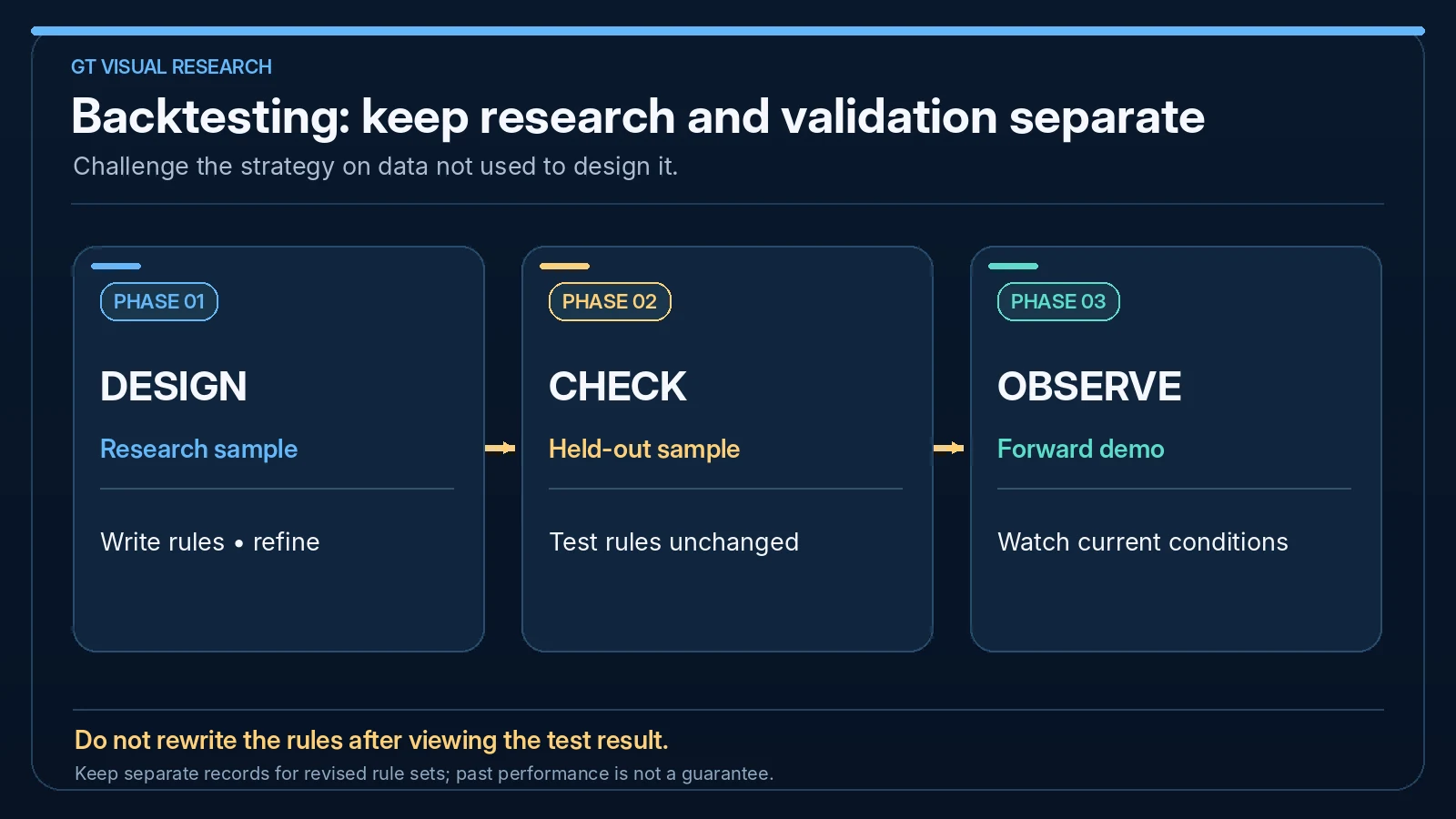
Exploration is part of strategy development, but it should not be mixed with the final test. If a new filter appears useful halfway through, create a new version and test it cleanly. Otherwise the result becomes a blend of different systems rather than evidence about one defined set of rules.
Clean Version Control
- Strategy v1 uses the original rules.
- Strategy v2 adds a documented change.
- Results remain separate.
- Changes are written before the next test.
Messy Backtest
- Rules change after losses.
- Filters appear only where convenient.
- Old and new trades are combined.
- The final result looks cleaner than the real process.
8. Forward Test Before Live Trading
A backtest looks backward. A forward test observes the same rules in current conditions, often through demo, paper trading or appropriately small-risk execution. This can reveal missed setups, operational mistakes and emotional interference that are difficult to reproduce in historical replay.
Do not treat a good backtest as permission to jump directly to normal live size. The next question is whether the process still works when the outcome is unknown in real time.
Backtesting Checklist For Prop Firm Traders
Prop firm traders should test the programme rules that actually apply to the firm and route they plan to use, not just whether a strategy eventually made historical profit. Daily loss limits, total or trailing drawdown, consistency rules, news restrictions, holding rules and automation permissions can differ between programmes and can change.
Daily Loss
Would the strategy’s worst tested day remain inside the programme limit?
Total Drawdown
Does the worst historical drawdown fit the programme’s calculation method?
Risk Per Trade
Is the sizing small enough to survive normal losing streaks?
Consistency
Is performance dependent on one unusually large winner?
News & Holding Rules
Does the strategy trade at times or hold positions in ways the programme restricts?
Automation Rules
If automated, are EAs, cBots, copy tools or third-party systems permitted on that specific route?
Final Verdict
A strategy deserves more attention when the testing process remains credible after you include the things that make the result less attractive.
The practical decision rule is to stop asking whether the backtest looks profitable and ask whether you could reproduce its rules, costs, risk and record keeping without already knowing the outcome. If the answer is yes, move to a disciplined forward test. If the answer is no, improve the process before increasing risk.
Source note: This guide combines GradTraders editorial judgement and practical trading-workflow analysis with current official product documentation. Forex Tester describes Forex Tester Online as a historical-data backtesting environment; TradingView documents Bar Replay and replay trading on historical data; MetaQuotes documents MT5 Strategy Tester for testing and optimising Expert Advisors; cTrader documents cBot backtesting and optimisation; TraderSync documents journaling, screenshots, notes, filters and trade analytics.
Official checks: Forex Tester Online guide · TradingView Bar Replay · MetaTrader 5 Strategy Tester · cTrader cBot backtesting · TraderSync features.
Useful next reads: What Is Backtesting? · Best Backtesting Software · Forex Tester Vs TradingView Bar Replay · Trading Software & Tools Map.
Explore GradTraders Internationally
GradTraders has 20 dedicated international gateways with local livestream times, market context and country-specific routes into the wider research site.
These country links are for navigation only; software availability, broker connections, eligibility and applicable terms must be checked separately.
Browse all 20 country gateways
Asia: Japan · South Korea · Taiwan · Hong Kong · India · Singapore · Thailand
Europe: Italy · Sweden · Switzerland · Germany · Norway
Americas: United States · Canada · Mexico
Middle East: United Arab Emirates · Saudi Arabia
Africa: South Africa
Oceania: Australia · New Zealand
Strategy Backtesting Checklist FAQ
What should be included in a strategy backtesting checklist?
A strategy backtesting checklist should cover written entry and exit rules, sample size, spread and commission assumptions, slippage, risk per trade, drawdown, journaling, version control and a forward-testing step before normal live risk.
How many trades do you need for a backtest?
There is no universal number that proves a strategy works. A very small sample deserves very little confidence. More trades across different market conditions can provide a more useful picture, but data quality and realistic assumptions still matter.
Does backtesting prove a trading strategy works?
No. Backtesting shows how a defined strategy behaved under historical assumptions. It cannot guarantee future performance because market conditions, execution, costs and trader behaviour can change.
What is the biggest backtesting mistake?
One of the biggest mistakes is hindsight bias: changing rules after seeing the outcome or selecting only attractive examples. Keep rules fixed during a test and record losing trades as carefully as winners.
Which software can be used for strategy backtesting?
The right tool depends on the job. Forex Tester is a dedicated backtesting environment, TradingView Bar Replay supports historical chart replay, MetaTrader 5 Strategy Tester is designed for testing and optimising Expert Advisors, and cTrader Algo can backtest and optimise cBots.
Should prop firm traders use a different backtesting checklist?
They should add the current rules of the exact programme they plan to use. That can include daily loss, drawdown calculation, consistency, news, holding and automation rules. Always check the firm’s current official terms before relying on a historical test.