Blue Guardian Review 2026: Is It Worth It For Funded Traders?
Blue Guardian offers instant, evaluation and futures routes, but I would judge these as separate propositions rather than treat the brand as one universal account. The drawdown, platform and payout conditions differ enough to affect whether a particular route suits a trader’s strategy. My comparison focuses on those practical rule differences and the evidence published for each model.
By Matthew Jackson Matthew JacksonFounder of GradTraders,
A concise Blue Guardian review covering account choice, drawdown, payouts and who the firm may suit.
Disclosure & Risk Notice: This article is educational and informational content, not financial advice, investment advice, tax advice or a personal recommendation. Forex, CFDs and futures are leveraged products and can involve substantial trading risk. Blue Guardian describes its standard programmes as simulated or demo environments rather than personal broker accounts. Challenge or account fees can be lost, rules can be breached and a profitable trading result does not automatically create an unconditional right to a payout.
Blue Guardian is not a current GradTraders commercial partner. GradTraders does have commercial relationships with some alternative prop firms discussed elsewhere on the site. Those relationships do not determine the order, role or conclusions in this review.
Current GradTraders partner routes and discounts are maintained on the Exclusive Discounts & Updates page.
Compare first: Blue Guardian’s main appeal is fast funding and account choice. Before buying any model, compare it with FTMO, The5ers, Funded Trading Plus, E8 Markets and the wider market in the GradTraders prop firm comparison table.
Quick Verdict: Is Blue Guardian Worth It?
Yes. Blue Guardian can make sense for an experienced trader who has a specific reason to want instant access or its futures division.
The main attraction is the number of account options. The CFD side covers instant, one-step and two-step accounts, while the futures business has separate products. The drawback is that the rules are not consistent across them: drawdown can be static, trailing or end-of-day, and payout conditions change with the account.
I would choose the account before looking at the fee. If “instant funding” is the reason for buying, the trailing drawdown, consistency rule and Guardian Shield conditions matter far more than the headline balance.
Fast-Funding Appeal.
Experienced, rule-disciplined traders comparing instant, evaluation and futures accounts.
Instant access plus a separate futures division.
Drawdown and payout rules change significantly by account.
Blue Guardian At A Glance
| Feature | Current Position | GradTraders View |
|---|---|---|
| Business model | Simulated/demo trading evaluation and performance programmes rather than a retail broker account. | Do not treat the displayed account balance as money deposited in your name. |
| CFD-style account menu | Instant Standard, Instant Starter, 1 Step Standard, 2 Step Standard, 2 Step Pro, BNPL and legacy models listed in the current help centre. | Broad range, but the rules cannot be blended into one universal specification. |
| CFD account sizes | $5K to $400K across the current product range depending on model. | Account size matters less than the drawdown and payout structure. |
| CFD platforms | MT5, Match Trader and TradeLocker; US clients are restricted to Match Trader and TradeLocker. | Good platform breadth with an important US limitation. |
| CFD markets | Forex, indices, gold/commodities and cryptocurrencies. | Standard multi-market coverage for this type of CFD-style prop account. |
| Standard funded profit split | 85% on standard funded accounts, with 90% add-ons on eligible models. | Check the exact account and add-on cost. |
| Instant Standard split | 80% default, with a 90% add-on. | Different from the standard funded split. |
| Instant Starter split | 90% fixed, with one payout before closure. | A small experience account rather than a normal repeat-payout account. |
| Standard payout timing | Generally every 14 days; an optional 7-day add-on is available on eligible accounts. | Fast still means account- and condition-dependent. |
| Instant payouts | On-demand once minimum-day, consistency and account conditions are met. | Instant eligibility does not mean unrestricted withdrawal. |
| Payout methods | Crypto and Rise Works, with published minimums and a processing fee. | Compare the net payout after fees and minimums. |
| Futures division | Reserve, Standard, Express and Direct. | A separate product category with different contract, drawdown and payout mechanics. |
| Assessment evidence | Published CFD and futures programme rules. | Rule comparison, not a personal execution or payout test |
Which Blue Guardian Account Should You Choose?
Start with the account, not the advertised balance. I would settle on the account first and only then compare the fee or headline account size.
Instant Standard
No profit target; 3% daily drawdown, 6% trailing maximum drawdown, five profitable days, generally a 20% consistency rule (15% on $300,000 and $400,000 Instant Standard accounts), and an 80% default profit split with a 90% add-on.
GradTraders view: the main fast-funding account, but trailing drawdown, consistency and funded-stage news rules make the detail more important than the headline.
Instant Starter
A one-time $5,000 account with no evaluation target, 3% daily drawdown, 5% trailing maximum drawdown, five profitable days, a 15% consistency rule and a fixed 90% split.
GradTraders view: useful as a smaller starter account, but the $250 maximum profit cap and one-payout closure make it very different from a repeat-payout account.
2 Step Standard
8% and 4% evaluation targets, 4% daily drawdown, 8% static maximum drawdown, three profitable days and an 85% funded split with an optional 90% add-on.
GradTraders view: the most straightforward two-stage option in the current CFD menu.
Blue Guardian Futures
Reserve, Standard, Express and Direct use futures-specific contract limits, payout rules and drawdown mechanics. Current official material states a 90% split and one-time fee structure without monthly subscriptions or activation fees.
GradTraders view: this is the more relevant Blue Guardian option for futures traders and many US-focused readers.
Blue Guardian Strengths And Trade-Offs
Blue Guardian does not have a confirmed sitewide GradTraders score, so I am keeping this assessment qualitative rather than inventing one.
| Area | Assessment | GradTraders View |
|---|---|---|
| Programme Choice | Strong | The current CFD and futures menus cover considerably more than one instant-funding model. |
| Fast-Funding Appeal | Strong | Instant Standard and Direct-style futures accounts give Blue Guardian a clear speed-focused role. |
| Rule Simplicity | Mixed | Static, trailing and EOD drawdown structures coexist across different programmes. |
| Payout Clarity | Mixed / Route-Specific | The help centre publishes detailed rules, but timing, caps, buffers, consistency and fees vary substantially. |
| Platform Choice | Strong | MT5, Match Trader and TradeLocker cover the CFD side, while the futures division uses a different platform stack. |
| US Relevance | Relevant | US clients can use CFD simulation accounts on Match Trader/TradeLocker and can separately research Blue Guardian Futures. |
What Is Blue Guardian?
Blue Guardian is a trading simulation and evaluation business, not a retail broker. Its current terms say it does not take client deposits, hold or manage client funds, or provide investment services. The CFD help centre states that its evaluation and funded accounts are demo accounts using virtual funds.
That matters because a displayed $100,000 or $400,000 balance is not cash deposited in a brokerage account in your name. You are paying for access to a simulated account under Blue Guardian’s rules, with potential rewards subject to the programme agreement and payout conditions.
The current terms identify Blue Guardian Limited in Saint Lucia for the simulated trading platform and Iconic Exchange FZCO in Dubai for educational products and payment processing, with administrative support also listed in Dubai.
Important distinction: this is a simulated prop-firm arrangement, not a personal regulated brokerage account.
How I Compare Blue Guardian’s Account And Payout Rules
I compare Blue Guardian’s CFD and futures account terms, platform access, risk rules, payout routes, geographic restrictions and published legal conditions against the GradTraders review methodology and the wider prop-firm bank. Those details reveal where the offer fits; they do not amount to a personally completed Blue Guardian account or payout test.
The documentation is detailed, which is useful. What it cannot tell me is how support, execution, compliance reviews or payouts feel in practice, so I do not make those claims here.
Blue Guardian CFD Account Routes Compared
| Route | Evaluation Target | Drawdown | Funded Split | Payout Route | GradTraders View |
|---|---|---|---|---|---|
| Instant Standard | None | 3% daily; 6% trailing overall | 80% default; 90% add-on | On-demand after minimum-day and consistency conditions | The core fast-funding route, but not a simple rule-free account. |
| Instant Starter | None | 3% daily; 5% trailing overall | 90% fixed | One payout only; $250 maximum profit cap | A one-time starter experience rather than a long-term funded route. |
| 1 Step Standard | 10% | 4% daily; 6% trailing overall | 85% default; 90% add-on | 14 days; optional 7-day add-on | Simpler evaluation depth, but trailing drawdown still needs close attention. |
| 2 Step Standard | 8% then 4% | 4% daily; 8% static overall | 85% default; 90% add-on | 14 days; optional 7-day add-on | The most conventional two-stage comparison in the current menu. |
| 2 Step Pro | 10% then 4% | 4% daily; 10% trailing overall | 85% default; 90% add-on | 14 days; optional 7-day add-on | More overall room on paper, but the trailing mechanism changes the practical risk. |
| Other / Legacy | Varies | Varies | Varies | Varies | The help centre also lists BNPL and legacy 1 Step Pro / 3 Step material. Verify availability and live rules before paying. |
Blue Guardian Instant Funding: What Actually Matters
Blue Guardian’s Instant Standard account removes the evaluation profit target, but it does not remove risk controls. The current model uses a 3% daily drawdown and a 6% trailing maximum drawdown, requires five profitable days before payout eligibility and generally applies a 20% consistency rule. The larger $300,000 and $400,000 Instant Standard accounts instead have a 15% consistency limit, and the first two rewards on $200,000, $300,000 and $400,000 accounts are capped at $10,000 each.
The usual 20% consistency rule, or the stricter 15% rule on $300,000 and $400,000 Instant Standard accounts, does not automatically breach the account when one day’s profit is too large. Instead, the payout button remains unavailable until total profits grow enough for the largest day to fall below the applicable percentage. That can change how a trader manages a profitable period.
The trailing drawdown also matters after profit is made. Once the account reaches 6% profit from the initial balance, the drawdown locks at the starting balance and a 1% withdrawal buffer applies. That means a trader cannot simply withdraw every dollar above the initial balance and expect the same breathing room to remain.
The small Instant Starter account is even more specific. It is a one-time $5,000 account with a 5% trailing maximum drawdown, 15% consistency rule, five profitable days, a $250 maximum profit cap and one payout before closure.
Drawdown And Guardian Shield: The Rules Can Change The Strategy
Blue Guardian uses several different drawdown structures. The 2 Step Standard route has an 8% static maximum drawdown, while Instant Standard and 2 Step Pro use trailing maximum drawdown. The futures division adds end-of-day trailing models on routes such as Standard and Reserve.
These are not cosmetic differences. A static drawdown gives the trader a fixed floor. A trailing drawdown can move as the account reaches new highs. End-of-day trailing logic can behave differently again because the threshold is updated from closing values rather than every intraday tick.
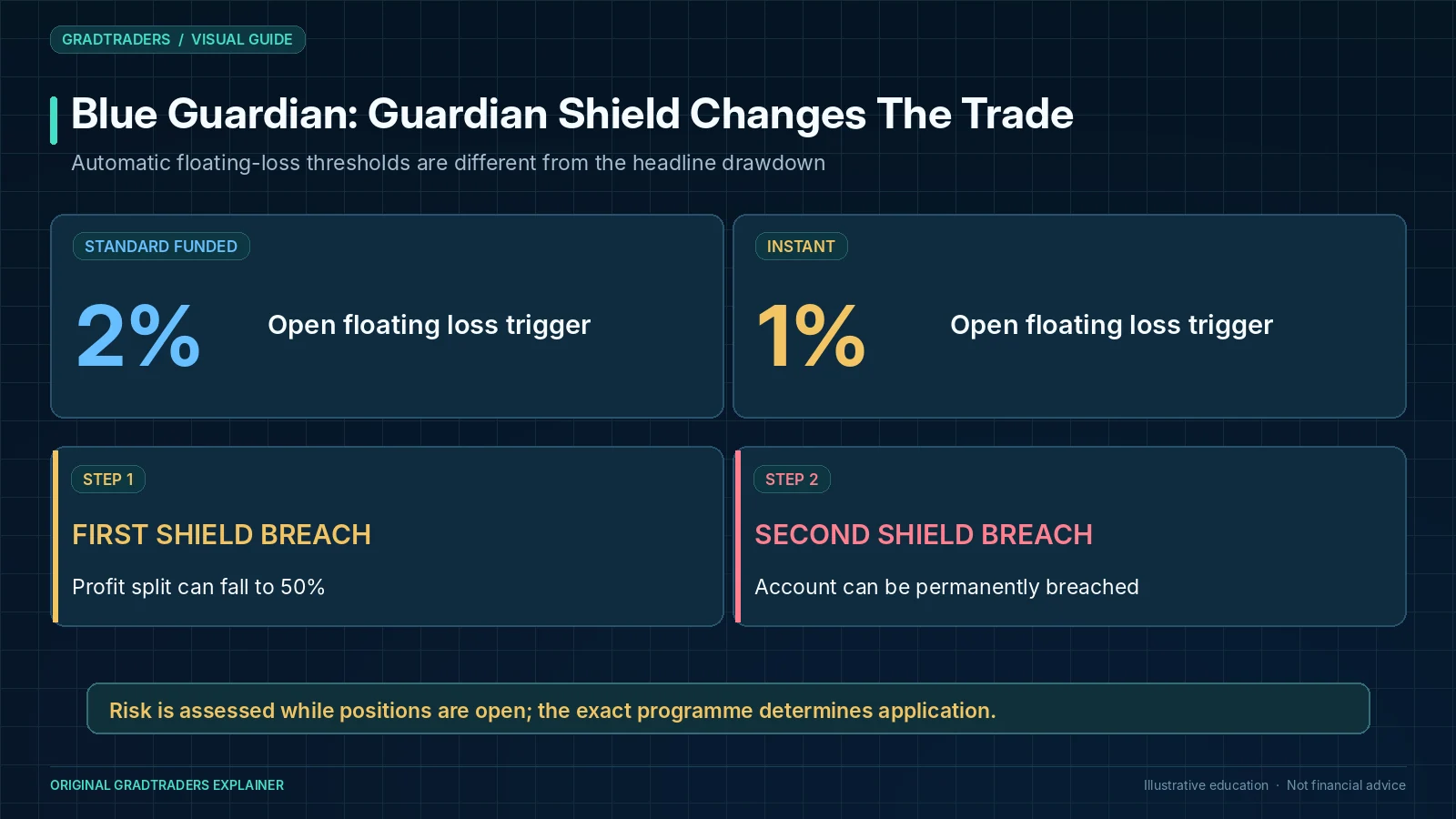
Blue Guardian also uses Guardian Shield on relevant funded CFD accounts. Current documentation says open floating loss can trigger automatic trade closure at 2% on standard funded accounts and 1% on instant accounts. A first Guardian Shield breach can reduce the profit split to 50%, while a second can permanently breach the account.
I would treat Guardian Shield as a core account rule, not a small protection feature. A strategy that routinely tolerates wide floating losses may be incompatible with it even if the final closed-trade statistics look acceptable.
Blue Guardian Payouts: Fast, But Not Automatic
The general payout policy says standard funded CFD accounts become eligible after the relevant minimum trading-day conditions and at least 14 calendar days from the first trade, with a 14-day cycle thereafter. Eligible accounts can add an optional 7-day payout cycle.
Instant accounts use on-demand payout access after their specific minimum trading-day, consistency and account-status conditions have been met. Blue Guardian states that approved payouts are processed within 24 business hours, subject to compliance and operational exceptions.
Current payout methods include cryptocurrency and Rise Works. Published minimums are $100 for crypto and $500 for Rise, with a 2% processing fee.
Caps and buffers matter. Instant Starter has a $250 maximum profit cap and closes after its one payout. Larger Instant Standard accounts can have early reward caps, while the futures programmes use their own payout buffers, caps and winning-day conditions.
Before paying, check: the first eligible payout date, minimum profitable days, consistency threshold, processing fee, payout cap, required account buffer, Guardian Shield status and whether the advertised 7-day or instant payout timing actually applies to the account being purchased.
Platforms And Markets
The CFD side currently supports MetaTrader 5, Match Trader and TradeLocker. US clients are limited to Match Trader and TradeLocker rather than MT5.
The simulated market range includes forex, indices, gold and other commodities, plus cryptocurrencies. Leverage varies by account and market, so a headline account size does not describe the practical exposure available on every instrument.
Blue Guardian permits EAs on relevant CFD programmes, but strategy rules still apply. Copy trading is limited to accounts owned by the same trader, and the published rules prohibit latency arbitrage, delayed-data exploitation and copying another trader. The CFD rules also include a minimum holding-time condition aimed at tick-scalping behaviour.
Blue Guardian Futures uses a separate platform stack including Deepcharts and Tradovate / NinjaTrader / TradingView routes. It also uses futures-specific contract limits and scaling rather than CFD-style lot exposure.
Blue Guardian Futures Is A Separate Decision
I would not fold Blue Guardian Futures into the CFD review as though it were the same account with different symbols. The futures products use exchange-traded contract logic, contract limits, end-of-day drawdown on relevant routes and their own payout rules.
The current futures menu includes Reserve, Standard, Express and Direct. Blue Guardian Futures advertises one-time purchase fees without monthly subscription or activation fees, a 90% profit split and up to $750,000 across funded accounts, subject to programme limits.
Standard currently uses a 6% evaluation target, end-of-day drawdown, a 40% funded consistency rule and payout eligibility three days after the first trade, with caps and buffers varying by account size. Reserve removes the standard daily-loss limit, uses a 50% challenge consistency rule and requires winning days before payout eligibility.
The futures help centre also documents a later Live Account tier using real CME market execution through partnered brokerage infrastructure. Reaching payout five does not guarantee promotion; it places the trader into a live-review pool for a separate risk-team decision.
That means Blue Guardian Futures should be assessed on its own. It also reinforces a practical point: the CFD and futures accounts should not be judged from one headline.
UK And US Availability
Blue Guardian’s current CFD restricted-country list does not include the United Kingdom or United States. Its platform documentation specifically states that US clients use Match Trader or TradeLocker rather than MetaTrader 5. Blue Guardian Futures publishes a separate restricted-country list, so futures eligibility should be checked independently.
For UK traders, Blue Guardian remains a prop-firm simulation option rather than an FCA-regulated broker account. That means the comparison should include the programme fee, payout contract and simulated-account rules against the cleaner ownership and withdrawal structure available through a normal broker.
For US traders, Blue Guardian’s separate futures operation may be the more natural option if the trader actually wants exchange-traded futures. A US trader should not choose the CFD-style programme simply because it uses a familiar index or forex label.
Blue Guardian Pros And Cons
Pros
- Instant, evaluation and futures options under one brand.
- Instant Standard removes the evaluation target.
- 2 Step Standard offers a more conventional static-drawdown structure.
- The separate futures division gives US and futures traders another option to compare.
- Current rule documentation is detailed and account-specific.
- MT5, Match Trader and TradeLocker provide reasonable CFD platform coverage.
- The futures products use their own platforms and contract rules rather than being presented as the same product as CFDs.
Cons
- The rulebook changes significantly between accounts.
- Trailing drawdown on several models can reduce the room available to trade.
- Consistency rules can delay payout eligibility even when the account is profitable.
- Guardian Shield can reduce the profit split after a floating-loss trigger.
- Early payout caps and account buffers apply on some models.
- Funded-stage news restrictions can matter to event-driven traders.
- US clients cannot use MT5 on the CFD side.
Blue Guardian vs FTMO, The5ers, E8 Markets And Funded Trading Plus
Blue Guardian belongs on the shortlist for a different reason from the four main GradTraders starting points: speed and the number of account types.
| Firm | GradTraders Role | Why Compare It With Blue Guardian? |
|---|---|---|
| FTMO | Benchmark | The stronger direct-use reference and the first comparison if operating history and a familiar evaluation structure matter more than instant access. |
| The5ers | Patient-Trader Route | The opposite emphasis: patience, scaling and programme fit rather than speed-led positioning. |
| E8 Markets | Modern Challenger | Useful for traders who want a newer alternative with different account design, drawdown rules and platform setup. |
| Funded Trading Plus | Flexible Partner Route | The clearest partner comparison when route flexibility matters, including instant, one-step and two-step choices. |
| Blue Guardian | Fast-Funding Appeal | Strongest when instant access, faster payout paths or a combined CFD/futures offering matters. |
Who Blue Guardian May Suit
Blue Guardian May Suit
- Experienced traders who already understand drawdown and consistency.
- Traders specifically comparing instant funding rather than only evaluations.
- Traders who want several CFD programme structures under one brand.
- US and global traders separately researching a futures-funded route.
- Traders comfortable reading programme-specific payout rules before buying.
Blue Guardian May Not Suit
- Beginners choosing by account size or discount alone.
- Traders who dislike trailing drawdown or consistency rules.
- Event-driven traders who need unrestricted funded-stage news trading on the CFD side.
- Strategies that regularly tolerate large floating losses and could trigger Guardian Shield.
- Anyone who assumes a simulated funded account provides the same protections as a regulated broker account.
Blue Guardian Or A Broker Account?
Blue Guardian can provide access to a larger simulated account without requiring the trader to deposit the displayed balance. That can be useful for a trader with a proven strategy but limited personal capital.
A broker account is a different setup. The trader deposits and risks their own money, controls the account directly and requests withdrawals under the broker’s terms rather than satisfying a prop-firm reward review.
My long-term preference remains broker-led trading where it is available and suitable because the ownership and withdrawal structure is cleaner. Blue Guardian can still make sense, but I would compare its fee and rules with what the same trader could do through a smaller broker account rather than assuming more simulated capital is automatically better.
Related GradTraders Reviews And Guides
| Guide | Why Read It? |
|---|---|
| Prop Firm Comparison Table 2026 | Compare Blue Guardian with the wider prop-firm market before buying. |
| Best Prop Firms 2026 | See why FTMO, The5ers, Funded Trading Plus and E8 Markets are the main GradTraders starting points. |
| FTMO Review 2026 | Read the GradTraders direct-use benchmark review. |
| The5ers Review 2026 | Compare Blue Guardian’s speed-led appeal with a patient-scaling route. |
| Funded Trading Plus Review 2026 | Compare another flexible route with current GradTraders partner status. |
| E8 Markets Review 2026 | Compare Blue Guardian with the GradTraders modern challenger. |
| Prop Firm Drawdown Rules | Understand static, trailing, daily and end-of-day drawdown before selecting a route. |
| Prop Firm Payouts Explained | Understand payout cycles, caps, buffers, consistency rules and why profit is not the same as payout eligibility. |
| Prop Firm vs Broker Account | Compare simulated programme capital with a personal broker account. |
Final Verdict: Is Blue Guardian Worth It?
Blue Guardian is worth comparing when instant access or its futures division solves a specific problem for your strategy. I would not treat it as a default first pick because the rules vary too much between accounts for that.
My shortlist still starts with FTMO, The5ers, Funded Trading Plus and E8 Markets for the roles already defined across GradTraders. Blue Guardian joins it when one of its faster account types fits the strategy well enough to justify the extra rule checking.
GradTraders verdict: Fast-Funding Appeal. Choose the account first, verify the live drawdown and payout rules, then compare the fee.
Source note: Official Blue Guardian CFD and futures documentation was checked on 25 August 2026. The 11 October 2026 factual maintenance corrected the current 2 Step Standard minimum profitable-day requirement and the special Instant Standard consistency and first-payout cap rules for larger accounts against Blue Guardian’s official help centre. Rules, programme availability, restricted countries, platform access, payout timing, add-ons, fees and account models can change, so verify the exact live product before purchasing.
Official CFD research: General rules · Account models · Instant Standard · Instant Starter · 1 Step Standard · 2 Step Standard · 2 Step Pro · Payouts · Platforms · Terms and legal structure.
Official futures research: Futures Standard · Futures Reserve · Contract limits and scaling · Futures introduction · Futures platforms · Futures Live Account.
Useful GradTraders research: Prop Firm Comparison Table · Best Prop Firms · FTMO Review · The5ers Review · Funded Trading Plus Review · E8 Markets Review · Prop Firm Payouts Explained · Prop Firm vs Broker Account · How GradTraders Reviews Trading Firms.
Explore GradTraders Internationally
Browse GradTraders’ country pages for regional trading context and related research. These links are for site navigation only; prop-firm programme availability, trading permissions, terms and eligibility may differ by country and provider.
Browse all 20 country gateways
Asia: Japan · South Korea · Taiwan · Hong Kong · India · Singapore · Thailand
Europe: Italy · Sweden · Switzerland · Germany · Norway
Americas: United States · Canada · Mexico
Middle East: United Arab Emirates · Saudi Arabia
Africa: South Africa
Oceania: Australia · New Zealand
Blue Guardian Review FAQ
Is Blue Guardian a legitimate prop firm?
Blue Guardian is an operating prop-firm business with current legal terms and separate CFD and futures documentation. Its CFD help centre states that evaluation and funded accounts use virtual funds, while Blue Guardian Futures separately documents a discretionary Live Account tier. It is not a retail broker and does not take client deposits. That distinction matters.
Does Blue Guardian offer instant funding?
Yes. Blue Guardian currently offers Instant Standard and Instant Starter routes on the CFD side. Instant Standard removes the evaluation profit target but still applies drawdown, profitable-day, consistency, Guardian Shield and payout conditions. Instant Starter is a one-time $5,000 account with one payout and a $250 profit cap.
What are the main Blue Guardian CFD account routes?
The current help centre lists Instant Standard, Instant Starter, 1 Step Standard, 2 Step Standard, 2 Step Pro and Buy Now Pay Later, plus legacy 1 Step Pro and 3 Step documentation. The exact target, drawdown, payout and funded-stage rules differ by model.
How fast are Blue Guardian payouts?
Standard funded CFD accounts generally use a 14-day payout cycle, with an optional 7-day add-on on eligible accounts. Instant accounts can request payouts on demand once their specific minimum-day, consistency and account conditions are met. Blue Guardian states that approved payouts are processed within 24 business hours, subject to compliance and operational exceptions.
Does Blue Guardian support US traders?
The current CFD restricted-country list does not include the United States, but US clients are restricted to Match Trader and TradeLocker rather than MetaTrader 5. Blue Guardian Futures has a separate country-restriction list, so US traders should verify eligibility for the exact CFD or futures product before purchasing.
Which platforms does Blue Guardian use?
The CFD side currently supports MetaTrader 5, Match Trader and TradeLocker, with US clients limited to Match Trader and TradeLocker. Blue Guardian Futures uses a separate platform stack that includes Deepcharts and Tradovate / NinjaTrader / TradingView routes.
Does Blue Guardian offer futures funding?
Yes. Blue Guardian Futures is a separate product line with models including Reserve, Standard, Express and Direct. The futures side uses contract limits, futures-specific drawdown rules and its own payout rules, so it should not be treated as the same product as Blue Guardian’s CFD-style simulated programmes.
Is Blue Guardian worth it?
Blue Guardian is worth comparing for experienced traders who specifically value instant access, a particular account model or the separate futures division. I would compare the exact rules with FTMO, The5ers, Funded Trading Plus, E8 Markets and a broker-account alternative before paying.